

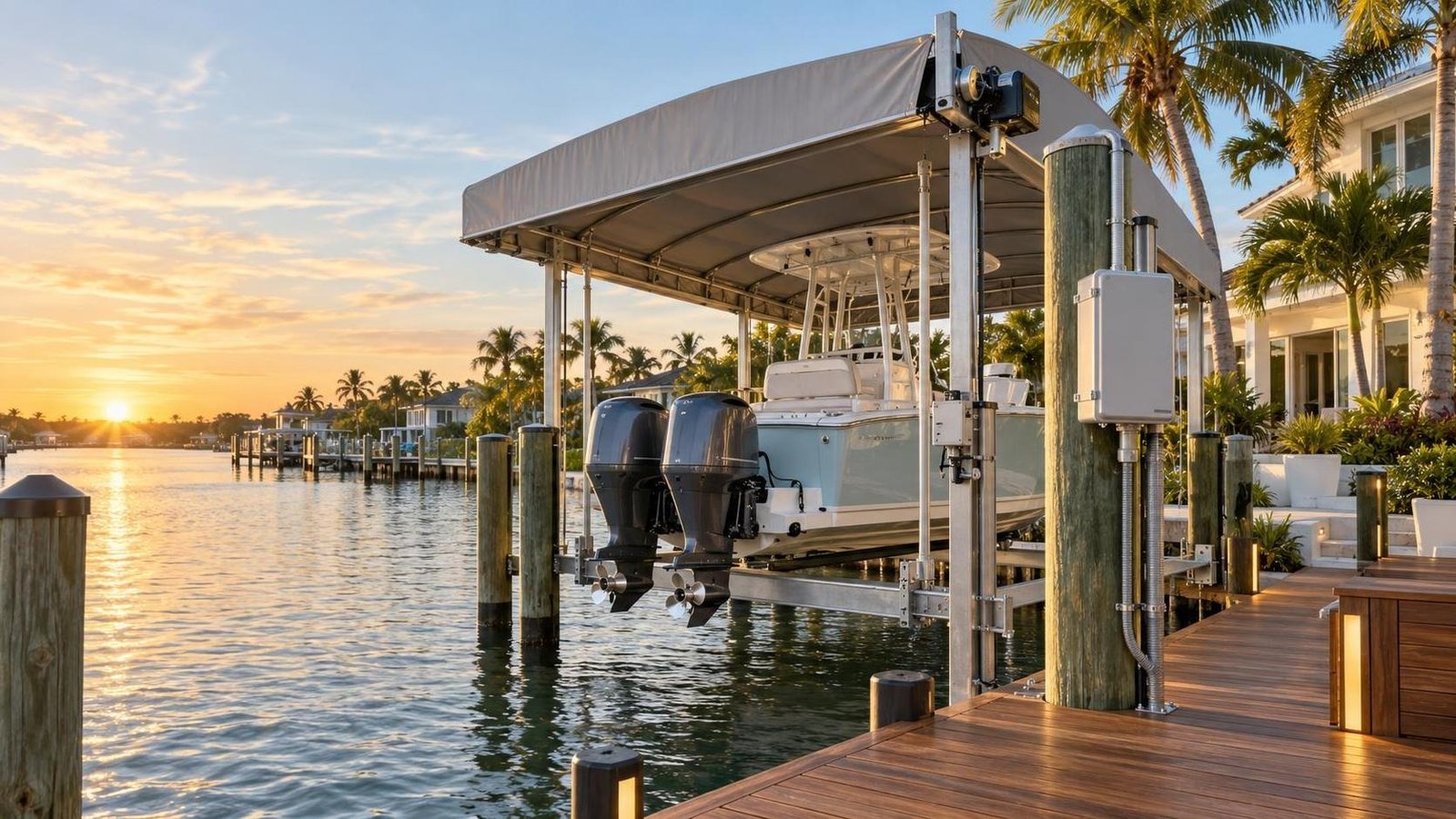
Boat-Lift Limit Switch and Canopy Motor Sharing One Control Box: What Should Merritt Island Buyers Verify?
By Carrie Liotta, Space Coast REALTOR® with REAL Broker | Published October 4, 2026
Do not assume one control box means the boat lift and powered canopy were designed to work together. A Merritt Island buyer should have qualified marine and electrical professionals identify each circuit and control, verify independent stopping and safe operating order, test the lift limits, and document what happens after a jam, failed switch, or power loss.
The arrangement may be manufacturer-supported, or the canopy may be a later addition sharing only an enclosure, remote, auxiliary output, or too much of the lift system. The box’s appearance cannot answer that. Before closing, obtain a component map, the correct manuals, a safe demonstration, records, and a written scope for anything uncertain.
First determine what “sharing one box” actually means
Stand back from the equipment and have the seller identify the ordinary controls without opening the enclosure. Record the manufacturer, model, serial number, and visible ratings on the control box, lift motors, limit switch, canopy motor, receiver, disconnect, and any separate switch station. Photograph labels and the exterior condition from a safe position.
Then ask the electrician or qualified lift technician to map the system. Two devices can appear to share one box while having different relationships:
- both motors may receive power through one listed controller designed for that purpose;
- the canopy may use a manufacturer-provided auxiliary circuit but retain separate stopping controls;
- two independent controls may simply occupy one larger enclosure;
- the canopy may have been field-added to a lift controller or remote channel without clear manufacturer support; or
- the canopy and lift may share a feed while using different overcurrent protection, contactors, relays, or switches.
Those are not interchangeable conditions. Ask for a simple professional diagram showing the source breaker, disconnect, controller, lift motors, canopy motor, limit circuit, and other dock loads. It should let the buyer match each record and label to a real component, not serve as a do-it-yourself wiring guide.
My comparison of an elevated lift disconnect and a larger dock box explains why the electrical route must be followed from the house panel to the waterfront. This control question begins with that same route, then goes deeper into how the two moving systems are coordinated.
The lift limit and canopy stop are separate safety questions
A boat-lift limit switch stops lift travel at defined positions when paired with a compatible automatic control. A powered canopy also needs a reliable stop before its frame, fabric, the boat, lift beams, or dock become the stopping mechanism. Even with one remote, each travel path needs separate verification.
Ask the technician to identify which device stops upward lift travel, which stops downward travel, and which controls canopy extension and retraction. Confirm whether the canopy has its own limit switches, current-sensing control, timed operation, manual hold-to-run switch, or another model-specific method. The buyer should not accept “it stops automatically” without knowing what component makes that happen.
Manufacturer instructions show why model identity matters. GEM Remotes’ current boat-lift wiring resources say its auto-run controls require the appropriate limit switch and direct installers to test that the lift stops in both directions. GEM also warns that its instructions, motor configuration, protection, and wiring procedure must be followed by a qualified technician. That guidance is useful evidence of the questions to ask; it does not prove the subject home has GEM equipment or authorize attaching an unrelated canopy motor to a GEM enclosure.
Demonstrate the operating sequence without turning the showing into a repair test
If normal operation is safe, ask the seller to demonstrate uncovering the boat, lowering and raising the lift, and closing the canopy. Watch from a clear position. No buyer should reach into moving equipment, stand beneath a suspended boat, open a powered enclosure, bypass a switch, or test a fault condition.
Note whether labels match operation and whether one command can move the wrong assembly. Must the canopy retract before the lift rises? Can the boat or T-top contact the canopy? Can both motors operate at once, and is that intended? Ask how direction changes and accidental remote commands are handled.
Have the professionals—not the buyer—answer the harder questions. Ask them how the controller behaves if a limit switch sticks, a canopy track binds, a relay welds closed, a motor overload trips, one lift motor falls out of level, the remote is lost, or dock power fails with the boat raised. The goal is not to create every failure. It is to compare the installed design, service information, and safe diagnostic results with the manufacturer’s instructions.
Inspect the enclosure as waterfront equipment, not as a household switch box
Merritt Island canal equipment lives with humidity, salt, sun, wind-driven rain, splash, insects, vibration, and occasional higher-water events. Inspect the exterior for corrosion, cloudy or cracked covers, missing fasteners, open holes, damaged seals, improvised cords, unsupported conduit, taped repairs, water staining, and labels that no longer match the controls.
Location matters too. The box should be reachable from stable decking without leaning over the water or entering the lift’s travel zone. Keep gear away from the disconnect and service area. Only an appropriately qualified professional should open the enclosure for inspection.
Florida’s Electrical Contractors’ Licensing Board licenses and regulates electrical contractors and distinguishes certified, registered, and specialty scopes. Verify the license category and jurisdiction rather than assuming every boat-lift installer can evaluate every part of a powered waterfront system.
Match the control box to the manuals, ratings, and actual loads
Request the manual and wiring diagram for the exact controller revision, not a similar image online. Match voltage, amperage, phase, motor horsepower, lift-motor count, receiver, limit-switch type, and any listed auxiliary feature to the installed nameplates. Do the same for the canopy motor and control.
GEM’s current product information distinguishes one-, two-, and four-motor controls, auto-stop models, compatible limit switches, and a special-order auxiliary circuit on certain systems. Verify the ordered configuration; do not assume a spare terminal can power a canopy. If the manual is missing, have the contractor obtain model-specific documentation.
The electrician should identify whether simultaneous operation is intended. A breaker that has not tripped does not establish correct conductor sizing, ratings, protection, or installation. A remote that makes everything move proves only that a command reached something.
Build the permit and service history in chronological order
Start with the original dock and lift records, then add every later canopy, motor, controller, remote, switch, and electrical change. For an unincorporated Merritt Island parcel, the official Brevard County permit search is a starting point. Confirm the actual jurisdiction for the address and compare the record with invoices, final inspections, warranties, and what is installed. A blank online result is not proof that work was exempt, approved, or unpermitted.
Dates often reveal the real question. A lift, later canopy, and still-later replacement controller may be well coordinated, but the records should show who evaluated the combined system. Ask whether the controller changed because of corrosion, a failed board, a motor upgrade, the canopy addition, or automation.
Service notes should identify more than “dock repair.” Look for limit-switch adjustment, control or motor work, canopy alignment, water intrusion, nuisance tripping, and any failure to stop. My article on documented dock electrical work versus a newer boat-lift motor explains why one recent component should not stand in for the whole system.
Verify clearance through the complete range of use
Electrical coordination is only half the answer. The boat, cradle, lift beams, canopy, guideposts, and dock must physically work together. Have a marine professional compare the intended boat’s operating weight, beam, height, accessories, and loading position with the lift and canopy geometry.
Do not assume the seller’s boat proves fit for yours. A taller console, different bunk spacing, heavier fuel load, or accessory above the hardtop can change the safe travel range. The limit may have been adjusted around the current boat rather than at the mechanical maximum. The canopy may also reduce room for loading, maintenance, or storm preparation.
Water access still comes first. Confirm canal width, typical depth questions, turning room, bridges, and route to the buyer’s preferred water before assigning value to the lift controls. My guide to Merritt Island canal homes for boats needing clearance and deeper water shows why a sophisticated lift cannot correct the wrong route.
Plan manual recovery before you need it
Ask for the written shutdown and recovery procedure. Identify how the entire system is de-energized, whether the lift and canopy can be isolated separately, how the canopy is secured if its motor fails, and who can safely lower or protect the boat after a control fault. Keep the emergency service number, controller model, remote information, and manual where a caretaker can find them.
Reject any recovery method that requires opening a live box, defeating a limit switch, or standing beneath the boat. If the manufacturer provides a manual process, have the technician document its limits and who may use it. Remote owners especially need a plan another authorized person can follow without guessing.
How should findings affect the offer?
A shared enclosure is not automatically a defect, and separate boxes are not automatically better. I would proceed when the installed configuration matches the correct manuals and ratings, each moving assembly stops as designed, the operating sequence prevents interference, the controls and disconnects are understandable, enclosure condition is appropriate, and the records support the work.
I would slow down when no one can identify the controller, the canopy was added without a matching scope, the lift will not stop reliably at both limits, labels conflict with operation, corrosion or water is visible, one remote command creates unexpected movement, or the only recovery plan is to bypass a safety device. Ask for a written diagnosis and scope rather than a verbal “we can fix that.”
Do not estimate correction cost from the box’s size. Scope may range from adjustment or a switch replacement to separate controls, weather-rated equipment, rewiring, canopy repair, lift leveling, permits, or obsolete-part replacement. Obtain itemized electrical and marine proposals before the inspection period ends and identify who owns final testing.
Seller-completed work with invoices, approvals where required, manuals, and a final demonstration may offer the cleanest handoff. If design questions remain, a price adjustment or lender-compatible credit plus an adequate reserve may be preferable. Safety, parts availability, closing timing, and control of workmanship should drive the choice.
Bottom line for Merritt Island canal buyers
When a boat-lift limit switch and canopy motor appear to share one control box, verify the relationship instead of judging the enclosure. Identify every component, follow the power and control paths, test ordinary operation and stopping through qualified professionals, match the installation to model-specific instructions, review permits and service history, confirm boat and canopy clearances, and write down the failure-recovery plan.
I help Merritt Island buyers organize waterfront due diligence so the canal lifestyle remains enjoyable after closing. Reach out for a no-pressure conversation about Brevard County waterfront homes for sale with Carrie Liotta, Space Coast REALTOR® with REAL Broker, and join my private Facebook group, Moving to Brevard County Florida, for practical local guidance. Your next chapter starts here.
