

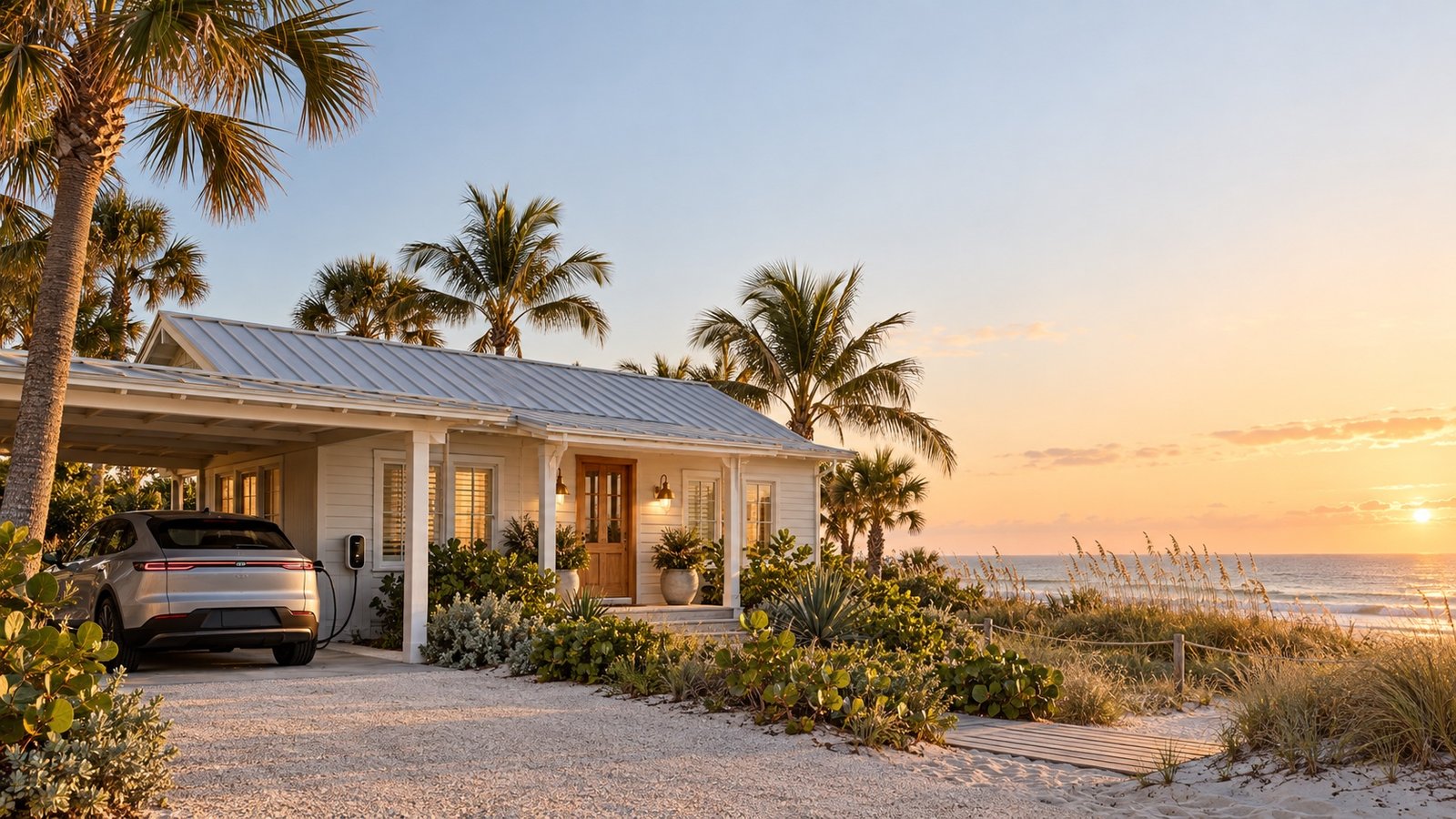
Should Melbourne Beach Relocators Choose an Older Ocean-Side Cottage With a Workable EV-Charging Path or a Larger Inland Home for a Two-Car Electric Household?
By Carrie Liotta, Space Coast REALTOR® with REAL Broker | Published October 23, 2026
If your household depends on two electric vehicles, the better Melbourne Beach choice is usually the home that can support your real parking and charging routine without an expensive electrical surprise. An older ocean-side cottage can still be the right fit, but only after an electrician confirms the service, panel capacity, parking layout, and installation path. More square footage inland is not automatically the better value either.
I see this decision become emotional quickly. One home has the beach walk, salt-air character, and a daily rhythm that feels like the reason you moved to the Space Coast. The other may have a wider driveway, newer electrical equipment, a two-car garage, and fewer coastal maintenance variables. For a two-EV household, the smart comparison is not cottage versus inland in the abstract. It is whether each property works on an ordinary Tuesday when both cars need to leave again in the morning.
What makes an ocean-side cottage workable for two EVs?
A cottage can be a good EV home without a charger already installed, but it needs a realistic path to one. Start with where each vehicle parks. A garage is convenient, but a driveway or carport can work when equipment and wiring suit the location. The U.S. Department of Energy notes that Level 2 equipment uses 240 volts and outdoor installations need outdoor-rated equipment. The useful question is whether the parking position, panel, conduit route, and equipment location can be made safe and code-compliant. Read the Department of Energy’s home-charging guidance before treating a garage outlet as a complete answer.
For a two-car household, I would ask for photos of the electrical panel, meter, garage or carport, and the path from panel to parking before the inspection period gets tight. Then have a licensed electrical contractor evaluate the specific property. An older cottage may have a modest service, a full panel, limited breaker space, or a difficult route across finished rooms. Those are not automatic deal killers. They are budget, timing, and disruption questions that deserve a real answer before you remove contingencies.
A home can also work well with a staged plan. Some owners begin with one properly installed Level 2 circuit and use Level 1 charging for the second vehicle when daily mileage is modest. Others may need a load-management solution, a panel upgrade, or a different vehicle-charging routine. The Department of Energy specifically advises that an electrician can determine whether a home has adequate capacity and whether circuits can be added. That is much more useful than assuming that any 240-volt outlet will serve two vehicles indefinitely.
Why coastal location changes the due-diligence list
Near the ocean, charging feasibility is only one part of the ownership picture. Salt air, wind-driven rain, exterior equipment placement, older wiring, and an exposed carport can all affect the scope of work. I would not let a buyer accept a vague promise that a charger “should be easy.” Ask the contractor to identify the proposed equipment location, weather protection, conduit route, panel work, and any site conditions that could add cost.
Florida’s permit law is also a reason to treat electrical work as a project rather than a weekend accessory. Florida Statutes section 553.79 generally requires a permit before construction, alteration, modification, or repair work, and its single-family exemption does not apply to electrical work. The exact local process and project requirements should be confirmed with the local enforcing agency and the contractor, but buyers should build permit and inspection timing into their plan. The current language is available in Florida Statutes section 553.79.
That same coastal caution belongs in the rest of the cottage file. A renovated kitchen does not tell you whether exterior receptacles are appropriately located, whether the panel was updated with permits, or whether a prior owner solved water-intrusion issues correctly. For a related property-condition review, see my guide to ocean-facing deck repair and coastal permitting questions in Melbourne Beach. The goal is not to make a beach cottage sound fragile. It is to make its systems visible before they become your systems.
When the larger inland home is the easier answer
An inland home often wins the practical comparison when it already has a two-car garage, a newer or higher-capacity electrical service, a clear path for dedicated circuits, and a driveway layout that lets both cars charge without a nightly shuffle. It may also have more room for a future vehicle, bikes, tools, or a home office without turning the garage into a compromise. Those advantages are real, particularly for households with long daily drives or irregular work schedules.
But I would still resist calling inland automatically cheaper. The property may trade beachside exposure for HOA dues, a longer drive to the ocean, different insurance factors, newer-home premiums, or a commute pattern that changes the value of overnight charging. If the inland house lets you avoid an immediate electrical upgrade, put a realistic contractor estimate beside the purchase-price difference and the monthly ownership costs. That is a better comparison than treating a charger as a small accessory.
Compare the whole ownership cost, not just the charger quote
The charger quote matters, but it is only one line in the decision. A buyer should separate the one-time electrical project from the home’s ongoing ownership costs. Ask for an estimate that distinguishes equipment, labor, panel or service work, trenching or exterior conduit if needed, permit fees, and restoration. If a cottage needs a panel upgrade or a complicated run to a detached parking area, that estimate belongs beside inspection findings, roof records, insurance quotes, flood-zone review, and ordinary maintenance—not in a mental “small improvement” category.
Then compare that number with what the inland house asks of you. Does the inland option have higher association fees, a different tax profile, a longer work commute, or a price premium for newer construction? Does the beach cottage give you a lifestyle you will actually use enough to justify the systems work and coastal maintenance? I encourage buyers to make a simple two-column ownership sheet before the offer becomes a negotiation. A home that costs more to make EV-ready can still be the better purchase if the location, condition, and long-term use justify it. The key is that the cost is known rather than discovered after closing.
If you need a broader framework for comparing an older water-adjacent property against a newer inland choice, my Space Coast carrying-cost guide for newer inland and older river-access homes is a useful companion. The property types are not identical, but the discipline is: compare price, insurance, maintenance, systems, and the way you will live there.
Questions to ask before you write the offer
The best time to investigate charging is before you are trying to solve it from another state or during the last few days of an inspection period. Ask the seller what they know, but verify the answer with the property and the professionals who would perform the work. I would put these questions in the due-diligence file:
- What is the electrical service size, and is there documented panel or service work?
- How much usable panel capacity is available after the home’s existing loads are considered?
- Where do both vehicles park in normal daily use, including visitors, trash-day access, and garage storage?
- Can the contractor run a code-compliant circuit to each parking position without an impractical route through finished areas?
- If charging is outdoors, what equipment rating and physical protection will the installation require?
- Will the work require a permit and inspection, and what is the estimated schedule?
- Does an HOA, historic review process, shared drive, or easement affect equipment location or exterior work?
- What is the backup plan if the preferred charging design is too expensive or cannot be approved?
That last question protects buyers from binary thinking. Sometimes the answer is a different charger, one Level 2 circuit plus overnight Level 1 use, a managed charging schedule, or simply choosing the house whose daily logistics work better. What I would not do is assume that a plug in the garage makes a property equivalent to a home with a properly evaluated charging plan.
Do not confuse renovation polish with electrical readiness
In Melbourne Beach, beautifully renovated cottages often win hearts because the visible work is complete: light cabinets, impact openings, fresh flooring, and a porch that opens toward the ocean. Those things have value. They just do not establish electrical capacity. A careful buyer should match the renovation story to permits, invoices, panel labels, and an inspection. If a seller has completed significant electrical work, ask what was done, when, and by whom. If the answer is incomplete, that is information—not necessarily a reason to walk away, but a reason to price the uncertainty honestly.
The same care applies to shared or unusual site features. A cottage with a shared drive, compact side yard, or private beach-access arrangement may have a tight physical envelope for new exterior equipment. Those features can be perfectly manageable when the documents and placement plan are clear. My article on private beach access, easements, and dune-crossover maintenance in Melbourne Beach explains why I like buyers to understand rights, responsibilities, and access before assuming a coastal convenience is simple.
Which buyer should choose the cottage?
I would lean toward the older ocean-side cottage for the buyer who genuinely wants Melbourne Beach daily life, has enough budget flexibility to address verified electrical work, and is comfortable treating the home as an ownership project rather than a turnkey promise. It can be a terrific fit for a household whose commute is modest, whose vehicles sit overnight, and whose parking layout supports a contractor-approved plan. The beachside premium should buy you a lifestyle you will use, not a listing photo you will admire from inland.
I would lean toward the larger inland home for the buyer whose household has demanding driving patterns, needs two cars charged predictably, wants more garage and driveway flexibility, or prefers fewer immediate projects after a cross-country move. That choice is not “settling.” For many relocating households, easy charging, storage, and a simpler first year in a new place have real value.
My bottom line for Melbourne Beach relocators
Choose the cottage when the coastal life is worth the verified cost and effort of making the charging plan work. Choose the inland home when reliable two-car charging, storage, and lower project uncertainty matter more than living steps from the ocean. In either case, get the electrician’s assessment and the property documents before you rely on a seller’s shorthand.
I am Carrie Liotta, a Space Coast REALTOR® with REAL Broker, and I help relocating buyers turn a beautiful home search into a workable ownership plan. If you are comparing Melbourne Beach with an inland option, reach out for a no-pressure conversation about Brevard County homes for sale. We can look at the parking, systems, insurance questions, and daily routine that listing photos cannot answer. Your next chapter starts here.
Join my private Facebook group, Moving to Brevard County Florida, for practical relocation guidance, local buyer questions, and Space Coast neighborhood insight.
