

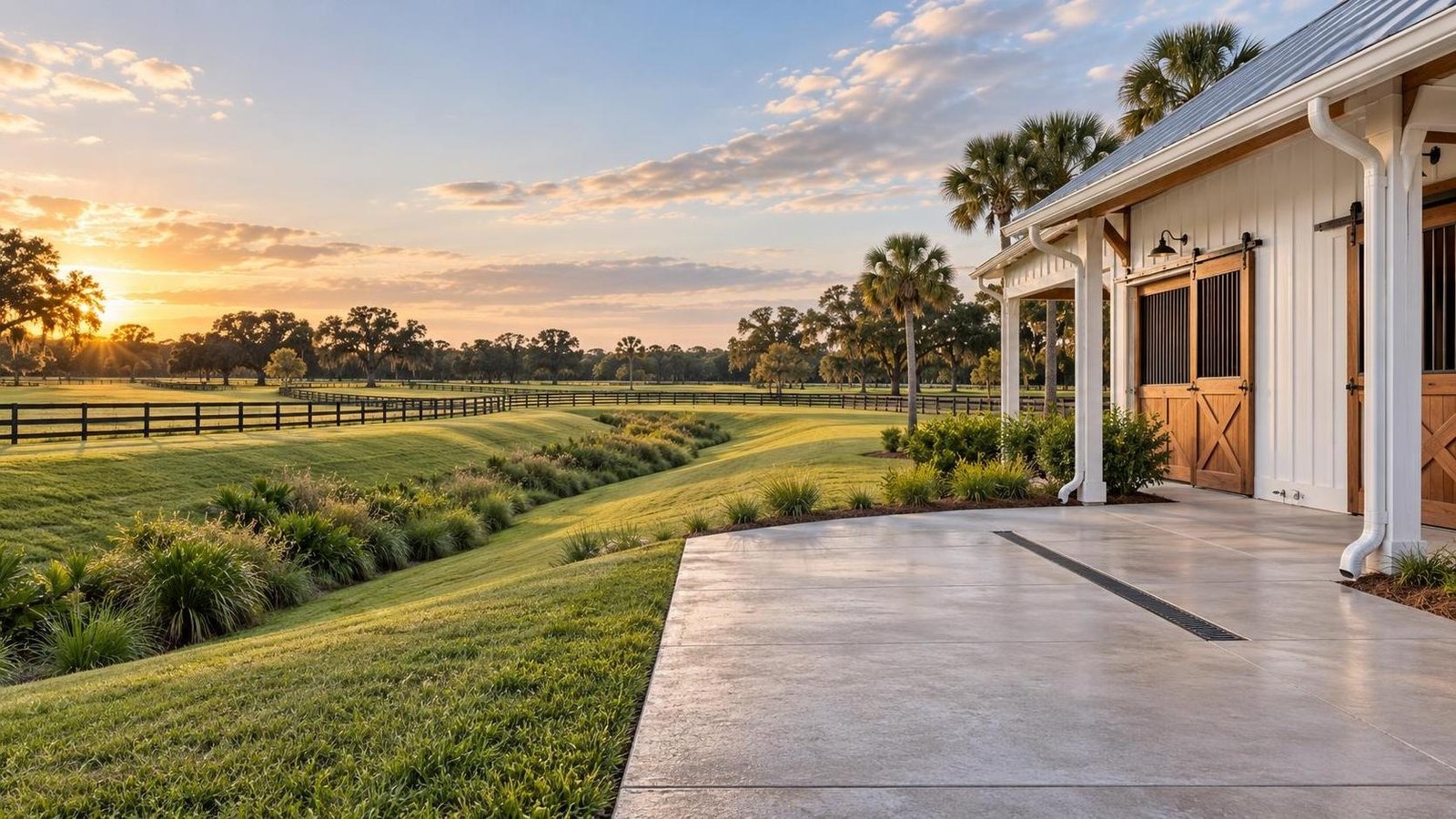
Barn Wash Rack and Roof Runoff Sharing One Swale: What Should Grant-Valkaria Buyers Verify?
By Carrie Liotta, Space Coast REALTOR® with REAL Broker | Published October 8, 2026
If a barn wash rack and the roof both drain toward one pasture swale, verify the entire route before you buy: slab slope, drain piping, downspouts, low points, soil condition, outfall, permits, and what happens after rain. The arrangement may be workable, but only when clean stormwater and animal-use wastewater are understood rather than casually mixed.
On Grant-Valkaria acreage, a broad grassy swale can look like a simple landscape feature during a dry showing. It may actually carry several jobs at once. The barn roof can send a large pulse of rainwater into it, while the wash area contributes smaller but dirtier flows containing soil, hair, organic material, shampoo, fly spray, or whatever was on the horse and slab. If nobody can trace those sources, a buyer cannot tell whether the route is functioning, merely dry that day, or quietly creating a footing, maintenance, neighbor, or water-quality problem.
Start by separating the two water questions
I would not begin by asking, “Does the swale drain?” I would begin with two questions: where does the roof water go, and where does the wash-rack water go? They may meet eventually, but they should be traced independently first.
For the roof, identify every gutter, valley, downspout, splash block, underground leader, pipe outlet, and eroded discharge point. Watch whether water is directed away from the barn foundation, stalls, feed or hay storage, electrical equipment, gate approaches, and septic components. A clean metal roof can still concentrate a surprising amount of water at one downspout; the roof’s condition does not prove the ground route is sensible.
For the wash rack, look at the slab pitch, drain grate, sediment trap if one exists, pipe material, cleanout access, visible outlet, and any place water can bypass the intended drain. Ask the seller to explain the normal cleaning routine and products used. Do not assume that a drain connects to sewer, septic, a permitted treatment feature, or even a pipe. It may empty at the slab edge or into an undocumented trench.
Florida DEP explains that stormwater flowing over rooftops and other surfaces can pick up sediment, chemicals, and other pollutants, and that controlling pollution at its source protects rivers, lakes, and estuaries. That statewide explanation on the Florida NPDES Stormwater Program page is not a parcel diagnosis. It is a good reason to stop treating every outdoor flow as harmless rainwater.
Why one shared swale can become a property-wide issue
The practical concern is not simply that the swale gets wet. It is whether its shape, vegetation, soil, outlet, and maintenance are adequate for the combined timing and volume of water. A wash rack may be used when the soil is already saturated. A roof pulse may arrive while hair, manure, bedding, or disturbed soil sits near the channel. A clogged grate or crushed pipe can move water across the barn apron instead of into the expected route.
Walk the path from high point to low point. Note bare soil, sediment deposits, algae lines, ruts, hoof damage, undermined fence posts, mosquito-prone pockets, soft gate approaches, washed-out pipe ends, and vegetation that differs sharply from the surrounding pasture. Then identify where the swale ends. Does it flatten and infiltrate on the property, enter a ditch or pond, cross an easement, approach a wetland, or continue toward neighboring land? “It goes out back” is not enough.
My broader guide to Grant-Valkaria wells, septic systems, and acreage drainage explains why buyers should map those systems together. This wash-rack question is narrower: the buyer needs to establish whether a daily-use barn feature and a stormwater feature are sharing a route by design, by later modification, or simply by gravity.
Test the route without creating damage
A dry walk-through is only the beginning. With the seller’s permission and the right professionals present, observe the wash area using clean water. The goal is not to flood the slab or run products into the yard. It is to see whether water reaches the grate, ponds against a wall, escapes under a gate, backs up, or appears at a known outlet. Note the travel time and whether the flow carries sediment.
Return after an ordinary rain if the contract schedule allows. Look at roof discharge, the barn apron, the shared low point, and the outlet. Seller photos from wet periods add context, not proof. The useful question is whether records, grades, stains, vegetation, and actual flow tell the same story.
Do not dig, open buried piping, enter a wet swale, handle electrical equipment, or release soaps for a buyer test. A home inspector can document visible conditions, but a drainage or civil professional may be needed to evaluate grade and capacity. A plumber can trace a constructed drain. An environmental or agricultural specialist may be appropriate when wash water, animal waste, wetlands, or surface water are involved. Those scopes answer different questions, so one clean home-inspection report should not be stretched beyond what the inspector evaluated.
Keep wells, septic, animals, and neighbors in the same map
On acreage, open land is not empty land. Mark the wellhead and treatment equipment, septic tank, drainfield and known replacement area, barn, wash rack, manure and bedding storage, troughs, paddock gates, fences, ponds, ditches, swales, easements, and property lines on a current survey or site plan. Add the observed direction of flow.
The U.S. Environmental Protection Agency notes that manure and wastewater from animal operations can contain nutrients, organic matter, sediment, pathogens, and other pollutants. Its animal feeding operations overview describes a regulatory category that may not apply to an ordinary private horse property, so I would never label a home an AFO or CAFO from a showing. The useful buyer takeaway is simpler: water that has contacted animal-use areas deserves more careful tracing than roof runoff alone.
Look for direct conflicts. Does the swale pass close to a well or through the apparent septic replacement area? Does it saturate the only gate between pasture and barn? Could an outlet send sediment onto a neighbor’s land? Is manure stored uphill of the wash area? Does roof water cross the route used by a farrier, feed delivery, or emergency vehicle? These are physical questions before they become legal or financial ones.
Match the present layout to records and jurisdiction
Ask for the current survey, any site or drainage plan, barn and slab permits, plumbing or electrical records, grading or fill documentation, contractor scopes, drain-cleaning receipts, gutter work, erosion repairs, and photographs showing prior conditions. Compare the documents with what is on the ground. A plan may show an open grass route where a shed, berm, fence, or expanded paddock now sits. An invoice may describe a drain repair without saying where the line discharges.
The Town of Grant-Valkaria’s official website and current code are starting points for parcel-specific questions. Do not infer from a neighbor’s setup that a drain, swale alteration, barn addition, or animal use is approved here. Confirm the responsible jurisdiction, records, and required review for a proposed correction.
Florida’s Environmental Resource Permit program regulates activities that alter surface-water flows, including some upland construction that generates stormwater runoff. The Florida DEP permitting overview also explains that DEP and Florida’s water management districts divide application responsibilities. That does not mean every backyard swale needs an ERP. It means a buyer should not deepen, pipe, fill, reroute, or discharge a shared drainage path first and ask about jurisdiction later.
Build a correction budget by cause, not by one guessed number
I would avoid asking a single contractor, “How much to fix the drainage?” until the cause is defined. Several separate projects can hide inside that question:
- Source control: gutter repair, added downspouts, splash protection, routine grate cleaning, a sediment basket, or changed wash practices.
- Plumbing work: tracing, cleaning, repairing, or replacing a wash-rack drain and documenting its outlet.
- Site work: survey or elevation information, grading, stabilization, erosion repair, vegetation restoration, or a professionally designed route.
- Barn-area work: slab correction, safer footing, fence-post repair, apron improvements, or moving stored material away from flow.
- Approval and restoration: plans, permits or agency review when required, inspections, fencing, sod, pasture recovery, and access for equipment.
Keep immediate safety and water-quality concerns separate from future improvements. A blocked grate may be inexpensive to clean; a poorly located outlet, saturated access route, or undocumented buried system can require a larger investigation. The purchase price should leave reserves for the unknown that remains after inspections, not for an internet average that ignores soil, access, jurisdiction, and restoration.
This is similar to the reasoning in my article about a documented pond-overflow route versus a newer barn roof. A visible improvement can be valuable, but a documented water path often protects more of the property. Here, the buyer is not choosing between two features. The buyer is deciding whether two flows can safely continue sharing one route.
What a clean due-diligence file should show
Before the inspection period ends, I would want a simple, written picture of the system. It should identify where clean roof runoff enters, where wash water enters, whether the lines are open or buried, who evaluated visible concerns, where the swale carries water, and what maintenance keeps it functioning. Include dated photos, invoices, any available permits or plans, and estimates for recommended work.
When records are missing, the answer is not automatically to walk away. Missing records change the offer strategy. A buyer may request more investigation, negotiate a credit that fits the contract and lender, require a defined repair with documentation, or preserve enough cash to correct the issue after closing. The wrong response is to accept “it has always drained fine” as a substitute for seeing the route.
When I would slow down before buying
I would pause when nobody can identify the wash-rack outlet; water backs toward stalls, feed, electrical equipment, or foundations; the swale crosses a drainfield or only access route; repeated erosion or fill is visible; the discharge appears to leave the parcel without a clear lawful path; animal waste is routinely washed into the route; or a proposed fix depends on altering wetlands, surface water, easements, or neighboring property.
I would feel more comfortable when the roof and wash flows can be traced separately, the shared route remains stable after ordinary rain, maintenance is realistic, the outlet is understood, records match the physical layout, and qualified professionals can define any correction. The property does not need a decorative drainage system. It needs a functional one that an owner can explain and maintain.
Bottom line for Grant-Valkaria buyers
A barn wash rack and roof runoff can sometimes share a broader drainage route without becoming a deal-breaker. The decision turns on what enters the swale, how the water is conveyed, where it ends, what the records show, and whether the system still works when the pasture is wet.
If you are relocating to Grant-Valkaria or comparing South Brevard acreage, I can help you organize the survey, permit, inspection, drainage, well, septic, insurance, and animal-use questions before your deadlines. Join my private Facebook group, Moving to Brevard County Florida, or reach out for a no-pressure conversation about Brevard County homes for sale with REAL Broker. Your next chapter starts here.
