

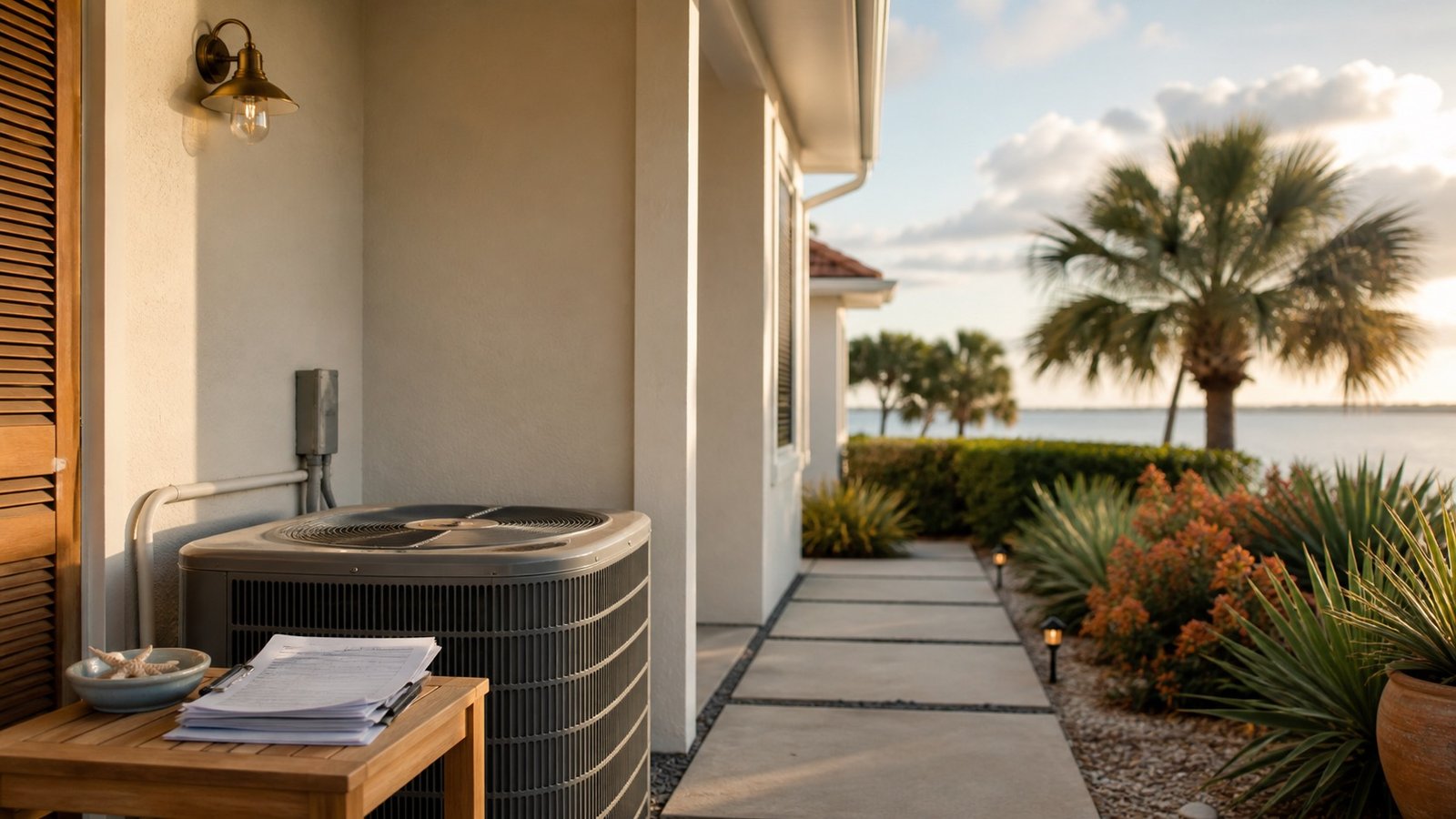
What Should Cocoa and Rockledge Sellers Document Before Listing Homes With Older Air Conditioners?
By Carrie Liotta, Space Coast REALTOR® with REAL Broker | Published August 14, 2026
If you are selling a Cocoa or Rockledge home with an older air conditioner, you do not automatically need to replace it before listing. You do need to make the system easy for a buyer to understand. That means gathering service records, permit history, model and serial numbers, recent maintenance notes, warranty information if any, and a clear explanation of how the system is performing today.
My direct advice is this: do not let the AC become a mystery. In Brevard County, an older air conditioner can affect buyer confidence, inspection negotiations, four-point insurance review, and the way the home competes against newer listings. A 13-year-old system that cools properly and has annual service records is a different conversation from a system with no paperwork, uneven cooling, and a seller who cannot remember when it was installed.
Cocoa and Rockledge have plenty of homes where this question matters. Established neighborhoods, mature trees, older block homes, updated interiors, and central Brevard convenience can all be strong selling points. But buyers are also comparing roof age, electrical panels, plumbing, HVAC, insurance, and the likely first-year repair budget. The paperwork helps them separate a normal older system from a looming surprise.
Start with one clean HVAC file
Before photos, before showings, and definitely before inspection day, I like sellers to build one clean HVAC file. It does not need to be fancy. It just needs to be complete enough that a buyer, inspector, insurance agent, or contractor can follow the system’s history without guessing.
Look for the installation invoice, permit or final inspection if available, manufacturer information, model and serial numbers, thermostat information, service agreement, annual maintenance receipts, repair invoices, parts replaced, refrigerant notes, drain-line cleaning records, and any warranty paperwork. If the system was serviced recently, keep the written report. If a capacitor, blower motor, fan motor, coil, thermostat, float switch, or drain component was replaced, keep that invoice too.
For homes in unincorporated areas, the Brevard County building permit search can be a starting point for permit history. If the home is inside Cocoa or Rockledge city limits, records may be held by the city rather than the county, so do not assume one search tells the whole story. The goal is not perfection. The goal is to confirm what you can and avoid casual claims you cannot support.
Why older AC systems matter to buyers in Cocoa and Rockledge
Buyers rarely reject a good home simply because the AC is older. They hesitate when the age, condition, and cost are unclear. That hesitation gets stronger when the home also has an older roof, an older water heater, dated electrical, plumbing questions, or visible maintenance issues.
In Rockledge, buyers may be comparing your established neighborhood, mature shade, Viera access, and lower HOA pressure against newer homes farther west. In Cocoa, buyers may be weighing value, river access, I-95 or US-1 convenience, and older-home character against system age and insurance comfort. In both markets, the AC story becomes part of the larger monthly-payment story.
I recently wrote about which Melbourne-area sellers should service HVAC before listing instead of offering a buyer credit, and the same principle applies here. Service first when the system is basically functioning and the issue is buyer confidence. Discuss replacement or pricing strategy when the system is failing, unreliable, or likely to dominate the inspection.
How four-point inspections change the HVAC conversation
A four-point inspection focuses on the roof, electrical, plumbing, and heating/cooling system. It is not the same as a full home inspection, but it can matter because insurers may use it to evaluate an older Florida home. Citizens Property Insurance explains on its inspection information page that a four-point inspection is required for all property owner, dwelling, and mobile home applications for properties more than 20 years old, and that the inspector checks electrical, plumbing, HVAC, and roof details including age, type, and condition.
That does not mean every buyer will use Citizens, and it does not mean a seller should panic. It does mean the AC should be ready for scrutiny. If the system does not cool, has unsafe wiring, is missing visible data plates, leaks condensate, has an inoperable air handler, or shows obvious neglect, the buyer may not see it as a small repair. They may see it as an insurance and closing risk.
My June guide to Brevard County four-point inspections explains the buyer side of that process. Sellers can use the same logic in reverse: reduce uncertainty before the buyer’s inspector has to name it.
What should you do before listing if the AC is old but working?
If the system is older but cooling well, I usually start with maintenance and documentation. Have a licensed HVAC contractor service it if that has not been done recently. Ask for a written invoice or report that states what was checked and what was corrected. Replace simple neglected items, clear the drain line, confirm the float switch if present, change the filter, verify thermostat operation, and make sure the outdoor unit has reasonable clearance.
Do not ask a contractor to promise an exact number of years left unless they are comfortable making that professional statement. Mechanical systems can fail unexpectedly. A factual report is stronger than an exaggerated claim. “Serviced on this date, cooling properly at time of service, drain cleared, capacitor replaced, no active condensate leak observed” is much more useful than “AC has plenty of life.”
Also walk the home the way a buyer will. Are some rooms warmer? Is the air handler closet clean? Are vents dusty or blocked by furniture? Does the thermostat look dated but functional, or confusing and unreliable? Does the outside condenser make a harsh noise at startup? Small details can make an older system feel cared for or ignored.
When should a seller consider replacement instead?
Replacement is worth discussing when the system is not cooling properly, has repeated service calls, needs a major repair close to replacement cost, has active leaks or electrical concerns, or is likely to stop a buyer from getting comfortable during inspections. It may also make sense when the rest of the home is being positioned at the top of its market and an obviously failing AC undercuts that story.
That said, I do not recommend automatic replacement just because a system is older. Sellers do not always get a dollar-for-dollar return, and buyers may prefer a credit, price adjustment, or their own equipment choice. The right answer depends on the home’s price range, competition, buyer profile, timing, and how the AC compares with the roof, water heater, electrical, and plumbing.
If the roof or other systems are also aging, read my guide to how Space Coast buyers compare a newer roof with a lower price. Buyers often evaluate major systems together. A seller strategy that works for one older system may not work when several are approaching replacement at the same time.
How to talk about an older AC in the listing and disclosures
Be factual. Do not hide the age if you know it, and do not overpromise performance. The seller disclosure should be accurate, consistent with your records, and updated if new information comes in. If the system has had recent repairs, disclose them appropriately and provide the invoices. If there has been a recurring issue, discuss the right disclosure language with your real estate professional.
I am careful with listing copy. I would rather say the home has documented HVAC service records than make a vague claim that the AC is “like new” when it is not. Buyers forgive age more easily than they forgive surprise. If the home has other strengths, such as a newer roof, updated electrical panel, strong location, or great lot, those strengths should be presented alongside the AC facts so the buyer sees the whole picture.
“From the start, her approach was impressive, the photography, video tour and social media outreach were outstanding, leading to multiple offers in a down market. Crucially, she was an absolute rock when it came to managing the multiple hurdles with various offers.”
A recent seller client
That is exactly the role of preparation. A well-documented older system is not glamorous, but it can keep a normal maintenance issue from becoming a dramatic negotiation hurdle.
My pre-listing HVAC checklist for Cocoa and Rockledge sellers
- Find the installation date, permit, invoice, and model/serial information if available.
- Collect maintenance receipts and repair records from the last several years.
- Service the system before listing if it has not been checked recently.
- Ask for a written report, not just a verbal “it is fine.”
- Correct active condensate leaks, clogged drains, thermostat problems, or obvious operating issues.
- Make sure the seller disclosure matches what you know.
- Decide in advance whether your strategy is service, replacement, buyer credit, or condition-based pricing.
Should you order a pre-listing four-point inspection?
Sometimes. If the home is older and you already suspect the roof, electrical, plumbing, or HVAC may raise insurance questions, a pre-listing four-point inspection can help you see what buyers may see. It is not always necessary, and it may uncover items you then need to address or disclose, so I treat it as a strategy decision rather than a default step.
In many cases, a targeted HVAC service report is the better first move. If the AC is the only major uncertainty, pay for the right professional to evaluate that system. If multiple systems are older, a broader pre-listing review may help you choose between repairing, replacing, pricing accordingly, or preparing buyer-facing documentation.
Bottom line
An older air conditioner does not have to weaken a Cocoa or Rockledge listing. What weakens the listing is uncertainty. Buyers want to know whether the system works, how it has been maintained, whether it may affect insurance, and how soon they should budget for replacement.
If you are preparing to sell, start with the paperwork and a service plan. Then price and present the home honestly. A clean HVAC file can help buyers focus on the home’s real strengths: location, layout, lot, commute, updates, and the Space Coast lifestyle they are trying to buy.
If you are thinking about selling a Cocoa, Rockledge, or central Brevard home with older systems, I can help you decide what to document before going live and how to position the home with confidence. Join my private Facebook group, Moving to Brevard County Florida, or reach out for a no-pressure conversation about selling your Brevard County home with REAL Broker. Your next chapter starts here.