

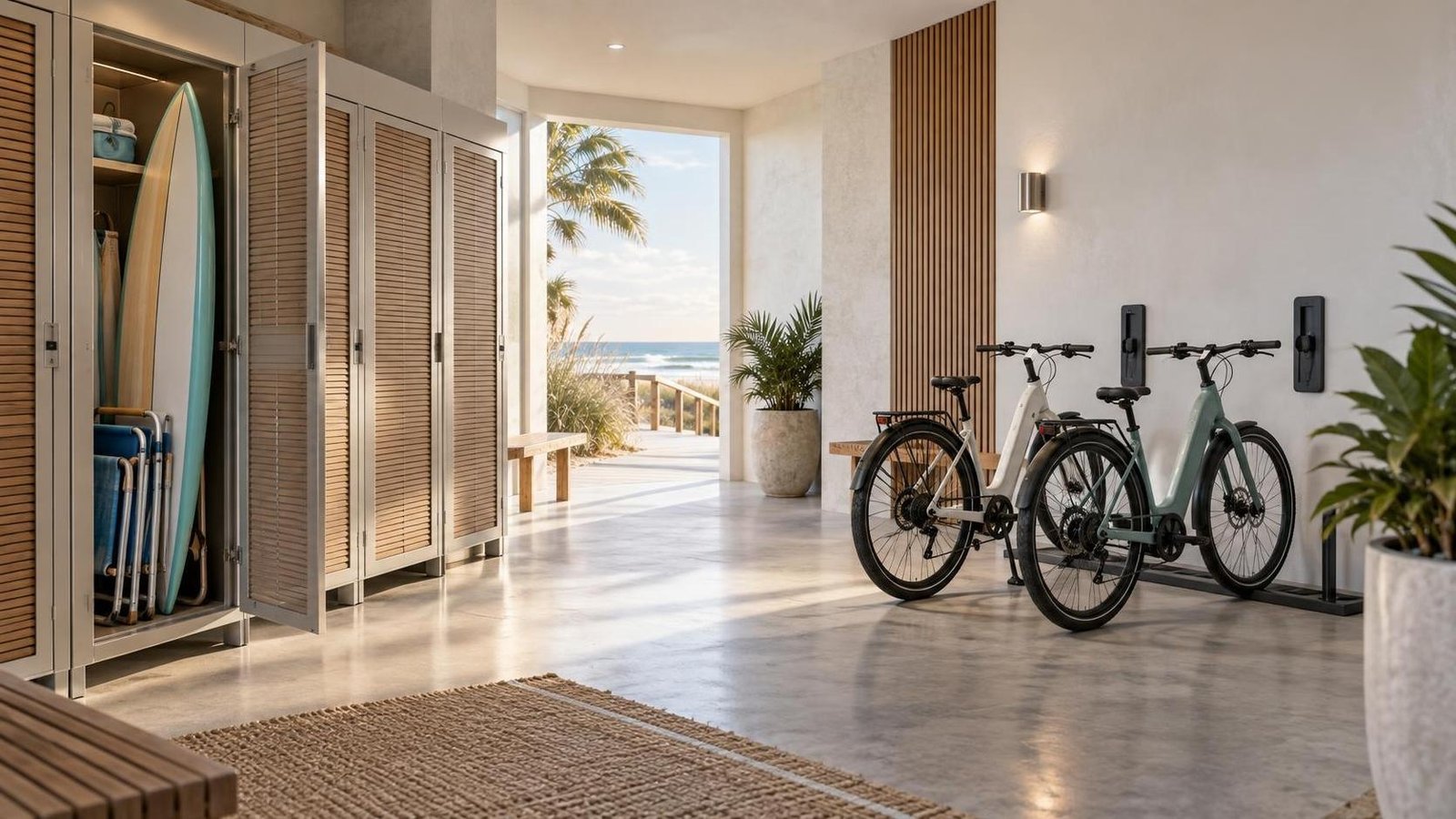
Private Storage Locker or Clear E-Bike Rules: What Should Cocoa Beach Condo Buyers Choose?
By Carrie Liotta, Space Coast REALTOR® with REAL Broker | Published September 23, 2026 on 321 Coastal Living
If an e-bike is part of your real beach routine, I would choose the Cocoa Beach building with clear written battery, charging, elevator, and storage rules over a larger private locker with uncertain power or ventilation. A locker is valuable only if you can use it legally and safely for the equipment you actually own.
This is a very modern condo-buying question. E-bikes make it easier to reach the beach, grocery store, restaurants, and nearby errands without moving the car. At the same time, older coastal buildings were not necessarily designed around heavy bikes, removable lithium-ion batteries, charging outlets, or residents carrying equipment through elevators and corridors.
The goal is not to find the building with the most permissive rule. It is to find one whose rules, electrical plan, fire-safety practices, storage layout, and enforcement all make sense together.
Separate bike storage from battery charging
Buyers often ask whether an e-bike “fits in the locker” as though storage and charging were the same decision. They are not. A building may allow a bike in a private locker but prohibit charging there. It may require batteries to be removed. It may direct charging to a designated room or prohibit micromobility devices in certain common areas. The unit, balcony, parking space, elevator, hallway, and locker can each have different rules.
Ask four separate questions: Where may the bike be parked? Where may the battery be stored? Where may it be charged? How may the bike travel between the unit and storage area? Get written answers tied to the current governing documents or adopted rules.
A seller’s personal habit is not the rule. “I always charged it by the locker” does not prove the association permits it, that the outlet belongs to the unit, or that the electrical system was designed for the use. Likewise, an unlabeled receptacle inside a storage area is not an invitation to charge.
Use federal battery guidance as the minimum personal practice
The U.S. Consumer Product Safety Commission’s micromobility guidance recommends products and batteries designed, manufactured, and certified to applicable voluntary safety standards. It tells consumers to use the charger supplied or recommended by the manufacturer, avoid modified or repurposed battery packs, remain present while charging, and not charge while sleeping or away from home.
Those practices matter even if a condo rule is silent. Building permission does not replace manufacturer instructions or safe personal behavior. Before buying, identify the exact bike and battery you own, its charging instructions, whether the battery is removable, and how you would comply with both the manufacturer and the association.
Check the CPSC recall information for your product, too. A building can have a beautifully organized bike room, but the owner remains responsible for understanding the equipment brought into it.
A private locker has more questions than square footage
Measure the door, interior dimensions, ceiling obstructions, turning space, and route from the exterior. A long locker can still be awkward if a bike cannot turn through the doorway. Check whether handlebars, pedals, or a front wheel must be removed and whether doing so would block neighboring access.
Then establish what the buyer is acquiring. Is the locker part of the unit, a limited common element assigned to the unit, a licensed space, or simply an area the current owner has used? Review the declaration, amendments, survey or floor plan if applicable, and assignment records. The locker number in the listing should match the association’s records.
Look for moisture, salt corrosion, leaks, ventilation openings, shared mechanical equipment, and outlets. My article about a Cocoa Beach locker sharing ventilation with an equipment room explains why apparently private storage may still depend on building systems and rules.
The stronger building will show its work
Ask for the current micromobility, bike, storage, garage, elevator, and charging rules; the board minutes where changes were discussed; any electrician or engineer reports tied to charging space; relevant contracts and permits; notices to owners; insurance correspondence the association can provide; and the budget for planned improvements.
Florida condominium records law matters here. Florida Statutes section 718.111 defines association powers and official-record duties. The Florida DBPR condominium FAQs summarize official-record categories that can include rules, meeting minutes, insurance policies, contracts, bids, permits, financial records, reserve studies, and life-safety reports.
A buyer may not have the same record-access rights as a current unit owner in every situation, so use the contract and seller’s cooperation to request what matters. The practical test is whether the building can produce a coherent paper trail. If the manager, board, seller, and posted sign give four different answers, do not assume the most convenient answer will survive after closing.
Read the minutes for change, not just the final rule
A one-page rule may say that batteries cannot be charged in lockers. The minutes can show why the rule changed, whether owners requested a dedicated room, whether electrical capacity was studied, whether a project was postponed, and whether enforcement has been consistent. That context affects both lifestyle and future cost.
Search for terms such as bicycle, e-bike, scooter, lithium-ion, battery, charger, outlet, garage, fire safety, storage, elevator, electrical, insurance, violation, and assessment. Read enough months to understand whether the current policy is stable or under active review.
If a dedicated charging project is planned, ask for the scope, funding source, contractor status, and expected operating rules. Do not pay today for a future amenity that has not been approved, funded, permitted, and completed.
Test the route from curb to storage
Bring the dimensions and weight of your actual bike. Start at the entrance you would use after a ride. Is there a ramp or step? Can the gate open while you control the bike? Does the elevator permit it, and is the cab large enough? Are protective pads required? Can you reach the locker without passing pool furniture, parked vehicles, or narrow fire doors?
For a heavier e-bike, “just carry it to the unit” may not be realistic. A ground-level room can be much more useful than a larger locker reached through several doors. Secure racks, camera coverage, key or fob control, floor drainage, and a place to maneuver may matter more than private enclosure.
Also check what happens during storm preparation. Must bikes be moved from a ground-level room? Does the association close garage access during an evacuation or building project? Where can a seasonal owner keep the bike when away? The everyday route and the storm plan should both be understandable.
Compare the total cost, not the free outlet
For the private-locker building, include the value of the assigned space, any transfer or rental fee, lock replacement, corrosion control, and the possibility that charging must occur elsewhere. For the building with a designated charging area, ask whether electricity is included, metered, billed by session, funded through dues, or subject to a future user fee.
Review association reserves and planned electrical work. A clear rule is valuable, but a building may still need panel, ventilation, access-control, fire-safety, or monitoring improvements. The monthly fee and assessment risk belong in the decision. Read my breakdown of which Space Coast condo documents to review before an offer so this single amenity does not crowd out the larger financial file.
A private locker can support resale for buyers with boards, chairs, fishing gear, or seasonal belongings even if they do not own an e-bike. Clear e-bike rules can appeal to a different group. I would not assign a universal premium to either. The winner is the feature that is legally assigned, physically usable, financially supported, and aligned with your routine.
Which buyer should choose each building?
Choose the larger private locker if you mainly need dry, secure beach-gear storage; the ownership or assignment is clear; your bike can be stored there under written rules; and you have a compliant charging plan elsewhere. It can also be the better option if the building prohibits all batteries in storage areas but your unit provides a practical, permitted path consistent with the rules and manufacturer guidance.
Choose the building with clearer e-bike rules and designated charging if you ride frequently, cannot carry a heavy bike or battery easily, want predictable access, and the charging area is professionally planned and supported by records. Clear restrictions are often better than vague permission because they tell you how the building will operate.
Choose neither if the seller cannot prove the locker assignment, charging relies on an unofficial common outlet, batteries are being charged unattended, management answers conflict with the documents, or a promised bike-room project has no approved funding.
If you are also comparing lifestyle features, my discussion of a ventilated Cocoa Beach locker versus a better balcony shows why practical storage can be more valuable than the feature that photographs best.
My buyer checklist before the review period ends
- Confirm the locker’s legal assignment and exact location.
- Read current rules for bikes, removable batteries, charging, elevators, balconies, garages, and common areas.
- Review minutes, notices, contracts, permits, budgets, insurance discussion, and planned electrical projects.
- Walk the actual route with bike dimensions and mobility needs in mind.
- Verify how charging electricity is supplied, controlled, and billed.
- Check the product, battery, and charger against manufacturer guidance and CPSC recalls.
- Ask how storm preparation, seasonal absence, construction, and elevator outages affect storage access.
- Have the appropriate attorney, insurer, lender, and inspector review issues within the contract timeline.
Bottom line for Cocoa Beach condo buyers
A large locker is not the better feature when you cannot use it for your e-bike routine. A designated charging area is not automatically better when the project, rules, or electrical plan are unclear. Choose the building that can explain storage, batteries, charging, access, enforcement, and cost in one consistent file.
I am Carrie Liotta, Space Coast REALTOR® with REAL Broker. If you are comparing Cocoa Beach condos, I can help you examine the unit, storage assignment, building records, monthly costs, and everyday beach-life logistics before you commit. Reach out for a no-pressure conversation about Brevard County homes for sale. Your next chapter starts here.