

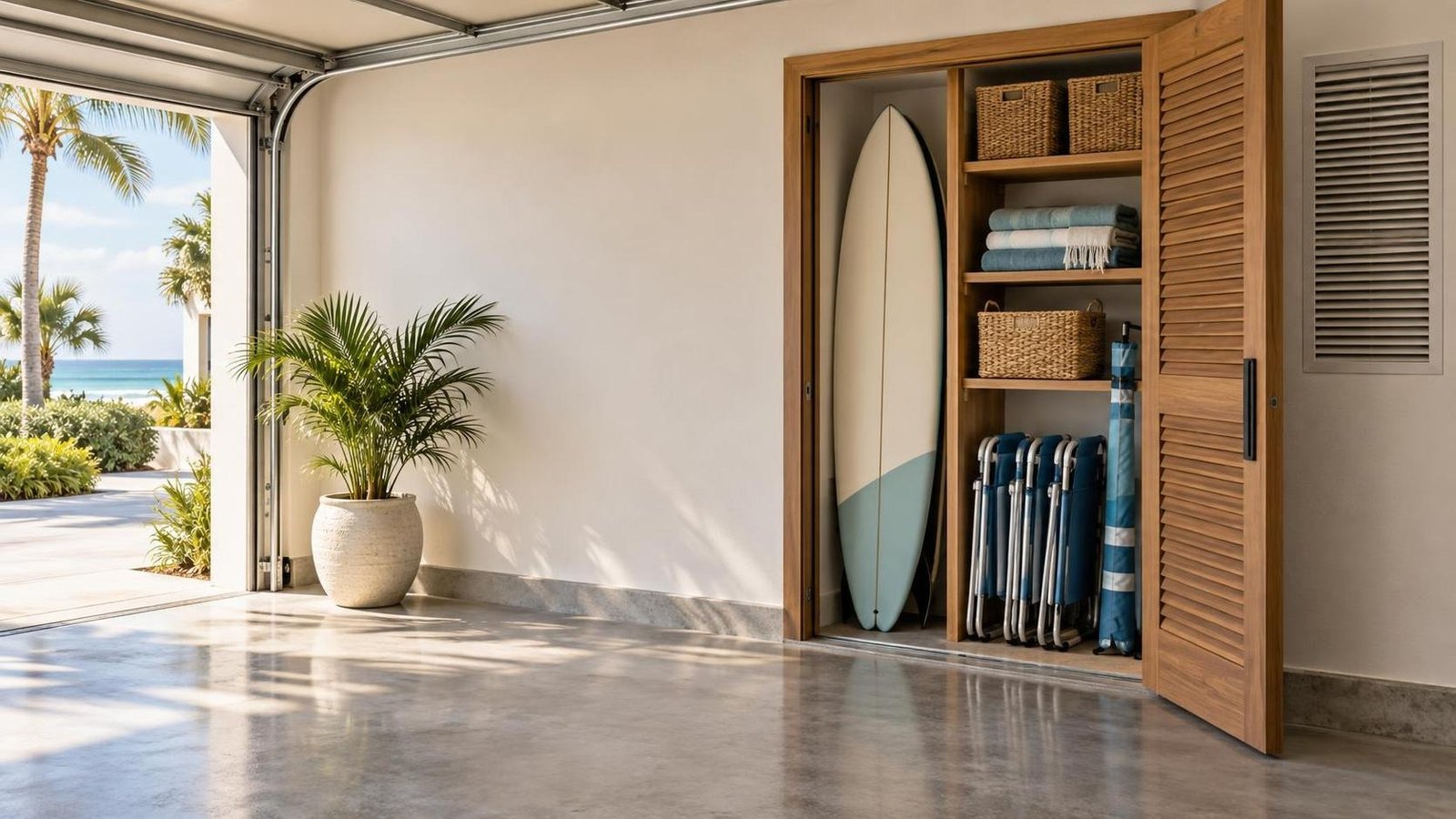
What Should Cocoa Beach Condo Buyers Verify When a Storage Locker Shares Ventilation With an Equipment Room?
By Carrie Liotta, Space Coast REALTOR® with REAL Broker | Published September 21, 2026
Verify the locker’s legal status, ventilation path, permitted contents, moisture history, fire protection, and maintenance responsibility before giving it value. A vented garage locker can be useful for beach gear, but shared air with mechanical equipment may bring heat, humidity, odor, dust, noise, or restrictions that make it unsuitable for batteries, fabrics, documents, or valuables.
Cocoa Beach condo buyers often see “private storage” and picture a clean extension of the unit. In reality, a garage-level cage, closet, or locker may be a deeded space, a limited common element, an assigned common area, or a revocable association assignment. Its walls may not be weather-tight. Its ventilation may connect to a garage, utility chase, pump room, electrical area, or mechanical space.
The right question is not whether the locker exists. It is what right you are buying, what environment the locker experiences, and what the building allows you to place there.
First, determine whether the locker transfers with the unit
Ask for the declaration, amendments, floor plans, survey or exhibit, deed, assignment agreement, current locker roster, and estoppel information. Match the locker number physically and on paper. A label painted on a door does not prove ownership.
Florida’s Condominium Act, Chapter 718 defines condominium units, common elements, limited common elements, association property, and other parts of the ownership structure. The declaration for the specific building determines how those concepts apply to its storage areas. Have the title professional or Florida condo attorney resolve ambiguity before closing.
Find out whether the association can reassign lockers, whether a separate key or access credential transfers, and whether the seller has placed items beyond the legal footprint. If the locker is leased from the association, confirm the fee and renewal terms instead of advertising it as owned.
Trace the ventilation rather than assuming “vented” means dry
Look at every grille, louver, gap, fan, and wall penetration. Ask where air comes from and where it exhausts. Is the locker passively open to the garage, mechanically exhausted, or connected to the equipment room? Does a fan run continuously, on a timer, or only when equipment operates? Who maintains it?
A licensed mechanical or building professional can evaluate the actual system. Buyers should not block vents, add a fan, seal openings, or run dehumidifiers without association approval and technical review. Changing airflow can affect other spaces, equipment, fire separation, and building operation.
The EPA’s indoor air quality guide identifies musty or stuffy air, condensation, dirty cooling equipment, and moldy belongings as signs worth investigating, and emphasizes source control and appropriate ventilation. A garage locker is not a living room, but those observations are useful when deciding whether the space is appropriate for what you plan to store.
Identify the neighboring equipment and its service history
“Equipment room” can mean many things: pool pumps, domestic water equipment, fire pump components, elevator equipment, electrical panels, irrigation controls, ventilation machinery, or building maintenance systems. Do not guess from sound or piping. Ask the manager for the room’s function and the association records that apply.
Look for maintenance contracts, recent invoices, leak reports, fan repairs, water intrusion, insurance claims, fire inspections, and meeting-minute discussions. The Florida DBPR condominium FAQs list association official records that can include rules, meeting minutes, current insurance policies, management agreements, contracts, permits, warranties, accounting records, reserve studies, and structural or life-safety inspection reports. That framework gives the buyer a practical records list for understanding the building around the locker.
If equipment has leaked or been replaced, ask what happened to the adjacent storage area. Was drywall removed? Were contents damaged? Did the association dry, clean, or test the space? A repaired event is not automatically a deal-breaker, but the buyer needs the full timeline.
Inspect the locker as a small coastal room
Visit after a humid period or rain if possible. Use sight and smell without disturbing equipment. Look for corrosion, peeling paint, efflorescence, swollen shelving, rusted fasteners, staining, damp cardboard, salt residue, pest activity, and blocked sprinkler heads. Check whether stored items sit directly on the floor.
Note the floor elevation relative to the garage entrance and drains. Ask whether water has entered during wind-driven rain, wash-down, plumbing leaks, or storm events. Review the building’s flood and insurance information, but do not assume the flood map describes every garage-level water event.
Hire the right inspector when the locker materially affects the purchase. A general condo inspection may identify visible concerns; a mechanical, fire-protection, electrical, moisture, or environmental professional may be needed for a specific issue.
Read the prohibited-storage rules line by line
Associations may restrict fuel, paint, chemicals, propane, flammable materials, food, furniture, batteries, charging devices, or anything that blocks ventilation or fire equipment. Some rules distinguish between storing an e-bike and charging its battery. Others may prohibit both in a garage locker.
Do not rely on what current owners appear to do. Obtain the current rule, recent board minutes, notices, fire inspection findings, and any enforcement history. The NFPA’s lithium-ion battery safety resources are useful general education, but the building’s approved fire-safety plan and association rules determine what the buyer may do in that locker.
If e-bike or mobility-device storage is a priority, compare the analysis in my Cocoa Beach approved e-bike storage versus covered-parking guide. Never assume an outlet near the locker authorizes charging.
Decide what belongs in this environment
A warm, vented garage locker may work for rinsed and fully dried beach chairs, a wagon, nonpowered boards, sand toys, or items designed for outdoor conditions. It may be a poor place for paper records, photographs, electronics, upholstered furniture, clothing, leather, medication, food, or anything sensitive to salt, heat, moisture, odor, or pests.
Even appropriate beach gear should not go into the locker wet or sandy if the rules require clean storage. Use shelves that comply with fire-clearance and association requirements. Do not drill walls, hang from pipes, cover louvers, or build a sealed cabinet without written approval.
The buyer should value the locker for the things it can safely and lawfully hold—not for the square footage alone.
Ask who pays when ventilation or equipment fails
Clarify whether the association maintains the walls, door, lock, fan, ducts, sprinkler, lighting, and adjacent equipment. Determine what the owner insures inside the locker and whether the association disclaims responsibility for stored contents.
Review the master policy summary, unit-owner insurance needs, deductible structure, governing documents, and any loss-assessment exposure with an insurance professional. Take an inventory and photographs after closing if you use the space. A private lock does not necessarily shift building-system responsibility to the owner, and association maintenance does not necessarily insure personal contents.
If the locker is a limited common element, ask how repair costs have been allocated in past events. The declaration, statutes, and legal advice—not hallway custom—should guide the answer.
Put the locker inside the building-wide due-diligence review
A useful locker cannot compensate for weak reserves, unresolved concrete work, inadequate insurance, elevator problems, or a major pending assessment. Read the current budget, financials, reserve study, milestone material when applicable, insurance, engineer reports, contracts, and at least a meaningful span of meeting minutes.
My June-style guide to the Space Coast condo documents to read before offering gives the complete building checklist. For this topic, search those records specifically for garage ventilation, mechanical rooms, storage, water intrusion, fire safety, pest treatment, and capital projects that could temporarily remove access.
Ask whether the locker must be emptied during equipment replacement, concrete work, painting, flood preparation, or garage maintenance. Seasonal owners should learn how notices are delivered and who can access the locker if they are away.
Compare the locker with storage elsewhere in the unit
A smaller but conditioned interior closet may be more valuable for sensitive belongings. A balcony storage closet may have different wind, water, and furniture rules. A ground-level locker may be easier for beach gear but less convenient when the elevator is out.
List the items you need to store and assign each to a lawful location. If the garage locker cannot hold batteries, linens, or documents, do not treat it as solving those needs. If it keeps sandy equipment out of the unit and has a clean record, it may be exactly the practical feature a full-time or seasonal owner needs.
For a related seasonal-use decision, see my comparison of a ventilated Cocoa Beach locker versus a balcony with stricter furniture rules.
My storage-locker due-diligence checklist
- Match the physical locker to the deed, declaration, exhibit, or assignment.
- Confirm whether the right is owned, limited-common-element, assigned, or leased.
- Trace ventilation and identify every adjacent equipment system.
- Review moisture, leak, fan, fire, and equipment-service records.
- Inspect for odor, corrosion, staining, pests, blocked vents, and floor-level water paths.
- Obtain current storage, charging, access, and modification rules in writing.
- Confirm maintenance and insurance responsibility.
- Price the locker only for items it can safely and lawfully store.
I would be comfortable with a shared-ventilation locker when the air path is understood, the equipment room has a clean maintenance record, the space is dry, the fire and storage rules fit the intended use, and the right transfers clearly. I would discount it heavily when odor, moisture, access, ownership, or battery rules remain vague.
Storage value comes from certainty, not just space
A Cocoa Beach condo locker beside an equipment room can be a real lifestyle advantage for surfside mornings—if the buyer knows what it is, how it breathes, what may be stored, and who maintains the systems around it. The documents and physical inspection should reach the same conclusion.
If you are comparing Cocoa Beach condos, I can help you look past “private storage” in the listing and organize the association, insurance, ventilation, access, and building-condition questions before the offer becomes emotional. I’m Carrie Liotta, Space Coast REALTOR® with REAL Broker, and I publish 321 Coastal Living to make coastal ownership decisions clearer. Reach out for a no-pressure conversation. Your next chapter starts here.