

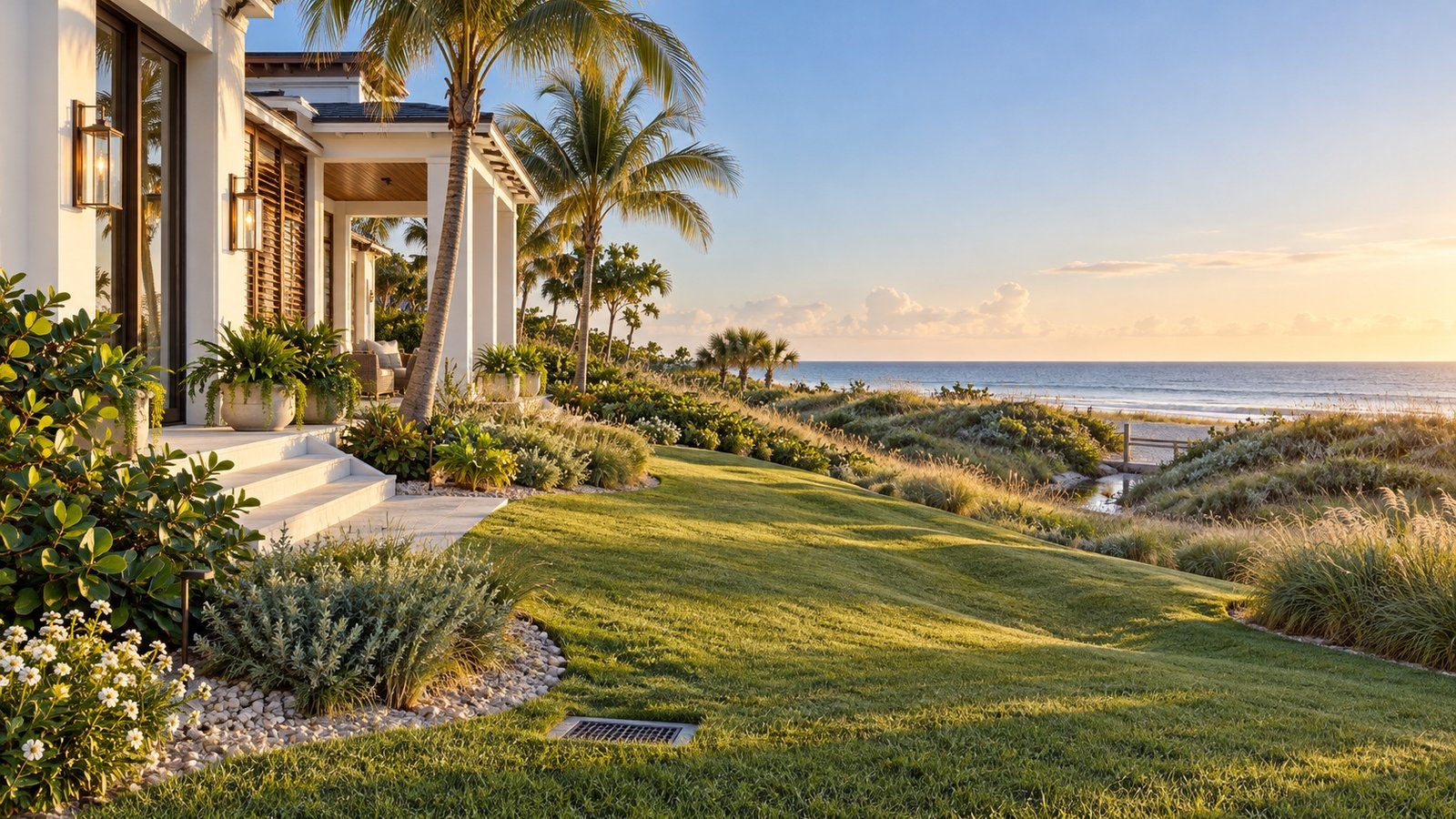
Buying in Indialantic? Verify a Shared Stormwater Outfall Easement Before You Close
By Carrie Liotta, Space Coast REALTOR® with REAL Broker
If an Indialantic home has a shared stormwater outfall easement, do not treat it as a line item to skim past at closing. Before you buy, confirm the recorded route, who may use it, what equipment or drainage it serves, and whether your plans for the yard would interfere with it. A clear answer can preserve both your use of the property and your leverage during inspections.
Beachside buyers often focus on the walk to the ocean, impact openings, roof age, and insurance. Those are all important. But a narrow drainage corridor can be just as consequential if it crosses a side yard, runs behind a fence, or gives a neighbor, association, or public entity a right to enter. It may be completely manageable. The problem is assuming that “shared” tells you enough.
I would approach this as a document-and-site question, not a scary mystery. An easement does not automatically mean you cannot enjoy the yard or that you will inherit a repair bill. It does mean the contract period is the right time to match the legal description to the physical property and to ask precise questions of the people who can answer them.
Start with the recorded documents, not the visible swale
An outfall can be easy to miss. You may see a catch basin, a pipe headwall, a shallow swale, a grated inlet, or nothing obvious at all because the line is underground. The physical clue is not the definition of the easement. Start with the title commitment and its exceptions, the survey, the recorded plat, any easement agreement, and any prior drainage or site plan the seller can provide.
The Brevard County Clerk’s Official Records information identifies deeds, subdivision plats, surveys, and other real-estate instruments among the records it maintains. The Clerk also cautions that online search information is not itself the official public record. That is a useful distinction: an online index can help you locate a document, but your title professional should tell you which recorded instrument actually affects the parcel you are buying.
I want a buyer to be able to point to the survey and ask, “Does this shaded strip match the recorded easement? Where does it begin and end? Does it cross the driveway, fence line, pool area, or side yard I thought I was getting?” A vague verbal answer from a seller or neighbor is not enough for a decision that may affect access and future improvements.
Confirm what the easement is for and who has rights
The phrase stormwater outfall easement describes a purpose, but the controlling document supplies the details. It may involve a private shared system, a platted drainage corridor, an association-maintained feature, or a route associated with a public drainage system. The holder and the wording matter. Ask the title professional and, when appropriate, the Town of Indialantic whether the document identifies an owner, association, utility, municipality, or another party with access rights.
Then ask what access is reasonably contemplated: inspection, maintenance, repair, replacement, or emergency work. You are not looking for a casual opinion about what happened years ago. You are looking for the recorded language, the current party responsible for the system, and any written maintenance arrangement. If there is an HOA or a small beachside association, request its governing documents, meeting minutes, budget, reserve information, and recent repair correspondence before the inspection period expires.
That level of clarity matters when you compare properties too. A home with a drainage route that is fully documented and easy to access can be simpler to own than a prettier yard with an unexplained inlet and no records. The same practical thinking applies to a backyard project; my guide to landscape changes and drainage at a Viera home explains why surface changes should be evaluated before, not after, a buyer commits to a plan.
Match the paperwork to the property during inspections
Once you have the documents, walk the site with them in hand. A current boundary survey is often the bridge between recorded language and real life. Have your surveyor, title professional, inspector, or other qualified adviser explain what each person is reviewing; they serve different purposes. The home inspector can identify visible drainage concerns or signs of water movement. The survey clarifies the plotted relationship of improvements and easements. A title professional interprets the title materials. If the issue is technical or the proposed work is significant, a civil engineer or qualified drainage contractor may be appropriate.
On a beachside lot, look beyond a neat lawn. Note downspouts, grade changes, low areas near the foundation, pavers, gates, planters, irrigation equipment, sheds, fences, pool equipment, and hardscape that may sit near the route. Ask whether any of it appears to obstruct access or redirect flow. Do not assume that a neighbor’s fence proves a fence is allowed, or that an existing improvement was approved.
The goal is not to perform your own engineering review. It is to identify the right questions early enough to get competent answers. If water has ponded after heavy rain, ask for photos, repair invoices, correspondence, claims history if the seller is willing to provide it, and the dates of any work. A single dry-day showing rarely tells the whole drainage story.
Do not separate the easement review from flood and insurance due diligence
A drainage easement and a flood zone are different things. One does not tell you the answer to the other. Still, both belong in the same purchase conversation because each can affect how you use, insure, improve, and resell the property. The FEMA Map Service Center is the federal starting point for checking the current flood-map panel for a specific address. Your lender, insurance professional, survey, elevation information, and policy quote are the sources for the transaction-specific answer.
For an Indialantic buyer, I would not let a reassuring listing phrase such as “no flooding” replace that work. Ask what the seller means: no water inside the home, no water in the yard, no known claim, or no current issue? Then ask the insurance professional to quote the actual property, not a nearby address. A shared outlet may work exactly as intended and still make drainage records worth understanding.
This is also why the inspection window should be used in an order that makes sense. Get the title commitment and survey early. Identify the easement. Ask for the documents. Bring the right professional to the site if questions remain. Then make a decision while you still have contractual options, rather than discovering a restriction after a contractor has drawn a pool, fence, or patio plan.
Ask about responsibility before you budget for improvements
Buyers sometimes hear “shared” and assume that every cost will be split evenly. That may be true in a specific recorded agreement, but it should never be an assumption. The documents may assign maintenance, access, notice requirements, or cost-sharing differently. They may also be silent on a practical issue that needs clarification before closing.
Ask the seller for the last several years of invoices, notices, repair requests, correspondence with neighbors or an association, and any permits or approvals tied to the outfall. If there have been repairs, ask what was done, who paid, and whether the work was intended as a permanent fix or a short-term response. If an association is involved, ask whether the system appears in its budget, whether a reserve or special assessment has been discussed, and whether there are unresolved drainage complaints.
Some buyers will decide the uncertainty is manageable if the price and lifestyle fit. Others may choose a different property if the access route bisects the space they intended to use or if responsibility cannot be explained. Both are reasonable outcomes. The mistake is treating the issue as a cosmetic detail and discovering that the outdoor plan depends on someone else’s right of entry.
Be cautious with fences, pavers, landscaping, and pool plans
Beachside yards invite improvements: a privacy fence, a gate for surfboards, turf, pavers, a spa, a shed, new planting beds, or a redesigned pool deck. None should be planned on the assumption that the easement can be ignored. An improvement may be physically possible yet still create an access, maintenance, approval, grading, or drainage question.
Before closing, I would ask the seller which improvements are existing, when they were installed, and whether approvals or permits are available. After you understand the recorded documents, contact the Town of Indialantic Public Works department or the appropriate local office for current project-specific guidance. Municipal requirements and site conditions can change, so a general article or a neighbor’s experience should not be treated as permission.
A helpful comparison is a beach-access easement: the usable yard can still be valuable, but the buyer needs to understand the route and access before paying for a feature that could have to be moved later. My article on a shared beach-walk easement in Satellite Beach walks through that same habit of checking the actual documents before falling in love with the lifestyle picture.
My Indialantic buyer checklist
Before the inspection period ends, I would want this file to answer the following questions:
- Is the outfall easement shown on the current survey, and does its route match what is visible on site?
- Which recorded plat, agreement, deed exception, or other instrument created it?
- Who holds access rights, and what maintenance or repair access does the document describe?
- What component does it serve: a pipe, swale, inlet, discharge point, shared system, or another feature?
- Who has historically maintained it, and are invoices, notices, or agreements available?
- Do any existing fences, pavers, gates, landscaping, sheds, or pool features appear to affect the route?
- Has the seller reported standing water, overflow, erosion, drainage work, disputes, or access requests?
- What does the current flood-map panel show, and what does the insurance quote say for this exact home?
- What does the appropriate Town office say about the improvement you would actually want to make?
Keep each answer in writing when possible. A good file is useful long after closing: it helps with contractors, future maintenance, insurance conversations, and a later resale. It also lets you explain the feature calmly if a future buyer asks the same questions.
Bottom line for an Indialantic buyer
A shared stormwater outfall easement is not automatically a reason to walk away from an Indialantic home. It is a reason to slow down, locate the recorded documents, compare them with the survey and site, and get the right people involved before you close. When the route, access, responsibility, and future-yard limitations are clear, you can decide whether the home still fits your beachside lifestyle and budget with far more confidence.
If you are comparing Indialantic homes, I can help you organize the practical questions around title, surveys, drainage, insurance, outdoor plans, and resale so that the whole property—not just the showing-day view—guides your decision. Reach out to Carrie Liotta, Space Coast REALTOR® with REAL Broker, for a no-pressure conversation about buying on the Space Coast. Your next chapter starts here.
