

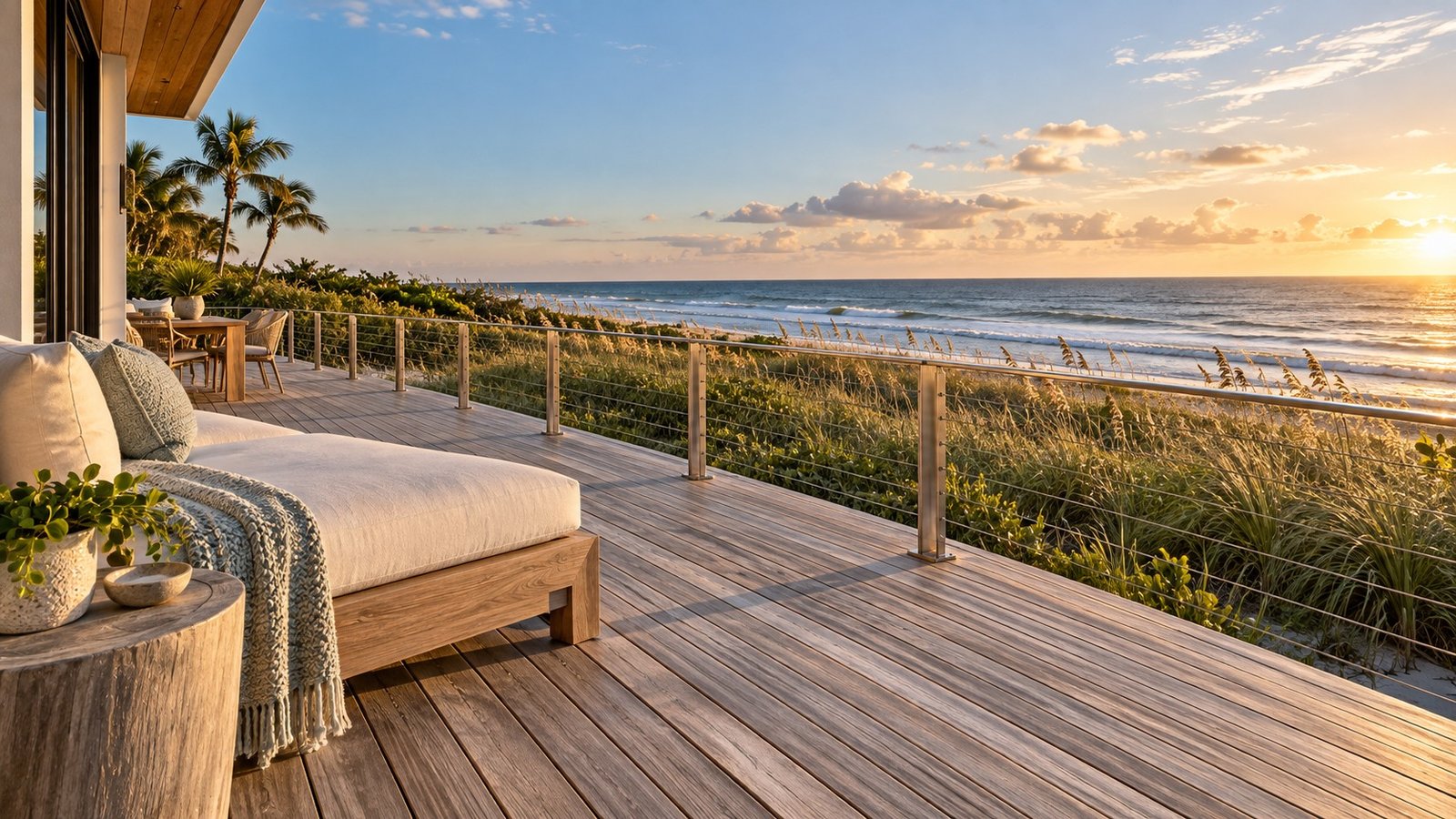
Ocean-Facing Deck Repair Near the CCCL: What Melbourne Beach Buyers Should Verify
By Carrie Liotta, Space Coast REALTOR® with REAL Broker | October 20, 2026
If an ocean-facing deck in Melbourne Beach needs repair or replacement, do not treat it as a simple weekend project attached to a beautiful house. Before you close, verify the deck’s records, the property’s coastal jurisdiction, the exact scope of work, and the approvals that may be needed. The difference between repairing what exists and changing its structure, footprint, elevation, or relationship to the dune can change both the timeline and the risk.
I love a home that lets you step outside, hear the Atlantic, and actually use the outdoor space. But on the barrier island, a deck can sit at the intersection of ownership, construction, erosion, flood exposure, dunes, and resale. The right question is not “Can we fix it after closing?” It is “What exactly is here now, what does the contract give us time to verify, and what would a future project require?”
Start by separating condition from permission
Buyers often see one issue: weathered boards, corroded fasteners, a loose rail, or a tired stair run. I want them to separate that visible condition from the permission question. A deck may be old but documented. It may look recently updated but lack a clear permit trail. It may be sound enough for today but impractical to alter in the way you imagine.
Ask the seller for the original construction records, later repair invoices, engineering documents if any, photographs taken before work was covered, and the name of every contractor who touched the deck. Then compare those records with the survey, title commitment, listing photos, and the actual structure. A permit number is useful, but it is not the whole answer. I want to know whether the final approved work matches the deck, stairs, landings, railings, lighting, and access route that are on the property now.
A good home inspector can identify visible safety and material concerns. A qualified contractor can help define a realistic repair scope. If the deck is a meaningful part of the purchase, bring in the right coastal, structural, or permitting professional before the inspection period closes rather than asking a general question after the earnest-money deadline has passed.
Why the Coastal Construction Control Line matters
Florida’s Coastal Construction Control Line program regulates structures and activities that can destabilize dunes, contribute to erosion, damage upland property, or interfere with public access. DEP explains that the CCCL establishes an area where special siting and design criteria apply. That does not mean every ocean-adjacent deck in Melbourne Beach has the same issue or needs the same approval. It does mean a buyer should not guess from the view, the sand line, a neighbor’s project, or an old listing description.
Florida Statute section 161.053 is the statewide framework behind the control line. It describes special coastal siting and design considerations and restrictions on construction, excavation, and alteration seaward of an established line unless the applicable authorization is in place. The practical takeaway is straightforward: determine where the property and deck sit before you price the improvement into your offer.
I would ask the seller, listing agent, and your closing team for any prior coastal correspondence, survey notes, permit conditions, site plans, and final inspections. Then ask the appropriate local building and coastal authorities whether your proposed work is treated as maintenance, repair, reconstruction, or a new or expanded improvement. Those words can matter. A contractor’s casual “we can replace it” is not a substitute for a jurisdiction-specific answer.
Get the exact deck scope in writing before you ask about approvals
“Replace the deck” can mean very different things. One seller may mean swapping deteriorated surface boards while keeping the framing, size, elevation, stairs, and rail layout. Another may mean rebuilding the framing, changing the stair landing, shifting posts, adding a roofed area, or extending the platform toward the dune. Those are not interchangeable scopes.
Before you call anyone for a permit opinion, create a one-page scope summary. Include the current dimensions, whether the framing stays or changes, the proposed materials, any new footings or piles, rail height, stair location, lighting, screens, roof cover, plumbing, electrical work, and how access for the work would occur. Use dated photos and the survey rather than relying on memory.
This step protects your budget. It also protects your negotiation. If the seller says the deck is “repairable,” ask what that statement is based on. If the inspector notes movement, rot, corrosion, or a questionable connection, ask the contractor to distinguish immediate safety work from a full rebuild. An estimate that looks low because it assumes surface work can become a very different project once the framing or supports are opened up.
Read the survey and title documents as carefully as the deck invoice
Deck questions are not only building questions. On an ocean-adjacent lot, the survey and title documents help you understand where the structure sits relative to property lines, easements, access rights, recorded restrictions, and other conditions that can shape use. Do not assume that because a deck has existed for years, every part of it is automatically inside the deeded area or free of restrictions.
Ask your title professional which exceptions and recorded instruments affect the parcel. Ask the surveyor whether the current survey shows the deck and whether any boundary, setback, or encroachment issue requires more investigation. If the purchase involves a shared beach route, an access agreement, or a crossover, read my guide on private beach access and dune-crossover due diligence in Melbourne Beach. Access rights and deck permissions are separate questions, but both need documents rather than assumptions.
This is also where I slow buyers down on future plans. A deck may be fine for ordinary enjoyment today while a larger entertaining platform, hot tub, outdoor kitchen, pergola, or reconfigured stair becomes much harder to approve. Buy the property for what is verified now, then treat unapproved future plans as possibilities to investigate, not features already included in the value.
Include flood information in the ownership picture
A deck repair does not by itself tell you the property’s flood risk, and a flood zone does not answer every construction question. Still, both belong in the same diligence file for an ocean-adjacent purchase. FEMA identifies its Flood Map Service Center as the official public source for flood-hazard information used in support of the National Flood Insurance Program. Look up the address, save the current result, and then speak with an insurance professional about the actual home, elevation information, coverage, deductible, and lender requirements.
For a deck, I also want buyers to understand the practical exposure: salt air, wind-driven rain, fastener corrosion, drainage, sand movement, and the wear created by frequent coastal use. Those are maintenance realities, not proof that a particular deck is defective. They are a reason to inspect carefully and to ask for a realistic maintenance history. A beautifully maintained ocean-facing deck can be a genuine asset. A deck with no records and visible shortcuts can become a recurring expense after the excitement of closing fades.
Build a diligence timeline that fits your contract
Do not wait until the final days of the inspection period to start this work. I would put the deck on the first-round inspection list and assign responsibilities early. The buyer can request records. The seller can authorize release of permit information. A contractor can evaluate condition. A surveyor, title professional, insurer, and appropriate government contact can each answer a different part of the question.
- First: collect the survey, title commitment, seller disclosures, deck permits, invoices, plans, and photographs.
- Next: inspect the deck and get a written description of condition and likely scope, not just a rough verbal estimate.
- Then: confirm the coastal and local review path for the actual scope you may pursue.
- Finally: decide whether you are comfortable proceeding, need a repair credit, want the seller to correct a defined issue, or should revise the offer around a larger unknown.
That order matters because it keeps you from negotiating a credit for a project nobody has defined. It also prevents a common emotional mistake: falling in love with the deck view, assuming a quick rebuild is inevitable, and discovering too late that the scope, timing, or cost is different from what you expected.
How this affects resale later
When you eventually sell, your buyer will ask many of the same questions. Clear permits, final inspections, invoices, photos of concealed work, product information, maintenance records, and an honest explanation of the deck’s relationship to the lot can make a future buyer more confident. A clean documentation file does not guarantee an approval or erase coastal risk, but it replaces mystery with facts.
That is especially valuable in Melbourne Beach, where buyers are often comparing ocean proximity, outdoor living, dune sensitivity, insurance, and the quiet character of the south barrier island. For a broader ownership lens, my Melbourne Beach waterfront buying guide helps put the deck issue alongside flood, insurance, access, and daily-life decisions. And if you are buying from a seller who has already gathered coastal records, this guide to ocean-adjacent home documentation explains why that preparation matters.
My bottom line for Melbourne Beach buyers
An ocean-facing deck can be one of the reasons a Melbourne Beach home feels unforgettable. Just make sure the purchase decision includes the deck you actually have, the records you can verify, and the project path you can realistically pursue. I would rather help a buyer ask ten precise questions before closing than spend months untangling an assumption afterward.
If you are considering an ocean-adjacent home in Melbourne Beach, I can help you organize the property records, coordinate the right due-diligence conversations, and compare the whole ownership picture before you commit. Reach out for a no-pressure conversation about Brevard County homes for sale with Carrie Liotta, Space Coast REALTOR® with REAL Broker. Your next chapter starts here.
