

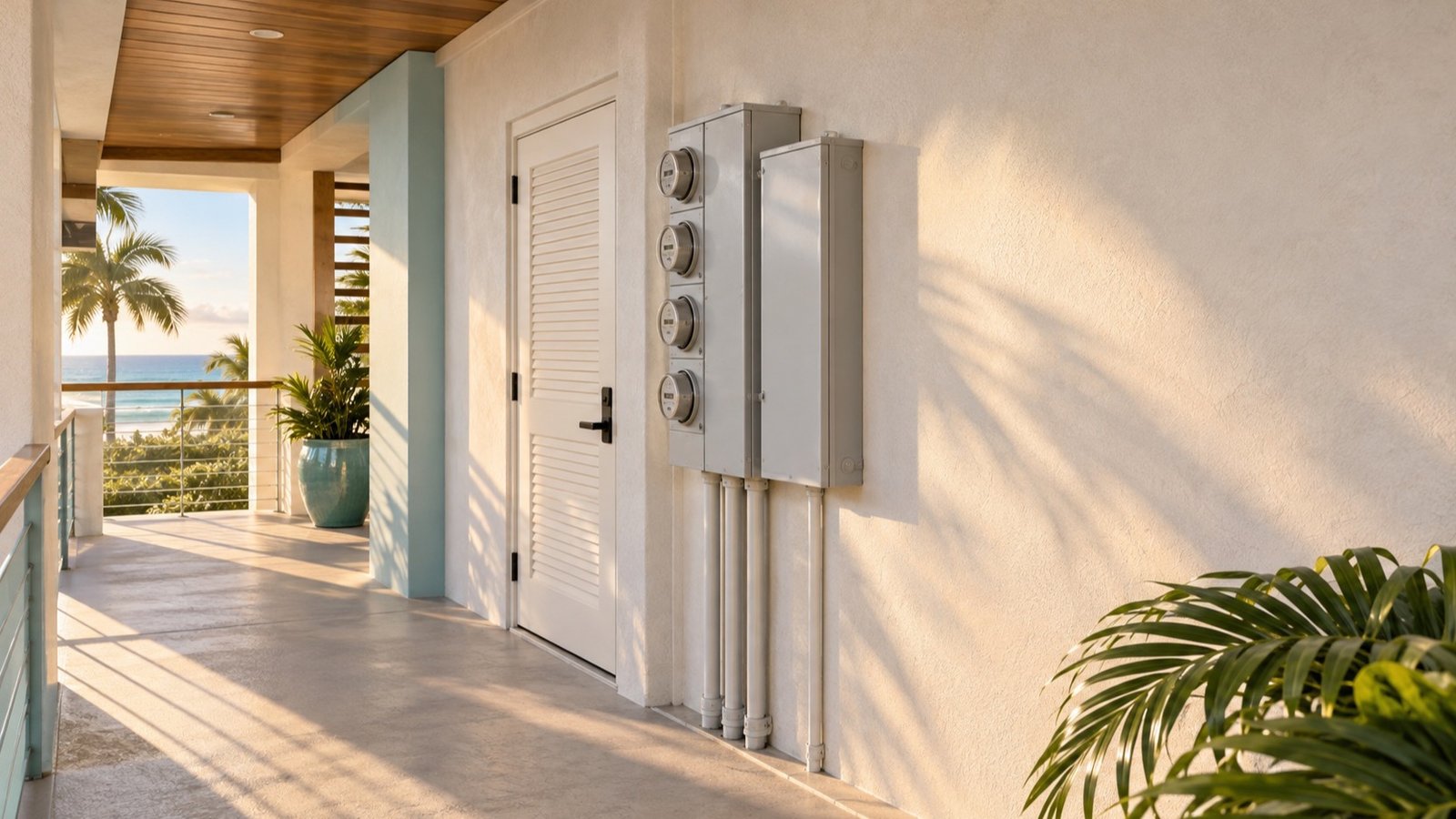
What Should Cocoa Beach Condo Buyers Verify When an Exterior Storage Closet Shares a Wall With the Electrical Meter Bank?
By Carrie Liotta, Space Coast REALTOR® with REAL Broker | Published October 14, 2026
A shared wall between your exterior storage closet and a condo electrical meter bank is not automatically a deal breaker. Before buying, verify who owns and maintains each component, whether the equipment has safe service access, whether moisture or corrosion is present, and whether past alterations were approved and permitted.
This is the kind of small physical detail that can reveal a much larger ownership question. The closet may be assigned to one unit, while the wall, conduits, meter enclosures, or surrounding corridor belong to the association. A buyer needs the documents, the visible condition, and qualified professional input to tell one responsibility from another.
Why does the shared wall deserve a closer look?
In Cocoa Beach, exterior building components live with salt air, wind-driven rain, humidity, and frequent wet-dry cycles. None of that proves there is an electrical defect. It does mean I would not dismiss rust staining, failed sealant, swollen wall material, recurring dampness, or an improvised opening as cosmetic until the right professional has evaluated it.
The location also matters because the meter bank must remain available to the people authorized to inspect, service, or replace it. A storage closet should not become an unofficial workshop, a place where beach gear presses against electrical components, or a renovation that narrows access on the other side of the wall. Buyers should observe, document, and ask questions; they should never open utility equipment or move covers themselves.
First, determine what you are actually buying
Do not assume that a deeded or assigned closet makes every surrounding surface the unit owner’s responsibility. Read the declaration’s unit-boundary language and exhibits. The closet might be part of the unit, a limited common element reserved for that unit, or a common element assigned for exclusive use. Those labels can change who approves alterations and who pays for maintenance.
Florida law provides the starting framework, but the recorded condominium documents supply the building-specific answer. Under Florida Statutes Section 718.113(1), the association generally maintains common elements, except when the declaration assigns maintenance of a limited common element to a unit owner. That is why a verbal answer such as “the closet belongs to Unit 304” is not enough.
Ask the seller or association to identify, in writing if possible:
- whether the closet floor, door, interior finish, shared wall, and exterior face are unit, limited-common-element, or common-element property;
- whether the meter bank, raceways, disconnects, and adjacent wall assembly are maintained by the association, utility, or another party;
- whether owners may attach shelving, hooks, fasteners, outlets, lighting, or wall coverings inside the closet; and
- who pays if an electrician needs access through the closet wall or if water intrusion damages both areas.
A clear answer lets you estimate risk. A vague answer tells you where more due diligence is needed.
Inspect access without touching energized equipment
During the showing and inspection, look at the relationship between the closet and the meter area from normal, lawful viewing points. Is the meter bank directly against the wall? Does its front appear unobstructed? Is there a gate, stored furniture, bicycle rack, planter, or closet door swing that could interfere with service access? Are unit labels legible, or does the equipment look patched and altered?
Do not decide code compliance from a tape measure or an online diagram. The required working space and equipment arrangement depend on the installation, applicable code, and field conditions. A licensed electrician and the authority having jurisdiction are the appropriate sources for that conclusion. The buyer’s job is to notice the condition early enough to ask for an evaluation during the contract period.
I would also ask whether the association has written storage rules for that closet. If the rules prohibit flammable liquids, battery charging, shelving on the shared wall, or items that obstruct a corridor, find out whether the current use complies. A neat closet can still contain an unapproved outlet or fasteners placed where concealed electrical equipment runs.
Look for a moisture path, not just a stain
Salt residue and surface rust are common enough near the ocean that buyers sometimes normalize them. The more useful question is whether the condition is stable surface wear or evidence of active moisture reaching the wall or equipment.
Look for peeling coatings, rust trails below enclosure edges, white powdery deposits, bubbling paint, swollen trim, musty odor, soft wall material, gaps around penetrations, or staining that crosses from the meter side into the closet. Ask whether rain reaches the area during a strong east wind and whether the closet has ever taken on water after a storm or pressure washing.
Then connect the visible clue to records. Has the association resealed conduit penetrations, replaced meter enclosures, repaired stucco, or investigated drainage above the area? Are there repeat complaints in meeting minutes? If service access crosses a private balcony or storage area elsewhere in the building, my guide to roof-drain service access through Cocoa Beach condo storage areas shows the same basic lesson: access and maintenance responsibility should be understood before closing, not during the next repair.
Verify alterations, permits, and repair history
An exterior closet often accumulates small owner projects: added shelves, a light, a receptacle, a charger, wall panels, or a new lockset. When the closet shares a wall with electrical service equipment, those changes deserve more scrutiny. Ask who installed them, whether the association approved them, whether the work required a permit, and whether a final inspection was recorded.
The City of Cocoa Beach Building Division states that permits are required for electrical work and explains that its process includes plan review, contractor-license and insurance confirmation, and inspection of completed work. A missing online result does not prove work was unpermitted, especially for older records, but it should prompt a direct question rather than an assumption.
Request invoices, permits, final inspections, association approvals, electrician reports, and warranties for any known work affecting the wall or meter area. Match the paperwork to what you can see. “The association handled it” is not a complete repair history if no one can identify the date, contractor, scope, or final outcome.
Read the condo records as a system
Florida’s condominium statute identifies a broad set of association official records. Section 718.111(12) includes the declaration and amendments, bylaws, rules, meeting minutes, developer-provided plans and permits when applicable, inspection reports, and permits for ongoing or planned construction among the records an association must maintain in the circumstances described by the statute.
For this issue, I would read recent board minutes and maintenance reports for references to meter banks, electrical upgrades, exterior corrosion, water intrusion, stucco repairs, utility coordination, access complaints, insurance claims, or special assessments. One repair is not automatically a red flag. A pattern of unresolved complaints, shifting explanations, or undocumented work matters more.
Resale buyers are also entitled to specified condominium documents under Florida Statutes Section 718.503(2). The exact contract and delivery facts control your deadlines, so review the documents promptly and consult a Florida attorney about legal questions. My broader checklist of Space Coast condo documents to read before an offer can help you organize the packet.
Bring the right professionals into the inspection period
A general home inspector can document visible conditions and help identify where specialist review is appropriate. For the meter bank and nearby wiring, use a Florida-licensed electrician who is authorized to evaluate the accessible installation. If staining or deterioration suggests an exterior-envelope problem, the association may need to involve its building professional, engineer, or qualified contractor.
Ask each professional a focused question. Instead of “Is this okay?” ask:
- Is there visible evidence of overheating, corrosion, moisture entry, damaged enclosures, or unsafe alteration?
- Does the closet use or door operation appear to interfere with safe access?
- Could shelving, screws, outlets, or wall coverings have affected concealed components?
- What further access or documentation is needed to reach a reliable conclusion?
- Is the recommended correction inside the unit, on a common element, or subject to association or utility coordination?
If the association will not permit opening or testing of common equipment, document that limitation. Decide with your inspector, electrician, attorney, lender, and insurance professional whether the available evidence is sufficient or whether you need a written association response, repair commitment, credit, extension, or cancellation right under your contract.
How should you judge the answer?
A manageable file usually has consistent documents, an unobstructed meter area, no active moisture evidence, clearly permitted work, defined maintenance responsibility, and an association that answers specific questions. The closet can still be useful; you simply know its rules and boundaries.
A higher-risk file has active corrosion or dampness, blocked access, unexplained penetrations, improvised electrical work, no approvals, or disagreement about who owns the wall. Multiple uncertainties compound. The cost may include investigation, moving stored items, wall repair, electrical correction, association legal review, or an assessment—not just a replacement closet shelf.
Storage itself can be a meaningful beachside amenity, but its value depends on safe, workable rules. For another example, see how I evaluate a Cocoa Beach storage locker that shares ventilation with an equipment room.
My bottom line for Cocoa Beach condo buyers
Do not reject the condo just because the storage closet shares a wall with the electrical meter bank, and do not wave it away because the closet looks dry on one sunny showing. Verify the legal boundary, maintenance responsibility, access, visible condition, alteration history, permits, and association records. Then let qualified professionals interpret the electrical and building details.
If you are comparing Cocoa Beach condos, I can help you organize the right document requests and inspection questions before the deadlines get tight. Reach out for a no-pressure conversation about Brevard County homes for sale with Carrie Liotta, Space Coast REALTOR® with REAL Broker. Your next chapter starts here.
Join my private Facebook group, Moving to Brevard County Florida, for practical relocation guidance and honest Space Coast buyer conversations.
