

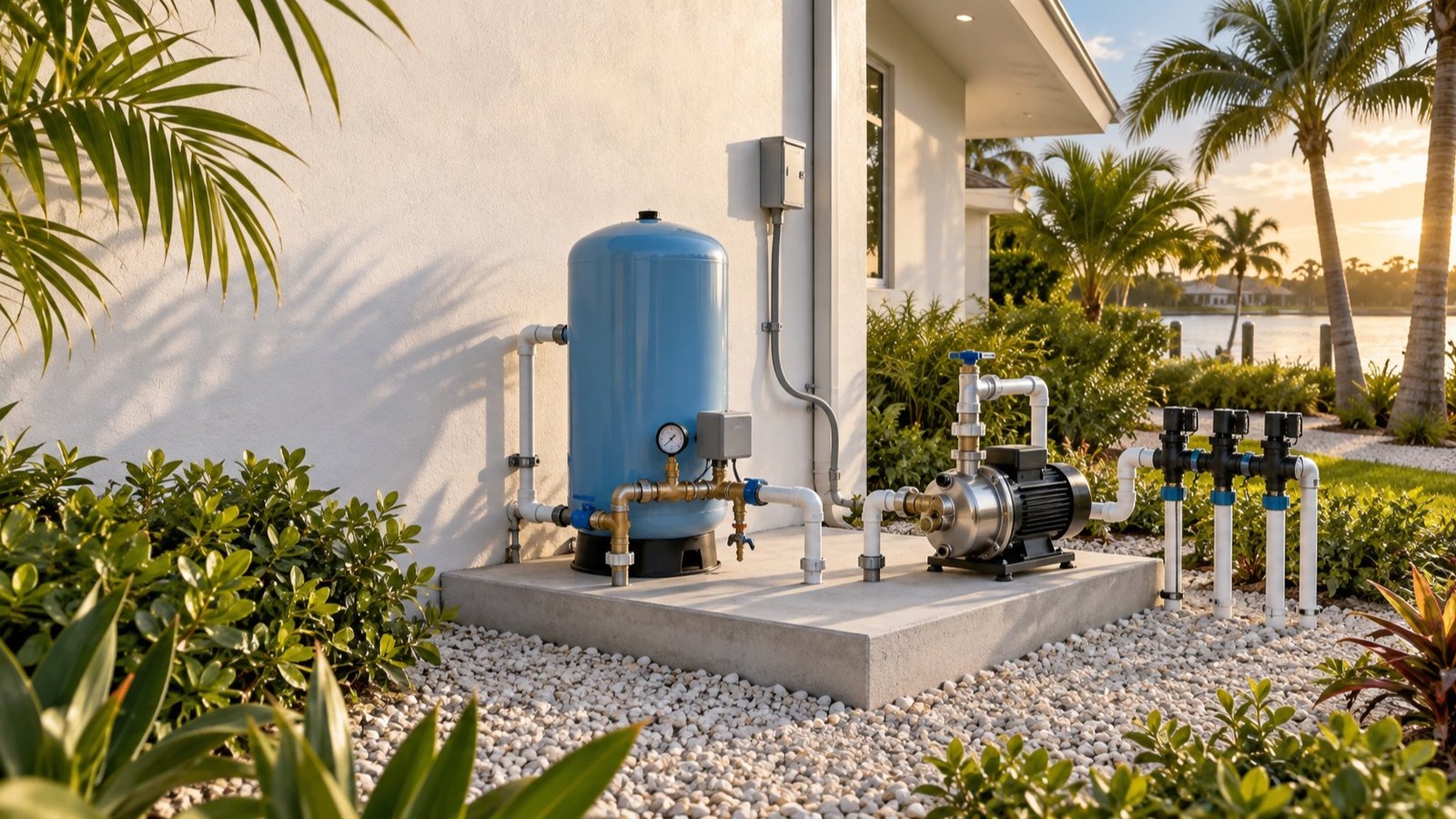
Well-Pressure Tank and Irrigation Pump Sharing One Pad: What Should Palm Bay Sellers Document?
By Carrie Liotta, Space Coast REALTOR® with REAL Broker | Published October 13, 2026
If your Palm Bay home has a well-pressure tank and an irrigation pump on the same concrete pad, document them as two separate systems before you list. Label what each pump serves, trace the visible plumbing and electrical controls, gather permits and service records, photograph the pad, and have a qualified professional explain anything you cannot identify confidently.
The shared pad is not automatically a defect. The real problem is ambiguity. A buyer sees two pumps, several pipes, pressure controls, wiring, and perhaps a water-treatment loop, then wonders whether the house depends on one system, whether the sprinklers can affect household water, and whether a repair would require dismantling everything. A clean seller file turns that visual confusion into a practical maintenance story.
Start with a one-page system map
I would begin with a simple sketch made from verified facts, not guesses. Mark the domestic well head if it is visible, the household well pump or submersible-pump controls, the pressure tank, the main shutoff, the line entering the house, the irrigation pump, its suction source, its discharge toward the sprinkler zones, and every electrical disconnect or breaker that a contractor confirms.
The map does not need to be an engineering drawing. Its job is to answer three buyer questions: Which equipment supplies drinking and household water? Which equipment supplies irrigation? What must be shut off before either system is serviced?
If a pipe disappears underground and no one knows where it goes, label it “destination not independently confirmed” until a pump, well, plumbing, irrigation, or electrical professional traces it. Sellers lose credibility when a neat-looking diagram overstates what anyone actually verified.
Separate the domestic-water story from the irrigation story
A pressure tank usually belongs to the household well system. It stores water under pressure so the pump does not have to start every time someone opens a faucet. An irrigation pump may draw from a different well, canal, pond, or another lawful source and then feed sprinkler zones. Palm Bay properties vary, so the equipment’s appearance alone does not prove the source.
For the domestic side, collect the well-construction or completion record if available, pump and pressure-tank invoices, water-treatment records, water-test reports, service dates, model and serial numbers, and notes about any known loss of pressure or short-cycling. The U.S. Environmental Protection Agency’s private-well guidance emphasizes that private well owners are responsible for maintaining their wells and the safety of their water. That makes a recent, clearly identified water-test report more useful than an old report with no sample location.
For the irrigation side, collect the pump invoice, controller information, zone map, repair history, and any documentation identifying its water source. Run each zone with the seller’s permission before listing or during a professional service call. Note broken heads, dead zones, air in the line, loss of prime, unusual noise, leaks, or a pump that cycles without building useful pressure.
This distinction matters because a buyer should not assume that an irrigation failure means the home will lose water—or that a working sprinkler system proves the domestic well is healthy.
Which records should a Palm Bay seller request?
Build the file in layers. Start with what you already have, then use public records and qualified contractors to fill reasonable gaps.
- Permits and inspection records: Search for well, pump, plumbing, electrical, irrigation, or related work. The City of Palm Bay Building Permits and Inspections portal is the municipal starting point for permit status, approved documents, and inspections. Depending on the address, age, and scope of work, another agency may hold part of the record.
- Well records: The St. Johns River Water Management District well information page is an official starting point for water-well construction and permitting information. Ask for records tied to the property, not merely a nearby parcel with a similar street number.
- Contractor paperwork: Keep proposals, paid invoices, warranties, equipment labels, service notes, and the contractor’s name and license information. Florida’s DBPR license search can help verify credentials for trades regulated by the state.
- Current-condition evidence: Save dated photographs, a video of normal operation, pressure readings taken by the appropriate professional, and a written service report that identifies which system was tested.
Do not panic if an older permit or invoice is missing. Record searches are not always complete, and older equipment may predate the current owner. State exactly what you found, what you did not find, and what a professional verified in the present.
Photograph the shared pad like a future technician will use the photos
Take one wide photo showing the full pad and its clearance from the home, fence, air-conditioning equipment, and landscaping. Then take close photos of pump labels, pressure-tank labels, pressure switch, gauge, valves, unions, electrical disconnects, conduit, piping transitions, hose bibs, treatment equipment, and visible well components.
Include the slab edges and the soil around them. Buyers and inspectors will notice cracking, settlement, standing water, eroded soil, rust staining, vegetation crowding, and pipes under strain. Those conditions do not all mean the same thing, but hiding them under fresh mulch creates more suspicion than a dated photograph and a clear repair invoice.
Photograph the equipment before and after any correction. If a contractor adds pipe supports, replaces corroded fittings, raises a component, improves drainage, labels shutoffs, or separates unsafe wiring, the before-and-after record helps a buyer understand exactly what changed.
What should the seller ask a pump or well professional to verify?
Ask for a written scope that distinguishes the two systems. Useful questions include:
- Which pump serves household water, and which serves irrigation?
- What is the confirmed source for each system?
- Does the domestic pump reach pressure and stop normally, or does it short-cycle?
- Is the pressure tank waterlogged, visibly corroded, leaking, improperly supported, or near a piping conflict?
- Does the irrigation pump prime, run, and shut down normally?
- Are check valves, shutoffs, unions, gauges, and controls accessible for service?
- Can either system be isolated without disabling or draining the other?
- Is water collecting on the pad, and if so, is the source rain, irrigation overspray, a plumbing leak, pressure relief, or treatment discharge?
A technician should answer within the limits of that trade. A pump professional should not casually certify electrical work, and an electrician should not be asked to declare water safe to drink. When multiple trades are needed, keep their reports together and make sure they use the same equipment labels.
If access around the pad is already tight because of a generator, fence, or storage, my guide to generator-slab and well-equipment access in Palm Bay explains why future service clearance belongs in the seller conversation.
Electrical documentation deserves its own page
Two pumps on one pad can look like one electrical system even when they have separate circuits and controls. Photograph the panel schedule, breakers identified by a licensed electrician, disconnects, conduit routes, junction boxes, pressure-switch wiring, and any irrigation controller. Ask the electrician to record breaker size, disconnect condition, grounding or bonding observations within the inspection scope, and any correction completed.
Do not rely on tape labels that say only “pump.” Use clear names such as “domestic well pump” and “irrigation pump” after the circuits have been verified. The listing file should also say whether the irrigation controller is hardwired, plug-connected, or battery-backed and whether a rain sensor is present and functioning.
Open splices, damaged conduit, missing covers, improvised extension cords, and controls exposed to water should be evaluated before listing. These are not cosmetic details. They affect safe operation and can stop a buyer from focusing on the rest of the property.
Inspect the pad, drainage, and service clearance as one system
A shared slab has to support equipment without forcing pipes into awkward bends or trapping water around electrical components. Look for cracks that have displaced equipment, anchors pulling loose, tank feet rusting, pipes bearing the weight of a pump, and valves blocked by walls or landscaping.
Then watch the area during a sprinkler cycle and after rain. If overspray keeps the pressure switch wet, roof runoff pounds one corner, or treatment discharge crosses the pad, document the cause and correction. A clean pad on a dry showing day does not answer how the area behaves during normal use.
Think about replacement access too. Can a technician remove the pressure tank or irrigation pump without cutting unrelated pipes, moving an air conditioner, or dismantling a fence? If the answer is unclear, get a written opinion and estimate before deciding whether to reconfigure the pad or price with that future work in mind.
Should you repair, separate, or simply disclose?
Sharing one pad alone is not a reason to rebuild the systems. I would consider correction before listing when there is an active leak, unsafe or exposed wiring, unstable equipment, damaged piping, chronic standing water, unidentified cross-connection concern, failed pump, or no practical service access. Those conditions create immediate uncertainty that paperwork cannot solve.
I would be less likely to recommend moving working equipment merely to make the pad look simpler when licensed professionals can identify both systems, each can be isolated and serviced, drainage is controlled, and the permits and current condition are documented.
Sometimes the practical answer is a repair and labels. Sometimes it is a larger re-pipe or separate base. Sometimes the seller chooses condition-based pricing and provides estimates. If the domestic well and drainfield are also competing for attention, this article on prioritizing a well-pump or drainfield replacement can help frame the bigger decision.
Create a buyer-ready handoff packet
Put the sketch first, followed by a photo index, permits, well records, contractor reports, invoices, warranties, water-test documents, irrigation-zone notes, electrical documentation, and estimates for any deferred work. Add a short timeline: installation dates if documented, service dates, repairs, and current operating observations.
Keep claims narrow. Say “irrigation pump operated all six zones during service on October 5” rather than “irrigation works perfectly.” Say “sample collected from the kitchen tap on this date” rather than “the entire system is certified.” If treatment equipment is involved, my guide to water-treatment documentation for Palm Bay well homes explains why buyers need to know what each component actually treats.
Bottom line for Palm Bay sellers
A well-pressure tank and irrigation pump can share one pad without becoming a sale problem. The risk is letting two systems appear to be one undocumented mystery.
Before listing, identify each system, verify its source and controls, gather the public and private records, document current operation, correct active safety or water problems, and give the buyer a truthful map of what is known. That preparation helps inspectors ask better questions, contractors price the right work, and buyers separate normal maintenance from real defects.
If you are preparing to sell a Palm Bay home with well, irrigation, septic, drainage, or other property-specific equipment, I can help you organize the pre-listing questions and position the home honestly. I’m Carrie Liotta, a Space Coast REALTOR® with REAL Broker, and 321 Coastal Living is where I share practical Brevard County guidance. Reach out for a no-pressure conversation about your sale.
