

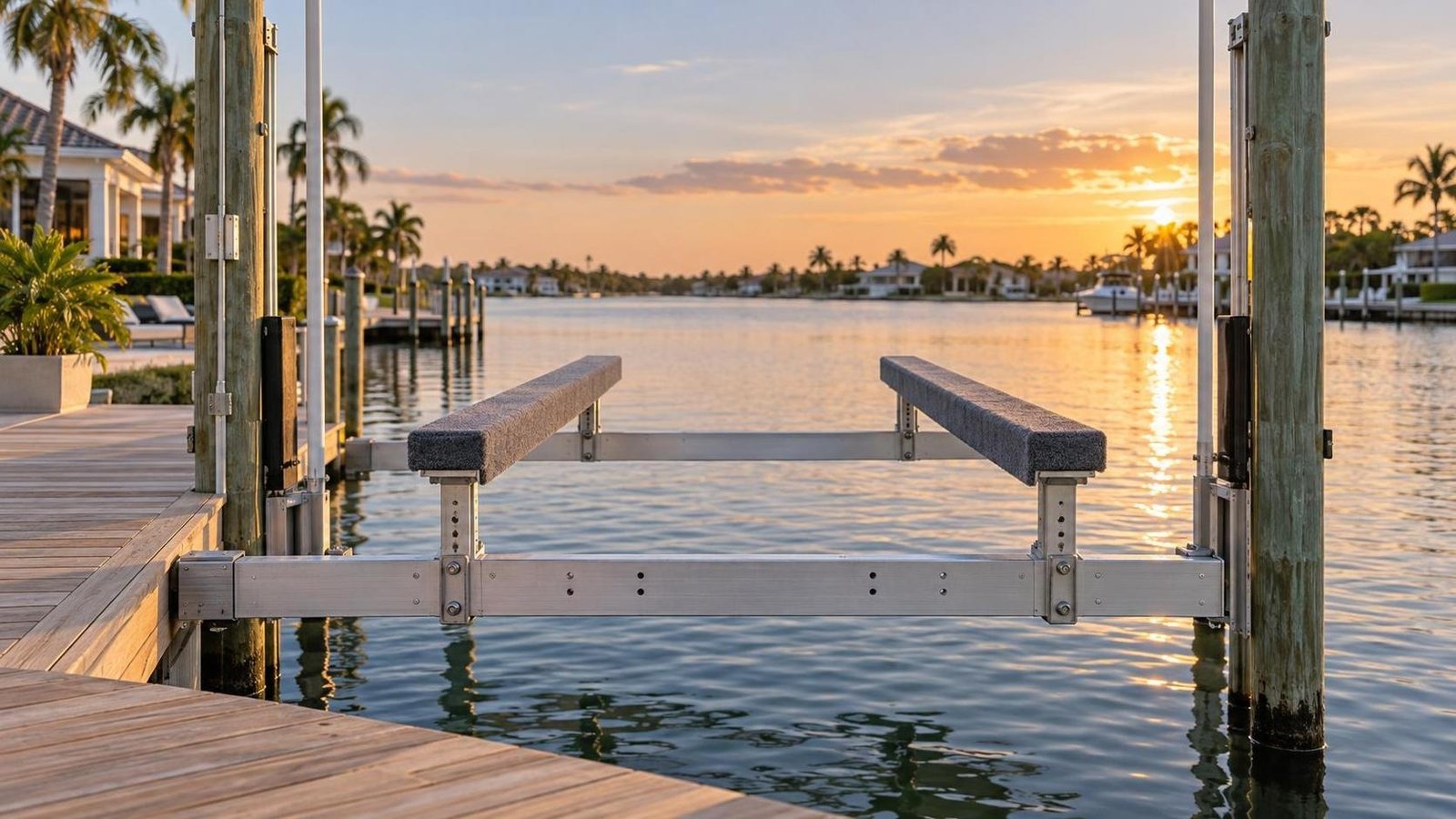
Boat-Lift Bunks Reconfigured for a Different Hull: What Should Merritt Island Sellers Document?
By Carrie Liotta, Space Coast REALTOR® with REAL Broker | Published October 9, 2026
If boat-lift bunks were raised, narrowed, widened, or otherwise reconfigured for a different hull, a Merritt Island seller should document the old and current setup, the vessel the change was designed for, who performed the work, and how the complete lift was evaluated afterward. A successful lift cycle alone does not prove correct hull support.
This is a small-looking change that can create a large inspection question. Buyers see fresh carpet and clean brackets and may assume the lift was upgraded. A marine technician may see unused holes, stacked risers, shifted hardware, or a support pattern that needs to be matched to one specific boat. The right seller file turns that visual puzzle into a factual history.
Start with the reason the bunks changed
I would begin with a one-page timeline. Identify the approximate date of the change, the boat used before it, the boat used after it, and the problem the reconfiguration was intended to solve. Perhaps the owner moved from a shallow-V boat to a deeper-V hull, replaced a pontoon with a center console, needed more clearance for a strake or transducer, or changed the resting height to improve entry at ordinary water levels.
Do not turn that timeline into a technical certification. A seller can accurately say, “The bunks were repositioned in May 2024 when we purchased this boat,” without promising that the configuration is appropriate for every future vessel. If the reason is unknown, say that. “Previous owner’s modification; no invoice located” is more useful than a confident guess.
Photographs are especially valuable. Gather images from before the work, during the adjustment, with the current boat resting normally, and with the empty cradle visible. If an installer marked measurements or supplied a sketch, preserve it. A buyer’s technician can compare that evidence with the lift that is actually present rather than trying to reconstruct the change from faded holes and different-looking fasteners.
Match every record to a physical component
The property file should identify the lift manufacturer, model, serial number, stated rated capacity, cradle type, beams, bunk material, riser or pivot brackets, guides, cables or straps, motors, controls, and any limit equipment. Then match the invoice to the components it actually covers.
An invoice for “bunk adjustment” does not establish that the contractor reviewed capacity, cables, electrical equipment, piling alignment, or the buyer’s proposed boat. Ask whether the scope included only moving the boards, replacing carpet, adding risers, changing brackets, correcting hardware, or evaluating the lift as a system. If the contractor issued observations or limitations, keep those pages with the invoice rather than advertising only the favorable first line.
Manufacturer information reinforces why model identity matters. Hi-Tide’s current boat-lift accessory catalog lists adjustable-height pivoting chock brackets, bunk riser brackets, tunnel-hull brackets, keel pads, and flare guides as different components serving different functions. That does not prove a Hi-Tide part belongs on the subject lift. It shows why “the bunks were raised” is not a complete description.
Record the boat, not just the lift
A useful file identifies the vessel the current configuration supported: manufacturer, model, year, hull type, length, beam, engines, and a defensible loaded-weight estimate. Include the boat manufacturer’s specification sheet if available, while recognizing that fuel, batteries, water, gear, electronics, towers, and other equipment can change actual weight and balance.
Hi-Tide’s lift-selection questionnaire asks for boat and dock information before making a recommendation. Golden Boat Lifts’ current selector asks about water type, depth, watercraft type, fully loaded weight, and vessel length. Those manufacturer tools are not a property inspection, but they illustrate a practical point: a lift match depends on more than the number printed on a motor or an old listing.
For the same reason, avoid saying, “It held our boat, so it will hold yours.” The buyer may own a catamaran, pontoon, stepped hull, deep-V, or center console with different support points and underwater appendages. Even two boats with similar published weight can have different beam, balance, strakes, chines, transducers, drives, or loading positions.
If the current boat will be present during due diligence, let the appropriate professionals decide whether and how to observe it. No buyer should crawl beneath a suspended boat, stand in the cradle path, move brackets, or treat a showing as a load test.
Have a marine professional explain the current configuration
The strongest pre-listing record is a dated written evaluation from an appropriately qualified marine professional who can identify what was inspected and what was not. I would ask for a simple diagram or labeled photographs showing bunk spacing, height, bracket type, fastener locations, contact areas, cradle travel, and any visible evidence of the prior configuration.
The professional should also note whether the empty cradle travels normally, whether the bunks and guides interfere with cables, beams, dock edges, ladders, motors, limit equipment, or boarding paths, and whether the present setup has visible movement, corrosion, deformation, loose hardware, split lumber, worn covering, or improvised spacers. That report should not promise compatibility with an unknown future boat.
Installation quality matters as much as the hardware list. Hi-Tide’s discussion of boat-lift installation and assessment stresses professional installation and recommends qualified assessment after rough weather. The manufacturer’s advice is specific to its products and dealer network, but the broader seller lesson is sound: preserve the identity and qualifications of the person who evaluated the change.
Florida’s official DBPR license search can help verify state-regulated license information when the represented scope requires it. A search result does not certify this installation, and marine, structural, and electrical scopes should not be blurred together. Match each contractor’s role to the work shown on the invoice.
Do not let the bunk question hide the rest of the lift
Reconfigured bunks may be the visible clue, but the seller should review the whole waterfront file. The buyer will still want the lift’s installation and service history, capacity documentation, cable or strap condition, motors, gearboxes, controls, disconnect, electrical work, piling or support condition, dock relationship, and permit records where applicable.
This is why my comparison of documented dock electrical work versus a newer boat-lift motor warns against treating one recent component as a new lift. Bunks can be new while the controls, cables, structure, or electrical installation remain older.
Also trace any related change. Were limit settings adjusted after the bunks were raised? Was a guide post moved? Did a taller resting position reduce canopy clearance? Did the new hull require a different loading position? My guide to a boat-lift limit switch and canopy motor sharing one control box explains why operating relationships need their own verification.
Separate maintenance from work that may need approval
A seller should not make a universal permit claim about a bunk adjustment. The answer can depend on the work, location, jurisdiction, lift design, structural changes, electrical scope, and whether a larger dock or lift project occurred at the same time. Search the property’s permit history, ask the applicable authority about the actual scope, and preserve any written answer.
Florida DEP explains that the state’s Environmental Resource Permitting program covers activities involving surface-water alteration, dredging, filling, and certain docking facilities and attendant structures. Its ERP coordination page also explains that DEP and water-management districts divide application processing. That does not mean moving bunks automatically requires a state permit. It means a seller should not use a small component change to make broad claims that the entire dock or lift is approved.
If the records are incomplete, keep the marketing narrow. State that the lift is present, provide documented manufacturer and service facts, disclose the known modification, and invite buyers to verify suitability for their vessel. Do not advertise an unsupported capacity, “fits any boat,” or “fully permitted” merely because one old permit appears in a search.
Decide whether to correct, document, or price around the uncertainty
Some sellers should address the setup before listing. I would pause for professional review when brackets appear improvised, multiple spacer layers are unexplained, hardware is loose or mismatched, support surfaces are damaged, the boat rests unevenly, parts interfere during travel, the lift has not been used recently, or no one can identify who changed it.
Other sellers may be better served by documentation rather than another adjustment. If a qualified professional can explain the current configuration, records match the installation, and the seller’s boat has a clear history with the setup, changing the bunks again for an imaginary future buyer may waste money. The next owner may have a completely different vessel and need a different professional plan.
Ask for written scopes when corrective work is recommended. One proposal may cover carpet and lumber; another may require brackets, beams, guides, cables, electrical coordination, or a different lift. A universal online price will not capture those differences. Keep quotes current enough to inform the listing strategy, but do not present an estimate as a guaranteed buyer cost.
The larger seller strategy is similar to preparing all boat-lift service records before pricing a Merritt Island canal home: reduce uncertainty without overstating condition. Good evidence can preserve confidence. Missing evidence should become a disclosed due-diligence item, not a story invented for the listing.
The seller file I would build before photography
- Lift manufacturer, model, serial number, and documented rated capacity.
- Current boat specifications and a note explaining why the bunks changed.
- Before, during, and after photographs with dates when available.
- Invoices identifying bunks, brackets, risers, fasteners, guides, and labor.
- Installer or technician name, qualifications, and written scope.
- A current evaluation with labeled measurements and stated limitations.
- Lift, dock, electrical, and relevant permit records gathered by jurisdiction.
- Service history for motors, controls, cables or straps, and limit equipment.
- Any current repair proposal, with unresolved questions clearly separated.
That file gives a serious boating buyer a clean starting point. It does not replace the buyer’s inspection or promise that the buyer’s boat will fit. It shows that the seller understands what changed and is not asking the buyer to price a waterfront mystery.
Bottom line for Merritt Island sellers
Raised or narrowed bunks are not automatically a defect, and a prior reconfiguration does not automatically mean the lift is unsafe. The risk comes from an unexplained change being marketed as universal boat compatibility.
If you are preparing to sell a Merritt Island canal home, I can help organize the property story, identify which waterfront records buyers are likely to request, and coordinate the real estate timeline with the right marine, electrical, and permitting questions. Reach out for a no-pressure conversation about selling your Brevard County home with REAL Broker. Your next chapter starts here.
