

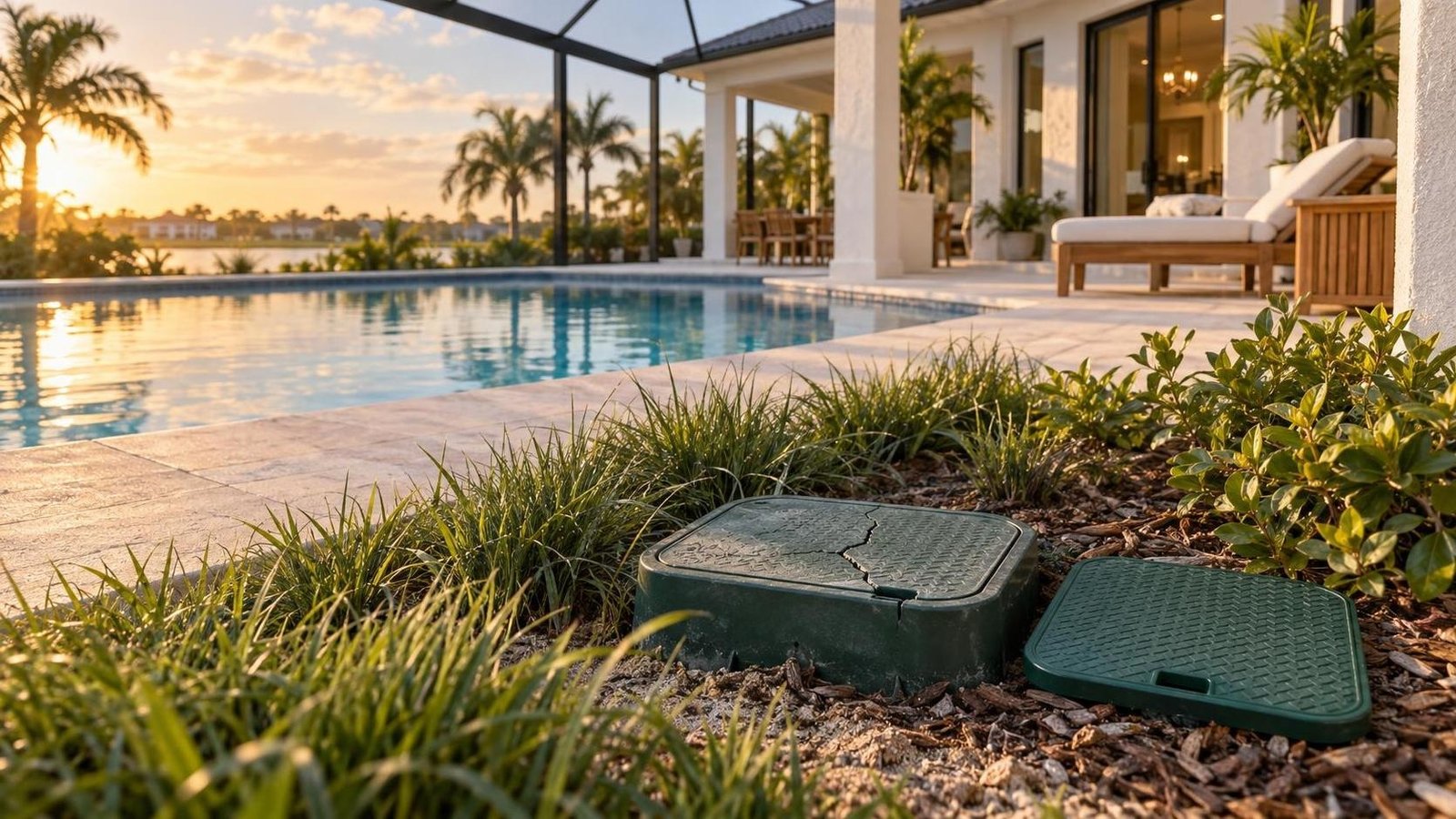
Cracked Pool-Autofill Valve-Box Lid: Should Viera Sellers Repair It Before Listing?
By Carrie Liotta, Space Coast REALTOR® with REAL Broker | Published October 8, 2026
Yes. I would usually replace a cracked pool-autofill valve-box lid before listing a Viera home, even when the backflow and irrigation records are current. First confirm that the damage stops at the cover. The repair should leave the correct valve accessible, protect the box, and document the small fix without overstating what it proves.
This is not a reason to turn a simple cover into a major plumbing project. It is a reason to remove an avoidable question. A buyer walking a pool deck or landscaped side yard sees a broken lid and wonders whether someone stepped through it, whether lawn equipment struck the box, whether water and soil have reached the valve, and whether the seller has ignored other pool details. Current records help, but they do not make a physically damaged cover disappear.
Why repair a small lid when the important records are already current?
A valve-box cover has a modest job: close the opening while preserving access to the components below. When it is cracked, it no longer does either job confidently. The damaged section may flex, shift, or leave an edge that catches a shoe. Mulch, sand, clippings, irrigation runoff, insects, or small roots may enter around the break. A buyer’s inspector may reasonably ask what is under the lid and whether the damage extends farther than it appears.
Addressing the lid before photography lets the seller identify the component, inspect the enclosure, fit the correct replacement, and save the evidence. Left for the inspection period, the same item can arrive with a recommendation for further evaluation and very little time to define the scope.
I use the same principle with larger systems: solve the known issue and preserve the evidence. My guide to pre-listing roof, HVAC, and irrigation service for Viera sellers explains why documentation helps an established resale compete with newer inventory. A visible neglected detail can create uncertainty beyond its actual cost.
First confirm what is actually cracked
Before ordering a replacement, have the box opened safely and identify what you are looking at. Sellers often use “autofill box” as a convenient name for any enclosure near the pool. It may contain a manual shutoff, a float-valve service connection, irrigation valves, a pressure regulator, wiring for a separate control, or more than one component. The visible lid does not prove the route or purpose of every pipe below it.
I would document four separate conditions:
- The removable lid: Is only the cover cracked, or are the rim, locking tabs, fastener points, or frame damaged too?
- The enclosure: Is the box upright and supported, or has surrounding soil, paver work, root growth, or equipment impact distorted it?
- The component: Is the valve dry, stable, identifiable, and reachable without pulling on piping or digging through packed debris?
- The surrounding grade: Will a correctly fitted lid sit flush and remain visible, or is the box buried, exposed above grade, or located in a walking path?
If the answer is truly “only the removable cover is cracked,” this may remain a focused maintenance item. Match the enclosure rather than forcing on a lid that is merely close in diameter or shape. A loose replacement that rocks, drops into the opening, or sits proud of the grade has not solved the practical problem.
If the rim is split, the box has settled, the piping is under stress, or the valve is leaking, stop treating it as a lid-only repair. That is the point to involve the appropriate pool, irrigation, plumbing, or backflow professional. The seller does not need to diagnose concealed plumbing, but the listing file should distinguish a fitted cover replacement from a wider system correction.
Open the box before closing it
The best time to inspect the enclosure is while the old lid is off. Do not simply drop a new cover over packed soil or standing water and call the issue complete. Photograph the box from above before cleaning, remove loose debris without pulling on unknown lines, and look for obvious moisture, cracked fittings, displaced valve handles, corrosion, pest activity, or roots pressing on the assembly.
Water after irrigation or heavy rain does not, by itself, prove a plumbing leak, and one dry afternoon proves little. If moisture is present, a qualified professional can distinguish surface drainage or overspray from an active fitting. Do not hide useful evidence beneath a new lid.
Keep the box visible and reachable rather than burying it under décor or mulch. If pavers or landscape edging caused the old lid to crack or prevent the new one from seating, correct that contact instead of trimming the replacement.
Current records are valuable, but they answer a different question
A current backflow test, pool-service record, irrigation invoice, or permit file can show what was inspected or serviced on a particular date. It does not establish that a lid damaged later is harmless, and a new lid does not extend or replace the underlying record. Keep those two stories separate.
For the repair, save the date, before-and-after photographs, an open-box view, and the product or contractor invoice. Keep the existing backflow, irrigation, pool-autofill, permit, and service records under their original dates.
The official Florida cross-connection-control rule for public water systems, effective May 5, 2014 and current when I reviewed it on October 8, 2026, requires community water systems to maintain written programs addressing required backflow protection, testing or inspection, maintenance, and records. The exact device and responsibility depend on the premises and serving utility. That is why I would not describe a plastic-lid replacement as a “backflow certification” or a system approval.
Do not let the lid repair blur the water-source question
Some Viera properties have reclaimed irrigation nearby; others have a different irrigation source or arrangement. Never assume a purple component, one valve cluster, or a seller’s memory identifies the source that supplies the pool autofill. The pool fill route and the irrigation route should be traceable as separate facts.
The current Florida reclaimed-water distribution and cross-connection rule, effective April 1, 2021 and reviewed October 8, 2026, says reclaimed water cannot be used to fill swimming pools and prohibits cross-connections to potable systems. It also addresses identification of reclaimed-water valves and outlets. The Florida Department of Environmental Protection’s Water Reuse Program overview, last modified September 10, 2024, explains that reclaimed water is highly treated domestic wastewater used for a beneficial new purpose and points to Chapter 62-610 as Florida’s comprehensive reuse rule.
Those rules matter when reclaimed service is present, but a listing photograph cannot identify this enclosure’s contents. Preserve records that trace the pool-autofill supply, backflow protection, and irrigation route. If they do not, use the open-box repair as a prompt for professional tracing rather than repeating an assumption.
I developed that larger distinction in my Viera seller guide to reclaimed irrigation, pool autofill, and backflow documentation. For this listing decision, the narrow point is simple: repair the damaged enclosure, but do not rewrite the system’s history.
Who should replace it?
Bring in a pool or irrigation professional when the valve function is uncertain, the autofill does not stop reliably, the box repeatedly fills with water, or the piping appears loose or stressed. Involve a licensed plumber or appropriately qualified backflow professional when the water source, cross-connection protection, or required device is unclear. Ask the serving utility or authority having jurisdiction when testing, device, or approval questions remain. The official 2023 Florida Building Code, Plumbing, Chapter 6 is the current statewide code reference for water-supply, cross-connection, and backflow provisions, but application to one property should come from the responsible professional and authority—not a seller’s interpretation of a cover.
If the inspection uncovers altered piping or work with an uncertain permit history, start with the Brevard County building permit search for a property in county jurisdiction. A particular Viera address may also involve a municipality, utility, community association, or other record source. A replacement lid by itself may be maintenance; changing plumbing, a backflow assembly, a pool-fill route, or hardscape access can be a different scope. Verify before representing the work.
What should go into the seller file?
I would keep this page of the property file short and factual:
- a dated “before” photo that shows the crack and the full enclosure location;
- an open-box photo showing the visible component without claiming what cannot be traced;
- the replacement-lid receipt or contractor invoice, including product size or model when available;
- a dated “after” photo showing the cover seated and the access area clear;
- any service note for leak, valve, box, grade, or piping work found during the visit; and
- the separate current backflow, irrigation, pool, and permit records already maintained for the property.
Use narrow language. “Cracked valve-box lid replaced October 2026; enclosure visually checked and access cleared” is supportable if that is what occurred. “Pool plumbing fully certified” is not supportable unless the right professional performed and documented that larger evaluation. If the contractor replaced the entire box or repaired a valve, state that separately.
Check that the pool plan, water-source record, irrigation file, backflow documents, and visible component names tell one consistent story. If prior paver work changed access, include that record. My article on organizing pool, outdoor-kitchen, and generator permits before selling in Viera shows how to keep related approvals from becoming one confusing stack.
How this changes the buyer conversation
A clean repair lets the seller answer the visible question immediately: the cracked cover was replaced, the box was opened, the accessible condition was documented, and the existing system records are available. It does not prevent a buyer from inspecting the pool, irrigation, plumbing, or backflow protection, nor should it. It simply keeps a known maintenance item from carrying more uncertainty than it deserves.
If the seller leaves the crack, disclose the known condition accurately and keep it visible. Expect questions about the box and system evaluation. A contract can address inspection, repair, credit, or another solution, but a verified lid-only condition is usually cleaner to replace before listing than to negotiate under deadline.
My pre-listing recommendation for Viera sellers
Replace the cracked lid, but earn the simple answer. Confirm that the cover is the only damaged part. Check the enclosure before closing it. Match the new lid correctly, keep it flush and accessible, save the before-and-after evidence, and retain the current backflow and irrigation records under their own dates.
If the box reveals a leak, distorted enclosure, unclear valve, buried access, or uncertain water route, expand the evaluation before the home reaches the market. That is not overreacting; it is defining the real scope while the seller still controls the schedule.
I help Viera sellers separate small maintenance from larger due diligence so buyers receive a clear, accurate property story. Reach out for a no-pressure conversation about preparing your Brevard County home for sale with REAL Broker, or join my private Facebook group, Moving to Brevard County Florida. Your next chapter starts here.
