

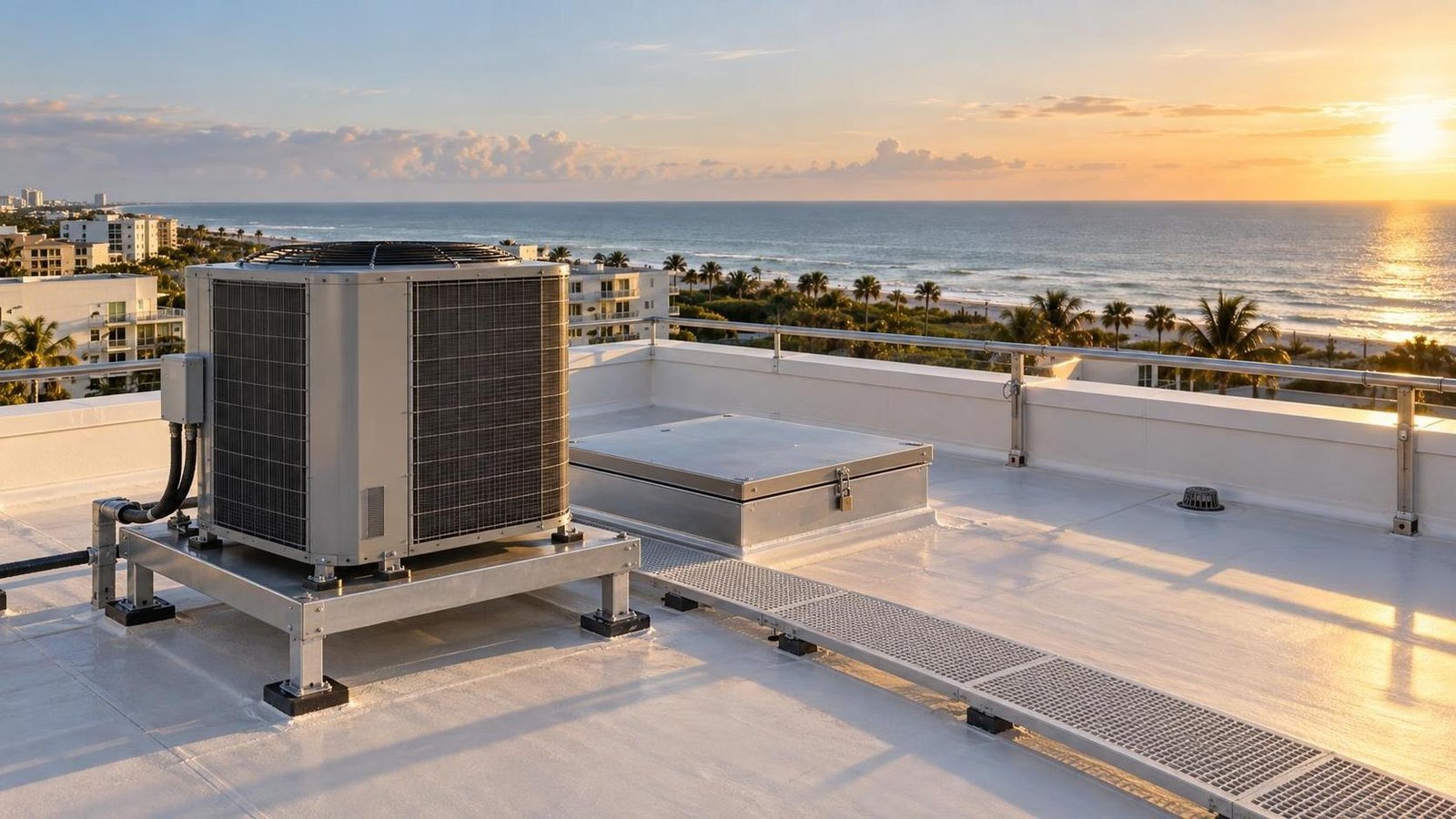
Rooftop HVAC Condenser Behind a Locked Roof Hatch: What Should Cape Canaveral Condo Buyers Verify?
By Carrie Liotta, Space Coast REALTOR® with REAL Broker | Published October 7, 2026
If your Cape Canaveral condo’s HVAC condenser sits behind a locked common-area roof hatch, verify who owns each component, who pays for it, how authorized contractors obtain routine and emergency access, and what roof, permit, warranty, and service records apply. A working air conditioner today does not prove that future service will be simple.
I would treat the condenser and the route to it as one purchase decision. The equipment may serve only your unit while sitting on a roof maintained by the association. That split can work perfectly well, but only when the condominium documents, management procedure, contractor requirements, and physical service path tell the same story.
Begin with responsibility, not the hatch key
The first question is not, “Will management give me a key?” It is, “What does the declaration say I own and maintain?” Ask for the declaration and amendments, equipment schedules or exhibits, current rules, maintenance standards, and any written policy covering rooftop HVAC work. Then identify the condenser, interior air handler, refrigerant lines, electrical disconnect, supports, roof curb or stand, penetrations, drain components, and controls separately.
Florida’s condominium definitions in Florida Statutes section 718.103 distinguish a unit, common elements, and limited common elements. A limited common element can be reserved to one unit even though it is not simply part of that unit. That is why a condenser serving one apartment is not enough evidence, by itself, to decide legal ownership or maintenance responsibility.
Section 718.113 states that the association maintains common elements except when the declaration assigns maintenance of a limited common element to the unit owner. It also allows the declaration to address whether the association performs that maintenance as a common expense or allocates the cost to the owners entitled to use the component. In practical terms, two Cape Canaveral buildings can handle similar-looking rooftop systems differently.
Map the entire service route
A locked hatch may protect residents, contractors, the roof membrane, and the association’s insurance procedures. The lock itself is not the problem. The problem is an access process that is vague, slow, unavailable after hours, or impossible for the contractor who must bring tools and replacement equipment to the roof.
Walk the route with permission. Start where a technician would enter the property. Is contractor parking available? Does the technician check in with management, obtain an escort, use a service elevator, cross a mechanical room, climb a fixed ladder, or bring a portable ladder? Can tools and recovery equipment fit? Is roof access prohibited during rain, high wind, construction, or certain hours? Who secures the hatch afterward?
Ask for the answers in writing:
- Who may request roof access: the owner, an association-approved vendor, or any properly qualified contractor?
- How much notice is required for ordinary service?
- What number is used when the system fails after hours or while management is away?
- Must a manager, board member, maintenance employee, or roof contractor be present?
- Which licenses, insurance certificates, waivers, protective materials, or deposits must the vendor provide?
- Are there access, escort, roof-protection, or administrative charges?
- Can a crane or lifting company stage on the property when replacement is needed?
This is the same due-diligence principle I use when a Cape Canaveral unit water shutoff sits inside a locked common closet. A shared-space restriction can be reasonable. The buyer still needs a dependable process for reaching a unit-serving component before a small failure becomes an expensive delay.
Confirm that the rooftop unit is actually yours
Rooftop equipment can be difficult to identify from inside the apartment. Request the condenser manufacturer, model number, serial number, installation date, permit record, paid invoice, warranty, and service history. Match those records to a durable unit label on the equipment and to the interior air handler or other paired components. An old handwritten apartment number is a clue, not complete proof.
Have a qualified HVAC contractor evaluate the system within the inspection period and explain what can and cannot be confirmed. The contractor should assess operation, equipment matching, visible corrosion, coil condition, electrical components, refrigerant-line condition, supports, clearances, disconnect location, vibration, and the serviceability of the installation within the contractor’s scope. A home inspector can flag concerns, but the locked hatch cannot become an excuse to skip specialist access entirely.
The U.S. Environmental Protection Agency explains in its Section 608 technician-certification requirements that technicians performing covered refrigerant service must hold the applicable certification. That federal credential does not replace state or local licensing, condominium approval, permits, fall-protection procedures, or the building’s vendor-insurance rules. Ask the contractor and association to satisfy all applicable layers rather than treating one card as permission for everything.
Read the roof file beside the HVAC file
A condenser can operate well while the installation around it creates future questions. Ask for roof warranty terms, roof replacement records, leak history near the equipment, photographs from the last project, recent roof inspection reports available to owners, and meeting minutes discussing rooftop equipment. Determine whether the condenser was removed and reinstalled during roof work, left in place on an approved support, or replaced afterward.
Then ask who coordinates future work. A condenser replacement may involve more than an HVAC proposal if the stand, electrical feed, roof flashing, line penetration, protective walkway, or lifting plan changes. The association may require its roofer to protect or inspect the membrane before and after another contractor works above it. That coordination can preserve a warranty and prevent a dispute over the source of a later leak.
My guide to reviewing Cape Canaveral reserve studies and roof warranties explains why a completed roof project is only as reassuring as the records behind it. Here, the buyer also needs to know whether the unit’s mechanical equipment can be serviced without compromising that roof story.
Service records should show more than a cold vent
Request several years of invoices if they exist, not just the most recent tune-up receipt. I want to see whether technicians have repeatedly reported refrigerant loss, electrical failures, restricted airflow, coil deterioration, drainage problems, noise, or difficulty obtaining roof access. Also ask whether any service appointment was delayed, canceled, or charged differently because management or an escort was unavailable.
ENERGY STAR’s heating and cooling maintenance checklist recommends annual pre-season professional checkups and identifies condenser-coil cleaning, electrical checks, refrigerant review, controls, and condensate drainage among typical maintenance items. In a coastal condominium, access has to support that work. A maintenance plan is not useful if the contractor can inspect only the indoor equipment.
It also helps to review the indoor side with the outdoor side. My article about a condo condensate riser accessed through an owner closet shows how a unit system and shared building infrastructure can create reciprocal access responsibilities. Cooling performance, drainage, refrigerant lines, electrical service, and building access should be evaluated together.
Build the replacement plan before you need it
A buyer does not need to replace a working condenser merely because it sits on the roof. The buyer does need to know whether replacement is physically, administratively, and financially workable. Ask an appropriate contractor for a property-specific budget or planning opinion rather than applying a generic online price to a coastal rooftop installation.
The scope may include matched equipment, electrical work, refrigerant-line work, controls, permit fees, crane or lifting service, roof protection, association review, contractor insurance, after-hours limitations, disposal, and repair of supports or penetrations. Some items may be the owner’s expense, some the association’s, and some recoverable only after the documents and cause of work are reviewed. Do not put one round number in the reserve budget until responsibility is clear.
Ask whether the building limits equipment dimensions, weight, sound, efficiency configuration, refrigerant-line routing, curb or stand design, or visible exterior appearance. Confirm whether current replacement models can reach the existing location and fit the approved support. If several owners expect replacements soon, review meeting minutes for crane scheduling, roof-access congestion, group projects, or proposed standards.
Use the inspection period to test the process
I would organize the due diligence in this order:
- Read the declaration and amendments to identify the unit boundaries, common elements, limited common elements, and assigned maintenance costs.
- Obtain the association’s written roof-access and vendor procedure, including emergency contacts and charges.
- Match the rooftop condenser to the unit with model, serial, permit, invoice, warranty, and equipment-pairing information.
- Arrange authorized access for a qualified HVAC evaluation before the inspection deadline.
- Review the roof warranty, project history, leak records, rooftop rules, and any required roofing coordination.
- Request a realistic repair or replacement scope that includes access and lifting logistics.
- Ask management how the same process worked on a recent comparable project, without requesting another owner’s private information.
This sequence turns a vague concern into specific facts. If management will not permit inspection during the buyer’s contract window, ask why and document the response. The buyer may need a different contractor, more time, a seller-provided professional report, a negotiated term, or legal guidance about the contract. What the buyer should not do is assume the system is acceptable because cool air came from the register during a short showing.
When the arrangement is reasonable—and when to slow down
I am comfortable with a locked rooftop installation when responsibility is clear, the equipment is accurately labeled, qualified contractors can obtain predictable access, emergency procedures exist, the roof warranty and HVAC process work together, and the buyer can budget for maintenance and replacement. Controlled access can be a sign that the association protects a sensitive common area rather than allowing untracked foot traffic.
I would slow down when the seller and manager give different responsibility answers, no one can match the condenser to the unit, access depends on one volunteer with no backup, contractors have been denied or repeatedly delayed, the roof warranty requirements are unknown, equipment supports or penetrations are disputed, or replacement logistics have never been considered. One uncertainty may be solvable. Several unresolved layers can turn a routine AC failure into a board, roofer, contractor, and owner conflict during the hottest week of the year.
The negotiation should follow the evidence. Possible paths include seller-provided records, specialist access, repair by the responsible party, an association letter explaining procedure, a contractor proposal, condition-based pricing, an allowable credit, or a decision not to proceed under an available contract right. The goal is not to demand a roof key. It is to buy a unit with an HVAC system you can legally, safely, and practically maintain.
Bottom line
A rooftop condenser behind a locked common-area hatch is not automatically a negative. It becomes a buying risk when ownership, maintenance cost, access, equipment identity, roof coordination, and replacement logistics remain unclear. Verify all six before the inspection period ends, and keep the written answers with the unit’s records for your own ownership and eventual resale.
If you are comparing Cape Canaveral condos and need help organizing the association documents, service-access questions, and coastal ownership costs, reach out to Carrie Liotta, Space Coast REALTOR® with REAL Broker, for a no-pressure conversation. You can also join my private Facebook group, Moving to Brevard County Florida. Your next chapter starts here.
