

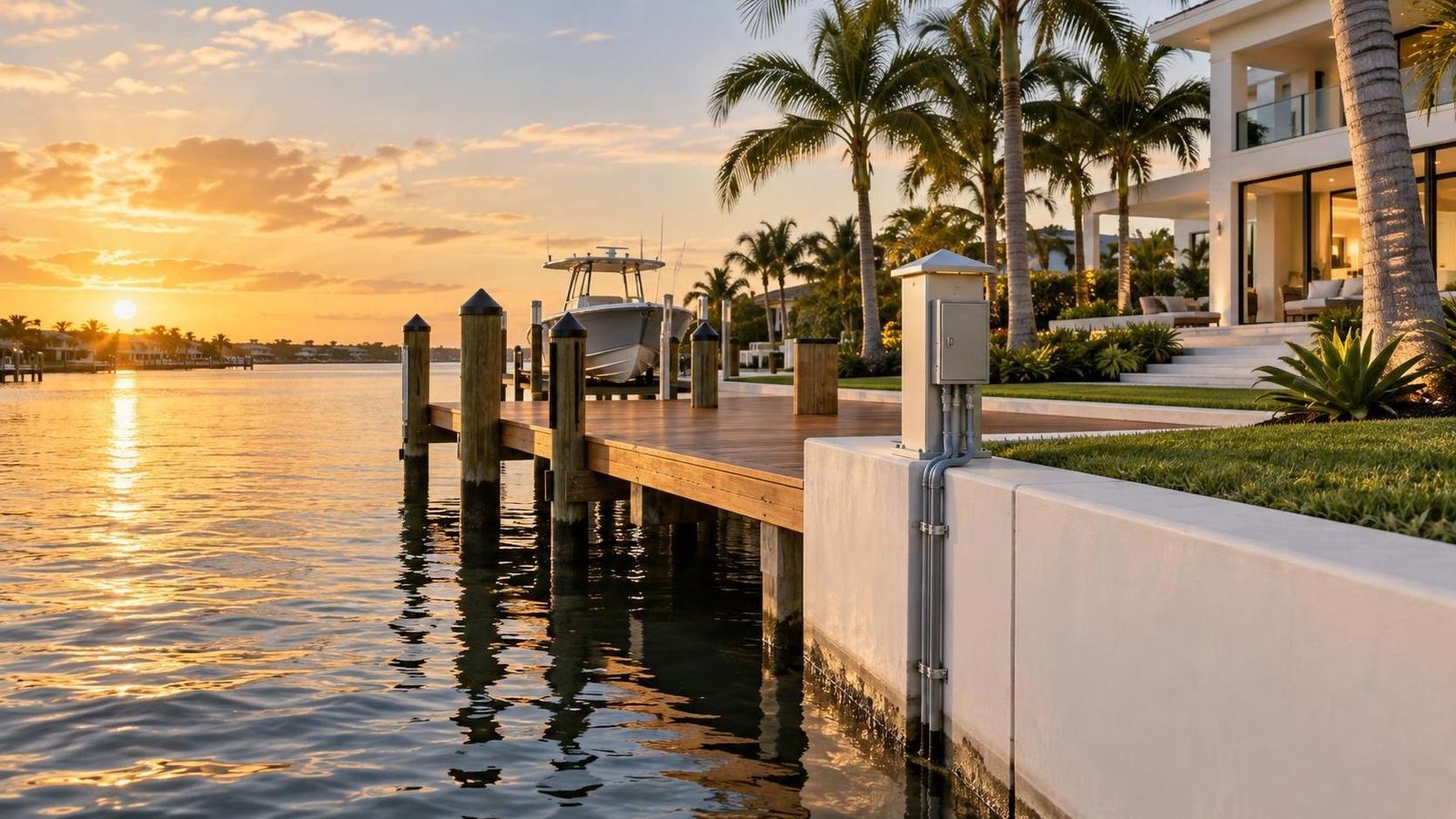
Dock-Power Conduit Crossing a Seawall Expansion Joint: What Should Merritt Island Buyers Verify?
By Carrie Liotta, Space Coast REALTOR® with REAL Broker | Published October 6, 2026
If dock-power conduit crosses a seawall expansion joint, I want a Merritt Island buyer to confirm what the joint is designed to do, how the raceway accommodates movement, whether the installation is permitted and serviceable, and what correction would require. The crossing is not automatically defective, but rigid conduit should never be accepted on appearance alone.
This is a narrow detail with a surprisingly wide reach. The conduit may feed a lift, receptacles, lighting, or a shore-power pedestal. The joint may separate wall panels, mark a construction transition, or sit beside a repaired crack that only looks like a joint. A tidy patch can hide the exact information the buyer needs: where movement occurs, which component takes that movement, and whether electrical and marine contractors are evaluating the same condition.
I would not ask a general home inspector to declare the assembly safe from one photograph. I would use the inspection period to identify the wall feature, trace the entire electrical route, and obtain coordinated written opinions from the appropriate professionals.
First, establish whether this is truly an expansion joint
Do not begin by naming a fitting or prescribing a repair. Begin by identifying the wall. Ask for original seawall drawings, panel or cap details, repair proposals, permits, final inspections, invoices, and photographs taken before landscaping or patch material covered the area.
A qualified marine contractor or engineer should explain whether the visible line is an intended joint, the edge between separate wall components, a later repair, or a crack. Those are different conditions. An intended movement joint should be evaluated as part of the wall system, while a crack may call for investigation of displacement, soil loss, drainage, cap condition, or tieback behavior. The electrician needs that answer before deciding whether the raceway detail makes sense.
Photograph the crossing from the yard and the water side where safely accessible. Mark the joint, conduit, supports, boxes, disconnects, dock equipment, cap, weep openings, patches, and any change in elevation on one site sketch. Note whether the raceway crosses the joint squarely, runs along it, disappears into concrete, or changes material nearby. Do not remove sealant, open energized equipment, or disturb the wall during an ordinary showing.
This is also where I separate this question from my guide to dock water and low-voltage conduit sharing a seawall sleeve. A sleeve question is mainly about identifying and servicing multiple lines through one opening. Here, the central issue is whether one powered raceway bridges a location that may be intended to move.
Trace the complete dock-power system, not just the six inches at the wall
The visible crossing is only one part of the circuit. Ask a licensed electrical contractor to identify the source panel, breaker, conductor and raceway route, grounding and bonding path, accessible junctions, disconnects, controls, receptacles, lighting, lift equipment, and final load. The contractor should also identify where the installation changes from building-side work to dock-side equipment.
Florida’s current statutory definition of an electrical contractor includes the installation, repair, alteration, and design of electrical wiring, apparatus, raceways, and conduit in compliance with applicable plans, specifications, codes, laws, and regulations. That definition appears in Florida Statutes section 489.505. The Florida Electrical Contractors’ Licensing Board explains that it licenses and regulates electrical contractors and distinguishes statewide certified, local registered, and specialty scopes.
For the buyer, the practical takeaway is not to accept “my dock guy installed it” as a complete answer. Confirm who performed the electrical work, the license under which it was performed, the permit number, the approved scope, and the final inspection. Match equipment model numbers and installation instructions to what is actually present.
The electrician should examine accessible components for corrosion, cracked or separated fittings, pulled supports, stressed boxes, damaged raceway, improvised transitions, missing identification, and evidence that the conduit has shifted relative to the wall. The evaluation should state whether an appropriate listed method accommodates the movement expected at this exact location. I would not assume a flexible-looking section is suitable, correctly sized, or installed for the observed environment merely because it bends.
Have the marine professional answer the wall questions
An electrical contractor can assess the raceway, but the marine professional should define what movement, access, and repair the wall needs. I would ask:
- Is the joint intentional, and which wall components are separated by it?
- Is there visible differential movement, failed sealant, cracking, spalling, corrosion staining, or soil loss nearby?
- Does the conduit or its support bridge the joint in a way that restrains inspection, maintenance, or expected movement?
- Can the electrical route be serviced without drilling, enlarging, or patching the wall?
- Would a future cap, panel, tieback, or joint repair require the circuit to be de-energized and temporarily rerouted?
- Who restores the wall and joint after electrical work?
The phrase “expansion joint” should not become a shortcut for predicting how far the wall will move or what fitting is required. Those conclusions depend on the wall design, materials, joint geometry, raceway type, support spacing, environmental exposure, and the adopted electrical requirements. The useful report identifies those inputs and defines the limits of each professional’s opinion.
Match every approval to the work it actually covers
Waterfront records often arrive as one thick file, but one approval does not necessarily cover every trade. A dock permit may show pilings and dimensions without showing a later electrical feed. An electrical permit may cover a lift circuit without documenting a seawall repair. A seawall invoice may describe joint sealant without saying whether the conduit was disconnected, protected, or reinstalled.
Confirm the parcel’s permitting jurisdiction, request the underlying plans and finals, and compare dates, contractor names, descriptions, and final status with the physical installation. A blank or vague online result is not proof that no record exists.
State environmental review is another separate lane. The Florida Department of Environmental Protection’s Environmental Resource Permitting page, last modified June 9, 2023 and reviewed for this article on October 6, 2026, says the program regulates activities involving alteration of surface-water flows and identifies docking facilities and attendant structures among activities generally reviewed by the department under operating agreements. Current Florida Statutes section 403.813 lists conditional exceptions for certain dock and seawall work while expressly preserving other applicable government requirements.
That distinction matters when someone says, “The seawall work was exempt.” An environmental exception is not evidence that the electrical crossing was designed, permitted, inspected, or installed under the correct contractor scope. Ask each authority and professional only the question within that authority’s lane.
Build one written correction scope before negotiating
If the installation needs work, a verbal price for “adding a flexible piece” is not enough. The buyer needs a coordinated scope that explains what will be disconnected, removed, supported, replaced, tested, restored, and documented. Otherwise, three contractors may each exclude the most difficult part.
I divide the possible project into five cost buckets:
- Investigation: record retrieval, electrical tracing, controlled testing, marine evaluation, and engineering when the wall condition requires it.
- Electrical correction: de-energizing, temporary protection, raceway and conductor work, movement accommodation, boxes, supports, disconnects, grounding or bonding work, labeling, testing, and permit finals.
- Marine work: safe access from land or water, joint or cap treatment, concrete or panel repair, and protection of drainage and structural components.
- Restoration: pavers, landscaping, dock boards, coatings, sealants, and any finishes opened to reach the route.
- Documentation: photographs before concealment, approved plans, equipment instructions, paid invoices, test results, warranties, and final inspections.
The written scopes should agree on sequence, safe access, temporary water protection, downtime, and final inspection. A cheap electrical allowance can become an expensive waterfront project when access and restoration are missing.
If the existing crossing is documented, serviceable, appropriate for the expected movement, and free of meaningful wall or electrical concerns, the buyer may not need a repair at all. The goal is not to force a project because conduit happens to be near a joint. The goal is to replace uncertainty with a professional explanation the next owner can maintain.
Use the inspection period to make a property decision
I would be comfortable moving forward when the wall feature is positively identified; the circuit and all accessible components are traced; permits, plans, and finals align with the installation; the electrical contractor can explain how movement is accommodated; the marine professional finds no related wall concern; and any future repair has a practical access path.
I would slow down when the conduit is cracked, pulled, tightly cast into both sides of a confirmed movement joint, repeatedly patched, unsupported, or impossible to isolate. I would also pause when no one can identify the circuit, the permit history conflicts with the installation date, the wall shows displacement or soil loss, or each contractor assumes another trade will open and restore the crossing.
Negotiation should follow the remaining uncertainty. Depending on the findings and contract, that may mean accepting a well-documented condition, requesting a licensed repair with permits and finals, negotiating a credit that fits lender and closing limits, obtaining a price adjustment, or deciding that the combined electrical and seawall scope does not fit the buyer’s reserve. I would not use an unsupported online repair number; access, wall construction, circuit length, and restoration can change the scope dramatically.
For the larger waterfront-system comparison, my guide to documented dock electrical work versus a newer boat-lift motor explains why records can matter more than one recently replaced component. Sellers can also see how I organize pool drainage, seawall weeps, and dock conduit along one waterfront edge.
My Merritt Island buyer checklist
- Confirm whether the visible line is an intended joint, construction transition, repair, or crack.
- Trace the dock-power circuit from source panel to every accessible endpoint.
- Identify what the circuit serves and how it is disconnected, protected, supported, grounded, and bonded.
- Match contractor licenses, permits, plans, finals, invoices, and equipment instructions to the field condition.
- Ask the marine professional what movement and future wall access must be preserved.
- Ask the electrician how the installed raceway accommodates that specific movement.
- Document corrosion, cracking, pullout, failed sealant, repeated patches, wall displacement, or soil loss.
- Price investigation, electrical work, marine access, restoration, and documentation as one coordinated scope.
- Put report limitations and unresolved assumptions in writing before the inspection deadline.
Bottom line
A dock-power conduit crossing a seawall expansion joint is not a detail I would ignore or diagnose casually. It is an interface between a powered waterfront system and a wall feature that may need to move, drain, remain visible, and be repaired independently.
The right answer comes from two coordinated questions: what does the seawall require, and how does the electrical installation respect that requirement? When the records, field condition, and professional opinions agree, the crossing can become a manageable ownership detail rather than a surprise.
If you are comparing Merritt Island canal homes, reach out for a no-pressure conversation with Carrie Liotta, Space Coast REALTOR® with REAL Broker, about the inspections, records, and repair scopes that belong in your decision. You can also join my private Facebook group, Moving to Brevard County Florida. Your next chapter starts here.
