

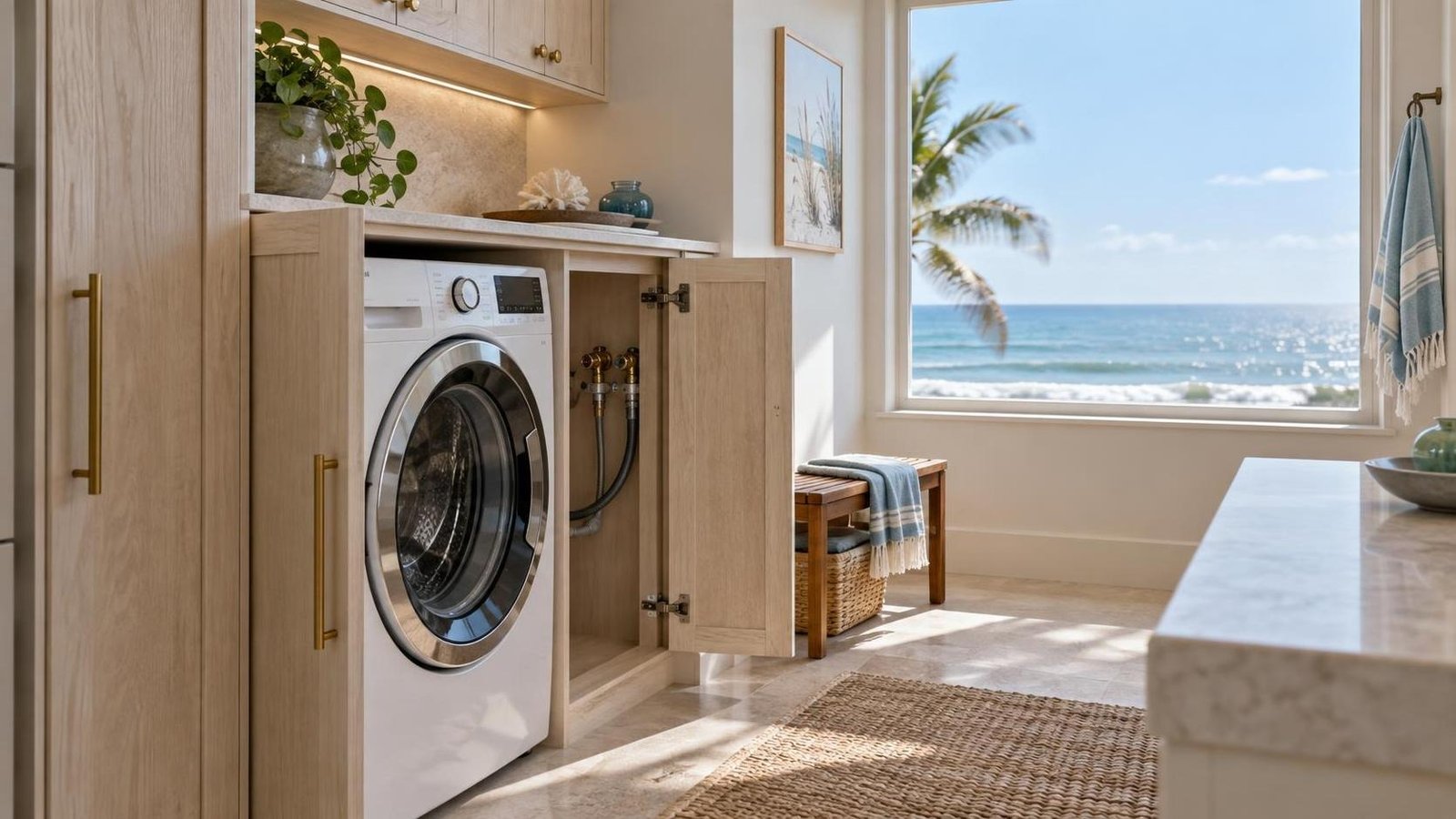
In-Unit Washer Added to an Older Cocoa Beach Condo: What Should Buyers Verify?
By Carrie Liotta, Space Coast REALTOR® with REAL Broker | Published October 5, 2026
Before buying, verify that the washer was approved by the association, permitted when required, and connected to plumbing and electrical systems that can support it. I would also inspect for prior leaks and confirm who pays if the alteration damages shared property. A working machine is not enough; the documents and field conditions should tell the same story.
An in-unit washer can be a real advantage in a Cocoa Beach condo that originally relied on a shared laundry room. It can also be an owner retrofit tied into an older drain stack with no clear approval, no final inspection, and no agreement about what happens after a leak. The value depends less on the appliance and more on the installation behind it.
Start by proving how the washer became part of the unit
I first ask the seller for a simple timeline. When was the washer added? Who designed and installed the plumbing and electrical work? Did the association approve it before work began? Was a permit issued and closed? Have later boards, insurers, plumbers, or property managers inspected or discussed it?
Collect the approval application, board response, permit and final inspection, contractor scope and invoice, warranties, photos taken before walls or cabinetry closed, and later service records. If the installer tied into systems beyond the unit boundary, ask for plans or a clear description of that route.
The City of Cocoa Beach Building Division says it reviews plans, issues permits, and performs inspections within the city. Its current guidance says permits are required for most construction and renovation projects, including plumbing or electrical work, and that the property owner is ultimately responsible for obtaining them.
That does not mean every washer addition has the same permit history or should be judged under today’s code. The installation date, original scope, building, and applicable code edition matter. Ask the City what records exist for this address and what review would be required now if the old file is incomplete. “The contractor handled it” is not a substitute for a permit number and final status.
Association approval and a City permit answer different questions
A municipal permit addresses the public construction and inspection process. Association approval addresses the building’s private documents and shared-property interests. A buyer may need evidence of both.
Read the declaration, amendments, rules, renovation standards, and maintenance chart. Look for provisions covering plumbing, water-using appliances, penetrations, waterproofing, licensed contractors, insurance certificates, and common elements. Compare those rules with the approval actually issued.
Under Florida Statutes section 718.113, common-element maintenance generally belongs to the association except for limited-common-element responsibilities assigned by the declaration. The same section says a unit owner may not do something within the unit or common elements that adversely affects the safety or soundness of condominium property maintained by the association.
The statute is a framework, not an answer for one laundry closet. The declaration may draw the unit boundary at finished surfaces, define portions of branch piping differently, or place certain valves, drains, finishes, and damage obligations on the owner. If the washer connects to a shared stack, uses a chase, penetrates a slab or wall, or depends on a shutoff outside the unit, have the relevant documents interpreted rather than assuming everything behind the appliance is private.
My broader guide to the condo documents Space Coast buyers should read before an offer explains the association-level review. For this purchase, add a washer-specific file instead of expecting the standard resale packet to contain every alteration record.
Have the complete installation traced, not just the appliance tested
A normal wash cycle proves only that the machine operated during that test. I want a qualified plumbing professional to identify the water supplies, shutoffs, hoses, drain connection, visible trap and vent arrangement, route to the building system, working clearance, and signs of repair. If electrical work changed, have the appropriate licensed professional evaluate the receptacle, circuit, protection, and panel labeling.
Verify professional licenses through the Florida DBPR license search. Do not ask a home inspector, plumber, electrician, property manager, or real estate agent to speak beyond that person’s scope. The useful result is a coordinated answer: what is present, what can be inspected, what remains concealed, what records support it, and what corrective work is recommended.
Pay attention to the building context. If most units still use shared laundry, ask whether the vertical drain, water service, and electrical distribution were ever evaluated for multiple private machines. One approved installation does not prove that unlimited future installations are appropriate. Conversely, the presence of shared laundry does not prove that every private washer is prohibited. The association’s records and the actual system determine the answer.
Read the building’s water history from the unit above and below
A laundry retrofit should be evaluated vertically. Request available work orders, leak notices, claims, remediation invoices, plumbing scopes, minutes, and correspondence involving the unit, stack, and adjacent areas. Ask whether ceiling repair below involved the washer, shutoffs have failed, or the drain has backed up.
Inspect the base of the appliance, supply-valve area, cabinet sides, wall and floor transitions, baseboards, neighboring closet, and ceiling below when access is available. Swollen material, corrosion, staining, patched drywall, loose flooring, odor, or mismatched finishes deserves an explanation. A dry surface on showing day does not erase a prior event, and a stain alone does not diagnose active leakage or mold.
The U.S. Environmental Protection Agency’s moisture guidance identifies leaking pipes, concealed pipe chases, delayed maintenance, and moisture-generating appliances as possible sources of building moisture. EPA emphasizes controlling moisture and correcting leaks. Use that as a reason to investigate the source and history, not as permission to label an unknown spot from a photograph.
Ask whether the association requires a drain pan, automatic shutoff, braided supply lines, periodic hose replacement, or a particular flooring detail. Those features may reduce some risks, but none proves that the drain connection, common piping, or approval is correct. Test any installed leak sensor or shutoff according to the manufacturer’s instructions and confirm who maintains it.
Know how routine service and emergency entry will work
The washer may sit inside private cabinetry, but a valve, stack, cleanout, or chase behind it can require association access. Measure whether the appliance can be pulled forward without removing a door, countertop, or fixed panel. Identify where water can be shut off if a hose fails and whether the owner can reach that shutoff immediately.
Florida Statutes section 718.111(5)(a) gives an association an irrevocable right of access to a unit during reasonable hours when entry is necessary to maintain, repair, or replace association-maintained property or prevent damage. That right does not tell a buyer the building’s everyday procedure.
Ask about emergency contacts, key or lockbox policy, seasonal absences, authority to shut down a shared stack, and who moves the appliance or cabinetry. Confirm notice for planned work and the after-hours procedure.
If the unit also has a private dryer, review that alteration separately. My article on a dryer vent routed through a Cocoa Beach condo’s common ceiling area explains why an appliance pair can have two different approval, maintenance, and access stories. A ventless dryer avoids an exterior exhaust route, but it does not answer the washer’s plumbing questions.
Separate the possible costs before negotiating
Do not reduce the issue to “keep the washer” or “remove the washer.” Build separate written scopes for the outcomes that are actually possible:
- Leave it in service: professional evaluation, minor corrections, updated valves or hoses, testing, and any required documentation.
- Bring the alteration into compliance: drawings, permit research, association review, plumbing or electrical correction, wall or cabinet access, inspections, and finish restoration.
- Remove it: safe disconnection, capping or restoration of utilities, repair of penetrations and finishes, and confirmation that abandoned work does not create a hidden problem.
- Investigate damage: leak tracing, drying or remediation, repair below or beside the unit, insurance coordination, and responsibility review.
Get property-specific estimates. A credit based only on the price of a new appliance misses the expensive variables: access, piping, electrical work, permits, cabinetry, common-property coordination, and restoration. Also ask the buyer’s insurer whether the installation or missing records affect underwriting, loss-prevention requirements, or the unit owner’s policy. The association’s master policy and the owner’s coverage are different layers; neither should be guessed from the monthly condo fee.
The strongest seller solution may be a closed permit and written association confirmation. It may be removal of an unapproved installation. It may be a credit paired with enough inspection time for the buyer to obtain approvals and scopes. The right contract response depends on the evidence, lender, insurer, association, and deadline.
Use the resale packet as a starting point, not the finish line
Current Florida Statutes section 718.503 identifies documents a purchaser in a nondeveloper condominium resale is entitled to receive, including current governing documents, financial statements and budget, and applicable inspection and reserve materials. Your transaction and delivery facts control the legal rights and timing, so rely on the contract and appropriate legal advice.
Those materials tell the larger building story, but a washer retrofit needs a targeted request. My file would include the alteration documents, City permit and final inspection, association approval, contractor records, service and leak history, stack work orders, photos, insurance feedback, and written inspection scopes.
Compare that evidence with the practical value of in-unit laundry. My guide to laundry access and daily livability in a Cocoa Beach condo explains why private laundry can matter so much to a full-time owner. Convenience deserves value when it is supported by a sound installation and clear records. It should not receive the same premium when the buyer is inheriting an unresolved alteration.
When I would move forward with the condo
I would be comfortable moving forward when the documents authorize the installation, permit records and field conditions agree, qualified professionals can trace and evaluate the work, the association can explain shared-system responsibility, and the buyer has a workable emergency and maintenance plan. A documented retrofit can make an older condo more livable without becoming the center of every future repair conversation.
I would slow down when the seller cannot identify who installed it, the association has no approval, the permit remains open or absent without explanation, the drain route cannot be established, neighboring water damage is unresolved, or everyone gives a different answer about responsibility. None of those facts automatically requires cancellation. They require time, written answers, and a price that leaves room for the real solution.
My bottom line for Cocoa Beach condo buyers
An in-unit washer is valuable only when the alteration works as part of the building, not merely when the appliance turns on. Verify approval, permits, plumbing, electrical work, leak history, service access, insurance, and responsibility before the inspection and document-review deadlines expire.
If you are comparing Cocoa Beach condos, I can help you connect the lifestyle features to the association records and inspection questions that make them dependable. Join my private Facebook group, Moving to Brevard County Florida, and reach out for a no-pressure conversation about Brevard County homes for sale with Carrie Liotta, Space Coast REALTOR® with REAL Broker. Your next chapter starts here.
