

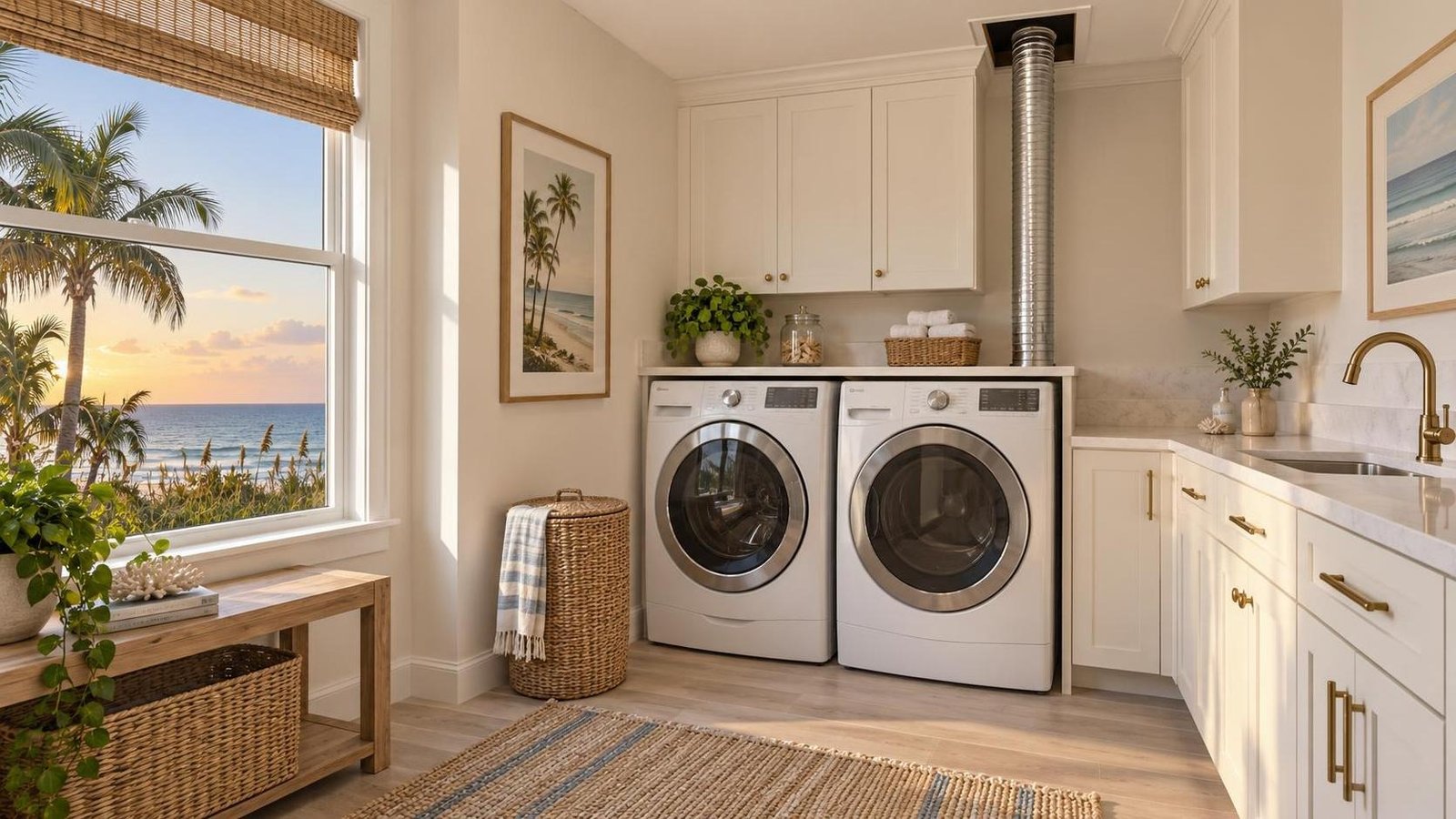
Dryer Vent Through a Common Ceiling Plenum: What Should Cocoa Beach Condo Buyers Ask?
By Carrie Liotta, Space Coast REALTOR® with REAL Broker | Published October 1, 2026
Do not treat a dryer duct that disappears above a condo ceiling as a minor appliance detail. I would ask a qualified mechanical contractor to identify the entire route, exterior termination, penetrated assemblies, cleaning access, and present condition, then match those findings to permits and condominium documents. The buyer also needs a written answer about who maintains and pays for every segment.
The word plenum makes this question more complicated. Some people use it loosely for any space above a dropped ceiling. In mechanical work, a plenum is an air-distribution space. A duct crossing a concealed ceiling cavity, a duct running through an actual environmental-air plenum, and a dryer connected to an engineered common exhaust system are not the same condition.
For a Cocoa Beach condo buyer, the decision is not simply whether the dryer turns on. It is whether moist, lint-bearing exhaust has a documented path outdoors without creating hidden buildup, condensation, fire-separation, common-property, or future assessment problems. That answer takes building records and a field inspection, not a seller’s assumption that “the association handles it.”
Start by naming the system correctly
Ask the association manager, maintenance supervisor, and contractor to use a marked plan or simple diagram. It should show the dryer connection at the unit, transition duct, rigid duct route, every elbow, any booster or central fan, wall or shaft penetrations, access panels, backdraft device, and exterior outlet. Mark where the route leaves the unit boundary and enters a common element, limited common element, shaft, corridor ceiling, roof space, or exterior wall.
Then clarify what “common ceiling plenum” means in this building. Is the space intentionally used to move supply or return air? Is it merely a concealed service cavity above gypsum board? Is the dryer duct enclosed in a rated shaft? Does one duct serve one unit, or do several units connect to an approved common system? A buyer should not accept those terms interchangeably because the inspection method, permitted design, cleaning plan, and repair responsibility can change with the answer.
The current Florida Building Code, Mechanical chapter on exhaust systems contains the statewide provisions for clothes-dryer exhaust, while its duct-systems chapter addresses ducts and plenums. Those chapters are a starting point, not a remote diagnosis. The approved code and design depend on when the work was permitted, the building classification, the exact assembly, manufacturer requirements, local review, and any later alteration.
Trace the route all the way to an exterior termination
Do not stop at the laundry closet. Ask where the exhaust exits the building and have the contractor reconcile that outlet with the unit. In a multistory condo, an outlet can be on an exterior wall, roof, or part of an engineered building system. The contractor should explain how the route was confirmed rather than inferred from the nearest grille.
Ask whether the dryer manufacturer’s installation instructions are available and whether the route is compatible with them. If a booster fan or common fan exists, obtain its specifications, permit history, service records, alarm or interlock information, and failure procedure. A fan should not become an excuse for an undocumented route. The contractor still needs to explain how the system moves exhaust, how it is accessed, and what happens when the equipment is off.
Why cleaning history is a purchase issue, not just housekeeping
The U.S. Fire Administration reports that failure to clean was the leading factor contributing to ignition in 31% of home clothes-dryer fires from 2018 through 2020. Its appliance and electrical fire-safety guidance also advises plugging major appliances, including dryers, directly into a wall outlet rather than an extension cord.
That national data does not tell you whether one Cocoa Beach duct is unsafe. It tells you why “the clothes get dry” is not enough evidence. Ask for the latest cleaning invoice, the scope of work, the segment actually cleaned, photos before and after if available, contractor qualifications, and the recommended interval for this design. A receipt saying “dryer vent cleaning” may cover only the flexible connector behind the appliance, not the concealed run or common shaft.
Separate unit responsibility from association responsibility
A duct can begin inside a private unit and continue through property the owner does not control. That is why the declaration, amendments, bylaws, rules, maintenance chart, unit-boundary description, and alteration approvals matter. Ask for a written association response identifying responsibility for the appliance connector, concealed branch duct, shaft or ceiling section, fan, firestopping, exterior hood, cleaning, access restoration, and damage caused by blockage or leakage.
Florida law supplies a framework but does not replace the building’s declaration. Florida Statutes section 718.113 says common-element maintenance is the association’s responsibility except when the declaration assigns maintenance of a limited common element to a unit owner. It also says an owner may not do work in the unit or common elements that adversely affects the safety or soundness of condominium or association property.
The practical lesson is not “association pays” or “owner pays.” It is “read the recorded documents and identify the component.” A dryer collar inside the laundry closet may be treated differently from a branch beyond the unit boundary. The association might arrange building-wide cleaning but charge participating units. An owner might be responsible for maintenance yet still need board approval and a licensed contractor to enter the common ceiling.
Request board minutes, maintenance notices, violation letters with personal information removed, prior leak or lint reports, and any engineering recommendations involving exhaust systems. If several units share the route or access area, ask whether the association has a current contractor and coordinated schedule. My guide to fire-safety updates in older beachside condos explains why a lower monthly fee is not automatically the better value when important building work remains undefined.
Reconcile permits, plans, and later alterations
The Florida Building Commission states that the Florida Building Code, Eighth Edition (2023), became effective December 31, 2023. Buyers can confirm that current baseline on the Florida Building Commission website. Do not apply the current edition backward to declare an older installation defective. Ask the city building department and the buyer’s contractor which code edition, permit, approved plan, and inspection history apply to the original work and each alteration.
Build a timeline for the building’s construction, unit renovation, laundry relocation, ceiling replacement, fire-alarm work, HVAC changes, duct cleaning, fan replacement, concrete restoration, and storm repairs. A dryer that moved from a common laundry room into the unit deserves special attention. So does a soffit that appears newer than surrounding finishes, an access panel without a label, a ceiling patch in the corridor, or an exterior hood added without a matching plan.
Ask for permit applications, approved drawings, correction notices, final inspections, contractor invoices, product data, and board approvals. A closed permit is useful evidence, but the field condition still needs to match the approved work. An open or missing permit is not proof of a dangerous installation, yet it leaves a question the buyer should resolve before ownership.
Choose the right inspection team
A general home inspector can document visible conditions in the unit, appliance connection, heat or moisture clues, and inspection limitations. A licensed mechanical contractor can trace and evaluate the exhaust route within that contractor’s scope. Depending on what the route crosses, the association may need its building engineer, fire-protection professional, electrician, roofer, or envelope contractor involved. The building official can address permit records and code administration; the official is not the buyer’s condition inspector.
Give the team one written question list:
- Is this a dedicated exhaust route, an engineered common system, or an unverified connection?
- Is the ceiling area an actual air plenum, a shaft, or simply a concealed cavity?
- Where are the unit boundaries, access points, and exterior termination?
- What duct material, route length, bends, fans, dampers, and penetrations are present?
- Can the whole route be inspected and cleaned without opening common finishes?
- Do permits, approved plans, association records, and current conditions agree?
- Who authorizes entry, who hires the contractor, and who pays for investigation, repair, and finish restoration?
If the condo has no in-unit laundry, do not assume adding it later will be simple. Utility capacity, drainage, electrical service, exhaust routing, board approval, permits, and building configuration all matter. For buyers comparing that tradeoff, my article on laundry access and full-time Cocoa Beach condo living helps separate daily convenience from the larger building decision.
Price access and uncertainty, not just a cleaning
I would divide the possible expense into five layers. First is diagnosis: records, contractor time, camera work, airflow or pressure testing where appropriate, and exterior access. Second is cleaning. Third is correction: replacing a crushed branch, rerouting a section, adding approved access, repairing a fan, or correcting a termination. Fourth is building restoration: ceilings, firestopping, paint, roof or wall waterproofing, and common-area protection. Fifth is coordination: engineering, permits, board review, lift equipment, resident notices, and access to neighboring units.
A low cleaning quote may cover only the reachable private segment. A mechanical proposal may exclude drywall and firestopping. A roofer may service the exterior hood without tracing the branch. Ask each vendor to state assumptions and exclusions. Also confirm whether the association has budgeted work, expects a special charge, or considers the disputed segment an owner expense.
This is similar to evaluating a drain or pipe that passes through shared property: access can cost more than the visible repair. My guide to roof-drain service access through a private balcony or storage area shows why ownership boundaries and entry rights deserve their own due diligence.
Before the inspection period ends, the buyer may ask for records, further access, a licensed evaluation, a completed repair, or a negotiated credit that works with the contract and lender. If the route remains unverified, do not value the in-unit dryer connection as a fully documented amenity. Decide whether the convenience still justifies the risk and whether the association’s response gives you confidence in future maintenance.
My decision rule for a Cocoa Beach condo
I would favor the unit where the dryer has a traceable path to the exterior, the design is accurately identified, permits and plans support the installation, penetrations and access have been professionally evaluated, cleaning records cover the relevant route, and responsibility is clear in writing. A longer route is not automatically a rejection, and an older building is not automatically a problem. Unexplained routing and divided responsibility are the real warning signs.
Before buying, require plain answers to six questions: What exactly is the ceiling space? Where does the duct go? How was that route confirmed? How is every segment inspected and cleaned? Who owns and pays for each part? What approvals are required when the route needs work?
If you are comparing Cocoa Beach condos, I can help you organize the declaration, board records, inspection scope, contractor questions, and ownership costs before an appliance convenience becomes a common-property dispute. Reach out for a no-pressure conversation with Carrie Liotta, Space Coast REALTOR® with REAL Broker, about Cocoa Beach and Brevard County homes for sale. Your next chapter starts here.