

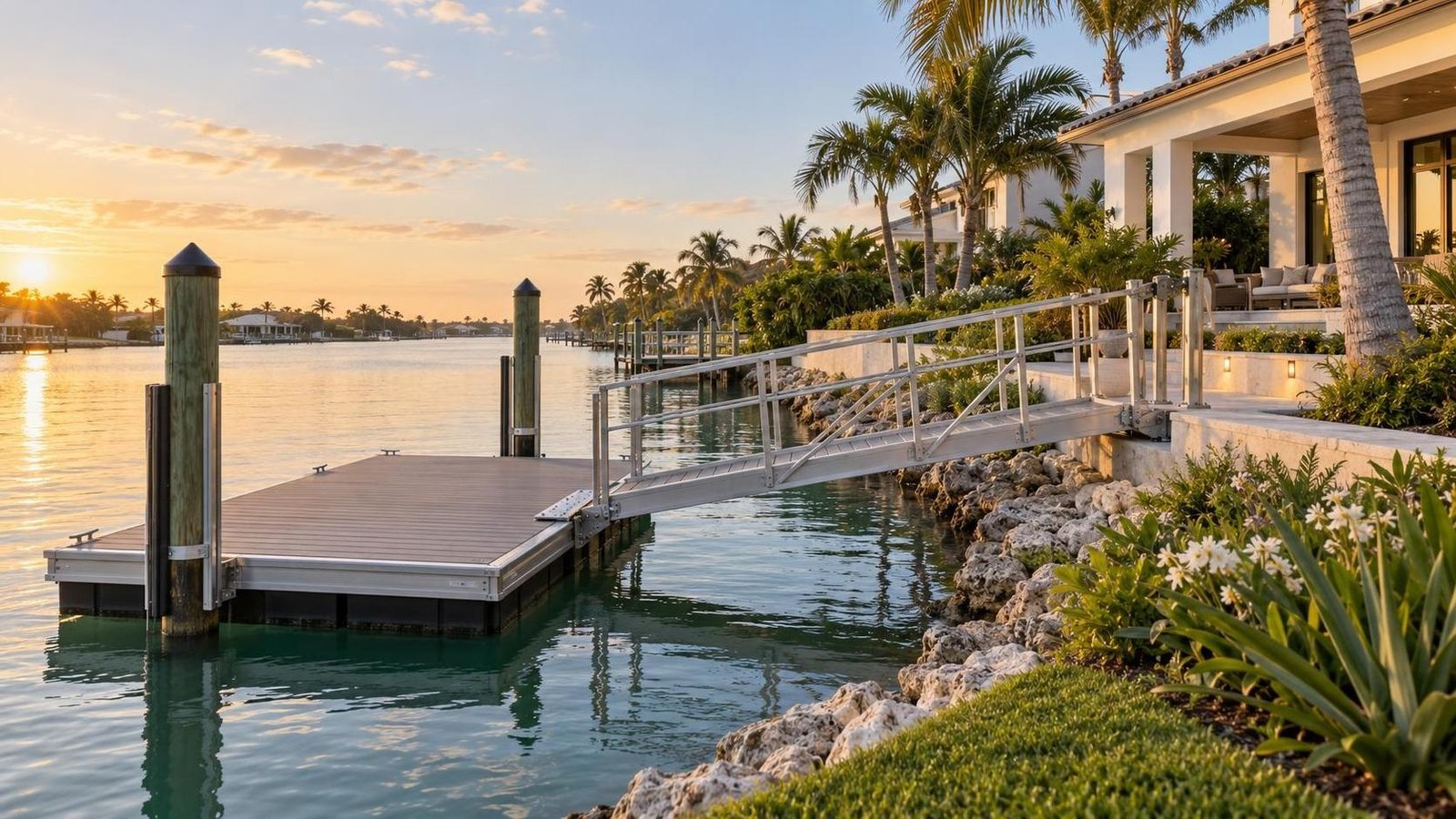
Selling a Merritt Island Home With a Floating Dock? Document the Hinge and Gangway Grounding
By Carrie Liotta, Space Coast REALTOR® with REAL Broker | Published October 2, 2026 on 321 Coastal Living
Yes. Before listing a Merritt Island home with a floating dock, document the gangway hinge, moving connections, and the electrical grounding or bonding path that a licensed professional identifies. The goal is not a seller-made safety certificate. It is a clear record showing what was installed, how the moving connection behaves, and what qualified inspectors found.
A floating dock is supposed to move while the shore landing stays fixed. That simple fact makes the gangway connection different from an ordinary backyard stair or a fixed deck. The angle changes with water level. Pins rotate, transition plates slide, rollers travel, and anything routed between land and the float must accommodate movement without being crushed, stretched, or turned into a trip hazard.
Start by defining the system, not by polishing the dock
Walk the route from the fixed shore landing to the floating section on a calm day and identify the parts without disassembling anything. The transition may include hinge plates, pins, clevises, brackets, rollers, a sliding plate, handrail joints, guide piles, flotation modules, and anchoring hardware. Electrical or water service may follow a separate support path.
Photograph the full route and then each connection. Record manufacturer and installer information where labels are visible. Look for invoices, engineering drawings, surveys, dock plans, electrical permits, waterfront authorizations, final inspections, repair receipts, and service notes. Match every document to what is actually present rather than assuming that an old permit covers a later float, gangway, lift, light, or outlet.
The Brevard County building permit search is a practical starting point when the property is in county jurisdiction. Confirm the address, scope, issue date, inspections, and final status. A dock or electrical record may sit under a different description than the seller expects, and a waterfront address may involve more than one reviewing authority.
This file is narrower than a general dock-electrical history. My guide to documenting dock electrical, generator, and lift shutoffs upgraded in different years helps sellers map the larger system. Here, the focus is the place where fixed land, a moving gangway, and a floating platform meet.
Have the hinge and gangway observed through real movement
A still photograph cannot show whether a gangway binds as the float rises, pulls sideways against a bracket, or lands cleanly on its transition plate. Ask an appropriate marine contractor, engineer, dock specialist, or other qualified professional to evaluate the structure and movement that fall within that person’s scope.
I want the written findings to address the condition and fit of the hinge plates, pins, retainers, brackets, fasteners, rollers, transition surface, walking deck, and handrails. The professional should note corrosion, elongated holes, missing retainers, loose connections, cracked welds, distorted metal, uneven bearing, sharp edges, movement at the fixed landing, and any repair that does not match the intended assembly.
The review should consider the movement observed or established from design records. A gangway that looks comfortable at one water level can become steep, bind, lift a transition plate, or push against a handrail at another. Do not advertise a universal tide range, load capacity, or storm performance from appearance alone. Those claims need qualified support.
Keep the walking path separate from the technical inspection. Observe the surface, transition, handrails, and anything crossing the route, but do not invite visitors onto a questionable gangway to “prove” it works. If the hinge, landing, float, or rail moves unexpectedly, stop using it and follow the professional’s direction.
“Grounding” and “bonding” are not interchangeable sales words
Owners often use “grounded” to mean that they see a wire attached to metal. That is not enough to identify the conductor, its purpose, its continuity, the equipment it serves, or whether the installation matches the applicable design and electrical requirements.
Ask a properly licensed electrical contractor to trace the dock supply from its source through the protective devices, disconnects, wiring method, junctions, receptacles, lights, lift controls, and any metal parts that require evaluation. The contractor—not the seller, photographer, or home shopper—should determine what equipment-grounding and bonding provisions apply to this installation. Florida’s Electrical Contractors’ Licensing Board regulates electrical contractors, and the official DBPR license search lets a seller verify a provider in a regulated profession.
At the moving connection, the inspection should account for motion as well as corrosion and water exposure. Ask whether each cable, raceway, bonding jumper, support, fitting, and connection has the correct identity, protection, flexibility, slack, strain relief, and route for the actual movement. Nothing should be pinched in the hinge, scraped by a roller, pulled tight at a low or high float position, or left loose across the walking path.
Do not tighten electrical connections, add a hardware-store strap, test continuity, reset repeatedly tripping protection, or open waterfront equipment yourself. The National Fire Protection Association’s electric-shock-drowning resource is a useful reminder that electrical concerns around water deserve conservative handling. If a professional identifies a potentially energized metal part, damaged wiring, or another immediate hazard, de-energize or restrict access as directed and document the correction.
Match the field condition to the permits and waterfront authorizations
A sound-looking hinge does not answer whether the floating dock was built, modified, or expanded under the right approvals. Separate the paperwork into at least three tracks: the dock and gangway structure, the electrical work, and the waterfront or submerged-land authorization. Then match the dates and drawings across the tracks.
The Florida Department of Environmental Protection’s Environmental Resource Permitting page explains that the ERP program covers activities involving surface waters and that DEP generally reviews docking facilities and attendant structures that are not part of a larger residential or commercial development. It also explains that DEP and Florida’s water management districts divide application responsibilities under operating agreements.
That does not mean every Merritt Island dock needs the same authorization or every repair needs a new permit. Exemptions, agency responsibility, submerged-land ownership, location, scope, and installation date can change the answer. County, state, district, federal, and local authorities may answer different parts of the question.
The U.S. Army Corps of Engineers’ Florida regulatory page directs property owners to federal permitting and jurisdiction resources. A seller should not label a dock “fully permitted” because one local record exists. A stronger file identifies each known approval, its scope, the work shown, and any question still awaiting the proper agency or professional.
Decide whether to repair, document, credit, or restrict use
Not every weathered hinge requires replacement, and not every missing receipt means the dock must be rebuilt. The decision should follow the diagnosis.
- Repair before listing when the defect is defined, the correction is reasonably scoped, and restoring a secure, usable connection will materially improve the waterfront presentation.
- Gather more evidence when documents conflict, the hinge binds only at certain water levels, corrosion hides the connection, the gangway or float has been modified, or the electrical route is unclear.
- Use condition-based pricing or negotiate a credit when the correction is substantial and a buyer may prefer a different dock plan. Confirm that any credit works with the contract, lender, appraisal, and closing costs.
- Restrict access and disclose the condition when a professional identifies a safety concern that cannot be corrected before showings. A rope or sign is not a repair, but it is better than presenting a questionable gangway as ready for use.
For electrical uncertainty, a written scope from a licensed contractor is more valuable than a round-number allowance. My article on correcting unpermitted dock electrical versus providing an estimate explains why a seller should define the permit and repair path before choosing an as-is strategy.
A repair should not narrow the path, interfere with a handrail, block a utility support, or redirect the gangway toward lift equipment. If kayaks, a ladder, or a lift cradle share the area, review the route as one working waterfront. My guide to evaluating a kayak launch, lift cradle, and seawall ladder at low water shows that use test.
Build a buyer-ready floating-dock file
Organize the handoff so a buyer can understand the system without guessing. I would include:
- A simple labeled diagram showing the fixed landing, gangway, hinge, transition, float, guide or anchor system, electrical source, shutoff location, and visible utility route.
- Dock, gangway, and electrical permits with inspection or final-status information, plus any DEP, district, federal, or submerged-land record that applies.
- Plans, engineering, product information, load information, and manufacturer instructions that can be matched to the installed components.
- Dated photographs at more than one observed water level when available, without claiming they represent every tide, storm, or seasonal condition.
- Marine and electrical inspection reports, repair proposals, paid invoices, contractor license information, warranties, and unresolved recommendations.
- Operating instructions and a factual statement of which dock equipment will remain with the property.
Remove personal account details and alarm or app credentials. If a connected controller transfers to the buyer, provide the manufacturer’s reset process rather than a seller password. Keep “not observed,” “unknown,” and “not in inspector’s scope” visible in the file; do not convert those phrases into approval.
Use listing language that the records can support
Avoid “code compliant,” “storm proof,” “safe for all tides,” “newly grounded,” or a specific weight capacity unless the right current document and professional support that statement. Even “permitted dock” can be too broad when the file covers the original fixed structure but not a later floating section, gangway, lift, or electrical change.
Useful language is narrower: “Floating dock and gangway; permit, waterfront-authorization records, October 2026 marine service report, and licensed electrical evaluation available.” If the hinge needs work, say so in the disclosure and negotiation materials. If power has been de-energized pending correction, do not describe the dock electrical as operational.
The current Florida Building Commission states that the Florida Building Code, Eighth Edition (2023) took effect on December 31, 2023. That date is useful context, but it does not let a seller decide which provision governs an older installation or a proposed repair. The permit date, project scope, adopted rules, and authority having jurisdiction control that review.
Bottom line for Merritt Island sellers
Document both sides of the gangway question. The marine side should explain the hinge, pins, brackets, transition, handrails, float movement, and visible condition. The electrical side should identify the supply and the grounding or bonding provisions that a licensed contractor actually verified, especially where conductors and metal parts cross a moving connection.
You do not need to promise a perfect dock. You do need to replace assumptions with a coherent file and make the repair, pricing, and access decision before buyers discover the question during their inspection period.
If you are preparing a Merritt Island waterfront home for sale, I can help you organize the dock records, identify the right specialist questions, and present the condition without overpromising. Reach out for a no-pressure conversation about selling your Brevard County home with Carrie Liotta, Space Coast REALTOR® with REAL Broker. Your next chapter starts here.
