

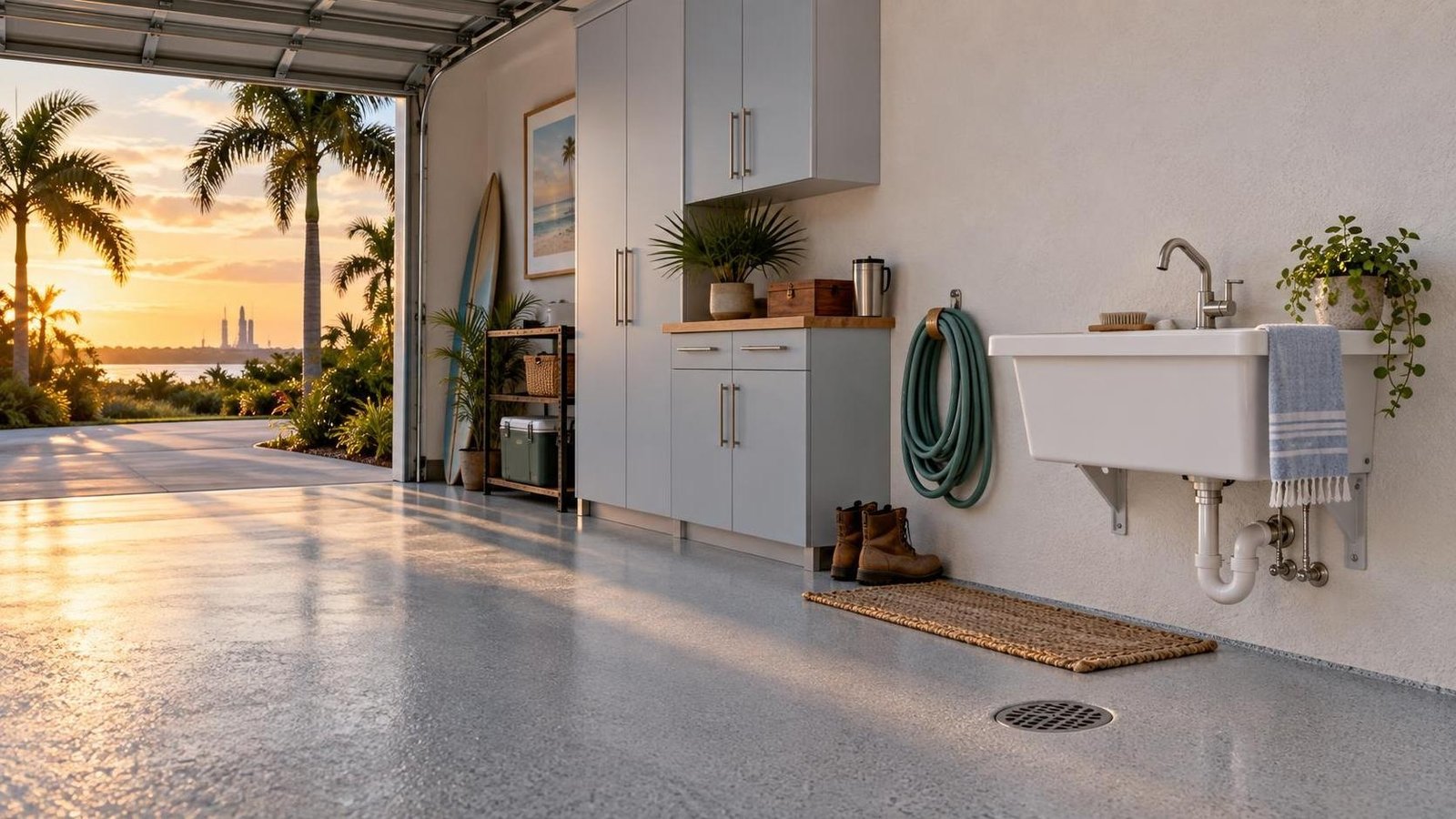
Garage Utility Sink and Floor Drain on One Unknown Discharge Route: What Should Titusville KSC Relocators Verify?
By Carrie Liotta, Space Coast REALTOR® with REAL Broker | Published October 1, 2026
Do not assume a garage utility sink and floor drain go to the same lawful destination just because they sit close together. Before buying, I would have a licensed plumber trace both routes, match them to permits and sewer or septic records, and identify what each drain is allowed to receive. An unknown outlet is a due-diligence problem, not a convenient feature.
This matters because the possible destinations are not interchangeable. The sink may join the home’s sanitary plumbing, while the floor drain could be separately trapped, capped, abandoned, connected to an approved system, or routed somewhere it should not go. A drain that disappears into concrete proves only that water leaves the visible opening. It does not prove where the water ends up.
For a KSC household comparing Titusville homes, the practical question is whether this garage can support normal cleanup without creating a sewer, septic, stormwater, odor, moisture, or future resale issue. The answer comes from records and tracing, not from pouring a bucket down the drain and watching it disappear.
First, treat the sink and floor drain as two separate systems
Begin with a simple sketch. Mark the utility sink, its trap, visible supply and waste piping, the floor drain, nearby cleanouts, the water heater, laundry connections, exterior walls, sewer lateral direction, septic tank and drainfield if applicable, and every place water appears outside. Then ask the plumber to explain which observations are confirmed and which remain assumptions.
A utility sink generally looks familiar because its trap and branch piping may be visible. The floor drain is harder. It may turn beneath the slab, and an older garage can contain abandoned or altered piping that never made it onto an easy-to-find plan. A prior owner may also have added the sink after construction, replaced a drain cover, filled part of a line, or connected a hose without completing a permitted plumbing alteration.
Do not let proximity become evidence. Two fixtures six feet apart can have different discharge paths. The buyer’s goal is to establish four facts for each one: where it goes, whether the route is approved for that use, whether the line is in serviceable condition, and what materials may safely enter it.
Why an unknown stormwater connection is serious in Titusville
The City of Titusville’s illicit-discharge guidance says a discharge into the city stormwater system is unlawful when it is not composed entirely of stormwater. The city specifically lists automotive products, oil, gasoline, grease, chemicals, degreasers, solvents, sewage, laundry waste, soaps, paints, and toxic materials among pollution concerns. That list should change how a buyer evaluates a garage drain near a workbench, vehicle bay, or cleanup sink.
Stormwater is not a substitute for sanitary plumbing. The U.S. Environmental Protection Agency explains that municipal separate storm sewer systems collect and convey stormwater and are not part of a sewage treatment plant. Polluted runoff commonly passes through those systems and can reach local waters untreated. EPA’s illicit-discharge program guidance makes the same distinction: wastewater goes to treatment, while stormwater generally reaches waterways without additional treatment.
Titusville’s stormwater network serves the Indian River Lagoon and St. Johns River watersheds. Never infer that a pipe leading toward a driveway, ditch, swale, or yard is acceptable because it has existed for years. Until the route is confirmed, keep vehicle fluids, cleaners, paint water, pesticides, detergents, and similar materials out of both drains.
Confirm whether the property uses sewer, septic, or both records
Start with the property’s actual utility history rather than the neighborhood assumption. Ask for recent water and sewer bills, a utility-account description with private information redacted, the survey, plumbing permits, and any sewer-connection or septic-abandonment documentation. If a house changed from septic to public sewer, do not assume every garage fixture moved to the new route.
For a sewer-served home, a licensed plumber may use cleanouts, a camera, locating equipment, and fixture testing. The city’s Sewer Smarts guidance warns that oil and grease do not belong down a drain and says recurring sewer odor, gurgling, or a slow backup deserves attention. Those symptoms inform the investigation but do not identify the route.
If the property uses an onsite sewage treatment and disposal system, commonly called septic, pull the septic permit, site plan, tank and drainfield location, capacity information, repair history, and inspection records. The Florida Department of Environmental Protection’s Onsite Sewage Program says septic permitting and inspection are handled through county environmental-health offices and emphasizes that proper design, construction, and maintenance protect groundwater. A garage fixture should not be casually added to a septic load without reconciling the approved system and current professional guidance.
Build a permit and alteration timeline
Search the original building plans and every later plumbing or garage-renovation permit. The City of Titusville Building Department explains that it uses plan review, permitting, and inspections to certify compliance with city codes and directs users to its online portal for permits from 2012 forward; earlier permits can be requested from the department. Ask for the application, scope, approved drawings, inspection results, corrections, and final status rather than relying on a one-line search result.
Create a chronology for the garage slab, sink, floor drain, laundry, water heater, septic or sewer conversion, additions, and any conversion from parking to living or workshop use. Compare contractor names and dates with visible materials. Fresh PVC meeting older metal below the slab, a patched concrete trench, a capped wall stub, a new sink beside an aged drain, or a floor coating that hides patch lines all deserve an explanation.
Florida’s current statewide baseline is the Florida Building Code, 8th Edition (2023), which the Florida Building Commission says became effective December 31, 2023. That date does not make today’s code the correct standard for every older installation. The applicable requirements depend on when the work was done, its scope, adopted provisions, and the authority having jurisdiction. That is why buyers need the permit timeline before anyone declares an older drain compliant or defective.
What should the inspection team actually do?
A general home inspector can document visible condition, evidence of leakage, odors, slope, staining, damaged covers, and apparent alterations. A licensed plumber should define the tracing method and evaluate piping within that professional’s scope. A septic contractor may need to locate and evaluate onsite components. The city or county can explain records and permit expectations; it does not replace the field evaluation.
Ask the team to answer these questions in writing:
- Does the sink have a sound trap, venting arrangement, accessible shutoffs, and a verified waste destination?
- Is the floor drain active, trapped, trap-primed, capped, abandoned, damaged, or dry enough to allow sewer gas?
- Can the route be traced without destructive work, and what uncertainty remains below the slab?
- Does either fixture connect to stormwater, a yard outlet, a dry well, a sump, a septic component, or an unverified buried line?
- Do permits, plans, utility records, and present conditions agree?
- Is there evidence of oil, paint, chemical, sewage, or detergent discharge that needs separate environmental or cleanup advice?
Do not open a suspicious cleanout, enter a tank, mix chemicals, or improvise pressure tests. If a camera cannot pass, ask what limited opening or access would be required and who is qualified to make it. If the route remains unknown, preserve that uncertainty in the written report and price it as unresolved work.
Separate normal cleanup from vehicle or workshop disposal
A garage utility sink can be useful for rinsing hands, gardening tools, or ordinary household items when the plumbing is lawful and the material belongs in that wastewater system. A floor drain can help with incidental water only if its design, destination, and permitted use support that purpose. Neither feature turns a residential garage into an approved disposal point for automotive or workshop waste.
This distinction matters for households bringing a work truck, tool carts, outdoor equipment, or shift-work routines to Titusville. Confirm the home feature without implying that a KSC employer requires or approves any particular garage setup. If vehicle fit and garage airflow also matter, read my guide to garage ventilation and work-truck charging for Titusville KSC buyers. It addresses parking, power, and ventilation; the drainage investigation remains a separate plumbing and stormwater question.
Inspect the floor for reverse slope, low spots, cracked patches, staining, loose drain frames, missing covers, and driveway water intrusion. A lawful drain cannot fix a poorly pitched slab, and a dry garage does not prove an unseen pipe has a lawful destination.
Price the unknown route before the inspection period ends
I would organize costs into three layers. The first is investigation: plumber time, camera or locator work, septic location, records, and any approved access. The second is correction: capping an abandoned line, restoring a trap, reconnecting a sink, separating an improper route, obtaining permits, or opening and repairing the slab. The third is restoration: concrete, epoxy coating, cabinetry, drywall, landscaping, driveway work, or drainfield protection after the plumbing work is complete.
Get written scopes from the relevant trades. A low plumbing estimate may exclude concrete cutting and finish repair. A slab contractor may assume the plumber has already marked the route. A septic quote may not address the garage fixture. Ask what is excluded, whether the price depends on finding an accessible connection, and what happens if tracing reveals a stormwater or unknown yard discharge.
The right contract response depends on the evidence. A seller might provide missing records, allow further tracing, complete a permitted repair, or negotiate a credit that works with the buyer’s loan and closing costs. A buyer may accept a capped floor drain if the utility sink has a verified lawful route and the garage still serves the intended use. But I would not value the drain as a functioning benefit while its destination remains unknown.
Buyers who also need trailer or equipment space can use my comparison of a permitted trailer pad versus a deeper Titusville garage. Keep the decisions separate: parking dimensions and HOA rules answer one question, while wastewater and stormwater tracing answer another.
My decision rule for a Titusville relocation
I would favor the home where each drain has a documented destination, the visible installation agrees with the permit history, a qualified professional can explain the present condition, and ordinary use will not send pollution into stormwater or overload an onsite system. A smaller or simpler garage with known plumbing is easier to budget than an impressive wash area built around an unexplained pipe.
Before the inspection deadline, require clear answers to five questions: Where does the sink go? Where does the floor drain go? What may legally and safely enter each one? What work created or changed the routes? What will it cost to investigate and correct every remaining gap?
If you are relocating for work at Kennedy Space Center or elsewhere in North Brevard, I can help you compare more than garage size and drive time. Reach out for a no-pressure conversation with Carrie Liotta, Space Coast REALTOR® with REAL Broker, about Titusville and Brevard County homes for sale. We can organize the records, inspection team, contract deadlines, and ownership costs before an unknown drain becomes your problem. Your next chapter starts here.
Related Space Coast guides
- Generator-Inlet Location or Larger Garage Workbench: What Should Titusville KSC Relocators Prioritize?
- Fixed Garage Workbench Blocking Panel Access: What Should Titusville KSC Relocators Verify?
- Buying in Mims for a KSC Commute? Verify the Access Easement Before You Count on the Outbuilding
- Moving to Florida’s Space Coast: relocation guide
