

Generator-Inlet Location or Larger Garage Workbench: What Should Titusville KSC Relocators Prioritize?
By Carrie Liotta, Space Coast REALTOR® with REAL Broker | Published October 2, 2026 on 321 Coastal Living
Prioritize the documented generator inlet when its transfer equipment is verified and its location supports a genuinely safe outdoor setup. Choose the larger workbench when the inlet is poorly placed, undocumented, or easy to correct later and the bench materially improves daily storage and parking. The label alone does not decide this comparison.
This choice comes up when a work zone and backup-power connection compete for the same wall, side-yard gate, or panel route. A KSC household may value outage preparation and still need room for tools, shift gear, bikes, or a work vehicle. I compare the installed facts first and the lifestyle feature second.
Do not confuse the inlet with the generator’s operating location
A generator inlet is a connection point. It is not proof that the portable generator can sit beside it while running. The safe operating area is determined separately by the generator manufacturer’s instructions, current safety guidance, the home’s doors, windows, vents, attached garage, exhaust direction, drainage, weather protection, and the route of an approved cord.
Current Ready.gov power-outage guidance says generators and fuel should be used outdoors and at least 20 feet from windows, doors, and attached garages. The U.S. Consumer Product Safety Commission is equally direct: never use a portable generator inside a home or garage, even with doors or windows open, and operate it outside at least 20 feet from the home with exhaust facing away.
That means an inlet mounted just inside the garage, beside a bedroom window, or across a narrow path may not create the convenience a buyer imagines. Never plan to run the generator in the garage and “vent it” through the open door. Instead, have a qualified electrician and the equipment instructions help define a lawful, workable connection plan while the generator itself remains in an appropriate outdoor location.
Verify the electrical system behind the cover
A weatherproof cover and a large receptacle do not tell you how the inlet connects to the house. Ask a licensed electrical contractor to identify the inlet rating, wiring method, breaker, panel relationship, transfer switch or listed interlock arrangement, neutral and grounding configuration within the contractor’s scope, protected loads, labels, cord requirements, and any visible defects or alterations.
The central safety question is whether the equipment prevents an unsafe connection between generator power and the normal utility supply. FEMA’s generator safety fact sheet warns against directly connecting a generator to a home power supply and says a qualified electrician or utility should install appropriate transfer equipment under local electrical codes. Buyers should not test this by energizing unfamiliar equipment during a showing.
Florida’s Electrical Contractors’ Licensing Board licenses and regulates electrical contractors, and the official DBPR license search is the place to verify a provider in a regulated profession. I want a written evaluation or invoice tied to the property, not a seller’s statement that “an electrician friend looked at it.”
Match the inlet to permits, finals, and the current panel
Pull the available electrical permit record and compare its scope with what is installed. The City of Titusville Building Department says it uses plan review, permitting, and inspections to enforce city code and regulations and provides an online search for permits from 2012 forward. First confirm whether the property is actually inside city jurisdiction; a Titusville mailing address does not answer that by itself.
Look for the permit number, described equipment, issue date, inspection history, and final status. Compare the breaker label, inlet rating, panel, and transfer equipment with the documents. An old panel permit does not automatically cover a later inlet, and a paid invoice does not prove a final inspection. Missing online history creates a question to resolve, not automatic proof that older work was unpermitted.
The Florida Building Commission states that the Florida Building Code, Eighth Edition (2023) became effective December 31, 2023. Do not use that date to judge every older inlet by today’s requirements on your own. Installation date, alteration scope, adopted electrical rules, and the authority having jurisdiction all matter.
Walk the real setup from storage to operation
After the electrical review, map the physical routine without running the generator. Where would the unit be stored? Can it be moved outside without lifting it over the workbench, squeezing between two vehicles, or rolling through a flooded low spot? Does the gate open fully? Would an approved cord cross the main walking path, sit under a garage door, or create a trip point near the driveway?
From the proposed outdoor location, look toward every door, window, vent, and attached garage—not just the inlet. Check exhaust direction and nearby fences, neighboring openings, equipment, drainage, and runoff, but do not treat a visual walkthrough as a safety certification.
Florida’s Division of Emergency Management generator guidance also stresses outdoor operation away from doors, windows, and vents, dry operation with ventilation, avoiding overloads, appropriate cords, and cooling before refueling. A well-placed inlet should support those practices rather than tempt the owner into a shortcut.
Now test whether the workbench is helping or hiding a problem
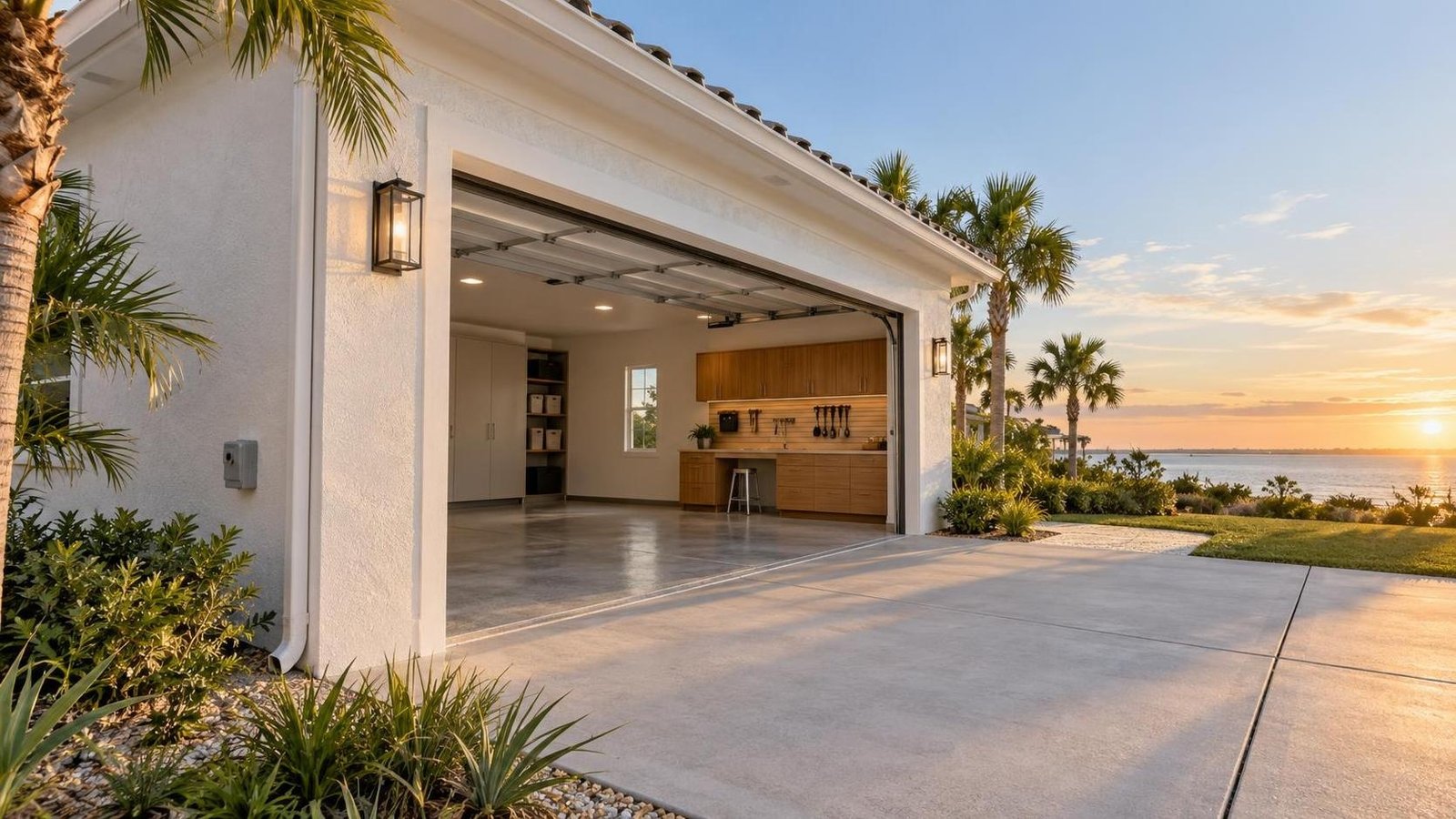
A built-in bench can be genuinely useful in a Titusville garage. It may keep tools, battery chargers, fishing gear, safety equipment, and household repair supplies organized. It may also consume the wall depth needed to park a longer vehicle, open a door, reach the panel, inspect the inlet backbox, or move the generator out of storage.
Measure the garage with the doors open and vehicles positioned as used. Record bench depth, aisle width, panel access, door swing, equipment access, and the route outdoors. Open every cabinet. Look for covered junction boxes, improvised wiring, moisture evidence, or a bench attached where service access is needed.
A smaller modular bench may work better than a deep installation, but do not remove sound storage merely because an inlet is nearby. My comparison of garage ventilation and a second work-truck charging outlet for Titusville KSC buyers uses the same principle: verify the building system, then decide whether the remaining space works on an ordinary weekday.
When the documented inlet should win
I would give the inlet more weight when the permit and final record match the installation, a licensed electrician confirms the transfer arrangement and labels, the rating fits the buyer’s intended essential-load plan, and the connection serves a safe outdoor operating route supported by the manufacturer’s instructions. It becomes more useful when the household has a real outage plan, working carbon-monoxide alarms, a dry storage strategy, and no need to improvise through a door or window.
The inlet can also win when resizing the bench is simple carpentry but recreating a verified electrical connection would require investigation, new equipment, wall repair, or a different exterior route. Get separate estimates; neither electrical correction nor bench removal is automatically minor.
Keep the value in proportion. A portable-generator inlet is not the same feature as an automatic standby generator. It does not provide fuel, start the generator, choose loads, guarantee runtime, or make every circuit available. For the broader distinction, read my guide to valuing a whole-house generator on the Space Coast.
When the larger workbench should win
Choose the bench when it fits the buyer’s daily routine and the inlet’s value is mostly theoretical. Warning signs include no permit or installation record, no identifiable transfer equipment, poor labeling, damaged or corroded parts, a location that conflicts with the safe outdoor plan, or a cord route that would cross vehicles and doors. A licensed electrician may find that relocation or replacement is the cleaner answer.
The bench may be better when the buyer has another resilience plan or needs a project and storage surface every week. Garage depth matters too. Compare the space with my guide to choosing a permitted trailer pad or deeper garage for a Titusville KSC household.
Still, preserve access around electrical equipment. A bench should not conceal defects, encourage storage against a panel, or force a person to climb over tools to reach a shutoff. If the cabinetry must be modified, get a clear carpentry scope and have the electrician identify boundaries before anyone cuts around wiring.
Use the inspection period to price three separate decisions
I would divide the comparison into electrical, safety-and-operation, and garage-use tracks.
- Electrical: identify the inlet, wiring, breaker, transfer or interlock equipment, labeling, permits, finals, defects, and recommended correction through a properly licensed contractor.
- Safety and operation: match the generator manual to a suitable outdoor location, required separation from openings, exhaust direction, dry-operation plan, approved connection path, fuel handling, carbon-monoxide alarms, and the loads the household actually intends to manage.
- Garage use: measure parking, door swing, panel and equipment access, storage, generator movement, bench dimensions, and the cost to retain, resize, relocate, or remove the cabinetry.
Ask for written estimates rather than one blended credit. An electrician’s correction, a carpenter’s bench change, and the purchase of a compatible generator are different costs. Confirm that any requested credit works with the contract, lender, appraisal, and closing-cost limits. If a potentially unsafe electrical condition is identified, a credit may not solve the lender, insurer, or occupancy concern.
Do not plug in a borrowed generator, fabricate an adapter, backfeed through a receptacle, remove a panel cover, defeat transfer equipment, or run an engine for an inspection demonstration. The goal is to verify the installed system and its documents, not stage an outage at the property.
My Titusville buyer decision sheet
Before assigning value, I want answers to these questions:
- Who installed the inlet, and can the license, permit, inspection, and invoice be verified?
- What transfer equipment prevents an unsafe utility-and-generator connection?
- Which loads are intended to be managed, and are the panel labels understandable?
- Where can the generator operate outdoors under its instructions and current safety guidance?
- Can the cord route remain dry, protected, and out of doors, windows, vehicle paths, and walking routes?
- Does the bench restrict electrical service access, parking, storage, or movement to the outdoor setup?
- What are the separate costs to correct the inlet, alter the bench, and buy any equipment that does not convey?
If the seller’s portable generator is shown in photos, confirm in writing whether it conveys. Do the same for the cord, adapters, wheel kit, cover, fuel containers, and manuals. Never assume that attached-looking emergency equipment is included or compatible.
Bottom line for Titusville KSC relocators
A documented generator inlet deserves priority when the entire path works: verified electrical installation, correct transfer equipment, useful labels, a suitable outdoor generator location, and a connection route that does not depend on the garage as an engine room. In that case, a smaller or modified workbench may be the reasonable compromise.
If those pieces do not line up, value the inlet as a question—not as a resilience premium. A functional workbench may serve the household every day while an electrician designs a safer, better-documented backup-power plan for the actual property.
I help Titusville and KSC relocators compare the systems behind the listing photos with the garage, storage, commute, and ownership routine they will live with. Reach out for a no-pressure conversation about Brevard County homes for sale with Carrie Liotta, Space Coast REALTOR® with REAL Broker. Your next chapter starts here.
