

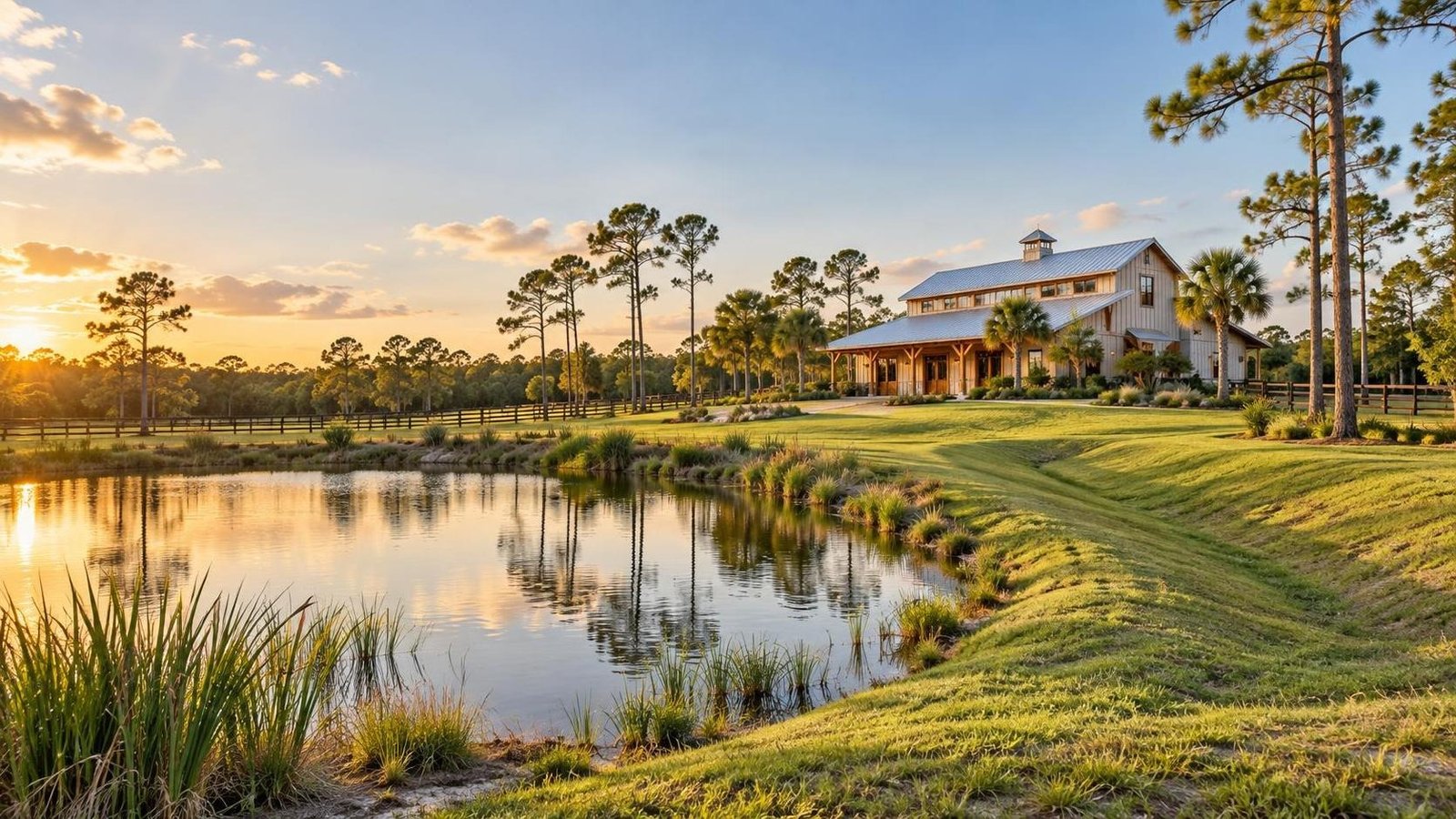
Documented Pond Overflow or Newer Barn Roof: What Should Grant-Valkaria Buyers Prioritize?
By Carrie Liotta, Space Coast REALTOR® with REAL Broker | Published September 29, 2026
I would prioritize the documented pond-overflow route. A newer barn roof is valuable, but water moving through the wrong part of an acreage property can affect the barn, driveway, septic area, fencing, neighboring land, and future projects at once. Choose the newer roof only when the pond’s drainage path is already verified and the remaining risk is manageable.
A roof is a defined building component that a qualified professional can inspect, scope, and often price. An uncertain overflow route is a site question that may involve elevation, outlet condition, erosion, easements, permitting, access, and where the water is allowed to go. I want the land to explain itself before the finishes impress us.
First identify what kind of pond you are buying
Do not assume every body of water on an acreage listing is the same. It may be an excavated pond, a pond created with an embankment, a drainage feature, an irrigation source, a permitted stormwater component, a natural low area, or a combination whose history is not obvious during a showing. The ownership and maintenance questions change with the answer.
The UF/IFAS pond resources explain that ponds can be formed by a dam or embankment, excavation, or a dike around a natural depression, and that ponds may store runoff from rainfall or irrigation. That is useful context, but it does not diagnose this parcel. Ask for the survey, site or drainage plans, permits and final records if applicable, invoices for pond or grading work, photographs from wet periods, and any professional reports.
Then ask a more practical question: when the pond reaches its normal high-water condition and more rain arrives, where does the next gallon go? You want to understand the ordinary outlet, any emergency overflow or broad low route, the receiving area, and what lies between them. A neat pond edge on a dry afternoon does not answer that.
What counts as a documented overflow route?
I am not looking for a seller’s hand gesture toward the back fence. I want several forms of evidence to agree.
- A current survey or reliable site plan that identifies the pond and relevant property features.
- Topographic or drainage information when elevation and flow direction matter.
- Available permits, approvals, final inspections, contractor scopes, or maintenance records.
- Clear identification of pipes, control structures, swales, culverts, embankments, and discharge points that actually exist.
- Seller disclosure and repair history, including known overtopping, erosion, washout, blocked outlets, water intrusion, or neighbor concerns.
- A field walk by the appropriate drainage, civil, pond, excavation, or environmental professional when the decision cannot be made from records alone.
The documents and the land should tell the same story. If a drawing shows an open swale but the route now contains a shed, berm, roots, equipment, or fill, ask whether its function changed. Identify both ends and the condition of any pipe. If water leaves the parcel, confirm the lawful route and recorded rights instead of trusting a worn path through grass.
Use the current Grant-Valkaria Code of Ordinances and the Town of Grant-Valkaria’s official contacts as starting points for parcel-specific questions. I would not generalize a setback, exemption, or permit path from another acreage property. The intended repair and exact jurisdictional history need to be checked for this parcel.
Why overflow uncertainty can outrank a younger roof
A roof problem is serious, but its influence is usually concentrated in and around one structure. A site-drainage problem can connect many parts of the property. Overflow may cross the barn approach, soften a trailer turn, erode a fence line, undermine a culvert, reach stored equipment, interfere with septic service access, or occupy the only practical location for a future workshop, arena, pool, or second driveway.
Damp grass after rain does not by itself make a pond unsafe. The buyer needs to understand the overflow’s frequency, route, depth, duration, erosion, and exposed assets. The issue is whether the property has a predictable, maintainable way to carry excess water without creating a larger chain of problems.
FEMA explains that heavy rain, poor drainage, and nearby construction can create flood damage and that a mapped flood zone is only one risk tool. Its flood-map guidance also says there is no such thing as a zero-risk zone. I still check the address in the official FEMA Flood Map Service Center, but I do not use the map as proof that a pond, driveway, barn pad, or pasture drains well after a local cloudburst.
If horses, trailers, or pasture use are part of the move, my Grant-Valkaria horse-property due-diligence guide explains why wet-season access, fencing, wells, septic, and trailer movement have to work as one operating system. This article goes narrower: it asks whether the pond’s excess water has a verified path that protects that system.
Now evaluate the barn roof as more than an installation year
A “newer roof” is not enough information. Request the permit and final status where applicable, contract, paid invoice, material and manufacturer details, warranty terms, contractor information, repair history, and photographs from the work. Start with the Brevard County building-permit search for available county records, then confirm which jurisdiction holds the file and whether the record was finalized. An online search result is a lead, not the whole investigation.
Have the structure inspected for active leaks, staining, fastener or attachment concerns, lifted or damaged material, flashing, penetrations, ventilation, framing movement, corrosion, pest activity, and drainage at the eaves. The roof covering may be young while the framing, electrical service, doors, slab, or use of the barn creates the larger expense. Conversely, an older roof may remain serviceable when its condition and maintenance are well documented.
Do not assume the barn is covered like the house
Send the full property description to the buyer’s insurance professional: barn size and construction, roof type and age, electrical or plumbing, current and intended use, animals, equipment, business activity if any, and estimated value of the structure and contents. Ask what is included, limited, excluded, scheduled separately, or subject to different loss settlement.
Florida’s current property-insurance consumer information distinguishes actual-cash-value roof coverage from replacement-cost coverage and tells consumers to review their policies with an insurance agent. Do not transfer a rule about the residence to a detached barn without confirmation. The declarations, endorsements, underwriting inspection, intended use, and carrier decision control the actual quote.
Include the barn’s gutters, downspouts, valleys, and ground discharge in the drainage walk. A newer roof can perform as designed yet worsen a low area if runoff is concentrated beside the foundation or sent toward the pond’s overflow route. The inspection scopes are separate, but water connects them.
Compare the cost of the unknown, not the shine of the improvement
Buyers often give the newer roof a clean dollar value because it is visible and recent. The documented overflow route feels less exciting because it may be nothing more than a broad grassy swale, a sound outlet, and a folder of plans and maintenance records. Yet that unglamorous evidence may protect more of the property.
Build two columns. For the pond, include professional drainage review, survey or elevation work, outlet cleaning or repair, erosion control, vegetation management, grading, culvert or pipe work, permitting, and restoration. Separate routine maintenance from a redesign. For the barn, include immediate roof repair if any, future replacement reserve, framing or electrical corrections, gutters and discharge, insurance treatment, and the cost of protecting the contents during work.
Do not rely on broad internet estimates. Access for equipment, soil conditions, pond construction, discharge location, structure size, roofing material, framing condition, wind requirements, and permit scope can change a proposal dramatically. Obtain written property-specific opinions during the inspection period whenever either issue could change your offer.
This is the same systems-first approach I use when comparing a generator-backed well with a newer Grant-Valkaria workshop. The feature with the freshest finish is not automatically the one that reduces the most ownership risk.
When the newer barn roof should win
I would put more weight on the newer roof when the pond has a clearly identified function, complete and consistent records, a visible and maintainable overflow path, no unresolved conflict with buildings or access, and a qualified review that fits the buyer’s intended use. In that case, the drainage question has moved from “unknown” to “understood maintenance.”
The roof can become the higher priority when the barn is central to the purchase and a leak would immediately threaten animals, equipment, hay, or feed. Even then, verify rather than reward the word “new.” An incomplete file, missing final, leaking penetration, poor runoff, or an insurance problem can quickly erase the apparent advantage.
When the overflow route should decide the purchase
I would treat drainage as the deciding issue when nobody can identify the pond’s outlet or emergency path; records conflict with the present grading; overflow approaches the residence, barn, septic components, well equipment, or only driveway; erosion or repeated repairs are visible; or the presumed route crosses another parcel without clear support.
I would also slow down when the buyer’s future plan occupies the same low corridor. A future barn expansion, arena, guest space, pool, garden, trailer pad, or workshop is not viable merely because the acreage total sounds generous. Usable land is the area left after water, wastewater, access, easements, setbacks, trees, utilities, and existing structures are respected.
My guide to Grant-Valkaria acreage records for ponds, culverts, private utilities, and accessory buildings shows what a prepared property file may contain. Missing records do not automatically make the property unacceptable, but they shift more investigation and uncertainty to the buyer.
My inspection-period sequence
- Map the site. Review the survey, property lines, easements, pond, barn, residence, septic areas, well equipment, driveways, culverts, fences, and planned improvements.
- Reconcile records. Match permits, finals, plans, invoices, disclosures, repairs, insurance information, and photographs with what physically exists.
- Walk the water route. From safe ground, identify high and low areas, outlet features, overflow path, erosion, obstructions, roof discharge, and receiving area. Return after ordinary rain when permission and conditions allow.
- Inspect the barn. Evaluate roof covering, attachment, flashing, framing, interior moisture evidence, electrical service, use, access, and ground drainage with the appropriate professionals.
- Quote both risks. Obtain written scopes for the likely drainage and barn work, plus insurance feedback for the exact property and intended use.
- Protect the contract decision. Decide whether to proceed, renegotiate, request a defined correction, preserve a larger reserve, or walk away before the due-diligence deadline.
The better buy has the clearer property story
A newer barn roof is easy to appreciate. A documented pond-overflow route is easy to overlook. On Grant-Valkaria acreage, I usually place the higher priority on the water path because it can influence several systems and future plans at once. Once that route is verified, the barn roof becomes the more familiar question of condition, coverage, timing, and reserve.
I am Carrie Liotta, a Space Coast REALTOR® with REAL Broker and the voice behind 321 Coastal Living. I help relocating acreage buyers compare what the land can support, identify the records and specialists a decision requires, and keep one attractive feature from hiding a larger site risk. Reach out for a no-pressure conversation about Brevard County homes for sale. Your next chapter starts here.
