

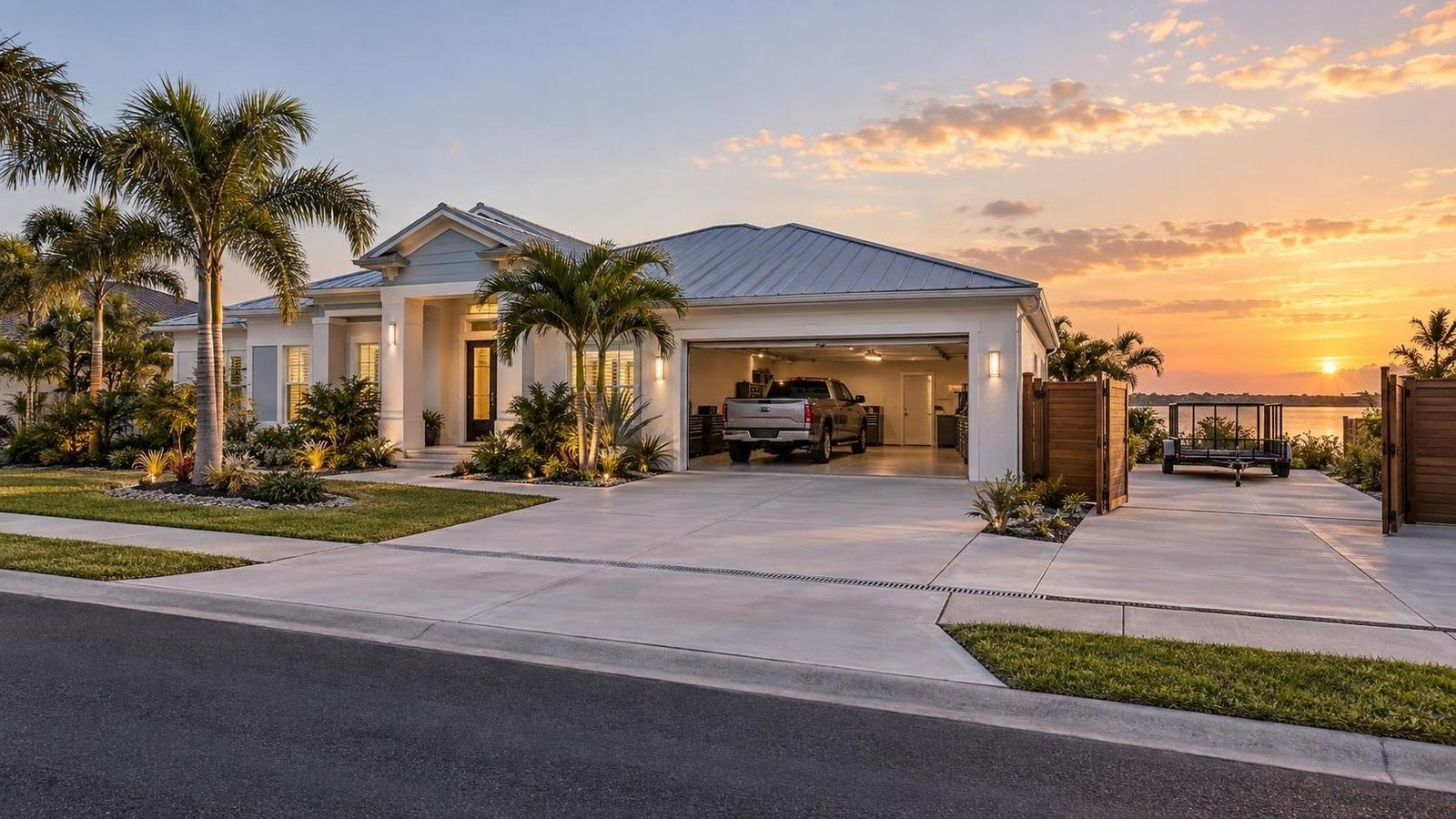
Permitted Trailer Pad or Deeper Garage: What Should Titusville KSC Buyers Choose?
By Carrie Liotta, Space Coast REALTOR® with REAL Broker | Published September 28, 2026
Choose the permitted trailer pad when you truly own and regularly move a trailer, the full access route works, and current city or HOA rules support the use. Choose the deeper garage when secure everyday storage matters more or neighborhood turning space makes the pad impractical. A concrete rectangle has no value if you cannot legally and safely reach it.
For KSC and aerospace households, this choice often involves a boat trailer, utility trailer, work equipment, motorcycles, a long pickup, or project storage. The pad looks like the specialized feature, while the garage looks ordinary. In resale, the more useful feature is the one a future owner can verify and use without a complicated maneuver or rule exception.
Start with the entire movement, not the parking spot
Measure from the travel lane to the final parked position. Record street width, on-street parking, curb radius, driveway width, mailbox placement, drainage swales, culverts, trees, utility boxes, gate opening, roof overhangs, air-conditioning equipment, fence posts, and the narrowest side-yard point.
Then consider the tow vehicle and trailer together. The trailer may fit on the pad yet require a swing that crosses the opposite lane, sidewalk, neighboring frontage, soft shoulder, or landscaping. A long driveway does not guarantee room to straighten. A wide gate is less useful when the approach is angled.
Do not test an unfamiliar maneuver during a showing with a real trailer. Use measurements, aerial context, cones where permitted, and a later controlled test with owner permission and an experienced driver. Verify overhead clearance as carefully as width.
“Permitted” needs a matching record
Ask for the permit, approved site plan, final inspection, contractor invoice, survey, and any HOA approval. Match the dimensions and location in those records to the improvement on the ground. A permit for a driveway extension may not necessarily establish every storage use the seller describes.
The City of Titusville maintains an official Codes and Resolutions portal linking its code volumes and recently adopted ordinances. The city says its online code volumes update quarterly, so buyers should verify the current rule and any newly adopted ordinance rather than relying on an old listing or neighborhood habit.
For a property outside city jurisdiction, the Brevard County permit search is an official starting point. Confirm jurisdiction first. A Titusville mailing address does not by itself answer which authority governs every parcel, and an HOA can impose separate restrictions even when public rules allow a use.
Read the storage rule, not just the site plan
Ask whether the trailer must be screened, stored behind a front building line, kept on an improved surface, registered and operable, limited by type or size, or prohibited during certain periods. Verify whether work trailers, commercial markings, boats, recreational vehicles, and utility trailers are treated differently.
Review the declaration, rules, amendments, enforcement notices, and architectural approvals if there is an association. A prior approval may apply to the pad’s construction without approving every future trailer. Get the current written rule and ask how it is enforced.
My recent guide to work-truck driveways and restrictive trailer rules for Titusville KSC buyers explains why the vehicle that fits physically can still conflict with the ownership documents.
Inspect the pad as drainage infrastructure
Look at slope, cracks, settlement, edge support, surface condition, tire ruts, standing-water evidence, and where runoff goes. A pad that sends water toward the house, garage, neighboring property, or side-yard gate can create a problem that did not exist before.
Check the culvert and swale where the tow vehicle enters. Heavy trailers can expose weak edges or soft shoulders. Ask whether the pad or access route has flooded, washed out, or needed repeated repair. Review the property’s official flood-hazard information through the FEMA Flood Map Service Center, but do not use a mapped zone as a substitute for lot-level drainage inspection.
If electrical power, a gate motor, lighting, or a charging outlet serves the pad, inspect and document those components separately. The pad permit should not be assumed to cover later electrical additions.
What the deeper garage solves better
A deeper garage protects vehicles, tools, bicycles, work equipment, storm supplies, and hobby storage from weather and casual view. It may offer better security, easier daily access, and broader resale appeal. For an owner who tows only occasionally and can store the trailer elsewhere, garage depth may improve every day while the pad sits empty.
Measure clear depth with the garage door closed, not wall-to-wall dimensions. Include steps, water heater, laundry equipment, cabinets, door tracks, attic ladders, charging equipment, bumpers, and the space needed to walk around the vehicle. Check door height and width, floor slope, ventilation, receptacles, lighting, and whether storage blocks panel or mechanical access.
My comparison of deeper garage storage versus a quieter bedroom wing shows how garage dimensions can be important without overriding the household’s daily living pattern.
Run the KSC workday through both homes
If the trailer supports work, ask how often it leaves, when it returns, and whether early or late movement will be practical. Backing through a narrow gate after a night shift is different from storing a weekend boat. Consider lighting, noise, visibility, help from another driver, and whether household vehicles must be moved first.
Test the commute from the driveway at the actual shift time and identify the reporting location or preferred gate. A pad may be worth less if its neighborhood adds a difficult turn, school queue, or launch-event bottleneck before you reach the main route. Conversely, a deeper garage farther from work may create a daily time cost that outweighs storage convenience.
For a five-year resale lens, see my comparison of approved work-truck parking versus a shorter KSC route. The strongest purchase usually supports both the current employer routine and a broader future buyer.
Price the trailer solution honestly
Compare the homes on more than the cost of concrete. Include gate and fence work, drainage correction, tree trimming, electrical or lighting needs, pad maintenance, security, off-site storage alternatives, garage shelving, door modifications, and the opportunity cost of losing side-yard or backyard space.
Also check insurance. Ask whether the trailer, contents, work equipment, and any detached or outdoor storage have separate coverage needs. Do not assume a homeowners policy covers commercial tools, trailer damage, flood, or theft the way you expect. Get advice on the actual property and use.
A permitted pad can deserve a premium when recreating it would be difficult because of setbacks, drainage, lot width, mature landscaping, or current approvals. A deeper garage can deserve a premium when it accommodates common trucks and storage while preserving a flexible yard. Neither feature returns its construction cost automatically.
My due-diligence checklist
- Measure the tow vehicle, trailer, garage, gate, driveway, street, and every pinch point.
- Verify jurisdiction, current public rules, and separate HOA restrictions.
- Match permits, final inspections, survey, site plan, and approvals to the built pad.
- Inspect slope, drainage, cracks, edge support, culvert, swale, and runoff path.
- Confirm lighting, gates, outlets, and security records separately.
- Test the full maneuver with safe planning rather than assumption.
- Drive the KSC route at the real shift time.
- Obtain property- and use-specific insurance advice.
- Plan for resale if the next buyer does not own your trailer.
When each feature wins
The pad wins for a buyer who owns a compatible trailer, uses it often, can make the turn without crossing prohibited or unsafe areas, has written approval for the use, and values on-site access enough to maintain the surface and gate. It is especially persuasive when off-site storage would add cost and time to every trip.
The garage wins for a buyer who needs secure daily storage, owns a long truck or equipment that benefits from weather protection, tows only occasionally, or discovers that street geometry makes the pad frustrating. It also wins when the pad reduces yard function or depends on a use rule that could narrow future resale.
If both features are imperfect, choose the home with the more correctable limitation. Shelving can improve a deep garage. A gate can sometimes be widened with approval. Street width, lot geometry, drainage easements, and the legal location of an existing structure may be much harder to change.
Bottom line
A permitted trailer pad is more valuable than a deeper garage only when the trailer can reach it safely, current rules allow the use, drainage is sound, and the owner will use it often. Otherwise, the deeper garage is usually the more flexible and broadly marketable feature.
Do not buy the pad from an aerial photo. Stand in the street, measure the swing, walk the gate, read the approvals, inspect the runoff, and imagine the maneuver at the end of a real KSC shift.
I help aerospace relocators compare Titusville homes around their actual vehicles, storage, commute, and resale plans. Reach out for a no-pressure conversation about Brevard County homes for sale, or join my private Facebook group, Moving to Brevard County Florida. Your next chapter starts here.
