

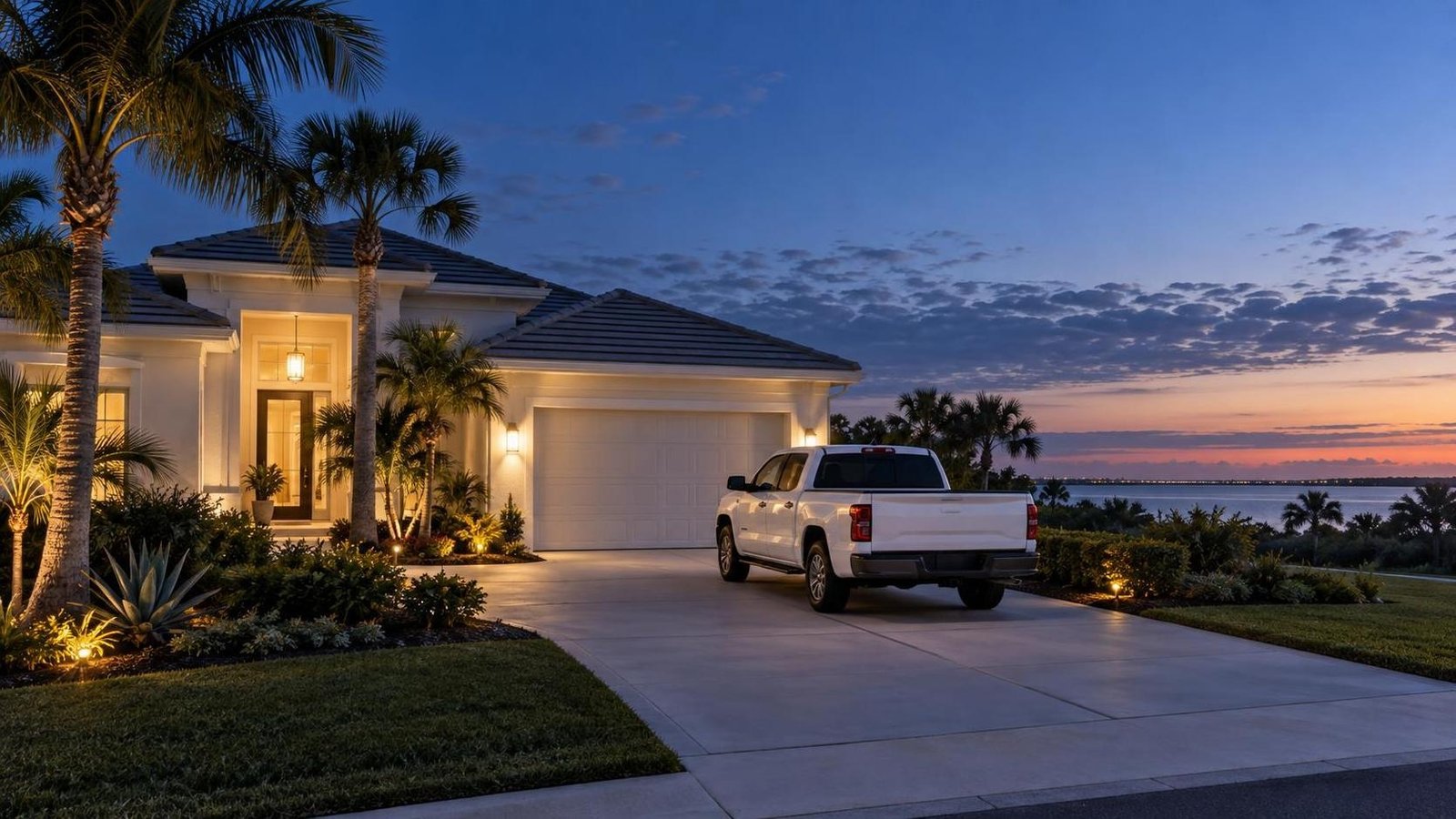
HOA-Approved Work-Truck Parking or a Shorter KSC Route: Which Titusville Home Is Better for Five-Year Resale?
By Carrie Liotta, Space Coast REALTOR® with REAL Broker | Published September 17, 2026
For a KSC buyer who must park a work truck at home, written and durable parking compliance usually matters more than shaving a small amount from the route. A shorter launch-day drive is valuable only if the actual gate and shift benefit is meaningful. Over five years, a parking violation, forced storage change, or unusable garage can cost more than modest commute savings.
The exception is a buyer whose employer provides parking elsewhere or whose truck can reliably fit inside the garage under the rules. Then the shorter route may win. I would test the exact vehicle, read the exact documents, and drive the exact KSC reporting route before assigning a premium to either home.
Define the vehicle before reading the rules
Write down the truck’s length, width, height, wheelbase, weight classification if relevant, employer ownership, registration type, visible logos, magnetic signs, ladder rack, toolbox, lights, trailer hitch, attached equipment, and whether a trailer ever comes home. The phrase “work truck” can describe a clean personal pickup or a marked fleet vehicle with equipment. Governing documents may treat them differently.
Ask whether the buyer needs overnight parking every day, occasional on-call access, weekend parking, or only temporary loading. Note whether tools must remain secure and whether removing a rack or sign is practical. This operating profile should guide the search before a buyer assumes a two-car driveway solves the problem.
Written approval must match the property and vehicle
Read the declaration, covenants, bylaws, rules, architectural standards, parking policies, amendments, board minutes, violation history, and any application or approval. Look for definitions of commercial vehicle, truck, van, signage, equipment, trailer, driveway, garage, street, overnight, and screened parking.
A seller saying “the HOA has never cared” is not approval. A board email to another owner about another vehicle may not protect this buyer. Ask the association or the appropriate legal professional to explain whether the rule allows the exact vehicle at the exact parcel and whether any approval is transferable, revocable, conditional, or dependent on screening.
Florida Statutes section 720.303 addresses HOA powers, board meetings, rules, and official records, including governing documents, current rules, minutes, and other association records. That framework helps a buyer request the right file, but the community’s recorded documents and parcel-specific facts control the practical question.
Use the estoppel without asking it to answer everything
Florida Statutes section 720.30851 requires specified information in an HOA estoppel certificate, including any parking or garage space number reflected in association records, assessments, open violations, transfer-approval requirements, and other associations. That makes the estoppel an important closing document.
It does not replace the covenants or a written answer about the future vehicle. A certificate showing no current violation may only mean the seller’s parking has not produced a noticed violation. The buyer should reconcile the estoppel, rules, approval file, and planned use before the due-diligence period ends.
Physically fit the truck, not a listing’s garage count
Measure the garage opening, interior width and depth, ceiling height, door tracks, water heater, air handler, steps, columns, storage, turning radius, driveway slope, curb, mailbox, gate, and sidewalk. A “two-car garage” can fail a long or tall pickup. A wide driveway can still violate rules if overnight truck parking must be enclosed.
Test how the buyer enters and exits without blocking a sidewalk, shared access, another vehicle, or the garage. Consider whether tools can be unloaded discreetly and securely. If screening, a fence, gate, driveway expansion, or detached structure is part of the solution, verify HOA and permit feasibility before the offer.
My guide to circular driveways and event-day parking at Titusville launch-view homes explains why pavement area alone does not establish practical or permitted capacity.
Map the actual KSC gate and shift
NASA describes Kennedy Space Center as a premier multi-user spaceport with about 100 private-sector partners and more than 10,000 people connected to the center. Those roles do not all report to the same place or schedule. Ask the employer for the appropriate reporting location and access guidance.
Drive from each home at the buyer’s likely shift start and end. Include subdivision exits, school zones, US-1 or I-95 approaches, causeway segments, gate procedures where applicable, parking, and the final walk. Use Florida 511 for current roadway information, but do not treat one result as a guaranteed commute.
Launch-day convenience needs a backup route
A home marketed for a launch-view lifestyle may experience different traffic patterns on high-interest event days. The buyer’s work schedule may also place the trip before, during, or after public traffic. Ask which route the household would use if the normal approach slows and whether that alternative is practical for the vehicle.
My analysis of Titusville KSC shift-worker route flexibility gives a fuller route test. The important point here is that a shorter map distance is not necessarily a more resilient five-year commute.
Build a five-year cost comparison
For the parking-compliant home, include any higher purchase price, HOA dues, gate or screening maintenance, garage modifications, and insurance. For the shorter-route home, include off-site truck storage if needed, added vehicle movement, potential fines or legal review, fuel, tool-security changes, and the cost of selling sooner if the arrangement becomes unworkable.
Do not assume HOA approval adds a fixed dollar amount to resale. It widens usability for a specific buyer group when the right is clear and the property also has a good roof, systems, insurance profile, layout, and location. A restrictive community may narrow the audience even when it accommodates this one truck.
Likewise, route value depends on the next buyer’s workplace. Titusville attracts KSC, contractor, healthcare, remote-work, retiree, and lifestyle buyers. A five-year resale should not depend on one employer or one gate alone.
Consider non-HOA and garage-first alternatives
If bringing the truck home is essential, compare non-HOA properties, larger garages, deeper driveways, side-yard storage where legal, and homes with documented accessory structures. No HOA does not mean no rules; city, county, easement, deed restriction, safety, and insurance requirements still apply.
A garage-first home can offer a cleaner solution when the truck fits and the household can still store personal vehicles and equipment. But older non-HOA homes may require more roof, electrical, drainage, driveway, or insurance due diligence. Do not trade one known restriction for an undocumented property problem.
Protect the resale file from day one
Keep the approval letter, application, vehicle description, governing rule, estoppel, board response, photographs of compliant parking, and any gate, fence, garage, or driveway permits. If the truck changes, ask whether a new approval is needed. Do not assume approval for a pickup covers a van, trailer, taller rack, or company decal later.
At resale, disclose the arrangement accurately. “Current owner parks work truck with written approval dated X, subject to documents and buyer verification” is more defensible than “work trucks allowed.” My seller guide to Titusville driveway-storage and launch-traffic documentation shows how a clean property file supports the next transaction.
Who should choose the approved-parking home?
I would prioritize it for an owner-operated service business, technician, on-call worker, or fleet employee who must bring the vehicle home most nights and whose income depends on immediate equipment access. Written compliance protects the daily routine and reduces the risk of forced off-site storage.
It is even stronger when the home has a garage or screened option that works if rules change within their lawful process. The buyer should still review whether current approvals can be modified and obtain legal guidance when the right is essential.
Who should choose the shorter route?
I would prioritize the route when the truck stays at work, is a normal personal vehicle under the rules, or fits fully inside the garage without sacrificing household function. The commute advantage should be demonstrated at the real gate and shift and should remain useful on ordinary and high-traffic days.
The route may also win for two-career households when the home improves school, childcare, and a second commute. Five-year resale favors choices that solve more than one buyer’s problem.
My before-offer checklist
- Document the exact truck, equipment, markings, dimensions, and parking schedule.
- Read all vehicle, commercial-use, parking, garage, trailer, and screening rules.
- Obtain parcel- and vehicle-specific written association guidance or approval.
- Review minutes, current rules, official records, violations, and the estoppel.
- Measure garage, driveway, gate, turning room, sidewalk, and storage function.
- Verify permits and HOA approval for any proposed physical change.
- Drive the exact KSC reporting route at real shift times and identify a backup.
- Compare five-year ownership, off-site storage, fuel, dues, and modification costs.
- Evaluate resale beyond one employer, gate, or current board practice.
- Keep the approval and compliance file current after closing.
Bottom line
If the work truck must come home, I would usually choose written, workable parking over a modest route advantage. If parking is already solved by the garage or employer, choose the shorter and more resilient KSC route. For five-year resale, the best Titusville home is the one whose parking rights and commute can both be explained with evidence.
If you are relocating to Titusville for KSC or another aerospace role, I can help you compare governing documents, vehicle fit, routes, costs, and resale before you commit. Reach out to Carrie Liotta, Space Coast REALTOR® with REAL Broker, through 321 Coastal Living for a no-pressure conversation. Your next chapter starts here.