

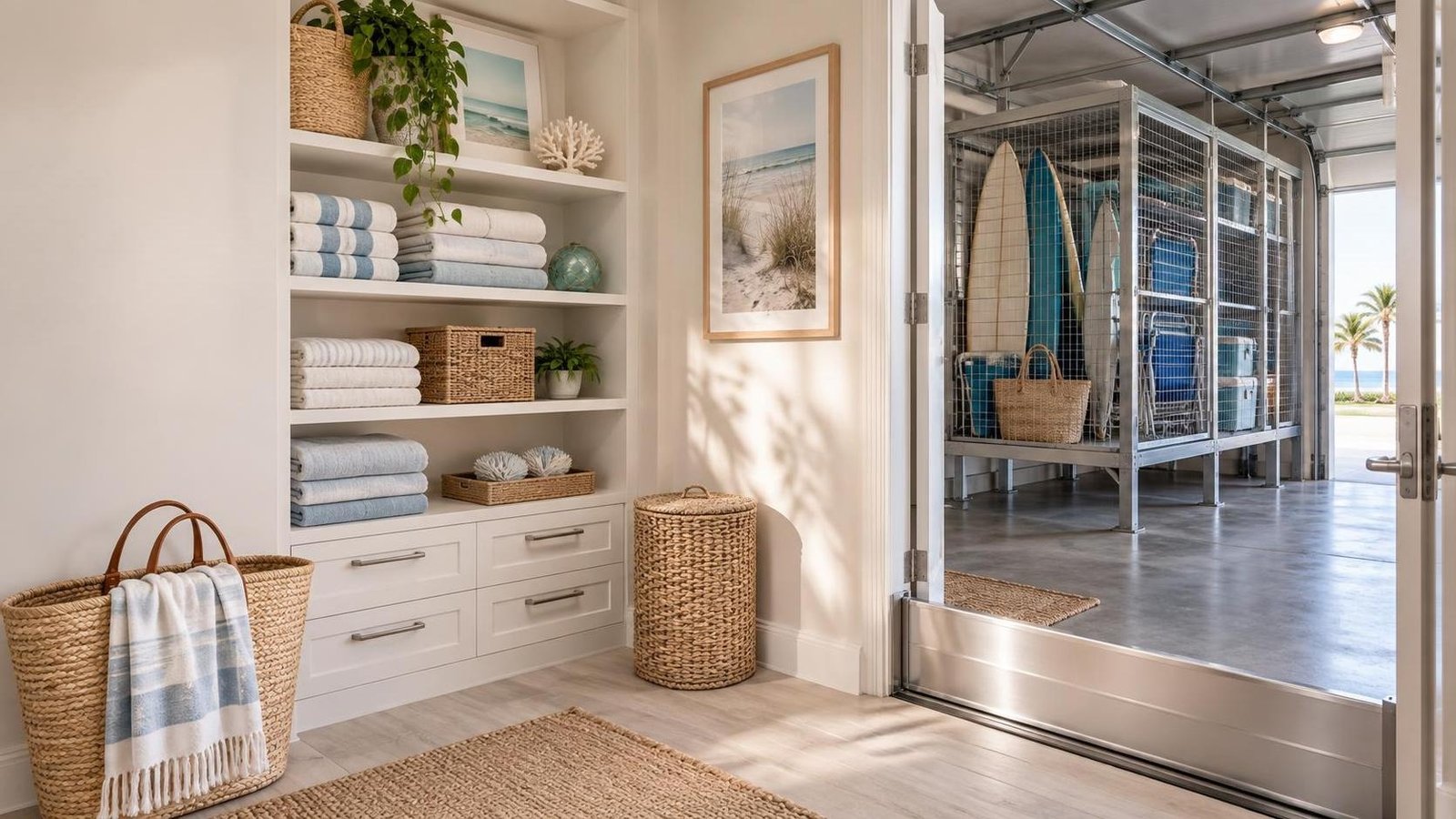
Conditioned Owner Closet or Garage Cage With Flood Barriers: Which Cocoa Beach Condo Storage Is Better?
By Carrie Liotta, Space Coast REALTOR® with REAL Broker | Published September 28, 2026
For most Cocoa Beach condo buyers storing electronics, linens, documents, or seasonal belongings, I would favor a secure conditioned owner closet. A larger garage cage can be better for boards, chairs, carts, and sandy gear, but documented flood barriers do not make garage-level storage dry, climate-controlled, insurable, or unrestricted. Verify both spaces and the building rules.
Storage is one of the least glamorous condo features and one of the easiest to regret. The listing may describe a “private cage” or “owner closet,” yet the real value depends on temperature, humidity, elevation, access, security, legal use rights, fire rules, elevator reliability, and what the association allows inside. In Cocoa Beach, the better choice follows your contents and routine—not the larger square-foot estimate.
Define what you actually plan to store
Start with an inventory. A conditioned closet can be ideal for luggage, clean linens, owner’s supplies, small appliances, paper records, décor, and items that dislike heat or dampness. A garage cage may work better for beach chairs, carts, umbrellas, coolers, bicycles, surf gear, and rinsed equipment that you do not want moving through the unit.
Neither space should be assumed suitable for batteries, fuel, paint, chemicals, propane, motorized equipment, or anything restricted by fire code or association rules. Ask for the written storage policy. If a seller currently keeps an item there, that does not prove the use is permitted.
Then measure the actual space. Listing dimensions may describe the enclosure, not usable shelf depth after pipes, sprinkler clearances, access panels, doors, columns, or shared equipment. Bring the beach cart you use—or at least its measurements—and test the route from parking and beach access.
What “conditioned” should mean in practice
A closet inside the conditioned envelope is generally less exposed to garage heat and outdoor humidity, but the word alone deserves testing. Is the closet truly within conditioned common space, or merely inside a corridor? Does it receive supply air or depend on surrounding temperature? Is there a return path or transfer grille? Are there musty odors, condensation, staining, or a shared wall with wet mechanical space?
Check security, lighting, shelving, door clearance, sprinkler or alarm devices, and whether plumbing runs above the contents. Ask who maintains the door, lock, walls, and any HVAC serving the area. If the closet sits on another floor, determine whether you need an elevator every time you retrieve a chair or suitcase.
My guide to storage lockers sharing ventilation with equipment rooms explains why a space that appears enclosed may still inherit heat, odor, moisture, or maintenance issues from adjacent building systems.
What a flood barrier does—and does not—prove
A documented garage flood barrier can be meaningful building infrastructure. The association may have deployable panels, gates, shields, pumps, or a broader flood-response plan. Ask for the product information, installation scope, maintenance records, deployment procedure, inspection reports, storage location for removable parts, and records of drills or actual use.
Then keep the claim narrow. A barrier is not a guarantee that water cannot enter through another opening, drain, joint, ramp, utility penetration, or overwhelmed system. It does not prevent wind-driven rain, plumbing leaks, sprinkler discharge, condensation, corrosion, or prolonged humidity. It also does not tell you whether the private cage or its contents are covered by association insurance or your unit policy.
Use the FEMA Flood Map Service Center to review official NFIP flood-hazard information for the address, then ask an insurance professional about the unit, personal property, storage location, master policy, and any coverage limitations. A building’s map designation and a barrier’s presence are different pieces of the risk review.
Read the condominium documents before assigning value
Find out whether the closet or cage is part of the unit, a limited common element, association property assigned by rule, or space used under a separate agreement. The difference can affect transfer, maintenance, alteration, leasing, and whether the space follows the unit automatically at resale.
Florida’s Condominium Act, Chapter 718 provides the statewide framework for condominium parcels, common elements, association governance, records, budgets, and disclosures. The specific declaration, amendments, bylaws, rules, plats, assignments, and board records tell you what this building and unit actually provide.
The Florida DBPR condominium division is the state’s official oversight and resource portal. For a purchase, use the association’s current documents and professional advice rather than assuming a generic state rule resolves the location or ownership of one locker.
Test the route at the time you will use it
A closet can be secure and dry but frustrating if it requires a long elevator trip every beach day. A garage cage can be convenient but awkward if the cart must cross vehicle lanes, pass a locked door, or squeeze beside assigned parking. Walk from the unit to the storage, then to the beach access, pool, vehicle, and exterior rinse area.
Check what happens during elevator service or storm preparation. My comparison of temporary storage access during elevator modernization shows how a usable space can become less valuable when the normal route disappears.
Inspect the garage cage like a coastal component
Look at the cage floor and the lower portions of doors, posts, fasteners, shelving, and stored items. Rust lines, efflorescence, swollen boxes, flaking finishes, musty odors, raised pallets, and repeated replacements can tell you how the area behaves. Ask whether the garage has flooded, taken wind-driven water, experienced drain backups, or remained humid after storms.
Ventilation cuts both ways. Open mesh can help wet gear dry, but it also exposes contents to salt air, garage exhaust, dust, pests, and view from passersby. A solid enclosure may improve privacy while trapping moisture. Ask what materials the association permits and whether owners can add raised shelving, covers, dehumidification, or other modifications.
Inspect overhead conditions. Pipes, drains, sprinkler heads, garage joints, and mechanical equipment can create risk unrelated to coastal flooding. Do not place high-value items beneath a stained pipe simply because the floor has a flood barrier.
Compare insurance without assumptions
Request the master insurance summary and ask your insurance professional how personal property in each storage location would be treated under your proposed unit-owner policy and any separate flood coverage. Confirm deductibles, exclusions, limits, loss-assessment considerations, and whether a locker outside the unit changes the answer. Do not rely on the seller’s coverage or a neighbor’s claim experience.
A documented barrier may help you understand mitigation, but it does not automatically create a policy discount or contents coverage. Likewise, a conditioned closet does not mean the association assumes responsibility for stored belongings. Your insurance decision needs the actual unit, building, storage designation, and policy language.
If building emergency power affects access, read my article on emergency power versus a larger Cocoa Beach balcony. Storage value depends partly on whether owners can safely reach it when normal operations change.
Calculate carrying cost and replacement inconvenience
A buyer may pay more for a unit with the better storage assignment, but the premium should reflect usefulness and scarcity, not the seller’s estimate of what cabinetry or a flood barrier cost. Ask whether there is a separate monthly charge, annual fee, transfer fee, waiting list, key deposit, insurance requirement, or special assessment connected to the storage or garage project.
Review recent budgets, reserve schedules, meeting minutes, project contracts, and assessment notices for the barrier system, garage drains, pumps, doors, ventilation, elevators, and storage areas. A new barrier is encouraging, but buyers also need to know how it will be inspected, maintained, deployed, and funded.
Then price the inconvenience of choosing wrong. If you buy the closet but need garage-level beach storage, will you rent off-site space or carry wet gear through the building? If you buy the cage but need controlled storage, will valuable items consume space inside the condo? The answer can change which unit truly has the better floor plan.
My due-diligence request list
- Declaration, amendments, plats, rules, and any assignment showing the storage space tied to the unit.
- Dimensions, location, key or access process, permitted contents, and alteration rules.
- Flood-barrier plans, installation and maintenance records, deployment procedure, and recent testing.
- Garage flood, water-intrusion, drain, pump, and insurance-claim history available from the association.
- Master policy summary and an address- and unit-specific insurance quote.
- Budgets, reserves, minutes, assessments, and upcoming garage or storage projects.
- Elevator, emergency-power, re-entry, and storm-storage procedures.
- A physical inspection of both the assigned space and the full access route.
Which storage wins for different owners?
The conditioned closet usually wins for a seasonal owner leaving linens, décor, luggage, and household supplies between visits; for a full-time owner short on interior storage; and for anyone whose contents are sensitive to heat, humidity, salt, or garage exposure. It is strongest when access remains practical and the space’s legal assignment is clear.
The garage cage can win for a surfer, cyclist, paddler, angler, or family moving bulky sandy gear several times a week. It is strongest when it is raised or otherwise thoughtfully designed, secure, ventilated, near the vehicle and beach route, and supported by a credible building flood-response plan. The owner still needs realistic contents and insurance expectations.
Some buyers need both kinds of storage. In that case, compare the unit’s interior closets and balcony rules before choosing one external space to do every job. A larger cage should not become a reason to store unsuitable items in the garage.
Bottom line
A conditioned owner closet is generally the safer all-purpose choice for Cocoa Beach condo contents. A garage cage with documented flood barriers can be the better lifestyle choice for bulky beach gear, but only after you verify ownership rights, contents rules, water history, barrier maintenance, insurance, and access.
Choose the storage system that protects what you actually own and fits the route you will actually walk. Do not pay a premium for the words “conditioned” or “flood protected” until the documents and physical space support them.
I help Cocoa Beach condo buyers compare the building details that make full-time and seasonal ownership easier. Reach out for a no-pressure conversation about Brevard County condos for sale, or join my private Facebook group, Moving to Brevard County Florida. Your next chapter starts here.