

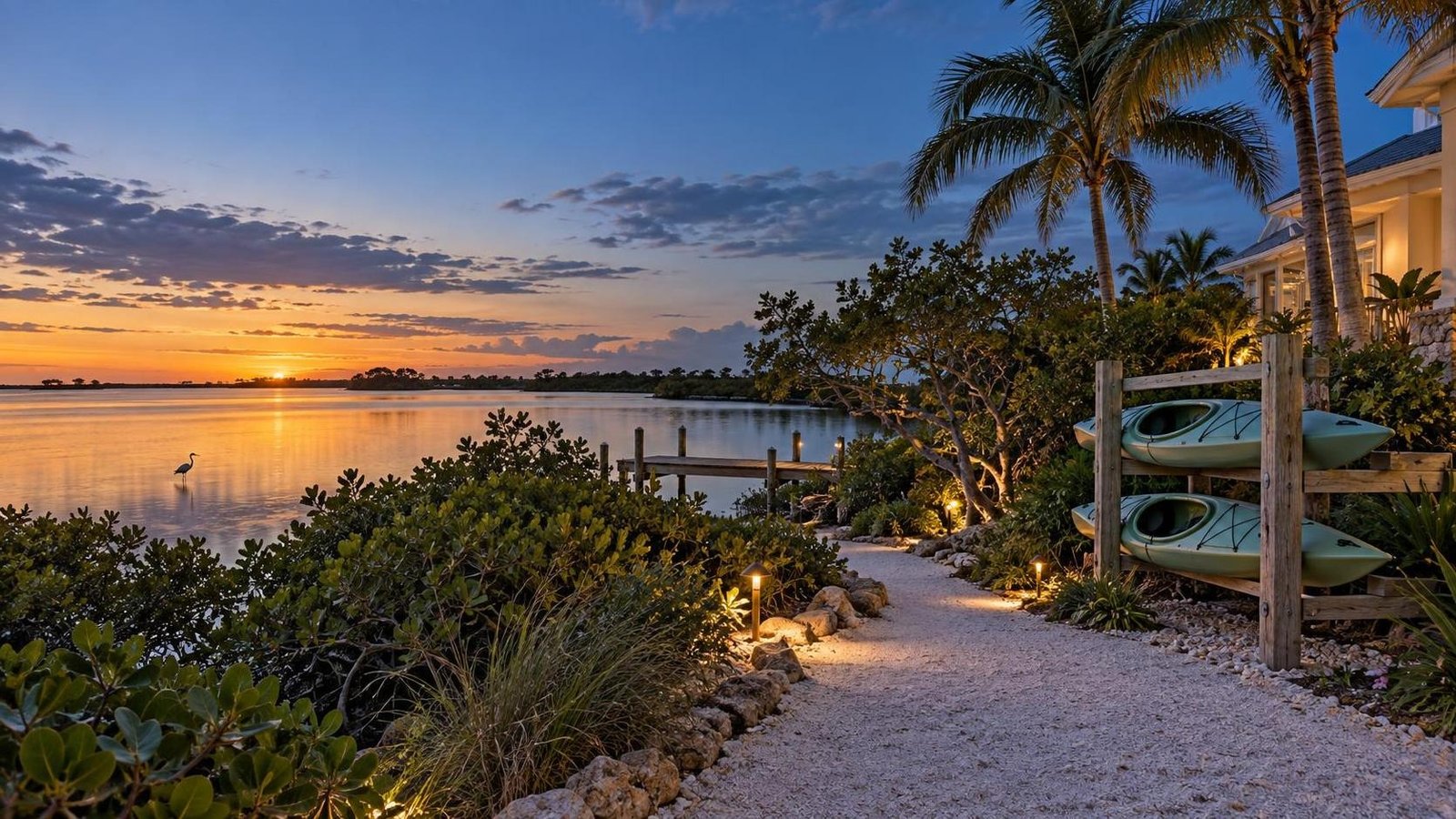
Selling a Merritt Island Waterfront Home? Organize Mangrove, Shoreline-Light, and Kayak-Rack Records
By Carrie Liotta, Space Coast REALTOR® with REAL Broker | Published September 27, 2026
If mangrove trimming, shoreline lighting, and a kayak rack were handled in different years, document them as three separate projects before listing your Merritt Island waterfront home. Collect authorizations, contractor records, photos, invoices, site plans, HOA approvals, and maintenance notes. Never imply that an earlier trimming decision automatically allows the next owner to repeat or expand the work.
These details may look minor beside the house, dock, or seawall. To a waterfront buyer, they shape view, access, nighttime use, maintenance, and the ability to carry a kayak safely to the water. They also touch different questions. Mangroves are regulated environmental features. Shoreline lights involve placement, wiring, and neighbor impact. A kayak rack may be movable personal property or a fixed improvement with its own approval history.
The seller’s goal is not to compress everything into one vague statement that the yard is “approved.” The goal is to show what happened, when it happened, who did it, and what a buyer still needs to verify.
Start with a dated shoreline history
Create a one-page timeline covering the period you owned the property. Note trimming dates, storm damage, professional consultations, shoreline or dock work, light installations or replacements, rack installation, electrical repairs, erosion observations, and changes in access. Add the related document name beside each entry.
Then gather photographs from before and after meaningful work. Photos do not replace permits or professional records, but they help explain what changed. Keep the original date information when possible. Avoid editing images in a way that removes context, and do not use an old photograph to represent current shoreline condition.
Include the current survey, any site plan, dock or shoreline drawings, and the waterfront portion of the seller disclosure. If the rack, lights, or path sits near a property line, easement, shared dock, or association area, flag that issue rather than assuming the current use proves a private right.
Mangrove records need their own section
The Florida Department of Environmental Protection’s current mangrove program page explains that trimming is regulated under the Mangrove Trimming and Preservation Act and directs owners to DEP district offices, delegated local governments, applications, homeowner guidance, and professional mangrove trimmers. DEP also identifies red, black, and white mangroves within the law’s definition and says the same trimming regulations apply to living and dead mangroves.
That means a seller should not describe past work as ordinary landscaping. Gather any application, authorization, exemption documentation, professional mangrove trimmer agreement, invoice, scope, correspondence, photographs, and follow-up records. If a professional provided a plan or specified a height and area, preserve that exact document rather than summarizing it from memory.
Florida’s official section 403.9324 addresses delegation of mangrove regulatory authority and makes clear that the responsible program can depend on whether authority has been delegated. For a sale, the practical lesson is to identify the actual authority and record that applied to the work. Do not rely on a neighbor’s process or an unnamed “county approval.”
If you have no records, do not recreate an approval story. Ask the appropriate agency or qualified professional how to research the history and current condition. The absence of a file may be a disclosure and negotiation issue; it is not permission to trim again before photography.
Describe the view without promising future trimming
A clear lagoon or canal view can be an important part of the home’s value, but listing language should describe present conditions. Avoid promises such as “view can always be maintained,” “mangroves can be cut back,” or “new owner may open the entire shoreline” unless current, property-specific professional and agency guidance supports the statement.
Use accurate language: water view from identified rooms, existing kayak access, observed shoreline vegetation, and records available for review. Let the buyer investigate future plans during due diligence. This is especially important when a buyer imagines enlarging a view corridor, adding a dock, or changing the shoreline after closing.
My broader guide for Merritt Island lagoon-front sellers organizing shoreline, mangrove, and shared-dock records explains why current use and future alteration are separate questions.
Build a lighting map, not just a fixture list
For shoreline lighting, collect purchase records, installation invoices, permits or finals that apply, contractor information, transformer and timer details, warranty information, repair history, and HOA approval. Mark each fixture, cable route, transformer, switch, timer, photocell, and shutoff on a simple sketch.
Explain whether the lights are hardwired, low voltage, solar, removable, dock-mounted, ground-mounted, or integrated into another system. If controls use an app, prepare manufacturer transfer instructions and remove personal access at closing. Do not hand a buyer the password to your home account.
Test the lights before listing. Replace burned-out lamps with the correct type, correct exposed or damaged components through an appropriately qualified professional, and photograph nighttime operation for the file. Check whether glare reaches neighboring homes, a shared canal, or boat approach. A beautiful lighting plan can become an objection when nobody can identify the circuit or when fixtures interfere with safe access.
Decide whether the kayak rack is property or personal property
A freestanding rack that the seller intends to remove creates a different issue from posts anchored into soil, concrete, dock framing, or a seawall cap. Decide early whether the rack and straps convey. Put that decision into listing and contract documents consistently, and remove excluded equipment before photography when practical.
If it stays, gather the product information, installation invoice, permit or association approval that applies, foundation or attachment details, repair history, and any key or lock information. Inspect for corrosion, loose hardware, sharp edges, rot, settlement, and damage where it connects to another improvement.
Then test the carrying route. Can a buyer move a kayak from rack to launch without stepping over wiring, squeezing past pool equipment, crossing unstable ground, or blocking marine service access? A rack can look convenient while creating an awkward or unsafe path. That route should be shown honestly in listing photographs and during tours.
Waterfront use is often decided by the narrow strip between house and water. My article about Merritt Island side-yard service and waterfront access can help sellers see the path through a buyer’s eyes.
Separate environmental, structural, and association approvals
One authority’s action does not automatically replace another’s review. An HOA letter may address appearance without deciding state environmental requirements. A mangrove authorization may not approve a rack foundation or electrical work. A contractor invoice proves work was billed, not that every required inspection was finalized.
Florida DEP’s environmental resource permitting overview describes state and water-management review for activities affecting surface-water flow, wetlands, other surface waters, docking facilities, and related structures. The correct path depends on the specific activity. For local permit history where county jurisdiction applies, use the Brevard County permit search as a starting point and verify status rather than relying on a permit number alone.
Organize the file by authority and project. Label documents “mangrove,” “lighting,” “kayak rack,” “dock,” “shoreline,” and “association.” A buyer should be able to tell which paper supports which feature without interpreting a stack of unrelated PDFs.
What if the records do not match the yard?
Pause before adding more work. Compare the survey and project documents with visible conditions, then involve the appropriate licensed, environmental, legal, or agency professional for the specific gap. Do not ask a landscape crew to provide a legal conclusion about mangroves, and do not ask an electrician to determine property rights.
If a light was moved, a rack was enlarged, or trimming went beyond the file you possess, identify what is known and what remains uncertain. Correct a fixable issue before listing when the benefit outweighs the delay. If correction is not complete, disclose accurately, provide the records you have, and avoid marketing language that treats the question as settled.
The same discipline helps with waterfront drainage and conduit. My seller guide to documenting pool drainage, seawall weeps, and dock conduit shows how separate systems can create one buyer concern when their records conflict.
Protect private information while making the file useful
Remove account numbers, access codes, signatures, personal email chains, and unrelated financial information from the buyer-review copy. Keep full originals secure. The shared file should include enough to identify the property, scope, dates, contractor or professional, authority, outcome, and transferable warranty without exposing private credentials.
Create a short index and name files by year and subject. Include contact information only for businesses or agencies where appropriate, not private neighbors. If there is a shared-use or cost-sharing agreement, provide the recorded or governing document through the proper transaction process rather than paraphrasing it in a text message.
My pre-listing shoreline checklist
- Current survey and a simple labeled shoreline sketch.
- Dated mangrove documents, professional records, invoices, and before-and-after photos.
- Lighting permits or approvals, contractor records, fixture map, controls, and repair history.
- Kayak-rack ownership decision, approvals, attachment details, condition, and clear launch path.
- Dock, seawall, drainage, and shoreline records needed to explain connected work.
- HOA or shared-property documents kept distinct from government and environmental records.
- Accurate seller disclosure and listing language that describes present conditions.
- A plan for unresolved questions before the first buyer inspection.
Bottom line
Mangroves, shoreline lights, and kayak storage can make a Merritt Island waterfront home feel personal and easy to enjoy. They can also create three different due-diligence tracks. The strongest seller file preserves those differences while showing how the yard works as one space.
If you are preparing to sell a waterfront property, I can help you organize the questions, coordinate the real-estate side of the document review, and present the lifestyle without making promises the records cannot support. Reach out for a no-pressure conversation about selling your Brevard County home with REAL Broker. Your next chapter starts here.
