

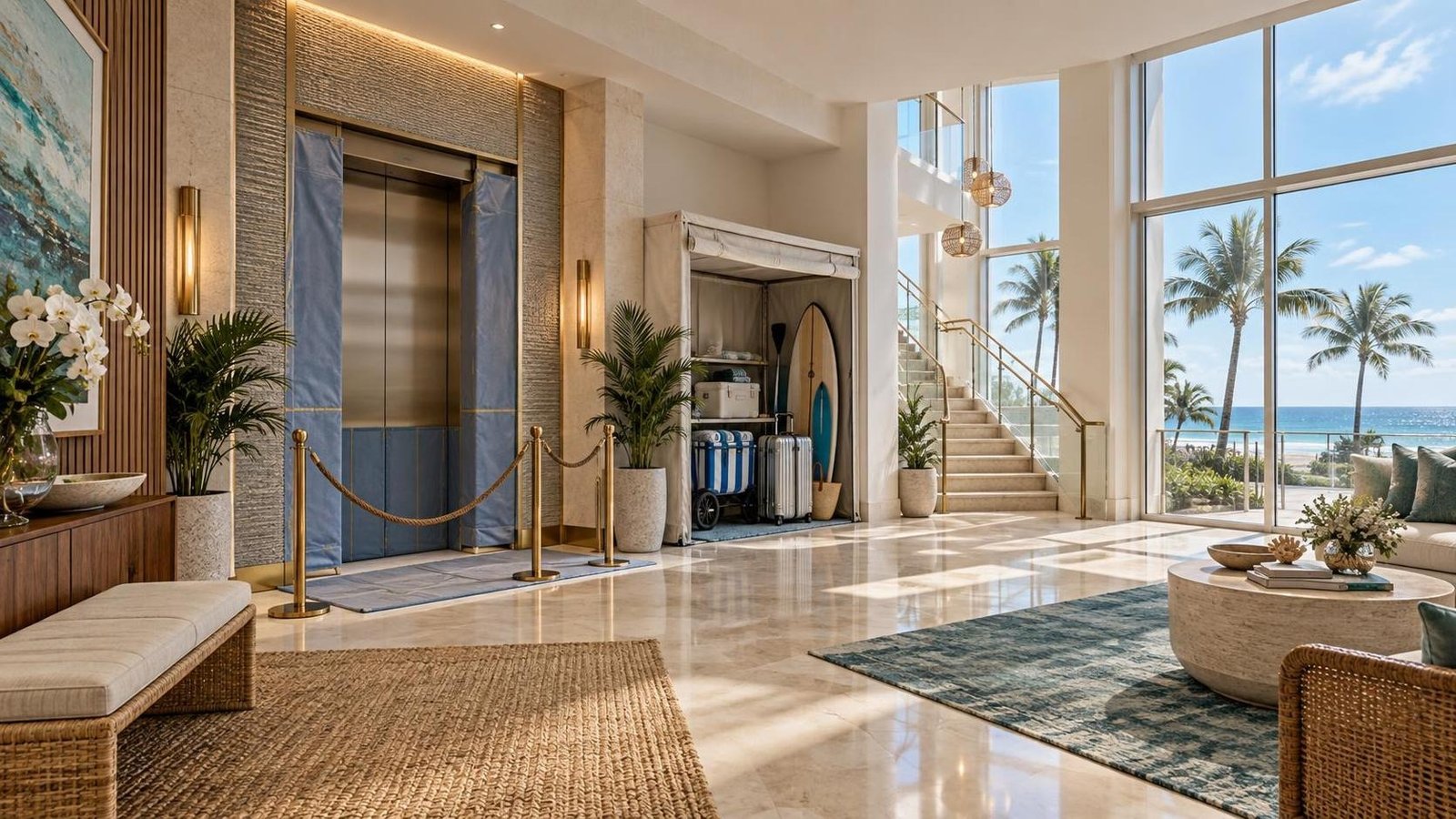
Temporary Storage or Elevator Downtime: What Should Cocoa Beach Seasonal Condo Owners Prioritize?
By Carrie Liotta, Space Coast REALTOR® with REAL Broker | Published September 26, 2026
For a seasonal Cocoa Beach owner, elevator downtime usually deserves priority over temporary storage inconvenience because it can affect whether you, your guests, and your belongings can reach the unit at all. But the better building is the one with a written project plan covering access, storage, deliveries, emergency procedures, funding, and schedule—not the one making the more reassuring verbal promise.
A modernization project can be a positive long-term investment. The difficult part is living through it from another state. Seasonal owners may arrive with luggage, groceries, beach gear, medications, and mobility needs, only to find that the elevator, storage room, loading area, or garage route operates differently from the last visit.
Start with your arrival day, not the finished project
Walk through the first hour of a seasonal stay. Where do you park? Which entrance is open? Can a luggage cart reach it? How many stairs lead to the unit? Where do oversized items go? Are contractors using the loading zone? Can a delivery driver enter? What happens after office hours?
A second-floor owner who travels light may tolerate elevator outages differently from an upper-floor owner carrying mobility equipment or hosting older guests. A ground-floor storage locker may reduce beach-gear friction but does not solve vertical access to the unit.
My recent comparison of documented emergency power and a larger Cocoa Beach balcony uses the same test: building operations can matter more than the feature that photographs best.
Request the modernization file, not a completion date
Ask for the signed contract or owner-facing scope, engineering or consultant reports provided to owners, permits, contractor information, board approvals, project calendar, payment schedule, change orders, meeting minutes, owner notices, contingency plan, and current status report. Identify whether work affects one elevator, all elevators, the cab, controls, doors, machinery, electrical service, fire-safety interfaces, or surrounding common areas.
A target date is not a guarantee. Ask what work is complete, what inspections remain, which dependencies could shift the schedule, and how owners will receive updates. If the building has more than one elevator, verify whether the other remains available throughout the project and whether construction use changes reliability or wait times.
Do not rely on the listing agent’s summary when the association records are available. The Florida Condominium Act, Chapter 718 organizes Florida condo governance, association duties, official records, assessments, and sale disclosures. Your attorney and real estate professionals should guide the specific document request and review.
Temporary storage needs its own written plan
Modernization can close a storage room because contractors need staging, electrical access, fire-safe circulation, or a clear route. Ask which lockers are affected, when access stops, whether owners must remove everything, where temporary storage is located, who has keys, what hours apply, and who bears moving or damage risk.
Confirm size, ventilation, elevation, security, pest control, insurance, cart access, and prohibited items. A temporary cage across the garage is not equivalent to a private dry locker near the lobby. Seasonal owners should also ask what happens to property left behind after the deadline and whether the association or contractor disclaims responsibility.
If the temporary space shares air or walls with mechanical equipment, investigate that arrangement rather than assuming it is suitable for fabrics, electronics, bikes, or beach gear. This guide to Cocoa Beach storage lockers sharing ventilation with equipment rooms explains why “storage provided” is not a complete answer.
Accessibility is not a lifestyle preference
Some owners can use stairs for weeks. Others cannot safely reach the unit without an elevator. Buyers should identify current household needs, likely guests, medical equipment, service animals, and the practical consequences of interrupted vertical access.
Ask the association in writing how it handles access concerns, emergency response, deliveries, and reasonable accommodation requests. Do not assume a volunteer board member’s hallway explanation is the official policy, and do not make legal conclusions from the project schedule alone. If access is essential, involve the appropriate attorney or advisor before the purchase deadline.
Read the budget beside the construction calendar
Determine how the project is funded: reserves, a special assessment, a loan, operating funds, insurance proceeds, or a combination. Ask what owners have paid, what remains due, whether change orders are included, and whether the budget contains a contingency. Review delinquency information and any financing terms made available for buyer review.
The Florida DBPR’s Condominium Information and Resources site was created to explain recent condo-law requirements and links to official summaries of building-safety, reserve, transparency, and association changes. It is a helpful orientation tool, but the specific association’s current budget, contracts, studies, minutes, and legal documents control the practical purchase analysis.
Do not call an elevator assessment good or bad based only on its size. A well-scoped, funded project may reduce future uncertainty. A small initial assessment may be less reassuring if the contract, contingency, or remaining work is unclear.
Financing review may extend beyond the elevator
If you are financing, give the lender the building name and project information early. Condo project review can consider repairs, insurance, litigation, assessments, project characteristics, and other association-level risks—not just your income and the unit appraisal.
Fannie Mae’s ineligible-project guidance, updated August 5, 2026, describes categories of project risk, including projects needing critical repairs and other characteristics. That page does not decide a particular Cocoa Beach building’s eligibility. It does show why the lender should review current facts before the buyer assumes a renovation is routine.
Cash buyers need the same discipline. A future buyer may finance, and project documentation can affect resale even when today’s purchase has no lender.
Check the flood and emergency route separately
Elevator modernization, emergency power, and flood exposure are related in daily planning but not interchangeable. Ask which building systems receive emergency power, whether elevators operate during testing or outages, how re-entry procedures work, and where mechanical and electrical equipment sit.
The FEMA Flood Map Service Center is the official public source for National Flood Insurance Program flood-hazard information. Check the building’s official map information, then review master flood insurance, unit coverage, garage and storage exposure, and evacuation plans with the appropriate professionals.
A temporary storage room at a lower level may be convenient for stairs and still carry a different flood or water-intrusion profile from the original locker. Ask where property will sit, not only how close it is.
Test the stair route like a seasonal owner
Walk from the assigned parking space to the unit using the route that will remain open during construction. Carry a normal bag if permitted. Count doors, turns, landings, and access points. Check lighting, handrails, heat, weather exposure, gate hardware, and whether contractors or materials narrow the path.
Then test the storage route. Can a beach cart, bicycle, cooler, or suitcase turn the corners? Is there a secure place to pause? Are there posted hours? Can guests reach the area without entering contractor zones? Will a move-in or furniture delivery require advance reservation?
Temporary garage work can create another layer. My article on storage closures during a Cocoa Beach garage-ventilation project shows how one building project can reshape owner access beyond the work itself.
Build a seasonal contingency plan
Before closing, write down what you will do if the elevator is unavailable on arrival day, if the storage room is still closed, or if the project extends through your planned stay. Consider luggage delivery, grocery help, medication handling, beach-gear storage, bicycles, guests, cleaning crews, and service appointments.
If you rent the unit when absent, review whether construction affects rental permissions, disclosures, guest access, contractor noise, luggage, or refunds. City rules, association rules, and rental contracts are separate layers. Do not promise tenants normal elevator or storage use when the project file says otherwise.
For a true seasonal retreat, flexibility has value. A building with proactive notices, clear after-hours contacts, staged access, and realistic timelines may be easier to own than one offering a slightly better locker with inconsistent communication.
My buyer document checklist
- Current elevator-modernization scope, contract, permits, timeline, status, and inspection plan.
- Board minutes and owner notices covering shutdowns, delays, change orders, and access.
- Funding source, assessment schedule, reserve information, project loan terms, and contingency.
- Written stair, loading, delivery, move-in, emergency, and after-hours procedures.
- Temporary storage location, dimensions, access hours, security, ventilation, insurance, and prohibited items.
- Accessibility and accommodation process reviewed for the household’s actual needs.
- Master insurance, flood information, building maintenance reports, and lender project review.
- A personal contingency plan for arrival, luggage, guests, beach gear, and an extended schedule.
Which inconvenience should decide the purchase?
Elevator downtime should usually carry more weight when anyone in the household cannot reliably use stairs, the unit is high in the building, stays involve heavy luggage, or the outage window overlaps peak occupancy. In that case, convenient temporary storage does not solve the central access problem.
Storage access may become the bigger issue for a lower-floor, stair-capable owner who keeps bikes, boards, fishing gear, mobility devices, or owner supplies onsite. Even then, verify that the temporary room is secure, suitable, and available for the full project.
Bottom line
A planned elevator modernization can support a building’s long-term function, and temporary storage can be a reasonable compromise. The purchase becomes risky when the schedule, funding, access, or owner communication is vague.
For most seasonal buyers, I prioritize reliable unit access first, then storage convenience. Read the project and association file, walk the temporary routes, involve the lender and insurance professionals early, and decide whether your household can live with the realistic delay—not only the target completion date.
If you are comparing Cocoa Beach condos, I can help you review the building operations, seasonal routine, documents, carrying cost, insurance, and resale story before you commit. Reach out for a no-pressure conversation with Carrie Liotta, Space Coast REALTOR® with REAL Broker, through 321 Coastal Living. Your next chapter starts here.