

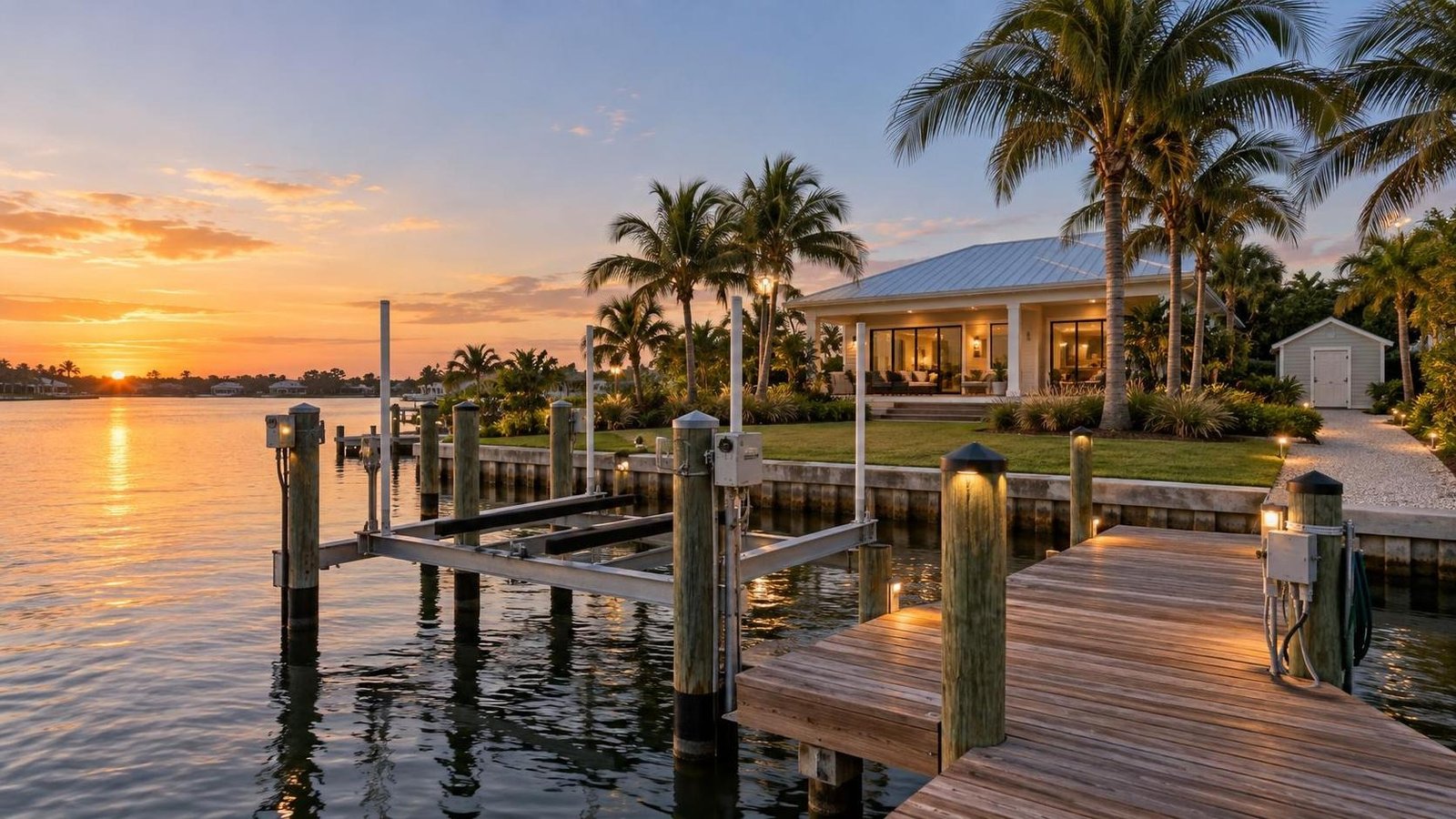
Dock Lighting and a Dedicated Lift Circuit or a Larger Waterfront Shed: Which Merritt Island Home Is Better?
By Carrie Liotta, Space Coast REALTOR® with REAL Broker | Published September 26, 2026
For a buyer who will use the boat lift regularly, I would usually choose documented dock lighting and a dedicated lift circuit over a larger waterfront shed. Safe, understandable marine electrical infrastructure is difficult to evaluate after problems appear. A shed is useful, but only if it is permitted, dry, accessible, and truly needed for your gear.
The word that matters is documented. Decorative lights and a labeled breaker do not prove the dock system was designed correctly. Likewise, a large shed does not add practical value if it blocks seawall access, crowds the side yard, traps moisture, or lacks a clear approval history.
Begin with the waterfront routine
Picture the last ten minutes of a boat day. You return after sunset, align the boat with the lift, step onto a damp dock, rinse equipment, carry gear toward the house, and secure everything. In that moment, lighting location, controls, receptacles, lift operation, and a clear walking path matter more than a shed’s square footage.
Now picture the buyer who kayaks occasionally, does not own a lift-dependent boat, and needs secure storage for paddles, fishing gear, storm panels, tools, and outdoor furniture. That household may use the shed every week while rarely using powered dock equipment.
The better choice follows the actual routine. I do not give automatic value to either feature until the buyer explains the boat, storage needs, storm plan, and maintenance tolerance.
What should “documented dock electrical” include?
I want to see the installation or repair invoice, contractor name, permit and final inspection where applicable, panel and breaker identification, equipment specifications, service records, and a simple route showing how power reaches the dock and lift. If repairs happened in different years, the file should connect them.
Ask who owns each component, where shutoffs are located, whether dock lights and lift equipment are separated as represented, and what happens during a power loss. Have a qualified electrician familiar with waterfront installations inspect visible conditions and test the system. Salt air, spray, sun, movement, and water exposure make this a poor place for assumptions or homeowner experiments.
Florida’s DBPR licensee search is the official starting point for checking people and businesses regulated by the department. Match the seller’s invoice to the contractor and scope rather than accepting “professionally installed” as the entire record.
A dedicated circuit is valuable only if the whole route makes sense
A labeled lift breaker is useful, but buyers should understand the complete path from panel to waterfront. Look for unexplained splices, exposed or damaged components, corrosion, makeshift supports, cords standing in for permanent wiring, and equipment placed where seawall or dock work would disturb it.
Do not open panels or energized boxes yourself. Let the appropriate inspector or electrician evaluate the service, protection devices, disconnects, grounding and bonding, wiring method, fixtures, and equipment condition under the standards that apply to the property and work.
Also verify what the circuit serves. A seller may call it a dedicated lift circuit even though lighting, pumps, receptacles, or other equipment were added later. The answer affects troubleshooting and the buyer’s plan for future upgrades.
My comparison of a private dock circuit and shared dock electrical reserves explains why ownership and maintenance responsibility matter as much as the visible hardware.
Inspect the lighting as a navigation system
Good dock lighting helps people see changes in elevation, corners, cleats, steps, the lift area, and the path back to the house without turning the waterfront into harsh glare. More fixtures are not always better. Placement, shielding, controls, condition, and serviceability matter.
Visit near dusk if possible. Daytime photography will not show whether one bright fixture creates deep shadows or reflects off the water. Test switches and controls with permission. Ask which fixtures work, which are decorative, and whether replacement parts remain available. Include the route from dock to side gate; the safest dock can still lead to a dark, obstructed path.
What makes the larger shed genuinely useful?
A waterfront shed earns value when its approvals are clear, the structure is sound, stored gear stays reasonably dry, doors open fully, and the path between dock and storage works. Measure long items. A large-looking shed may still fail to hold paddles, fishing rods, a beach cart, or removable storm panels without awkward stacking.
Review foundation or anchoring, roof condition, wall and floor moisture, ventilation, electrical work, door hardware, pest evidence, setbacks, drainage, and proximity to pools, equipment, fences, seawalls, and easements. If it has power, treat that as a separate inspection question rather than assuming the dock electrical file covers it.
Waterfront permitting does not stop at the electrical box
The dock, lift, shoreline, drainage, and over-water work may involve different authorities and different records. The Florida Department of Environmental Protection explains that the Environmental Resource Permitting program regulates activities in, on, or over surface waters and wetlands, along with certain activities that alter surface-water flows. Its Submerged Lands and Environmental Resources Coordination page also notes that applications may be processed by DEP or a water management district under agency agreements.
That does not mean every bulb, shed, or dock repair needs the same approval. It means a buyer should not infer the status of one improvement from the records for another. Use the St. Johns River Water Management District permitting resources and Brevard County Natural Resources Management as agency starting points, then confirm the exact property and proposed work with the appropriate professionals.
Think about future seawall and dock access
A shed can be perfectly useful today and still complicate future waterfront work. Walk the route a contractor might need for materials, tools, carts, pumps, or small equipment. Look at gate width, turns, pool enclosures, air-conditioning equipment, landscaping, fences, and the space between the shed and house.
If the larger shed consumes the only practical service corridor, its storage benefit may come with a future labor or access problem. My guide to choosing a dock service path instead of a larger pool deck applies the same test: waterfront ownership works better when maintenance access is preserved before it is needed.
The dock wiring route matters here too. Conduit placed where seawall caps, tiebacks, deck boards, or lift components may be serviced could affect the scope of future work. Ask marine and electrical professionals to explain the relationship rather than evaluating each system in isolation.
Compare repairability, not just present condition
Two systems can work on inspection day and carry different ownership risk. A dock electrical system with clear shutoffs, accessible equipment, labeled circuits, current records, and a known installer is easier to diagnose. A shed with standard doors, dry access, clear anchoring, and space around it is easier to maintain.
By contrast, beautiful custom fixtures with unavailable parts can be frustrating. So can a shed built tightly between the seawall and pool equipment. Ask what happens when one component fails, who can reach it, and whether surrounding improvements must be removed first.
This is also where the boat itself matters. Confirm lift capacity, cradle arrangement, controls, and fit through qualified inspection; do not assume dedicated power means the lift works for your boat. At low water, the relationship between the lift, ladder, seawall steps, and kayak access can change. I cover that physical overlap in this Merritt Island lift and low-water access guide.
How I would price the tradeoff
I would not subtract a generic shed price from a generic electrical-upgrade price. Instead, build a reserve for the unresolved work in each home.
For the dock-electrical home, price a specialist inspection, correction of visible defects, replacement of aging fixtures or controls, and any record or permit resolution identified by the appropriate authority. For the shed home, price moisture or structural repairs, anchoring, doors, ventilation, pest treatment, electrical correction, removal if necessary, and replacement storage if the structure cannot remain.
Then add the major waterfront items that neither feature solves: seawall condition, dock structure, lift service, flood insurance, homeowners insurance, roof, HVAC, drainage, canal utility, and boat route. A neatly lighted dock is not compensation for an unclear seawall. A large dry shed is not compensation for a canal your boat cannot use.
Who should choose the documented dock system?
Give the dock electrical system more weight if you boat frequently, return after dark, rely on the lift, expect guests or children on the dock, or want a waterfront setup that is easier for professionals to understand. It is especially valuable when the records, inspection, shutoffs, service path, and equipment layout tell one consistent story.
The shed deserves more weight if boating is occasional, the dock has simple needs, and secure storage is the daily problem. It can also win for buyers with kayaks, boards, fishing equipment, and storm gear when the structure is demonstrably sound and does not compromise drainage or waterfront access.
My canal-home decision checklist
- Use the actual boat, gear, and after-dark routine to rank the features.
- Match dock and lift invoices to contractors, permits, panel labels, and service records.
- Have qualified professionals inspect waterfront electrical and marine components.
- Visit near dusk and test the lighting layout with permission.
- Measure the shed for the gear you own, not an imagined storage total.
- Verify shed approvals, moisture condition, anchoring, drainage, and electrical work.
- Walk the future seawall and dock service route from street to water.
- Confirm canal, bridge, depth, flood, insurance, and lift-fit questions separately.
- Reserve cash for the unresolved system, even if it works today.
Bottom line
For an active Merritt Island boater, documented dock lighting and a dedicated lift circuit usually deserve priority because they affect every departure, return, and service call. Choose them for proven function, not for the glow in a twilight listing photo.
A larger shed can be the better feature for a gear-heavy, lighter-boating household, but only after its legality, condition, drainage, access, and actual dimensions are clear. In both homes, the winner is the feature that is understandable, serviceable, and aligned with your real waterfront life.
If you are comparing Merritt Island canal homes, I can help you organize the marine, electrical, storage, insurance, and access questions before you choose. Reach out for a no-pressure conversation with Carrie Liotta, Space Coast REALTOR® with REAL Broker, through 321 Coastal Living. Your next chapter starts here.
