

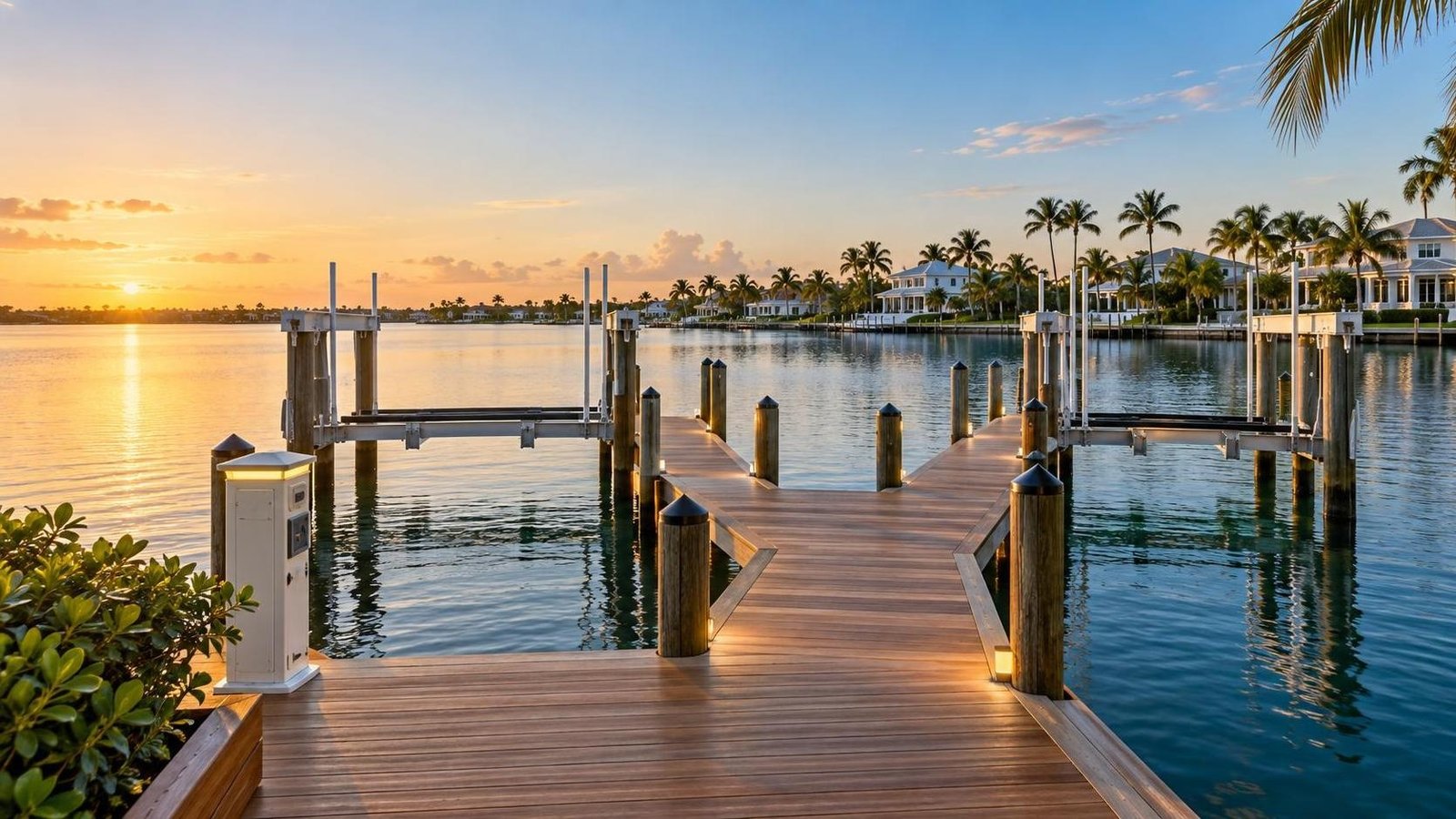
Private Dock Circuit or Shared Dock With Reserves: Which Merritt Island Home Is Better?
By Carrie Liotta, Space Coast REALTOR® with REAL Broker | Published September 23, 2026 on 321 Coastal Living
I would choose the private dock circuit when licensed inspections, permits, shutoffs, and maintenance records are clear and I want control. I would choose the shared dock only when ownership, electrical responsibility, reserve funding, repair authority, and access rights are written and workable. “Shared cost” is not automatically cheaper if no reliable decision process exists.
Canal buyers understandably focus first on the boat route, lift, seawall, and sunset view. Electrical service tends to become a question later, even though it may support lift motors, lighting, receptacles, a fish-cleaning area, or other dock equipment. On a shared structure, one cable or panel can connect several owners’ responsibilities in ways the listing description does not explain.
This comparison is not private equals safe and shared equals risky. Either arrangement can work well. The better purchase is the one where a licensed professional can evaluate the physical system and the documents clearly explain who controls it.
Define what “private” and “shared” actually mean
A private dock may sit behind one home and be used only by that owner, but do not assume every part is exclusively owned. The seawall may connect to neighboring sections. The dock may extend over sovereign submerged lands. Utilities may cross an easement. A lift may have been installed after the original dock permit. The electrical feed may originate from the house panel, a subpanel, or a route that is not obvious from shore.
A shared dock can mean many things: two neighbors using one walkway, several slips under an association, a recorded easement across one parcel, or an informal arrangement that has simply continued for years. Those are not interchangeable. Ask for the survey, deed, title documents, recorded easements, association records if any, and written maintenance agreement.
My earlier comparison of a private kayak launch versus shared Merritt Island water access explains the same core principle: convenient use should be supported by recorded rights and a realistic maintenance path.
Private control comes with full responsibility
The appeal of a private circuit is direct control. You can choose the electrician, schedule repairs, shut the system down, decide whether to upgrade equipment, and maintain records without waiting for another owner’s vote. For a buyer who uses the lift frequently or keeps expensive equipment at the dock, that control can be worth paying for.
The tradeoff is that the invoice is yours. The service route from the house, panel capacity, protective equipment, conduit, pedestals, fixtures, controls, and connections all belong in the inspection. Salt, moisture, sun, movement, landscaping, and prior do-it-yourself work can affect exterior installations. A neat enclosure is not proof of proper wiring.
Ask a licensed electrician with appropriate waterfront experience to evaluate the system. The home inspection is useful, but I would not expect a general inspector to dismantle equipment or certify a dock circuit. The buyer needs a written scope that identifies visible condition, source, shutoff, tested components, excluded areas, and recommended corrections.
Shared reserves are only useful when the rules work
A funded reserve can make a shared dock attractive. Several owners may spread the cost of scheduled electrical service, lighting, walkway repairs, or a future replacement. But a bank balance alone does not answer the important questions.
Who owns the account? What expenses may it pay? How are contributions calculated? Is there a required minimum? Who can authorize emergency work? What happens when one owner does not pay? Does one user’s lift or added equipment change the cost allocation? Is there a qualified contractor relationship? Can the system be shut down promptly if a problem appears?
Read the agreement and recent records together. Request budgets, contribution history, invoices, inspection reports, meeting notes, notices, and correspondence about repairs. A small reserve with predictable annual service may be more credible than a larger stated balance that no one can document. I use the same discipline with condo documents: the account, rules, and actual decisions must tell the same story.
Permits and waterfront authorization are separate from condition
Physical condition does not prove that a dock, lift, dredging project, or electrical improvement was properly authorized. The Florida Department of Environmental Protection’s Environmental Resource Permitting page explains that the program covers surface-water alterations and that DEP generally handles certain docking facilities, attendant structures, and dredging applications. Depending on the work, other state, water-management, federal, county, or local review may also matter.
For local records in unincorporated Brevard, begin with the Brevard County building permit search. Match documents to the actual components you see. A permit for the original dock does not necessarily document a later lift, added receptacle, replacement pedestal, or modified circuit.
Trace the electrical story from panel to water
Ask the electrician to identify where the dock circuit originates, how it is labeled, where it can be disconnected, what equipment it serves, and whether later additions changed the original design. For a shared setup, identify which house, common meter, or panel supplies the electricity and how usage is allocated. A verbal claim that everyone “splits it somehow” is not enough.
Request installation invoices, repair history, breaker or protective-device records, lift service, storm-damage work, and any recent professional evaluation. Look for inconsistencies: an old permit paired with visibly newer equipment, multiple conduit types, controls with different installation dates, or a shared invoice paid by only one owner.
Electrical is also one of the systems considered in a four-point inspection. The Florida Department of Financial Services provides a plain-English four-point inspection guide. A dock circuit may require separate specialized review, but buyers should understand whether exterior electrical questions connect to the home’s larger panel and insurance file.
Inspect the use pattern, not just the hardware
Stand at the dock and walk through a normal boating day. Where do you plug in equipment? Can you reach controls without stepping around another owner’s gear? Does one household need access across another parcel? Can a shared user turn off power during service? Are lift remotes, keys, gate codes, and emergency contacts managed clearly?
Then consider competing loads and future plans. If you want a different lift, added lighting, a cleaning station, or other equipment, do not assume the existing service or agreement supports it. Private ownership may provide more control, but capacity and permitting still matter. Shared ownership may prohibit unilateral additions even when there appears to be physical room.
If kayak and boat features overlap in limited space, see my guide to Merritt Island kayak launches, lifts, ladders, and low-water access. The best dock is not the one with the longest feature list; it is the one whose layout supports the watercraft you actually own.
Do not let the circuit distract from seawall and flood questions
A documented electrical system is only one part of waterfront due diligence. Review the seawall, cap, tiebacks, drainage, dock structure, piles, decking, hardware, lift, roof, wind mitigation, flood information, and insurance quotes. A private circuit should not earn a premium if the supporting dock or shoreline needs major work.
Check the property at the FEMA Flood Map Service Center, the official federal source for flood-hazard information. Obtain property-specific insurance guidance rather than assuming two canal homes share the same cost or coverage story.
When major components compete for reserves, prioritize safety, structure, insurability, and water access before convenience upgrades. My comparison of Merritt Island seawall tiebacks versus a whole-home generator offers a useful model for ranking expensive waterfront systems.
Calculate the private and shared costs differently
For the private dock, build a five-year ownership worksheet with current repairs, routine electrical evaluation, lift service, dock and seawall maintenance, and a contingency for unexpected waterfront work. Use written property-specific estimates. The benefit of control is real, but control does not make maintenance inexpensive.
For the shared dock, include regular contributions, known projects, possible special contributions, and the risk that another owner delays or disputes work. Review whether the agreement has a method for adjusting contributions when use or equipment differs. Ask whether unpaid shares become a lien, personal obligation, or unresolved neighbor conflict; have the appropriate attorney explain the documents.
Then compare your temperament. Some buyers would rather pay the full bill and control timing. Others prefer cost-sharing and are comfortable with a formal group process. Neither preference is wrong. Trouble begins when a buyer pays a private-dock premium for a poorly documented circuit or accepts shared control under an informal handshake.
My contract-period checklist
- Current survey, title review, deed, recorded easements, and shared-use agreement;
- dock, lift, electrical, shoreline, and dredging permits or authorizations that apply;
- licensed waterfront-electrical inspection and written repair scope;
- dock, lift, seawall, and drainage evaluations suited to the property;
- shared reserve statements, contribution records, invoices, notices, and decision rules;
- flood-map review and property-specific insurance quotes;
- written confirmation of what equipment, remotes, controls, and warranties convey;
- navigation due diligence for the buyer’s actual boat, without relying on promised depths.
If any crucial right or cost allocation exists only in conversation, pause. A waterfront feature can add real lifestyle value, but future buyers will ask the same ownership questions you are asking now.
Which option would I choose?
I would choose the private circuit for a frequent boater who values immediate control, has the reserve to maintain everything, and receives a clean professional and permit file. I would choose the shared dock for a buyer whose usage is lighter, whose slip and access rights are clear, and whose cost-sharing agreement has funded reserves, consistent records, and an effective repair process.
I would walk away from either arrangement if specialized inspection is blocked, ownership cannot be explained, permits do not match the improvements, or the only maintenance plan is “the neighbors handle it.” The view does not cure uncertainty about water, electricity, access, and money.
Bottom line for Merritt Island canal buyers
Private control is valuable when the system is documented and you can afford full responsibility. Shared ownership can be efficient when the agreement, reserves, and repair authority are stronger than an informal neighbor arrangement. Compare the paperwork and operating process as carefully as the dock itself.
I am Carrie Liotta, Space Coast REALTOR® with REAL Broker. If you are comparing Merritt Island canal homes, I can help you organize the waterfront specialists, records, cost questions, and offer protections before you pay for a dock feature you do not fully control. Reach out for a no-pressure conversation about Brevard County homes for sale. Your next chapter starts here.
