

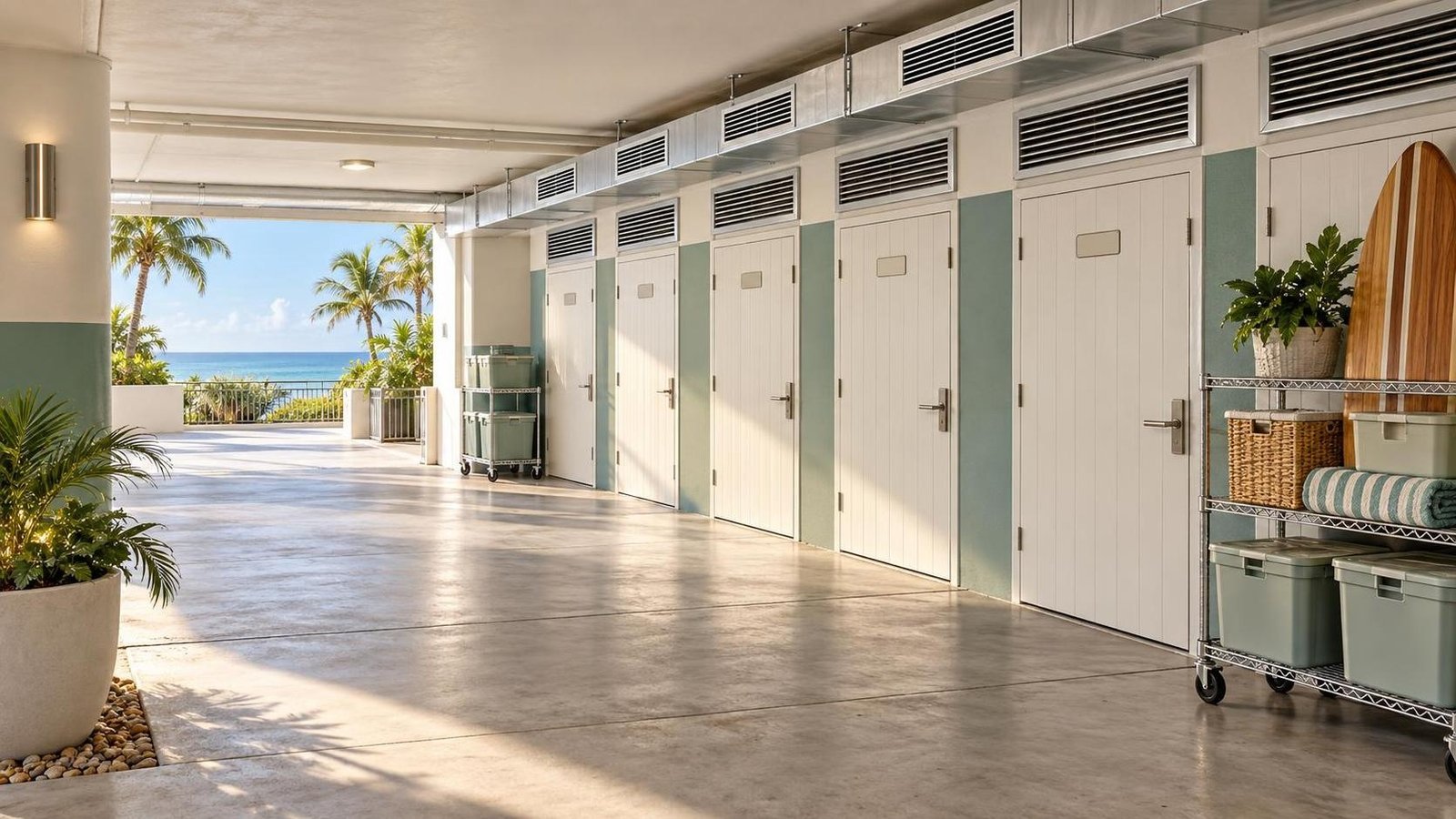
What Should Cocoa Beach Condo Sellers Document When Garage Ventilation Work Closes Storage Lockers?
By Carrie Liotta, Space Coast REALTOR® with REAL Broker | Published September 22, 2026
A Cocoa Beach condo seller should disclose the locker closure early and provide the actual project file: notices, scope, dates, access restrictions, funding, temporary-storage plan, and the document establishing the unit’s storage rights. Buyers can accept inconvenience; what creates distrust is an advertised locker that cannot be used and has no reliable reopening story.
This issue affects more than beach chairs and holiday boxes. In a coastal condo, storage may be part of the unit’s practical value. Full-time residents need room for bikes, boards, fishing gear, luggage, and storm supplies. Seasonal owners need a secure place to leave belongings. If a ventilation project interrupts that use, the listing must explain what is happening without guessing.
Start by proving what the seller actually owns or controls
Do not describe a locker as “deeded” simply because it has the unit number on the door. Review the declaration, recorded exhibits, amendments, unit deed, association records, and any assignment document. The space may be part of the unit, a limited common element reserved for a unit, a common element assigned by rule, or a revocable-use arrangement.
The distinctions matter because they affect transfer, maintenance, access, and what can be promised to a buyer. The Florida Condominium Act, Chapter 718 defines condominium units, common elements, limited common elements, declarations, assessments, and association obligations. The governing documents for the specific Cocoa Beach association still control the property’s particular arrangement.
My rule is simple: match the listing language to the document. If the paperwork establishes assigned use rather than separate ownership, say that. If the association can relocate lockers, disclose that authority. If the records are unclear, have the seller seek appropriate legal or title guidance rather than creating certainty in marketing copy.
Build one project timeline buyers can follow
Collect every notice related to the ventilation work and place it in chronological order. Include the initial problem description, engineering or consultant summary available to owners, board approvals, contractor agreement or scope summary, permit information, start notice, access schedule, revisions, delays, and current completion estimate.
Separate confirmed dates from targets. “Substantial completion anticipated in November” is not the same as a guaranteed reopening date. If final inspection, balancing, testing, punch-list work, or board authorization must occur before owners regain access, identify those steps.
Board meeting minutes are particularly useful because they show how the project evolved. Request the relevant official records early, not after a buyer raises the question. The Florida DBPR condominium resources provide official links to statutes, rules, forms, and owner guidance, but they do not replace reviewing this association’s documents.
Explain why the lockers are closed without diagnosing the building
A seller should accurately relay the association’s stated reason for closure: construction access, dust control, air-balancing work, fire or life-safety separation, equipment replacement, electrical work, or another documented purpose. Do not expand that into your own engineering conclusion.
If the project concerns ventilation shared with a garage or equipment area, buyers may ask about odors, moisture, temperature, air movement, or stored-item restrictions. Give them the available reports and rules. If a qualified professional has not declared the completed condition, neither the seller nor I should promise it.
For buyers approaching the issue from the other side, my guide to a Cocoa Beach storage locker sharing ventilation with an equipment room explains the questions that careful purchasers will bring to the showing.
Show the financial path, including what remains uncertain
Provide the adopted project budget, contracts or summaries distributed to owners, reserve allocation, insurance proceeds if officially documented, special assessment notices, loan documents, payment schedule, and current owner ledger. If the seller has paid an assessment, retain proof. If installments remain, the contract should clearly allocate responsibility with advice from the closing professionals.
Buyers will also want to know whether the ventilation project is part of a larger garage, electrical, fire-safety, structural, waterproofing, or reserve plan. Give them the current budget, available reserve study, recent financials, insurance summary, and relevant minutes so the project is not presented in isolation.
Do not say “fully funded” unless the records support it and no pending board action changes that conclusion. A project can have an approved budget and still face change orders. The right language is factual: amount adopted, amount collected, contract status, disclosed contingency, and any open decisions.
This is also why I encourage condo sellers to order lender-facing documents early. My article on whether a Cocoa Beach seller should obtain an association questionnaire when dues rise shows how building information can affect financing and timing.
Document temporary storage as carefully as the locker
If the association offers temporary storage, get the rules in writing. Identify location, dimensions or capacity, access hours, security, item restrictions, humidity or ventilation limitations, insurance responsibility, move-in process, labeling, and the date by which items must be removed.
If the seller rented off-site storage, clarify that the rental is personal and does not automatically transfer. Provide costs only as the seller’s current arrangement, not as a guaranteed rate for the buyer. If no alternative exists, say so directly and remove stored items before the deadline required by the association and contract.
Photograph the locker empty before construction access when possible, then keep an inventory of anything relocated. Do not photograph confidential labels, codes, keys, or neighbors’ property for the listing file.
Adjust listing photography and remarks to present reality
Do not use an old wide-angle locker photo without disclosing that access is suspended. If the area is an active or restricted work zone, respect the association’s rules and contractor safety requirements. The buyer does not need dramatic construction footage; the buyer needs truthful context.
A useful listing statement might explain that the unit has an assigned storage right subject to the governing documents, access is temporarily closed during an association ventilation project, and project records are available for review. The exact wording should reflect the file and any legal guidance.
Storage should not dominate the marketing if it is temporarily unavailable. Lead with the unit’s genuine strengths—condition, parking, layout, beach routine, balcony, building amenities—then make the project information easy to obtain. Transparency is not the same as making the listing sound distressed.
Anticipate the buyer’s practical questions
A full-time buyer may ask where bicycles and hurricane supplies can go now. A seasonal owner may need after-hours access when arriving from out of state. A surfer or paddler may care whether sandy or wet equipment is permitted in temporary storage. A retiree may ask how far the alternate space is from the elevator or parking.
Answer from written rules. If no answer exists, send the question to the association through the proper channel and preserve the response. Do not promise an exception based on what another owner appears to do.
Sometimes the locker matters less than balcony use or interior closet space. Sellers can help buyers evaluate that tradeoff by linking them to accurate floor plans and rules. My comparison of a ventilated Cocoa Beach storage locker and a better balcony with stricter rules explores that lifestyle decision.
Keep flood and insurance records separate but available
A garage project can prompt questions about elevation, water entry, prior claims, and storage risk. Do not imply that ventilation work solves flood exposure or that a garage location proves a particular flood condition. Give buyers the association’s documented project reason, current master-insurance information, known claim information required for disclosure, and any available flood documents.
The FEMA Flood Map Service Center is the official public source for National Flood Insurance Program hazard mapping. Buyers should still obtain unit- and building-specific insurance guidance. Stored personal property coverage, master-policy coverage, unit-owner coverage, and flood coverage are separate questions.
What I want ready before the listing goes live
- The deed, declaration provisions, exhibits, and assignment records describing the locker right.
- Current rules for lockers, garages, wet gear, batteries, hazardous materials, and access.
- Project notices, scope, consultant information, contract summary, permits, and timeline.
- Minutes covering approval, changes, delays, funding, and reopening conditions.
- Assessment notice, seller ledger, proof of payments, and remaining installment details.
- Temporary-storage terms and the seller’s inventory or removal plan.
- Current budget, available reserve study, financials, master-insurance summary, and lender questionnaire.
- A written explanation distinguishing confirmed facts from projected dates.
How this affects price and negotiation
A temporary closure does not automatically require a dramatic discount. The impact depends on duration, funding certainty, storage importance, available alternatives, project risk, and the unit’s competitive position. A short, well-documented closure with funded work is different from an open-ended restriction and missing records.
Price should recognize friction without pretending the project has no value. Improved ventilation or completed building work may benefit the property, but buyers still experience the closure now. I compare competing Cocoa Beach listings by usable storage, parking, building records, total monthly cost, and financing readiness—not by the locker alone.
If a buyer asks for a credit, confirm that it works with the contract and lender. A precise closing solution may be better than an unsupported estimate for inconvenience.
Bottom line for Cocoa Beach condo sellers
Make the storage right, closure, project scope, funding, temporary plan, and reopening conditions understandable before buyers tour. Correct weak listing language, give purchasers time to read the file, and update the package whenever the association changes the schedule.
A seller cannot control every contractor delay or board decision. You can control whether the buyer receives a coherent, accurate story. If you are preparing to sell a Cocoa Beach condo during building work, I can help organize the records, presentation, pricing, and buyer questions without overstating what the association has promised. Reach out for a no-pressure conversation with Carrie Liotta, Space Coast REALTOR® with REAL Broker. Your next chapter starts here.