

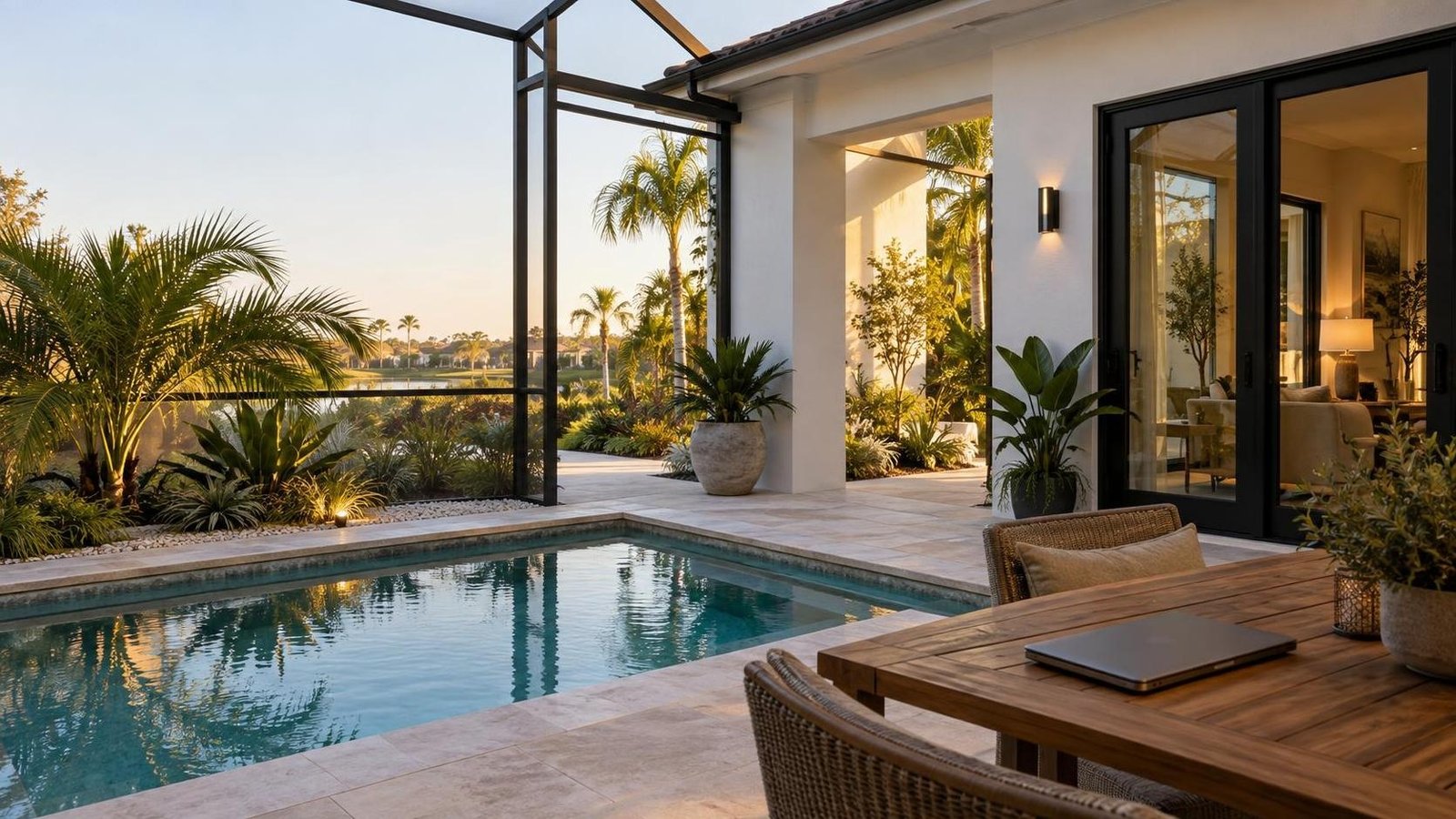
Shaded Interior Courtyard or Corner Lot: Which Viera Home Fits Remote Work and Pool Privacy?
By Carrie Liotta, Space Coast REALTOR® with REAL Broker | Published September 22, 2026
Choose the shaded interior courtyard if quiet work calls, controlled afternoon light, and immediate privacy matter more than yard flexibility. Choose the Viera corner lot when you need broader outdoor options and service access—but only after verifying setbacks, easements, drainage, fence rules, and the actual pool footprint.
This is one of those decisions that looks simple on a listing portal and becomes very personal during a second showing. The courtyard photographs beautifully and may feel calm at noon. The corner lot looks larger and suggests possibilities. Neither impression tells you what the office feels like at 4 p.m., whether a future pool can be approved, or how exposed the outdoor area feels from two street fronts.
The courtyard is a daily-life feature, not just a design detail
An interior courtyard can give a Viera home a protected outdoor room between wings of the house. For a remote worker, that configuration may soften direct light, create a pleasant view from an office, and separate work space from the street. It can also make a smaller footprint feel more connected to the outdoors.
The best courtyard homes are easy to use. The doors open naturally from rooms where you spend time. Water drains away from thresholds. The space has shade when you need it but still dries after rain. Outdoor equipment is accessible without routing service workers through the house. The landscaping is scaled to the enclosure rather than crowding walls, screens, and drains.
The tradeoff is that a courtyard can trap sound and heat if the design is wrong. Pool equipment, a neighbor’s compressor, a fountain pump, or conversations may reflect between walls. A shaded courtyard can also remain damp longer than an open yard. I want buyers to listen, not just look.
My recent comparison of a shaded Viera office and a brighter corner room explains why the best office orientation depends on screen glare, task lighting, and your actual schedule.
A corner lot offers options, but not unlimited freedom
Corner lots often provide visual openness, additional frontage, and a side-yard configuration that appears more generous. That can help with garage approach, guest parking, landscape design, or the route used to build and service a pool. But a corner lot can also have more public exposure, more sidewalk edge, more lawn to maintain, and a yard that is less private than its dimensions suggest.
The second street creates another front-facing relationship. Fences, landscaping, gates, and accessory improvements may be regulated differently from what a buyer assumes is a normal side yard. Utility, drainage, or access easements may cross the most convenient-looking area. A broad lawn is not the same thing as a buildable pool envelope.
That is why I never tell a buyer, “You can put a pool there,” based on a showing. We need the survey, recorded easements, applicable county requirements, neighborhood documents, utility locations, and a qualified pool contractor’s site review. If the pool is central to the purchase, do that work during the contract period rather than after closing.
Test home-office glare at the time it happens
A remote worker should visit when the sun is most likely to affect the proposed office. Bring the laptop you use or a similarly reflective screen. Sit at the likely desk wall. Check whether blinds would need to remain closed through every afternoon call. Look for reflected light from water, pale pavers, neighboring windows, and white exterior walls—not only direct sun.
Then consider what a shade solution would change. Exterior planting may take time to mature and may be limited by association rules. A permanent awning or screen may require approval. Interior shades may solve glare but remove the courtyard view that attracted you. A different desk position may work, but only if outlets, doors, and circulation cooperate.
For buyers comparing outdoor orientation more broadly, I also wrote about choosing between a west-facing Viera pool and an east-facing lanai. The lesson is the same: compass direction is useful, but house geometry and neighboring conditions decide how the space actually performs.
Pool privacy has three separate layers
When clients say they want privacy, I ask what they mean. Visual privacy, sound privacy, and functional privacy are different.
Visual privacy
Stand where the pool, seating, and screen door would likely go. Look toward sidewalks, neighboring second-floor windows, walking paths, and the street corner. A corner lot may allow more landscape buffering, but sight triangles, utility clearance, and HOA standards can limit what you plant or build. A courtyard may block views naturally, although windows from the surrounding rooms can make the pool feel more internal than secluded.
Sound privacy
Listen for traffic acceleration, school-route activity, recreation areas, pumps, and nearby mechanical equipment. Walls and screens do not erase sound. An interior courtyard may shield some street noise but amplify equipment mounted within the enclosure. A corner yard may spread sound outward while bringing two street edges into the experience.
Functional privacy
Think about service access, wet bathing suits, outdoor showers, deliveries, and guests. Can a pool technician reach equipment without crossing the home office window? Can children move from the pool to a bathroom without tracking through the main living space? Is the gate location practical and compliant? Privacy that makes maintenance awkward can become a daily annoyance.
Drainage should shape the decision before décor does
Viera’s planned landscape and drainage infrastructure are part of the community context. The Viera Stewardship District describes district responsibilities that include drainage-system and community-canal maintenance in its service area. That does not replace parcel-level due diligence. Water still moves according to the grading, swales, roof discharge, neighboring lots, and improvements around the specific home.
After rain is the best time to observe. Look at courtyard drains, paver edges, door thresholds, side-yard swales, downspout discharge, low spots, and staining. Ask whether fences, pools, screen enclosures, patios, or landscape beds changed the original flow. Request permits and approvals for completed improvements.
Use the FEMA Flood Map Service Center for official flood-hazard mapping, but do not confuse a mapped flood zone with a complete drainage assessment. A property can have nuisance ponding or poor lot drainage without that issue being explained by a national flood map.
I also pay attention to irrigation overspray and run times. The University of Florida’s IFAS irrigation resources are a useful Florida-specific reference, but the inspection should still identify where this home’s heads, valves, drains, and controller are located. A courtyard with constantly wet walls or a corner lawn watering the sidewalk deserves investigation.
Documents that matter before you choose
Ask for the current survey first. Mark the property lines, easements, existing improvements, and dimensions you care about. Then review the declaration, architectural guidelines, and any supplemental rules for the exact association. “Viera rules” are not one universal document.
For an existing pool, courtyard enclosure, fence, patio, or structural shade feature, compare seller records with available permits. The Brevard County permit-search page is a starting point for county records. Some records may be under another authority, and absence from an online search is not proof that work was unpermitted.
For a proposed pool, ask the association what approval is required, then involve the pool designer, surveyor, utility locator, and any other qualified professional needed for the site. Request a concept that shows water, deck, enclosure, equipment, drainage effects, access route, and setbacks. A sales sketch that only shows a blue rectangle is not enough.
Resale: which lot type will the next buyer value?
A well-designed courtyard can be memorable. It may appeal to remote workers, frequent travelers, buyers who prefer lower visible yard maintenance, and people who want a protected outdoor room. Its resale weakness appears when the enclosure is dark, damp, noisy, difficult to service, or too small for the buyer’s outdoor plans.
A corner lot can attract buyers who want openness, side access, landscape presence, or a more flexible yard. Its resale objections may include traffic exposure, reduced privacy, extra maintenance, and confusion about what can be fenced or built.
Neither lot type earns a universal premium. Condition and execution matter. A usable courtyard is more valuable than an awkward one; a corner lot with documented improvements and a private outdoor plan is stronger than a larger lawn crossed by restrictions.
Preserve views add another layer. If you are also considering them, read my guide to a preserve-view resale versus a newer Viera home, because view protection, drainage, and future plans should be verified separately.
My practical decision test
Choose the courtyard if you work from home most days, need reliable screen comfort, prefer an enclosed outdoor room, and the drainage and sound checks are clean. It is especially compelling when the home already fits your space needs and you do not need a conventional backyard pool.
Choose the corner lot if the extra outdoor flexibility supports a real plan—pool, pets, gardening, side access, or a less enclosed lifestyle—and the survey and rules confirm that the apparent space is usable. Budget for the added landscape edge and privacy work rather than treating them as free.
Before offering, visit both homes at the hour that matters, stand in the proposed office and pool areas, and review the documents with the same seriousness you give the roof or HVAC. The right answer is the home whose light, privacy, maintenance, and approvals fit your ordinary Tuesday—not the one with the more impressive aerial photo.
If you are comparing Viera lots and need help turning orientation, association documents, and future pool ideas into a practical decision, reach out for a no-pressure conversation about Brevard County homes for sale. I am Carrie Liotta, Space Coast REALTOR® with REAL Broker, and I publish 321 Coastal Living to help buyers make these choices before they become expensive surprises. Your next chapter starts here.
