

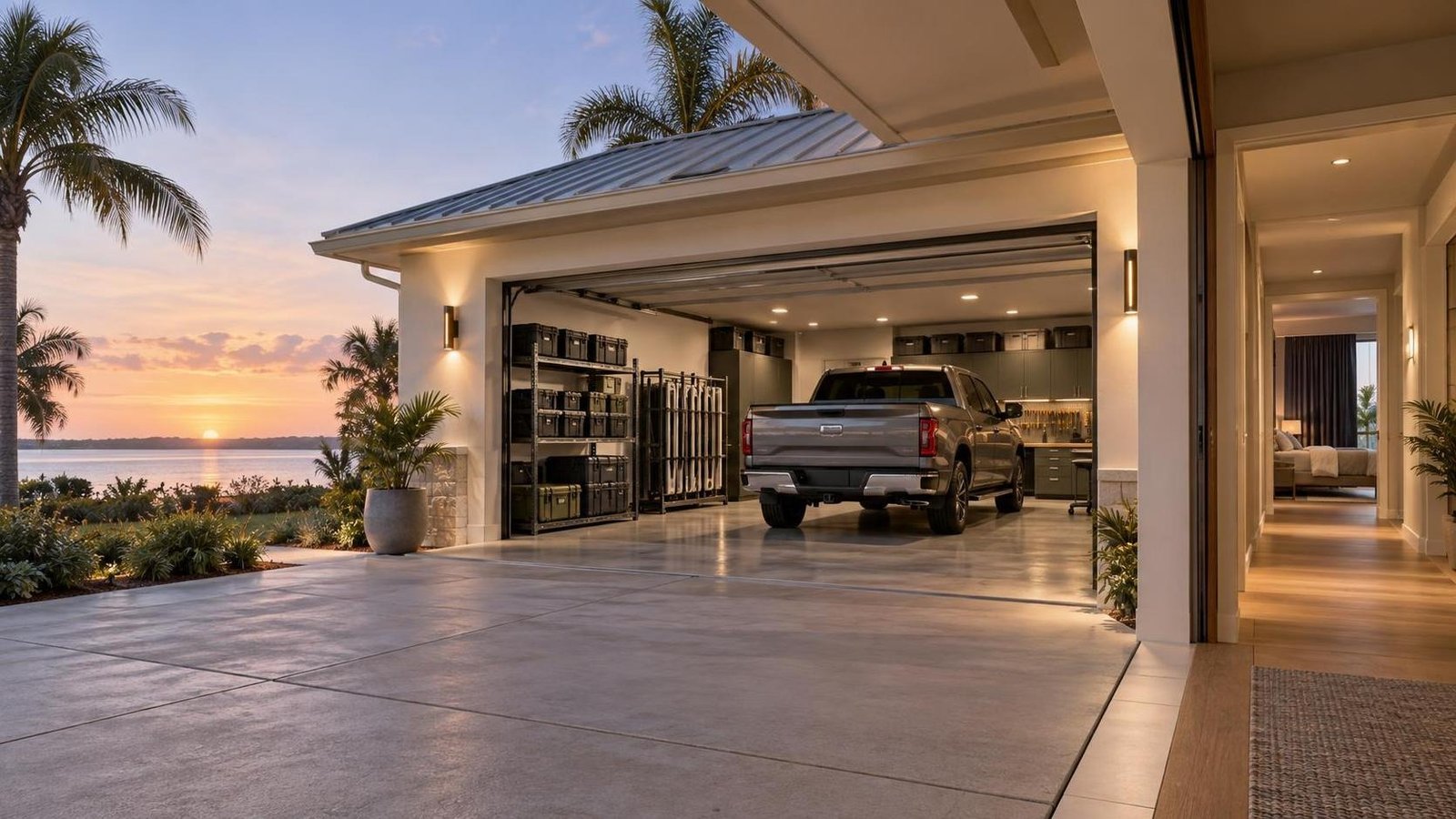
Deeper Garage or Quieter Bedroom Wing: What Should Titusville KSC Shift Households Choose?
By Carrie Liotta, Space Coast REALTOR® with REAL Broker | Published September 19, 2026
Choose the quieter bedroom wing when night-shift sleep affects health, work safety, and the household every week. Choose the deeper garage when a work truck, boat gear, tools, or storm storage otherwise cannot function on the property. I would favor the feature that is physically hardest to add after closing, but only after measuring both.
This Titusville comparison is not storage versus luxury. It is two forms of daily reliability. The garage may protect a vehicle from weather, keep tools secure, and prevent HOA or street-parking conflict. The bedroom wing may let one person sleep while children, guests, laundry, deliveries, and daytime life continue.
The mistake is assuming listing labels answer either question. “Oversized garage” needs measurements. “Split bedroom” needs a noise test. “Close to KSC” needs the exact gate, shift, and route.
Measure the garage around the real vehicle
Bring the vehicle dimensions, including mirrors, hitch, racks, toolboxes, ladder systems, tailgate clearance, and turning needs. Measure the garage door’s clear width and height, interior depth from the closed door to the nearest obstruction, ceiling tracks, steps, water heaters, laundry equipment, shelving, electrical panels, attic ladders, side clearances, and the space needed to walk around the parked vehicle.
A garage can be deep at the center but unusable near a water heater or step. A wide door does not guarantee that a long work truck can turn in from the driveway. A boat may fit by length but block the panel, refrigerator, door to the house, or storm-panel storage.
Park the actual vehicle if the seller and showing rules allow, or create a scaled floor sketch. Open every door and the tailgate. Test the driveway approach. Check whether garage cabinets convey. Do not rely on the seller’s smaller car as proof.
Define every item that must live under cover
KSC and contractor households may need more than vehicle space: personal protective equipment, work boots, coolers, tool cases, bicycles, launch-day supplies, surf or fishing gear, hurricane shutters, generator equipment, holiday bins, and a second household member’s car. Rank what must stay inside, what can use approved exterior storage, and what should not be stored in a hot garage.
If a work truck has commercial markings, racks, or equipment, review current HOA and municipal rules before offering. Garage depth does not solve a restriction that applies to the vehicle itself. My comparison of work-truck parking and a shorter KSC route in Titusville explains why written rules and five-year resale should be part of the same decision.
Test the bedroom wing during daytime life
A night worker’s bedroom should be evaluated when the neighborhood and household are active. Sit inside with doors and windows closed. Listen for the garage door, kitchen, laundry, television, plumbing, front entry, doorbell, lawn service, school traffic, dogs, delivery vehicles, pool equipment, HVAC equipment, and neighboring driveways.
Trace the bedroom’s relationship to bathrooms and closets. A bedroom at the opposite end of the house may still share a wall with a shower, air handler, or busy guest bath. A hallway door, solid wall, closet buffer, or separate return can help, but the complete layout matters more than the phrase “split plan.”
Check light control, temperature, airflow, blackout options, exterior security, and whether another adult can reach the kitchen, laundry, garage, and front door without crossing the sleep zone. The quietest room may be a smaller secondary bedroom, not the primary suite. That can work if the household is willing to use the house differently from the floor-plan labels.
Compare the cost of creating what is missing
Adding meaningful garage depth can require structural work, setbacks, lot coverage, driveway changes, HOA approval, utility relocation, and a building permit. On many lots, it may not be feasible at all. A detached shed or carport is not an automatic substitute, especially when rules, insurance, storm design, and vehicle size are considered.
Creating a quieter bedroom may involve solid-core doors, seals, soft finishes, insulation, window improvements, mechanical adjustments, landscaping, or schedule changes. Those measures can reduce household noise, but they cannot erase a busy road, active neighbor, school entrance, industrial source, or garage door directly under the room.
Before treating either improvement as simple, consult the City of Titusville Building Department and the applicable HOA or architectural-review process for that address. Verify feasibility before assigning future value to an addition.
The KSC route still matters—but test the right one
NASA describes Kennedy Space Center as a multi-user spaceport with a large network of partners and activity. That employment ecosystem is why Titusville attracts aerospace households, but “KSC commute” is not one route. Reporting locations, gates, credentials, shifts, bridge conditions, incidents, and launch activity can change the practical drive.
Use Florida 511 for official live traffic and incident information, then drive from each candidate at the shift times you expect to use. Test the return trip too. A ten-minute difference after a night shift may matter more than the morning trip shown by a generic map.
Do not trade away sleep for an estimated route that has not been tested. Also do not buy garage capacity so far from the preferred gate that the household resents the drive. Put the route, bedroom, and storage into one weekly schedule.
Inspect the systems that affect both choices
The garage and bedroom can share hidden dependencies. The garage door, opener, attic access, electrical panel, water heater, air handler, ductwork, and roof structure may affect usable depth and bedroom noise. Ask the inspector to evaluate moisture, fire separation, door operation, outlets, visible structural modifications, ventilation, and any signs that shelving or equipment hides damage.
For the bedroom wing, assess HVAC comfort, return-air path, window and door condition, ceiling insulation where visible, plumbing noise, and exterior drainage. An old condenser beside the wall can defeat an otherwise excellent floor plan.
Review permit history for garage conversions, additions, carports, electrical work, HVAC changes, and window replacements. A garage marketed as storage should not contain an undocumented living conversion, and a bedroom count should match legal and appraisal records.
Think about launch-day and event-day parking
Some Titusville locations experience unusual visitor or neighborhood parking patterns around major events and launch viewing. Visit during more than one condition, ask how the street functions, and review parking rules. A deep garage is more valuable if the driveway must stay clear; a quiet bedroom is less useful if event-day activity concentrates outside its window.
My article on circular driveways and event-day parking at Titusville launch-view homes explains why parking geometry and lifestyle marketing should be verified rather than assumed.
Build the five-year ownership plan
For the deeper-garage home, price garage-door age, opener, floor condition, storage systems, electrical capacity, cooling or ventilation goals, driveway work, and any HOA obligations. For the quiet-bedroom home, price duct or window work, doors, blackout treatments, sound reduction, HVAC balancing, and any exterior source you can realistically address.
Add roof, insurance, flood review, electrical, plumbing, taxes, and commute costs to both. Do not spend the entire reserve solving storage or sleep while ignoring a near-term major system.
Buyers who are considering off-site storage can compare this guide to Titusville and Port St. John storage tradeoffs for KSC households. Sometimes the right home does not hold every object, but the alternative must be convenient enough to use.
Which feature has broader resale appeal?
A genuinely oversized garage can attract work-truck owners, boaters, hobbyists, multicar households, and buyers who need storm storage. A quiet separated bedroom wing can attract shift workers, multigenerational families, remote workers, guests, and households with older children. Both are useful when the benefit is real and documented.
For resale, keep measurements, permits, floor plans, door specifications, storage-system details, and any noise or comfort improvements. Avoid promising that the garage fits every truck or the bedroom is silent. Future buyers should be able to repeat the same practical test you used.
My offer-stage checklist
- Measure the vehicle, door opening, interior depth, height, turns, steps, tracks, and obstructions.
- List every item that must be stored and whether rules allow it.
- Test the intended bedroom during actual sleep hours and daytime activity.
- Drive the exact work route at both outbound and return shift times.
- Review HOA vehicle, trailer, commercial-marking, parking, and exterior-storage rules.
- Check permits for garage, carport, conversion, electrical, HVAC, and bedroom work.
- Inspect systems that affect garage function, noise, light, airflow, and comfort.
- Verify addition feasibility before assuming either feature can be created later.
- Compare five years of maintenance, reserves, commute, and off-site storage costs.
Bottom line
For a Titusville KSC household, I would choose the quiet bedroom wing when night-shift sleep is the nonnegotiable and the garage alternative still handles the vehicle safely. I would choose the deeper garage when vehicle or equipment dimensions make ordinary storage impossible and the other home can become quiet enough through realistic improvements.
Measure before you prioritize. Test the house when one person would sleep. Drive the real route. The right feature is the one that prevents a recurring problem your household cannot cheaply solve later.
I am Carrie Liotta, a Space Coast REALTOR® with REAL Broker, and 321 Coastal Living helps aerospace relocators compare North Brevard homes beyond the listing photos. If you are balancing garage space, shift-work sleep, and a KSC route, reach out for a no-pressure conversation about the measurements, records, and inspections that will make the choice clearer. Your next chapter starts here.