

What Should Viera Sellers Document When EV, Solar, and Battery Upgrades Have Separate Approvals?
By Carrie Liotta, Space Coast REALTOR® with REAL Broker | Published September 19, 2026
Build one chronological energy file that connects every permit, final inspection, HOA approval, utility document, contract, warranty, and service record. Then have qualified professionals confirm how the EV charger, solar array, battery controls, and main panel work together. Buyers do not need three disconnected upgrade stories; they need one verified household system.
These improvements can make a Viera home stand out, especially for remote workers, EV households, and buyers who care about backup planning. They can also slow a sale when the roof permit predates the solar removal and reinstall, the battery was added later, the charger uses a different panel, or the seller cannot explain whether the solar equipment is owned.
I do not recommend solving that uncertainty with more adjectives in the listing. Solve it with records before photography.
Create a timeline before collecting random documents
Start with installation dates, not file names. List the roof, main-panel or service upgrade, solar array, battery, transfer or gateway equipment, EV charger, and any later repairs in order. Add the contractor, permit number, final date, warranty, utility interaction, HOA approval, and current ownership status for each item.
The sequence matters. A charger installed before a battery may have been designed around a different load calculation. Solar panels removed for roof work should have a removal-and-reinstallation record. A battery added after solar may use controls and warranties separate from the original array. A buyer or inspector should not have to reconstruct that history from faded invoices at the kitchen table.
Use the Brevard County building-permit resources as a starting point for a Viera property in the county’s jurisdiction, then confirm the exact permit, scope, and final status. If a record is missing online, contact the appropriate office rather than stating that no permit was required.
Make permit scope match the equipment on the wall
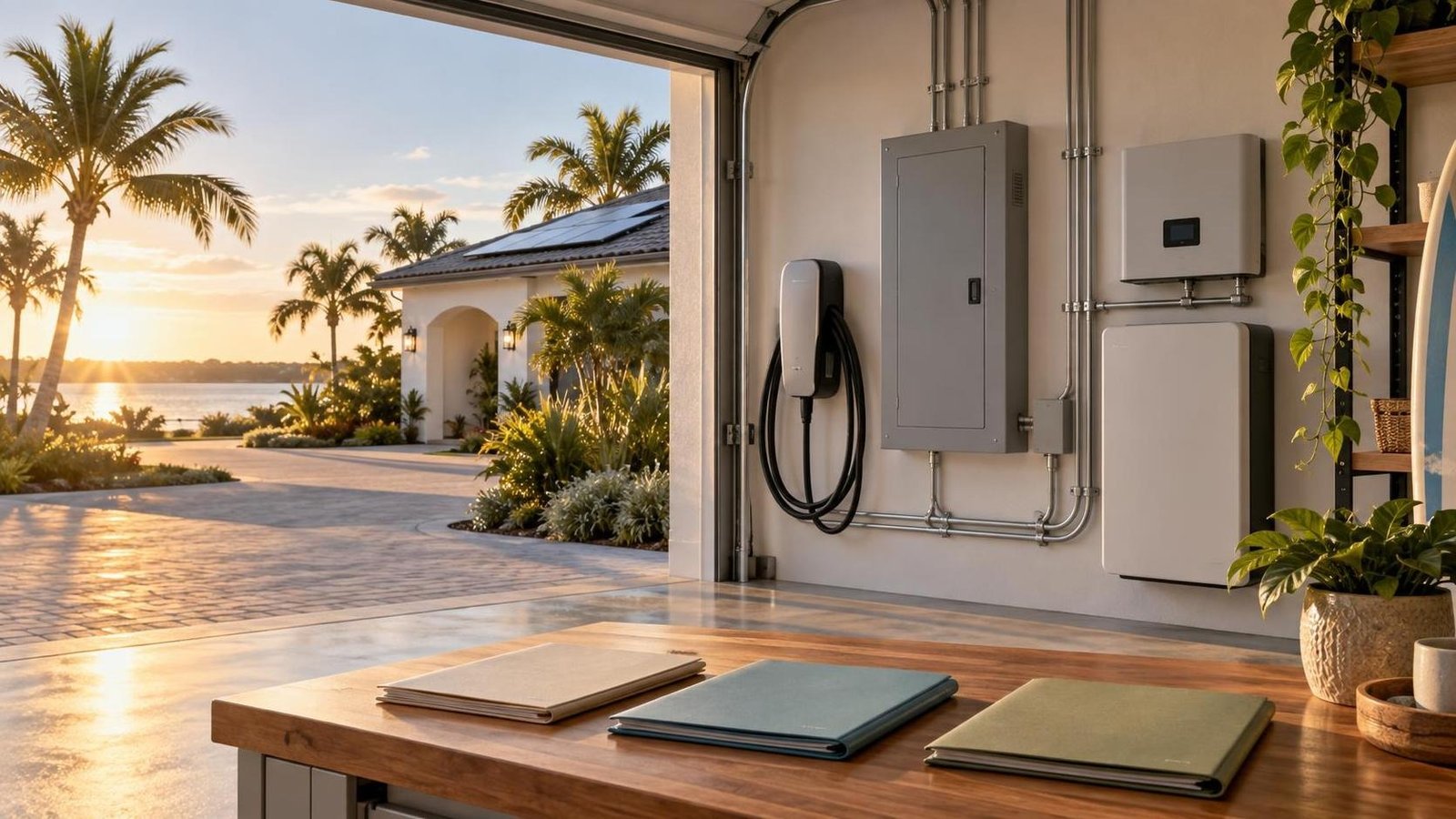
A permit title alone may not tell the full story. Match each record to the visible equipment: charger model, battery units, gateway or transfer equipment, inverter, disconnects, main panel, subpanels, meters, and roof-mounted array. Photograph labels for the transaction file, but blur serial numbers and account information from public marketing.
If the current installation differs from the approved plans or final, ask the original contractor and governing authority what documentation is needed. Do not ask a handyman to “make it look finished.” Electrical and energy systems deserve licensed evaluation, and correction work should create its own invoice and permit trail where required.
The U.S. Department of Energy’s home EV-charging guidance emphasizes evaluating home electrical capacity, using appropriate equipment, checking permits, and using qualified installation. For a seller, that translates into a simple rule: prove the charger is part of a coherent electrical design rather than an attractive appliance attached to a garage wall.
Clarify solar ownership before listing
Buyers need to know whether the solar equipment is owned outright, financed, leased, or subject to another agreement. Gather the signed contract, payoff information if applicable, lender or provider contact, warranty, production or monitoring information, utility interconnection records, and transfer instructions. Do not advertise “paid off” until the paperwork supports it.
The U.S. Department of Energy’s Homeowner’s Guide to Going Solar explains the importance of comparing ownership structures, contracts, warranties, system design, and utility processes. In a resale, those same documents help the buyer, lender, title company, and closing team determine what transfers and what must be resolved.
If there is a loan or lease, involve the provider and closing professionals early. Transfer requirements and timing are contract-specific. A listing agent should not promise that the buyer can “just take it over” without written confirmation and lender coordination.
Explain what the battery actually does
A battery may store solar energy, support selected backup loads, respond to time-of-use programming, or participate in a broader energy-management setup. Its presence does not prove that the entire home operates normally during an outage. Sellers should document capacity, served circuits or loads, operating modes, warranty, service history, app or account-transfer procedure, and any required manual steps.
Ask the installer for a current system report if available. Have qualified professionals address fault messages, offline components, damaged covers, blocked clearances, or unexplained shutoffs before showings. Keep the manufacturer and installer manuals together, but do not give buyers the seller’s login credentials. Transfer accounts securely through the provider’s approved process.
Ready.gov’s outage guidance is a good reminder that backup planning includes communications, food safety, medical needs, and safe operation. Marketing should state documented function, not promise uninterrupted life.
Pull the HOA approvals into the same file
Viera neighborhoods can have different architectural-review requirements. Gather the solar, battery-enclosure, equipment-screening, conduit, charger, roof, and related exterior approvals that apply to the specific home. Include approved drawings, conditions, completion acknowledgments, and correspondence resolving any deviations.
An HOA approval is not a substitute for a building permit, and a permit is not proof that every covenant requirement was satisfied. Keep the two tracks distinct but aligned. If landscaping screens battery or electrical equipment, confirm that current access and clearance remain workable before promising that the setup is complete.
Connect the roof story to the solar story
Buyers will ask how old the roof is, when solar was installed, whether penetrations were inspected, and what happens when the roof eventually needs service. Gather the roof permit and final, roofing warranty, solar mounting information, array-layout documents, and any leak or repair history. If the roof was replaced after solar, include removal-and-reinstallation invoices and the related permit record.
Do not claim that solar “extends roof life” or that the roof has a particular number of years remaining without qualified support. The useful story is factual: installation dates, contractors, permits, warranties, maintenance, and current inspection findings.
Prepare the garage for an electrical inspection, not a showroom illusion
Clear access to the panel, charger, battery controls, disconnects, and service labels. Remove storage that blocks working space. Do not paint over labels, hide conduit, or stage furniture in front of equipment. Replace missing covers or correct visible defects through the appropriate professional.
Buyers comparing panel capacity and annual obligations may find this companion article on Viera EV charging versus a lower district assessment helpful. Sellers should expect that level of comparison and make the records easy to review.
Use precise listing language
Strong remarks identify features without guaranteeing results: owned solar when verified; permitted charger when the record matches; battery backup for documented circuits; transferable warranty when written terms confirm it. Weak remarks use phrases such as “no electric bill,” “runs the whole house,” “off-grid,” or “free charging” without evidence.
Utility costs depend on household behavior, rates, weather, equipment, and program terms. Show buyers a useful history through appropriate transaction channels, but do not promise that they will reproduce the seller’s bills. Monitoring screenshots can illustrate operation only after personal and account information is removed.
Plan the handoff before the contract
Create a closing checklist for utility or solar account steps, monitoring transfer, equipment manuals, installer contacts, warranties, keys, physical shutoffs, app ownership, and any remaining payoff or release. Coordinate timing with the title company, lender, provider, and buyer rather than waiting until the final walk-through.
If smart irrigation, leak sensors, or generator controls are also part of the house, use the same discipline. My guide to documenting Viera smart-home and generator controls explains how to separate real-property systems from personal accounts and subscriptions.
Remote-work buyers may also compare the battery with other resilience options. This article on Viera generator load management versus portable backup shows why sellers should describe served loads and operations instead of making blanket outage claims.
My pre-listing energy-file checklist
- Chronology of roof, service, panel, solar, battery, charger, and repair work.
- Permits, approved plans, notices, and final inspections matched to current equipment.
- HOA applications, approvals, conditions, and completion correspondence.
- Solar contract, proof of ownership or current obligation, transfer steps, and payoff process.
- Utility interconnection and monitoring documents.
- Battery capacity, served-load information, modes, warranty, and service history.
- Charger model, circuit, qualified installation record, and warranty.
- Roof permit, warranty, solar mounting file, and any removal/reinstallation records.
- Professional evaluation of current operation and visible concerns.
- Secure account-transfer plan for closing.
Bottom line
Separate approvals do not have to make a Viera sale complicated. The problem is not that the home evolved; it is that buyers cannot see how the pieces connect. Build one timeline, reconcile permits with equipment, prove ownership, verify HOA approval, explain backup limits, and prepare a secure transfer plan. That turns a wall of technology into a confident resale story.
I am Carrie Liotta, a Space Coast REALTOR® with REAL Broker, and 321 Coastal Living helps Viera owners prepare for the questions careful buyers will ask. If your solar, battery, charger, and roof records live in different places, reach out for a no-pressure conversation about organizing the file and deciding what to verify before listing. Your next chapter starts here.