

Public Boat Ramp or Private Dock: Which Merritt Island Home Is the Better Buy?
By Carrie Liotta, Space Coast REALTOR® with REAL Broker | Published September 18, 2026 on 321 Coastal Living
If the monthly costs are genuinely close, choose the private-dock home only when you will use the water often and the seawall, dock, route, and insurance file are sound. Otherwise, a well-located inland home near a dependable public ramp usually gives you more financial flexibility with less waterfront maintenance risk.
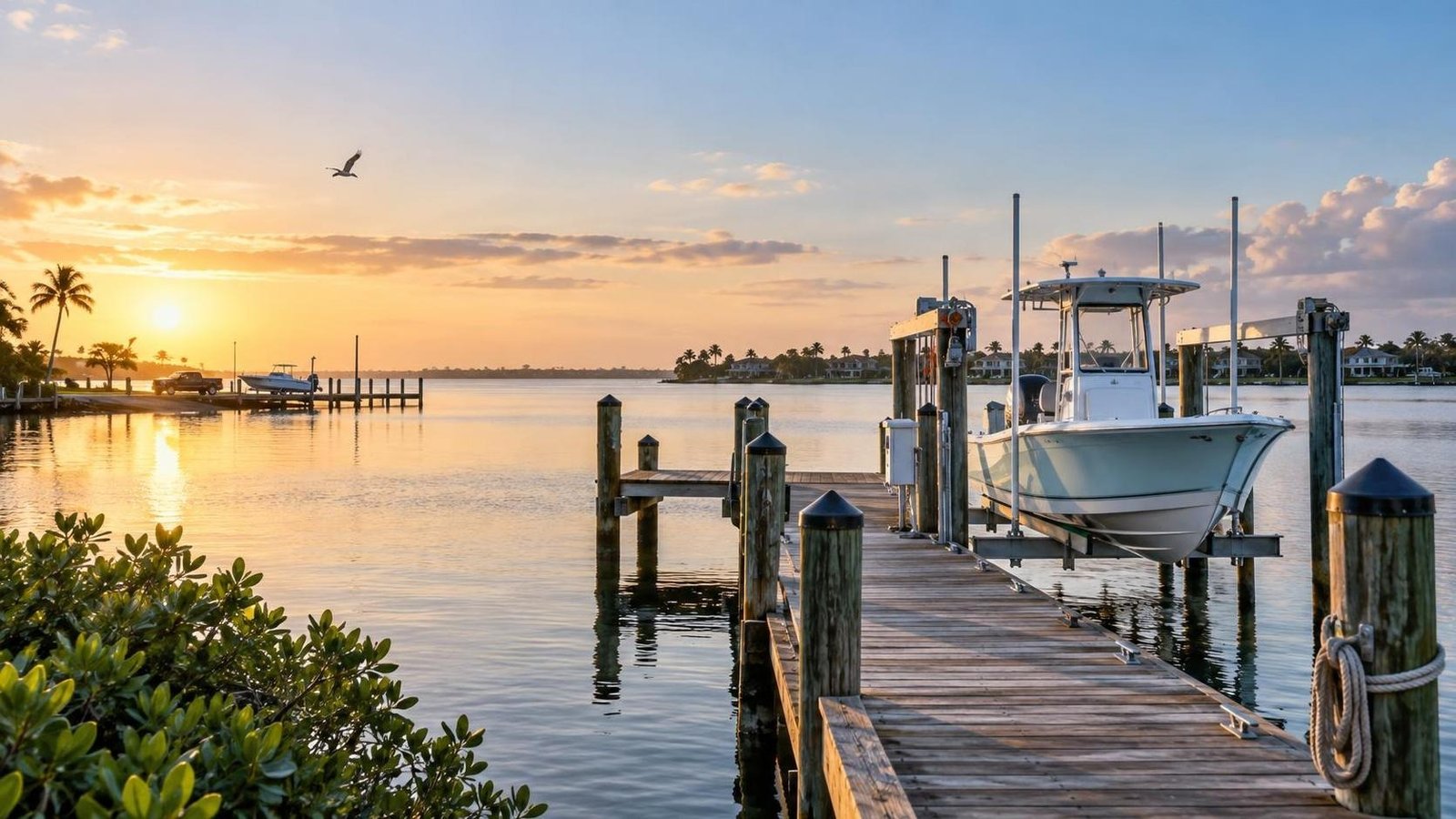
I help Merritt Island buyers make this comparison by separating the boating dream from the ownership job. A private dock can turn an ordinary Tuesday evening into a quick sunset run. It can also add structures, permits, electrical equipment, flood questions, and repair obligations that do not appear in the mortgage calculator. Public-ramp convenience is less spontaneous, but it may let you buy a stronger house, keep a larger reserve, and choose different waterways for different trips.
Start with the way you actually boat
The right answer depends less on whether you call yourself a boater and more on the routine you will maintain after closing. Someone who fishes before work twice a week, keeps a boat in frequent use, and wants to rinse and secure it at home may get enormous value from a private dock. Someone who launches twice a month, travels often, or prefers kayaking and paddleboarding may not recover enough lifestyle value to justify the added ownership stack.
Write down a realistic month. How many launches? What time of day? Who handles the trailer? Does your vehicle fit comfortably at home? Do you need a lift, shore power, water, fish-cleaning space, or protected storage? Would a five- or ten-minute route to a ramp feel easy, or would it become the reason the boat stays parked?
Merritt Island makes the comparison especially important because “waterfront” is not one uniform product. A canal on Sykes Creek, a route toward the Banana River, a river-near property, and an inland home with quick access to a public launch can serve very different boats and weekend patterns. My guide to buying canal-front property in Merritt Island explains why the water route deserves as much attention as the house.
Compare the whole monthly cost, not two mortgage payments
Buyers sometimes tell me the private-dock home and inland home are “only” a small amount apart each month. Before I accept that comparison, I rebuild both budgets from the ground up.
For the dock home, include the principal, interest, taxes, homeowners insurance, any flood insurance, association obligations, and routine home maintenance. Then add a waterfront reserve for the seawall, cap, tiebacks, dock decking, pilings, hardware, electrical components, lift service, washdown equipment, and corrosion. I do not turn that reserve into a universal dollar estimate because condition and scope vary dramatically. I ask a marine contractor and insurance professional to price the specific property.
For the public-ramp home, include trailer registration and maintenance, vehicle capability, fuel used for towing, any boat or trailer storage charge, ramp or park requirements, and the value of your time. Confirm the current facilities and rules for the launch you expect to use through the Brevard County Parks and Recreation directory or the agency that manages that particular ramp. Hours, parking, trailer capacity, closures, and amenities are operating facts to verify, not assumptions to make from an old review.
The private-dock choice often costs more in irregular chunks rather than a neat monthly line. The public-ramp choice often costs more in effort. A sound comparison assigns a reserve to one and a realistic time budget to the other.
A private dock is only valuable if the route works
A beautiful dock does not fix a route that is too shallow, too narrow, too long, or limited by bridge clearance. Before paying a waterfront premium, match the route to the boat you own or realistically plan to own. Verify draft, beam, height, turning room, canal width, typical water conditions, and the path to your preferred destination. Visit at more than one time if water level or traffic could change the experience.
I also want a buyer to test the “door to open water” time, not just admire the view. A private dock that requires a slow canal transit may still be perfect for a family that values convenience at home. A public ramp closer to the desired fishing ground may be more efficient for someone who already has a polished launch routine.
If the home uses a lift, review capacity, model, service history, controls, pilings, and how the hull sits. A private lift with deferred maintenance can be less valuable than a shared or off-site solution with a clear reserve. This recent comparison of a private lift and a shared lift with a funded replacement reserve shows why ownership structure matters as much as convenience.
Inspect the waterfront before you price the lifestyle
A standard home inspection is not a substitute for waterfront due diligence. Depending on the property, I may recommend a qualified marine contractor or engineer for the seawall and dock, an electrician familiar with marine installations, a lift specialist, a current survey, and an insurance review. The buyer should understand visible cracking, movement, erosion, drainage, cap condition, tiebacks, pilings, decking, fasteners, electrical protection, and prior repairs.
Ask for permits, final inspections, contractor invoices, warranties, engineering documents, electrical records, and service logs. Then compare the improvements shown in those records with what exists. Florida law contains exemptions for certain qualifying private docks and some repairs, but an exemption is not permission to ignore every other state, local, proprietary, navigation, or environmental requirement. The details in Florida Statute 403.813 are exactly why I tell buyers to verify the actual authorization path rather than accept “a permit was not needed” as a complete answer.
Flood risk belongs in both comparisons
Do not assume the inland home has no flood risk, and do not treat every waterfront parcel as identical. FEMA explains that flood maps show relative risk and that there is no true “no-risk zone.” Its official flood-map guidance says areas with at least a one-percent annual chance of flooding are considered high risk, while lower-risk designations still do not mean zero risk.
For each address, review the current map, elevation information when available, drainage history, insurance quotes, lender requirements, and any transferable policy information. Ask what happens to the total payment if the quote changes before closing. For a dock home, also look at how the yard drains toward the shoreline and whether the seawall drainage system has been maintained. For a ramp-near inland home, look at street and lot drainage after heavy rain rather than relying only on distance from the water.
When the public-ramp home is the smarter choice
I lean toward the public-ramp home when boating is important but not frequent enough to justify making the waterfront infrastructure part of the household budget. It can also be the stronger choice when the inland home has a newer roof, deeper garage, better trailer access, stronger insurance file, more useful floor plan, or a location that works better for school and work.
The ramp option makes sense for buyers who enjoy different launch points. You may want access to one part of the lagoon on Saturday and a different route for another trip. Keeping the boat on a trailer can preserve that flexibility.
But the property still has to support the routine. Measure the garage and side yard. Read HOA and municipal rules for boats and trailers. Check driveway slope, gate width, overhead obstructions, turning radius, and whether street parking complicates backing. A “boat-friendly” listing is not evidence that your trailer fits or that overnight storage is allowed.
When paying for the private dock is reasonable
The private dock earns its premium when it materially changes how you live and the expensive parts are supportable. I want to see a useful route, documented structures, acceptable inspections, realistic insurance, and enough reserves left after closing. The home should still work even if the buyer has to service the lift or repair dock components sooner than hoped.
Private access can be especially valuable for a household that uses the boat several times a week, dislikes towing, needs to load children or gear gradually, or wants kayaking and paddleboarding directly from home. It may also widen the future buyer story when the route and infrastructure are unusually good. The value is not simply “water behind the house.” It is reliable, documented access that another buyer can understand.
Some buyers want river air and a water-oriented setting but not the infrastructure. If that sounds closer to your goal, read where Merritt Island buyers can enjoy river breezes without owning a seawall. That middle path can preserve much of the lifestyle while reducing direct shoreline responsibility.
Use a three-column decision sheet before offering
I ask buyers to compare the two homes in three columns: use, risk, and exit.
- Use: How many realistic boating days does each property support? How much setup time does it remove or add?
- Risk: What are the near-term projects, insurance conditions, permit gaps, storage restrictions, and reserve needs?
- Exit: In five or ten years, can you clearly explain why another buyer should choose this home?
Then stress-test each option. If the lift fails, does the private-dock budget still work? If the preferred ramp closes temporarily or fills early, is there a practical alternative? If your boat changes, does the canal route still fit? If your work schedule becomes busier, will you appreciate instant access or stop using it enough to justify the upkeep?
This exercise keeps a small payment difference from controlling a much larger ownership decision. It also helps identify the documents and inspections that belong in the offer timeline.
My offer strategy for each type of home
For a private-dock home, I build enough inspection time to evaluate the house and marine improvements, request the waterfront records early, and start insurance conversations before the contingency clock becomes uncomfortable. If the seawall, dock, or lift materially affects value, I want qualified findings rather than a casual repair guess.
For a public-ramp home, I verify boat-storage rules before offering, physically test dimensions, drive the ramp route at the time the buyer expects to use it, and identify at least one backup launch. I also compare the price with other non-waterfront homes instead of paying a hidden “boater premium” for a garage or side yard that is not actually usable.
Neither option is automatically safer. The safer purchase is the one whose routine, restrictions, physical condition, and cash demands have been investigated.
The bottom line for Merritt Island buyers
If boating is central to your week and the waterfront file is strong, a private dock can be worth more than its payment difference because you will use the access constantly. If boating is occasional, reserves are tight, or the marine structures are uncertain, the home near a good public ramp is often the better buy.
I would rather help you choose the option you will still appreciate after the first repair, crowded launch morning, insurance renewal, and ordinary workweek. Carrie Liotta is a Space Coast REALTOR® with REAL Broker, and 321 Coastal Living is where I share practical Brevard County buying guidance. Reach out for a no-pressure conversation about Merritt Island homes for sale. Your next chapter starts here.
