

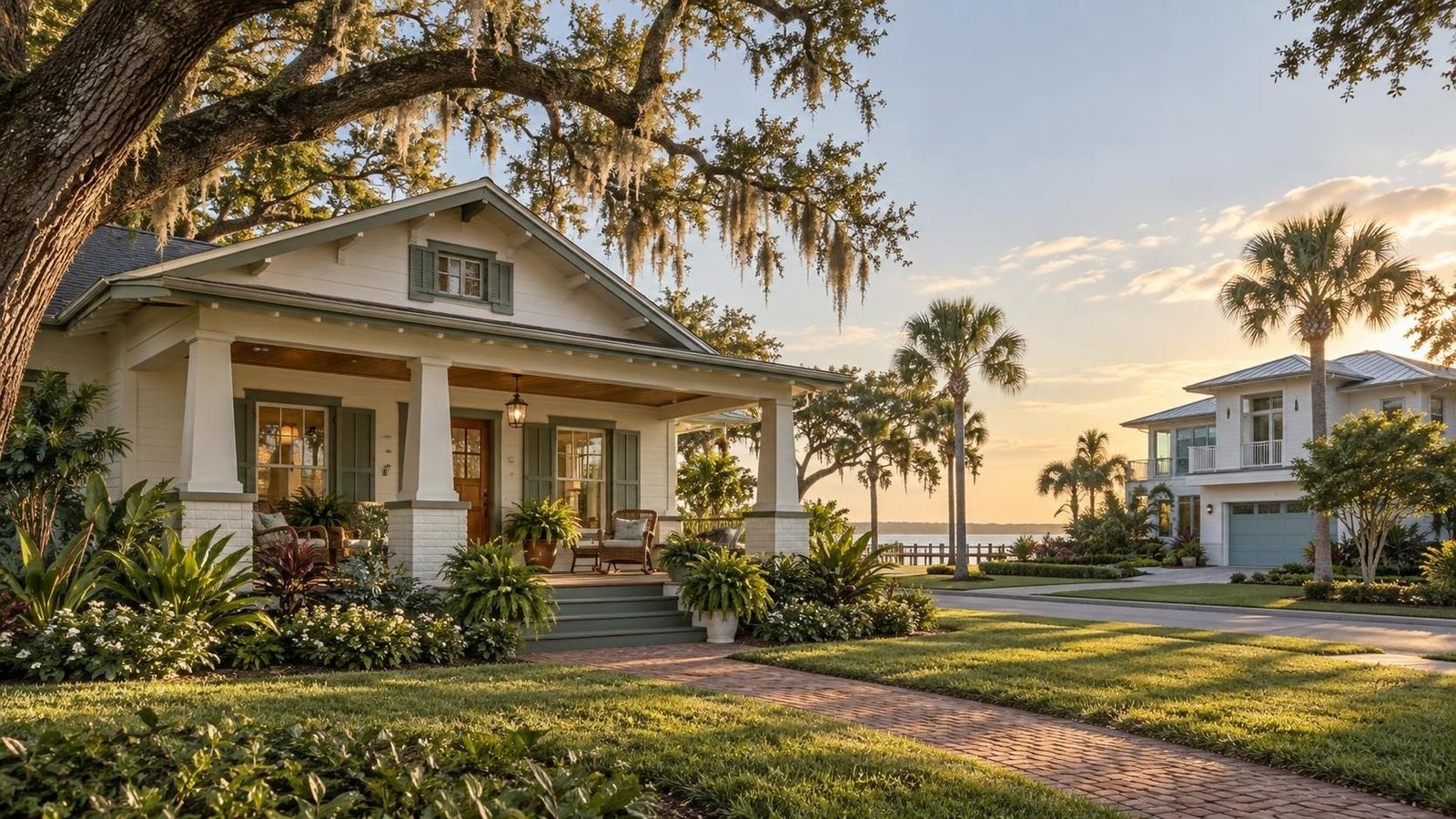
Cocoa Village Historic Home or Newer Rockledge Home: Which Should Relocators Choose?
By Carrie Liotta, Space Coast REALTOR® with REAL Broker | Published September 16, 2026
A Cocoa Village-area historic home is the better choice for relocators who will genuinely use walkable restaurants, events, riverfront spaces, and neighborhood character enough to accept older-home due diligence. A newer Rockledge home is usually stronger for buyers who prioritize predictable systems, garage and storage function, easier insurance documentation, and a more conventional suburban routine.
I would not decide from charm versus age alone. The real comparison is a week of life: parking, groceries, dog walks, school or work routes, home office, storm preparation, yard care, guest space, and the projects the buyer can realistically manage. A renovated older home can be easier to own than a neglected “newer” one. A Rockledge resale can offer mature character too.
Decide whether walkability is a routine or a vacation idea
Cocoa Village attracts buyers who want a recognizable district rather than a subdivision-centered lifestyle. The appeal is being near local restaurants, shops, performances, community events, and the Indian River. The City of Cocoa’s official site regularly identifies Cocoa Village events and redevelopment activity, which reflects the area’s continuing public role in the city.
But “walkable” should be tested from the actual house. Walk the route to the destinations you would use. Check crossings, shade, sidewalks, lighting, train or traffic noise, parking spillover, event-day activity, and the return trip with groceries or in summer weather. A home that is near the district on a map may not deliver the easy front-door experience a buyer imagines.
I ask relocators to estimate how many weekly car trips the location would truly replace. If the answer is several meals, coffee, exercise, events, and riverfront walks, paying for proximity may improve daily life. If work, schools, groceries, and most activities still require a car, the walkability premium may function mostly on weekends.
What the Cocoa Village-area home asks from its owner
Older homes can offer porches, original details, mature landscaping, smaller-scale streets, and layouts that feel personal rather than repeated. They may also combine renovations from different decades. One room can have updated wiring while an addition, panel, plumbing run, roof connection, window, or enclosure tells a different story.
Before offering, build a property history. Ask for permits, final inspections, surveys, seller disclosures, roof and HVAC invoices, plumbing and electrical records, termite treatment, insurance claims, flood history, and renovation plans. The Brevard County permit search is a useful starting point for county-jurisdiction properties, while a home inside Cocoa may require city records. The absence of an online record does not prove work was never permitted, and one permit line does not prove every improvement received final approval.
Ask the inspector to pay particular attention to roof transitions, electrical service and panel, plumbing supply and drain materials, HVAC distribution, crawlspace or slab concerns, moisture, windows and doors, termite evidence, foundation movement, and prior additions. Specialized contractors may be needed when the general inspection raises a material issue.
Why insurance belongs near the beginning
Do not wait until the end of the inspection period for insurance. Older roof documentation, electrical systems, plumbing, HVAC, openings, prior claims, flood exposure, and visible deferred maintenance can affect carrier questions. A four-point and wind-mitigation inspection may be useful depending on the home and insurer.
The Florida Department of Financial Services maintains a current summary of Florida property-insurance changes. Legal rules about roof age and available coverage options do not guarantee that every older home will receive the same quote. Condition and the complete risk profile still matter.
My guide to Brevard County four-point inspections before an offer explains how roof, electrical, plumbing, and HVAC questions can change price, terms, and timing. Use that lens before falling in love with restored floors or a front porch.
Flood risk is parcel-specific on both sides of the comparison
River proximity is part of Cocoa Village’s lifestyle appeal, but the marketing phrase “near the river” does not determine the flood zone or premium. Search the exact address in the FEMA Flood Map Service Center, review available elevation information, ask about prior flooding and drainage, and obtain a buyer-specific insurance quote.
A newer Rockledge home also needs parcel-level flood and drainage review. Newer subdivision engineering, ponds, swales, and association-maintained systems do not make every lot identical. Look at grading, rear-lot drainage, gutters, downspouts, driveway slope, pond setbacks, and meeting minutes that mention recurring water problems.
I never let “older near the river” and “newer inland” become shortcuts for high risk and low risk. The property evidence decides.
What the newer Rockledge home offers
Newer Rockledge homes often give relocators a more familiar ownership package: larger garage, open kitchen and living space, separate laundry, modern primary suite, standardized storm protection, and younger roof, HVAC, electrical, and plumbing systems. That can reduce the number of immediate projects during a job move or school transition.
The location may also provide convenient access toward Viera errands, medical offices, I-95, Cocoa, and central Brevard employers, depending on the address. My Rockledge guide for Viera access, schools, and HOA tradeoffs helps buyers compare those daily factors without treating Rockledge as one uniform market.
Newer does not mean maintenance-free. Inspect the roof installation, stucco, windows, drainage, HVAC, appliances, garage door, irrigation, and any solar, pool, fence, lanai, or generator work. Review builder warranties if any remain, but confirm transfer terms and exclusions. A newer house with unresolved drainage or undocumented additions can create more risk than an older house with an excellent file.
The HOA can simplify or constrain the Rockledge option
A newer Rockledge community may have HOA rules for exterior colors, fencing, roofs, parking, work vehicles, trailers, sheds, solar equipment, generators, landscaping, rentals, pets, and architectural changes. Those rules can protect a consistent streetscape and reduce neighbor uncertainty. They can also conflict with a buyer’s plans.
Review the declaration, amendments, rules, current budget, financial statements, insurance, reserve information, meeting minutes, violations, assessments, and architectural process. Ask what the dues cover and whether roads, ponds, gates, common landscaping, or recreation facilities have pending work.
Cocoa Village-area homes may have no mandatory HOA, which gives more owner control. That freedom also means the owner is responsible for the entire exterior and cannot rely on association standards to address neighboring property issues. Choose the governance model that fits the buyer, not the one that sounds less expensive in a listing.
Compare parking, storage, and guests honestly
Historic-home buyers should measure the driveway, garage if present, street parking, turning space, and access during events. Confirm property lines and any shared driveway or alley arrangement. A beautiful home can become frustrating if two commuters, visiting family, bicycles, tools, and storm panels do not fit.
The Rockledge home may offer a two- or three-car garage, wider driveway, attic or closet storage, and a split-bedroom guest arrangement. Confirm actual garage dimensions; a nominal two-car garage can still feel tight with modern vehicles, trash carts, hurricane supplies, and a workbench. HOA rules may limit overnight street parking or trailers.
If guests visit only twice a year, do not automatically buy an extra bedroom and bathroom. Compare the annual cost of larger square footage with the usefulness of the space. If multigenerational family stays for months, separation and parking may be worth far more than district walkability.
Renovation budget versus monthly premium
The Cocoa Village-area home may have a lower or similar purchase price but require an immediate project reserve. The Rockledge home may cost more and carry HOA dues, yet need fewer early system updates. Build both into a five-year comparison.
For the older home, include inspection-driven electrical, plumbing, roof, HVAC, window, drainage, termite, and cosmetic work, plus temporary housing or storage if a project disrupts occupancy. Distinguish mandatory safety and insurance work from optional design changes. Obtain contractor input rather than using a television renovation budget.
For Rockledge, include HOA dues and increases, taxes after sale, insurance, district or special assessments if applicable, builder or system warranty limits, and the cost of missing features such as blinds, gutters, fence, screened patio, or mature landscaping. A clean kitchen does not make those costs disappear.
Test the commute from the driveway
Cocoa Village can be practical for Cocoa, Merritt Island, Cape Canaveral, and north-central Brevard routines, while a Rockledge location may favor Viera, I-95, medical, or southbound travel. Those are directional patterns, not guaranteed times.
Drive from the actual homes to each workplace, school, daycare, airport route, and family obligation at the hours that matter. Include the neighborhood exit and afternoon return. If a household works partly from home, also evaluate office separation, internet at the address, and package delivery.
A historic home that saves several enjoyable weekly trips may offset a slightly less convenient work route. A Rockledge home that simplifies two commutes and school pickup may create more daily value than a district the household visits only on Saturday.
Who should choose Cocoa Village-area character?
Choose it when the household actively values walking, local dining, events, riverfront atmosphere, architecture, and a less standardized neighborhood; has cash reserves for property-specific work; and is comfortable coordinating older-home specialists. It is strongest when permits and renovations are well documented, insurance is clear, parking works, and the home has been updated without erasing what makes it special.
It is weaker for buyers who need a large garage, highly predictable systems, strict neighborhood uniformity, or no near-term projects during a demanding relocation.
Who should choose newer Rockledge?
Choose it when the household values a modern floor plan, garage and storage, younger systems, easier storm preparation, and practical access toward Viera and I-95. It is strongest when HOA rules fit, drainage is documented, the total monthly cost is comfortable, and the extra space supports real needs.
It is weaker for buyers who feel isolated without walkable destinations, dislike association oversight, or would be paying for rooms and yard they will not use.
My decision-day checklist
- Walk the Cocoa Village route and count trips it would genuinely replace.
- Drive every required route from both properties at realistic times.
- Build permit and renovation histories for both homes.
- Inspect older-home systems and newer-home drainage with equal seriousness.
- Obtain property-specific homeowners and flood quotes early.
- Verify parking, garage dimensions, guest capacity, office function, and storage.
- Review HOA documents and assessments for the Rockledge option.
- Price five years of projects, dues, taxes, insurance, utilities, and maintenance.
- Choose the routine the household will use, not the lifestyle that photographs best.
Bottom line
The Cocoa Village-area historic home is the better relocation choice when walkability and character will shape everyday life and the buyer is prepared for careful older-home ownership. The newer Rockledge home is better when system certainty, storage, suburban convenience, and lower project management are more valuable.
I can help you compare these very different paths with inspections, permit questions, insurance, commute, and five-year costs on the same page. Reach out to Carrie Liotta, Space Coast REALTOR® with REAL Broker, through 321 Coastal Living for a no-pressure conversation. Your next chapter starts here.
Related Space Coast guides
- Should Cocoa Buyers Choose a Renovated Cottage or a Newer Inland Subdivision?
- Interior Laundry Room or Garage Laundry Area: What Should Rockledge Relocators Choose?
- What Should Cocoa Village Sellers Document About Windows, Alley Access, and Historic Exterior Work?
- Moving to Florida’s Space Coast: relocation guide
