

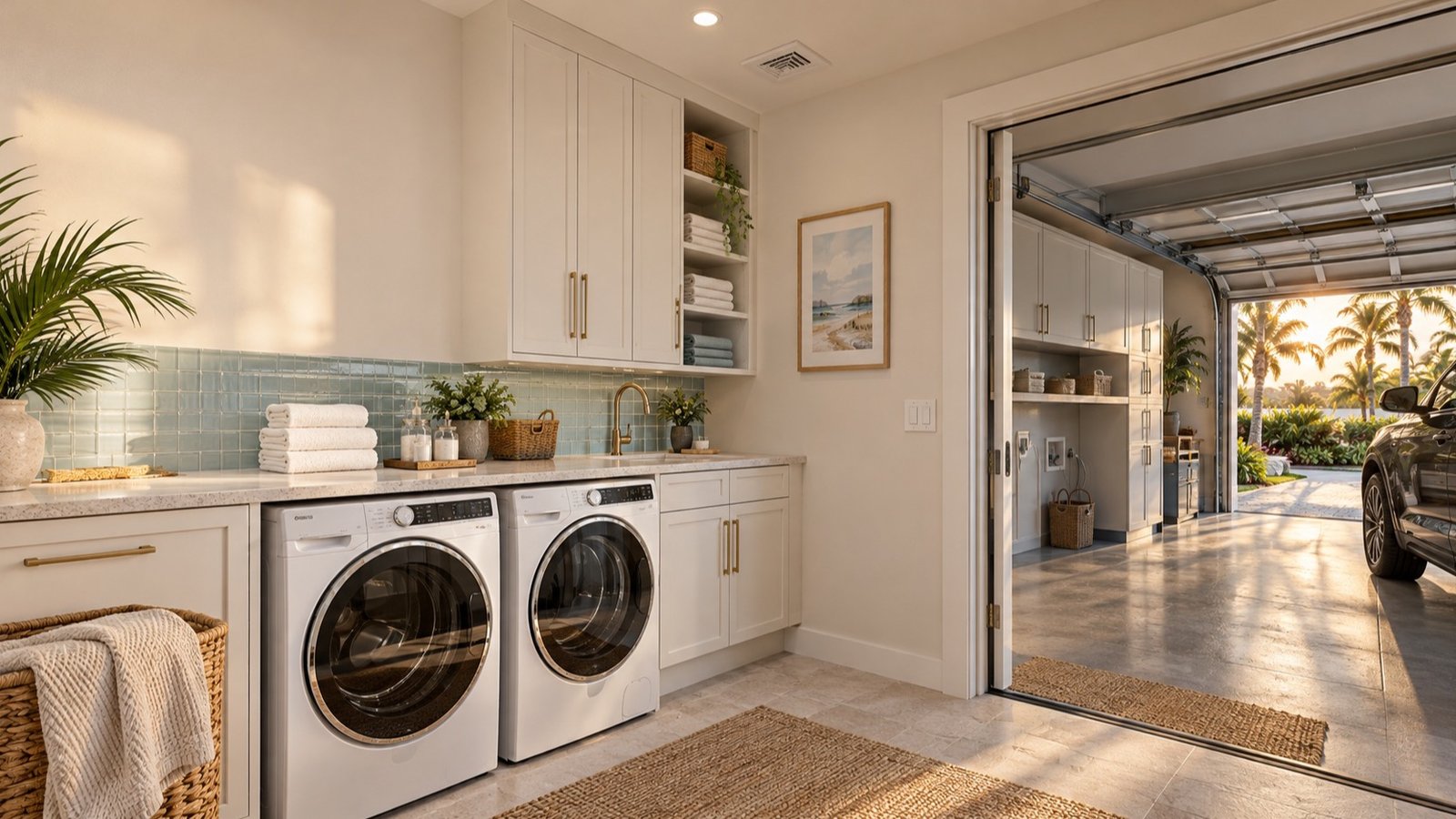
Interior Laundry Room or Garage Laundry Area: What Should Rockledge Relocators Choose?
By Carrie Liotta, Space Coast REALTOR® with REAL Broker | Published October 12, 2026
For most Rockledge relocators working hospital, aerospace, public-safety, or other irregular shifts, I would choose a properly vented interior laundry room over a garage laundry area. It is usually easier to use quietly, comfortably, and consistently in Florida humidity. A garage setup can still be the smarter buy when it has a short, sound exhaust route, protected utilities, good airflow, and enough space to keep laundry from competing with parking and storage.
The room label on a listing does not settle the decision. I want to know what happens at 5:30 a.m. after a night shift: Can you move a load without waking someone? Are clean clothes entering conditioned space dry, or sitting in a warm garage? Can you reach the shutoffs and lint path? Does the dryer actually exhaust outdoors? Those details matter more than whether the laundry area photographs beautifully.
Why an interior laundry room usually wins for shift-work households
An interior room removes the daily trip through a hot or humid garage and makes it easier to move clothes between bedrooms, baths, and storage. That sounds minor until laundry happens around a changing schedule. If one person sleeps during the day and another needs uniforms ready before dawn, convenient access reduces the temptation to leave damp loads in the washer or clean clothes in a basket in the garage.
Conditioned space also gives you more control over humidity. The U.S. Environmental Protection Agency says moisture control is the key to mold control, recommends keeping indoor relative humidity below 60 percent when possible, and advises venting moisture-producing appliances such as clothes dryers outside. Its home moisture and mold guidance is useful here because a laundry decision is not simply about comfort; it is about how the room handles wet clothes, plumbing, condensation, and dryer exhaust.
Interior does not automatically mean quiet. A laundry closet sharing a wall with the primary bedroom can transmit vibration and end-of-cycle alerts more noticeably than a garage setup. I would rather have a modest interior room buffered by a hall, pantry, or bath than a stylish closet directly behind the headboard. Close the door, run a spin cycle, and listen from the sleeping rooms during the showing if practical. Look for a level floor, stable machines, intact supply hoses, and a door that does not strike the appliance.
If sleep protection is the deciding issue, compare the room itself with the larger house plan. My guide to quiet bedrooms, humidity, and older ductwork in Rockledge explains why the quietest-looking room is not always the most comfortable sleeping space.
When a garage laundry area can be the better choice
A garage laundry area creates useful acoustic separation. Someone can sort uniforms, run water, and close appliance doors farther from sleeping rooms. In an older or more compact Rockledge plan, keeping the washer and dryer in the garage may also preserve valuable conditioned square footage for a pantry, office, or larger bedroom.
It can also offer a simple exhaust route when the dryer sits near an exterior wall. That advantage disappears if the duct is crushed behind the machine, snakes through a long concealed path, or terminates where lint and moisture cannot escape properly. The U.S. Consumer Product Safety Commission warns that lint buildup in a dryer or exhaust duct can block airflow, create excessive heat, and contribute to a fire. Its clothes-dryer safety guidance recommends periodic vent and exhaust-duct cleaning, checking that air escapes at the outside vent, keeping the area around the dryer free of clutter, and replacing plastic or foil accordion-style ducting with rigid or corrugated semi-rigid metal duct.
The tradeoff is the garage environment. Florida heat and humidity can make folding unpleasant, encourage damp items to linger, and expose cabinets, paper products, and stored linens to conditions they would not face indoors. A garage door opening during a summer rain can add another burst of humid air. I would not assume a portable fan solves that. The better question is whether the space has a practical workflow: hamper to washer, washer to dryer, dryer to a clean folding surface, then straight into the house.
Parking and storage matter too. Measure with both vehicles in their normal positions. Confirm that appliance doors open fully, the path to the house remains clear, and the machines are not vulnerable to a bumper, bicycle, lawn tool, or stored chemical. A laundry area that depends on parking one vehicle outside may change both daily convenience and how the garage functions at resale.
Inspect the water, drain, power, and exhaust—not just the appliances
Washers and dryers are replaceable. Moving the connections can be the expensive, disruptive part. During due diligence, identify the hot- and cold-water shutoffs, drain or standpipe, dryer receptacle or gas connection, exhaust termination, and any floor or wall staining. Test access: could you shut off the water quickly without pulling a full-size machine out of a tight alcove?
Look for corrosion at hose fittings, swollen baseboards, patched drywall, rust on nearby metal, musty odor, cracked drain components, or a pan with no clear drainage path. None of those automatically makes the house wrong, but they justify a closer inspection. If the machines are included, ask what conveys in writing and still evaluate the hookups independently. A newer washer does not correct an improper drain, and a new dryer does not improve a restricted exhaust path.
For the dryer, locate the exterior termination rather than accepting “it vents out” as an answer. Check whether the duct appears accessible for cleaning and whether the outside flap opens while the dryer runs. For the washer, ask where an overflow would go. Interior rooms deserve particular attention because a leak can affect finished flooring, drywall, cabinetry, and adjacent rooms before anyone sees it.
Also note electrical panels, water heaters, HVAC equipment, and garage door tracks nearby. You are looking for service access and a layout that does not force one system to block another. An inspector and the appropriate licensed contractor can evaluate conditions beyond a visual buyer review.
Do not assume moving laundry is a simple weekend project
Relocators sometimes see garage hookups and mentally move them inside before writing the offer. I would price that idea only after a qualified contractor evaluates the actual route. A relocation can involve water supply, drainage slope, venting, electrical work, wall repair, flooring, cabinetry, and protection against leaks. If the desired interior location sits far from plumbing or lacks a practical exterior exhaust path, the project may be more complicated than the listing suggests.
Likewise, converting an interior laundry room to living space is not merely removing appliances. You still need a plan for capped utilities, dryer exhaust, moisture history, finishes, and the new laundry location. Ask who completed prior work and whether permits or final inspections apply to that scope.
The official Florida Building Commission portal identifies the Florida Building Code, Eighth Edition (2023), as effective December 31, 2023. That does not answer whether a particular Rockledge project is permitted or compliant. Requirements depend on the property, the work, and the authority having jurisdiction. Verify the address and proposed scope with the applicable building department, and use the Florida DBPR license search when checking a regulated professional’s credential.
How I compare the two layouts during a Rockledge home search
I use four passes rather than giving either layout an automatic point.
- Night-shift test: Trace the route from the sleeping room to the laundry. Note shared walls, doors, vibration, appliance alerts, and whether household members must cross a bedroom or main living area.
- Humidity test: Look for conditioned air, condensation, musty odor, damp storage, rust, and a verified outdoor exhaust termination. Ask where wet uniforms and towels wait before the next load.
- Failure test: Find shutoffs, inspect visible hoses and drains, and consider what a leak or blocked vent would affect. Easy access is valuable at 2 a.m.
- Resale test: Decide whether the setup feels intentional and usable for the next household. A clean garage laundry with protected hookups can be more convincing than a cramped interior closet, while a true interior room with folding and storage often has broad practical appeal.
Then I compare the laundry result with the household’s real commute and sleep schedule. If you are coordinating hospital shifts and school routines, the same address-level thinking applies to traffic. See my Rockledge school-pickup and hospital-shift traffic guide. Buyers balancing route convenience against a quieter street may also want the quiet-street versus I-95-access comparison.
Questions to ask before you make an offer
- Does the dryer exhaust directly outdoors, and where is the termination?
- When was the exhaust path last cleaned, and is it accessible for future service?
- Are there visible signs of prior leaks, rust, condensation, or repaired water damage?
- Can the water supply be shut off without moving the appliances?
- Does the laundry share a wall with a room used for daytime sleep?
- Can both garage parking spaces function with the appliance doors open?
- Were relocated hookups or room conversions permitted and finalized when required?
- Would the planned washer and dryer fit, including door swing, hoses, duct, and service clearance?
Frequently asked questions
Will an interior laundry room add more resale value?
It may appeal to more buyers because of convenience and climate control, but value depends on execution. A noisy closet with poor access or questionable venting is not automatically better than a clean, spacious garage setup. Compare the whole floor plan, not one feature label.
Is a garage laundry area a mold problem?
Not by definition. Moisture, leaks, wet materials, poor airflow, and habits create problems. Inspect the actual space for humidity clues, verify the dryer exhaust, and avoid storing clean fabrics where they repeatedly absorb garage moisture or odors.
Should shift workers avoid laundry next to a bedroom?
Not necessarily, but test it. Door quality, wall construction, machine balance, floor stiffness, and household routines all affect sound. If daytime sleep is essential, acoustic separation may outweigh the convenience of an interior location.
Can I move garage laundry inside after closing?
Possibly, but do not budget from appearance alone. Have qualified professionals evaluate drainage, water, electrical capacity, exhaust routing, leak protection, permits, and finish work before treating the conversion as easy or inexpensive.
My bottom line for Rockledge relocators
If two homes are otherwise close, I generally favor the interior laundry room for a shift-work household because conditioned comfort and a shorter daily workflow are hard to recreate cheaply. I would choose the garage laundry instead when it offers meaningful noise separation, a better exhaust route, accessible and well-kept hookups, and does not sacrifice the parking or storage the household needs.
The right answer comes from inspecting the system and rehearsing your actual week. I can help you compare Rockledge homes by laundry layout, bedroom quiet, commute pattern, humidity clues, and the improvements you would realistically take on after closing. Join my private Facebook group, Moving to Brevard County Florida, or reach out for a no-pressure conversation about Brevard County homes for sale with REAL Broker. Your next chapter starts here.
