

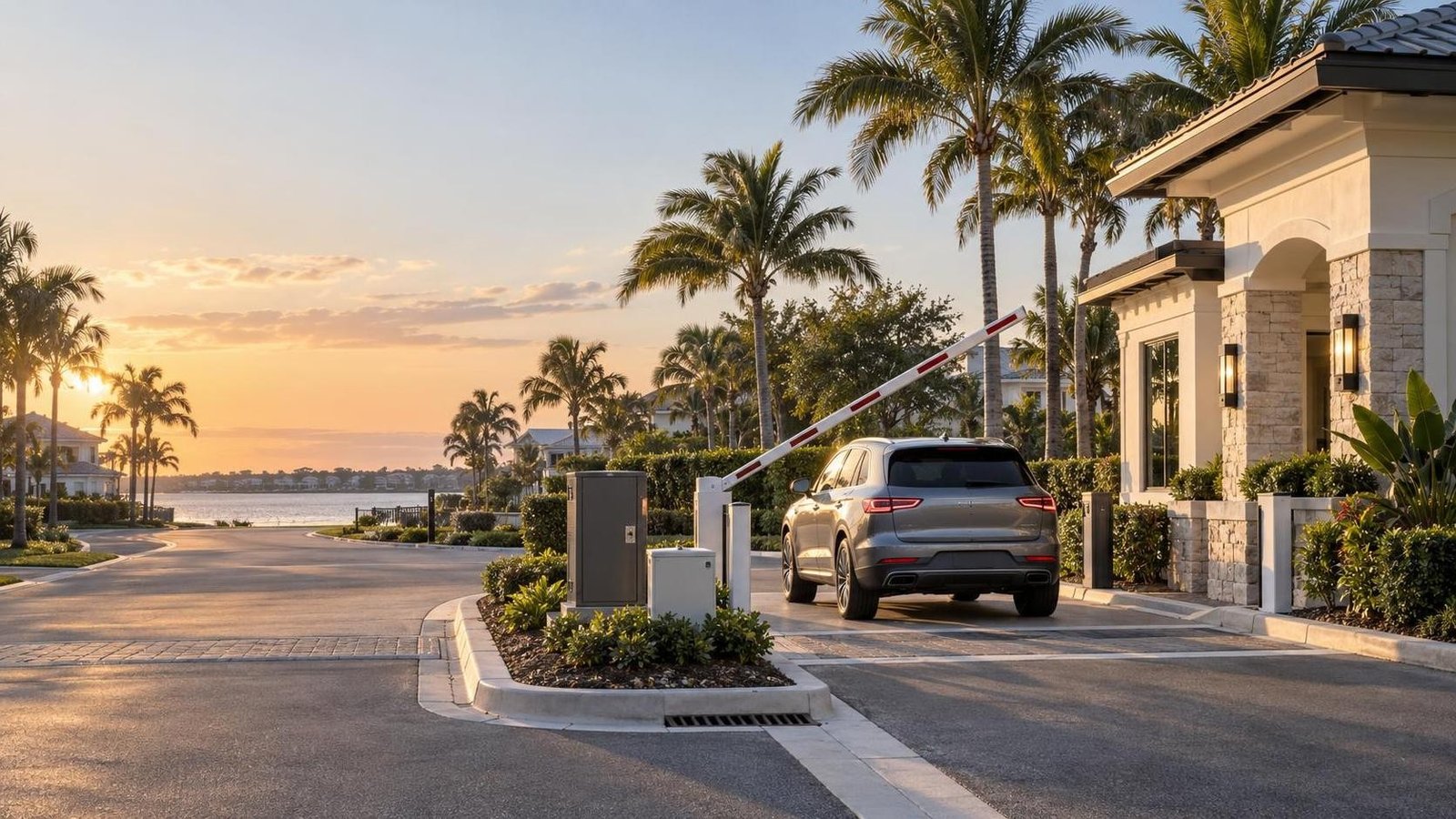
Community Gate Motor and Battery Backup: What Should West Melbourne Relocators Test Before the Morning Commute?
By Carrie Liotta, Space Coast REALTOR® with REAL Broker | Published September 30, 2026
Test the gate during your real weekday departure and return windows, then verify the outage procedure, battery age, service contract, repair history, secondary exit, and association budget before you buy. A gated West Melbourne address is not convenient if one weak motor, dead backup battery, or unclear call procedure can turn the community entrance into the hardest part of your commute.
I would not reject a home because it has one controlled entrance. I would reject the assumption that a working gate during a quiet afternoon showing proves reliable access at 6:45 on a rainy Monday. For an airport-corridor, aerospace, healthcare, or shift-work household, the gate is part of the route from bedroom to badge gate. It deserves the same practical testing as the driveway, school drop-off, and employer entrance.
Start with a live morning-exit test
Arrive before the household would normally leave for work. Park legally outside the community or ride as a passenger with someone who has authorized access; do not tailgate, block traffic, or ask for a resident’s code. Watch several normal cycles. Does the exit arm react smoothly? How many vehicles can clear without the line backing into an intersection or internal turn? Do residents wait for a swing gate, a barrier arm, or both? Is there enough stacking space when a delivery vehicle or guest stops at the entry side?
Then repeat the test during the likely return window. Entry can create a different problem from exit. A resident may use a windshield tag, phone app, remote, keypad, or transponder while a visitor uses a call box or staffed lane. Ask which method actually conveys with the property, what it costs to replace, whether there is a delay before new credentials activate, and what happens when a phone number changes.
Measure the gate separately from the rest of the commute. My guide to airport-corridor noise versus a shorter West Melbourne commute explains how to test the full route at the hours that matter. Here, the goal is narrower: learn whether the first and last two minutes are predictable enough for your workday.
Ask what happens when normal power disappears
“Battery backup” is not a complete answer. Ask which gate components it serves, how the system behaves when utility power fails, how long the current battery is expected to support that configured equipment, when the battery was installed, who tests it, and what the most recent test showed. The entry gate, exit gate, call box, camera, credential reader, network connection, and pedestrian access may not all have the same backup path.
Federal Ready.gov power-outage guidance notes that outages can disrupt communications and transportation and advises people to inventory electricity-dependent needs and determine how long battery backup will last. That does not establish how one community gate will perform. It gives buyers the right mindset: verify the actual system and procedure rather than treating the word “backup” as a guarantee.
Request the written outage plan. Does the gate fail open, remain closed until manually released, or follow another professionally configured sequence? Who is authorized to act? Is the manual release accessible to trained personnel without exposing the community to an uncontrolled security problem? What phone number should a resident use after business hours? If an app or internet connection fails while power remains on, is there a local credential or physical alternative?
Separate one slow cycle from a weak operating system
I would want the seller, through the association or management channel available to the owner, to request the current maintenance contract, recent invoices, battery replacement record, service tickets, incident reports if available, warranty information, and board minutes discussing recurring failures or planned replacement. Identify whether one vendor supports the motor while another supports the credential software or call box. A complete gate file should make those responsibilities clear.
Florida’s homeowners’ association records statute lists applicable official records that include plans, specifications, permits, and warranties for association-maintained improvements; board and member minutes; current contracts; insurance policies; and financial records. It also sets website or application posting duties for associations with 100 or more parcels. That does not mean every technical detail will be handed directly to a prospective buyer on demand. It does mean the current owner and association file may contain far more useful evidence than a sales brochure.
Read the budget for the next gate, not only the current one
Compare maintenance spending, the current vendor contract, planned replacement, and available funding. A large gate line is not automatically bad; it may show that the association is addressing a capital item instead of postponing it.
Florida’s required HOA disclosure summary for prospective purchasers warns that owners are obligated to pay association assessments, that regular or special assessments can change, and that buyers should review the covenants and governing documents before purchasing. For a gated community, I would connect that general obligation to the specific entrance system: what is owned, what is contracted, what is aging, and what might be funded next?
Test the exception paths, not only the resident lane
Daily life includes guests, contractors, childcare, pet sitters, deliveries, rideshares, moving trucks, and emergency service. Ask how each is admitted without sharing a permanent resident credential. Does a call box ring a resident’s phone? Can a guest receive a time-limited code? Is there a separate delivery policy? What happens when the resident is on a flight, inside a secure workplace, asleep after night shift, or unable to answer?
Walk the pedestrian route too. A vehicle gate is not automatically a safe or permitted walkway. Confirm whether there is a separate pedestrian opening, how it is secured, and whether a household member can return from a walk when the phone, app, or network is unavailable. If accessibility matters, evaluate the path, surface, reach, lighting, and hardware with the appropriate professional rather than assuming an electronic gate solves access for every user.
Ask about a secondary vehicle exit, but verify what it really is. Some communities have a fully usable second entrance. Others have an emergency-only route, construction access, or a gate that is not available to residents. Drive the legal alternative from the home to the employment corridor. An exit on the opposite side of a large community may change the commute more than the home’s street location suggests.
Inspect the physical setting around the operator
Without touching equipment, look at the gate area as part of the property tour. Is the operator cabinet upright and protected from vehicle contact? Does water pond around the motor, pedestal, conduit, or loop area after rain? Are arms straight and reflective materials intact? Is landscaping crowding sensors or visibility? Do curbs and lane markings make the approach understandable at night?
West Melbourne’s airport and employment access is changing with public road projects. The city describes the Ellis Road Widening Project as an effort to improve access to Melbourne Orlando International Airport and nearby economic hubs. That is useful corridor context, not a promise about travel time from one subdivision. Buyers still need to test the exact gate, turn, school-zone interaction, and employer entrance.
Visit after dark and, when practical, after ordinary rain. Do not trespass or interfere with operations. You are looking for visibility, queue behavior, drainage, and whether residents appear to improvise around a recurring problem. A neat monument sign can coexist with worn moving parts or confusing traffic flow.
Build the gate question into the contract period
Before making the offer, identify which records matter enough to request and who can obtain them. During the contract period, review the governing documents, budget, current financials, meeting minutes, contracts or summaries available through the proper channel, assessment information, and seller disclosures. Ask targeted written questions instead of “Does the gate work?”
Better questions include: How many unplanned service calls occurred in the last 12 months? When were the operator and backup battery last replaced or tested? Is a replacement proposal pending? What is the resident procedure during a power, internet, or credential-system outage? Are owners responsible for remote or transponder charges? Is there a temporary access plan during lane construction?
If records reveal repeated failures, do not jump immediately to a price reduction. First determine the consequence. A documented replacement under contract and funded in the budget may be more reassuring than a gate with no visible problems and no maintenance file. An unresolved proposal, repeated after-hours lockout reports, or an unfunded capital need deserves closer financial and practical review.
Run the whole household through one difficult morning
The strongest test is a realistic scenario: one adult leaves for an early shift, another handles school or daycare, a guest needs entry later, and a storm has interrupted power or internet. Who has each credential? Can both vehicles exit? Can the caregiver return? Can the guest be admitted without the employee answering from work? Is there a number that reaches someone after hours?
Relocating and night-shift households should also compare gate noise and community activity with bedroom position. My article on a quieter West Melbourne courtyard lot versus a shorter airport-corridor drive explains why daytime sleep and route testing belong in the same decision. A home close to the entrance may save internal drive time but hear more gate motors, vehicle acceleration, and visitor calls. A home deep inside may be quieter but add several turns before reaching the main road.
Do not optimize for one perfect weekday. Test the household’s hardest recurring deadline. If the gate adds only a predictable cycle, it may be a minor tradeoff. If nobody can explain the outage plan and the buyer must protect a strict shift or school handoff, uncertainty carries more weight.
My gated-community due-diligence list
- Observe authorized entry and exit during the real weekday morning and return windows.
- Identify every resident credential, activation process, replacement cost, and closing-day transfer step.
- Request the written power, battery, app, internet, and equipment-failure procedures.
- Review service contracts, recent invoices, battery dates, incident history, warranties, and board minutes.
- Compare maintenance spending, planned replacement, available funding, and possible assessment exposure.
- Verify guest, delivery, contractor, pedestrian, rideshare, and after-hours access.
- Confirm whether a secondary exit is available to residents and test its legal route.
- Observe drainage, visibility, lane stacking, and gate operation without touching or bypassing equipment.
- Drive from the home through the gate to the exact employer entrance at the actual shift time.
Bottom line
A community gate should make access controlled, not mysterious. For West Melbourne relocators, the right gated home is one where the normal morning cycle is acceptable, the outage and manual procedures are documented, the vendor and association responsibilities are clear, and the budget acknowledges future repairs.
I would choose evidence over appearance. A plain gate with a current service file, tested backup, clear resident process, and funded plan is more useful than an impressive entrance nobody can explain when the power or app goes down.
I am Carrie Liotta, a Space Coast REALTOR® with REAL Broker, and I publish 321 Coastal Living to help relocating buyers test the details that shape real Brevard County workdays. Reach out for a no-pressure conversation about West Melbourne homes, HOA records, commute routes, and inspection strategy. Your next chapter starts here.
