

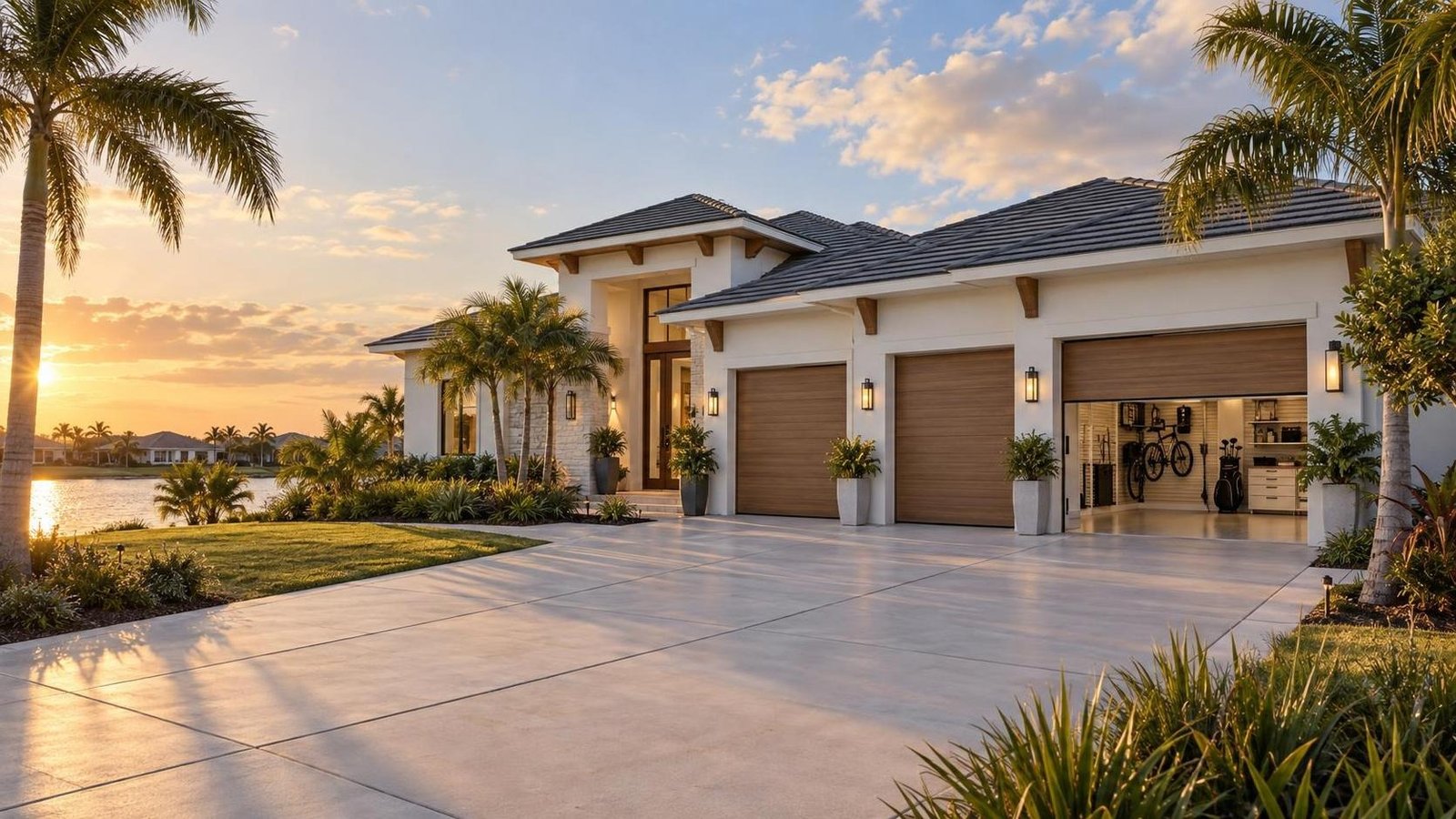
Smaller Three-Car Garage or Larger Two-Car Garage With Lower Assessments: Which Viera Home Wins?
By Carrie Liotta, Space Coast REALTOR® with REAL Broker | Published September 21, 2026
Choose the three-car garage only if the third bay solves a real parking or storage problem that the larger two-car garage cannot. If both layouts handle your vehicles, tools, and storm gear, the home with lower verified assessments usually gives you more monthly flexibility—and you benefit from that difference whether or not the garage is full.
Relocating buyers often see “three-car garage” as an automatic upgrade. In Viera, it can be extremely useful for a golf cart, workbench, bicycles, beach equipment, holiday bins, an extra vehicle, or the things Florida homes do not store in basements. But the label can hide an awkward reality. Some three-car layouts have two standard bays plus a narrow tandem or single bay, while a well-designed two-car garage may be wider, deeper, and easier to use every day.
The other side of the choice is less photogenic but just as important: district assessments, HOA obligations, taxes, insurance, and the rest of the payment. I want buyers to compare usable garage function against the actual recurring cost, not compare two listing bullet points.
Measure the garage as if your move has already arrived
Bring the dimensions of your vehicles, including mirrors, roof racks, trailer hitch, and the space needed to open doors. Then measure the clear garage opening, interior width and depth, and the pinch points created by steps, water heaters, air handlers, utility panels, support columns, or built-in cabinets.
A three-car garage can disappoint if the third bay is too narrow for the intended vehicle or if the driveway geometry makes it difficult to enter. A two-car garage can surprise you if it has extra depth behind the parking area, tall ceilings for approved overhead racks, and uninterrupted side walls. I also check where the attic access drops, where the exterior door swings, and whether a parked vehicle blocks the electrical panel or hurricane panels.
Do not assume you can solve a tight garage by moving everything outside. Viera neighborhoods can have architectural standards and rules affecting sheds, driveway parking, trailers, visible storage, and exterior additions. Read the current documents for the exact association before you assign value to a future storage plan.
Decide what the third bay is worth to your household
The strongest case for the third bay is not “resale.” It is daily use. If one spouse drives a work vehicle, a teenager will soon need parking, or you own kayaks, bicycles, tools, golf equipment, and storm supplies, the extra separation can keep the first two bays functional. For frequent travelers, keeping every vehicle inside may also matter.
The case is weaker if the third bay will become an expensive closet for items you would not pay to move. Buyers should inventory the garage before shopping: two vehicles, mower, workbench, four bikes, beach wagon, shutters, generator, trash carts, refrigerator, and storage bins. Sketch where each item goes in both homes.
If you are also comparing charging capability, read my guide to Viera garage EV readiness versus lower district assessments. A third bay does not guarantee adequate panel capacity, a permitted charger, or a practical cable route.
What do “district assessments” mean in West Viera?
Do not treat every Viera property as if it carries the same charge. The Viera Stewardship District explains that it was established to fund and maintain public infrastructure associated with West Viera’s planned development. Its listed maintenance functions include drainage and community-canal work, street lighting, and wetland and habitat maintenance. That tells you why the district exists; it does not tell you the exact obligation on a particular parcel.
For each home, review the current tax bill, non-ad valorem lines, seller records, applicable district documents, and any payoff or amortization information available. Ask your lender and closing professional how the charge is treated in qualification and escrow. If the listing says an assessment is “paid off,” verify what was paid, whether any ongoing operations charge remains, and whether another association or special charge applies.
I avoid quoting a generic Viera amount because the correct figure is parcel-specific and can change. The buyer’s job is to turn the public record and closing estimate into an annual and monthly number for each address.
Build a real monthly comparison
Start with principal and interest, estimated property taxes after purchase, homeowners insurance, flood insurance if applicable, HOA dues, district or non-ad valorem assessments, and any required club or maintenance fee. Then add the near-term home costs that differ: roof, HVAC, tires or paint do not disappear because one garage has another door.
The seller’s current tax bill is useful evidence, but it is not your future guarantee. Use the Brevard County Property Appraiser tax estimator to model a purchase-price scenario, then review the result with your lender or tax professional. The estimator is planning help, not a final bill.
If the lower-assessment home saves a meaningful amount every month, decide what that flexibility would do for you. It might fund garage cabinetry, off-site boat storage, a future HVAC reserve, travel, or simply a safer emergency cushion. Recurring savings have a different value from a one-time feature because they affect every year you own the home.
Separate garage size from the condition of the whole house
A three-car garage should not erase an older roof, an undersized air conditioner, weak window documentation, or a drainage concern. Likewise, a lower-assessment home is not automatically the better value if it needs major work immediately after closing. I compare the five-year ownership picture, not just the first payment.
Ask for permits and invoices for garage conversions, added outlets, attic stairs, overhead storage, EV equipment, and any wall or door changes. The Brevard County permit search is a starting point where county records apply; a property inside another jurisdiction may require a different records office. A beautifully finished garage is not worth a premium until you know the work is safe, documented, and acceptable to the association and insurer.
Look at the driveway too. A shallow driveway, sidewalk crossing, curved approach, or nearby street parking restriction can make a nominal three-car setup less useful. Open every garage door, park or imagine each vehicle in place, and test whether people can unload groceries without moving another car.
Which feature is harder to add later?
You generally cannot add a third garage bay casually. Lot coverage, setbacks, drainage, structure, utilities, permits, and HOA approval may make expansion expensive or impossible. That gives a truly functional three-car layout scarcity value for the household that needs it.
But you also cannot negotiate away a recurring assessment after closing simply because the garage feels too small. You can improve storage inside a generous two-car garage with cabinets, wall tracks, ceiling racks approved for the structure, and disciplined organization. You cannot turn a narrow two-car footprint into comfortable three-vehicle parking with shelves.
This is why the answer changes by buyer. The physical limitation matters most when it blocks a nonnegotiable use. The recurring cost matters most when the two-car garage already works.
Consider resale without pretending every buyer is the same
A functional three-car garage can widen appeal among buyers with multiple drivers, hobbies, golf carts, or storage-heavy lifestyles. In a community where many competing homes have three bays, a two-car home may need a stronger price, lot, interior, or monthly-cost story. That does not guarantee a dollar-for-dollar resale return.
The lower-assessment home has its own resale argument. Future buyers also qualify against the total payment, and a manageable recurring cost can help when rates, insurance, or taxes are pressuring affordability. The most marketable choice is usually the one whose tradeoff is easy to explain: “two generous bays and a lower ongoing cost” or “three genuinely usable bays that solve a difficult storage problem.”
For another example of making that complete-payment choice, see how I compare builder incentives with a Viera resale’s lower remaining district balance.
My showing-day test
I would ask the family to perform the same test at both homes:
- Measure the door opening, clear depth, clear width, and ceiling constraints.
- Map every vehicle and storage category instead of relying on the bay count.
- Check driveway access, street rules, and guest-parking reality.
- Review the HOA rules for trailers, sheds, exterior racks, and overnight parking.
- Verify permits and electrical capacity for planned workshop or charging use.
- Confirm parcel-specific assessments and model the post-purchase tax bill.
- Compare the roof, HVAC, insurance file, and immediate repair reserve.
- Put the monthly difference beside the one-time cost of improving storage.
That exercise prevents the garage from becoming an emotional shortcut. It also exposes whether the “larger two-car” description is genuinely useful or merely a few extra feet that do not change your routine.
When I would choose each Viera home
I would choose the smaller three-car garage when the third bay independently holds a real vehicle, golf cart, workshop, or equipment category; the driveway works; the documents are clean; and the complete monthly payment remains comfortable. I would not apologize for paying for function I know I will use.
I would choose the larger two-car garage with lower assessments when it parks the household’s vehicles without daily shuffling, has enough wall and ceiling storage, and leaves more room in the budget for reserves and life. That answer becomes even stronger when the home also has the better roof, HVAC, lot, or floor plan.
Do not let a future possibility outweigh today’s reality. If a teenager may drive in six years, model that scenario. If a boat, golf cart, or workshop is only an aspiration, decide whether you want to finance storage for it now. The right Viera home supports the life you are likely to live, not the most equipment-heavy version of yourself.
Make the garage earn its place in the payment
The winning home is not the one with the highest garage count. It is the one whose storage works after the cars are parked and whose recurring costs still leave you comfortable. Measure both garages, verify every assessment, and compare the full five-year plan.
If you are relocating to Viera, I can help you test the floor plan, pull the parcel-level questions into one comparison, and keep storage needs in proportion to taxes, insurance, HOA obligations, and home condition. I’m Carrie Liotta, Space Coast REALTOR® with REAL Broker, and 321 Coastal Living is where I explain these local decisions without the sales pressure. Reach out for a no-pressure conversation. Your next chapter starts here.