

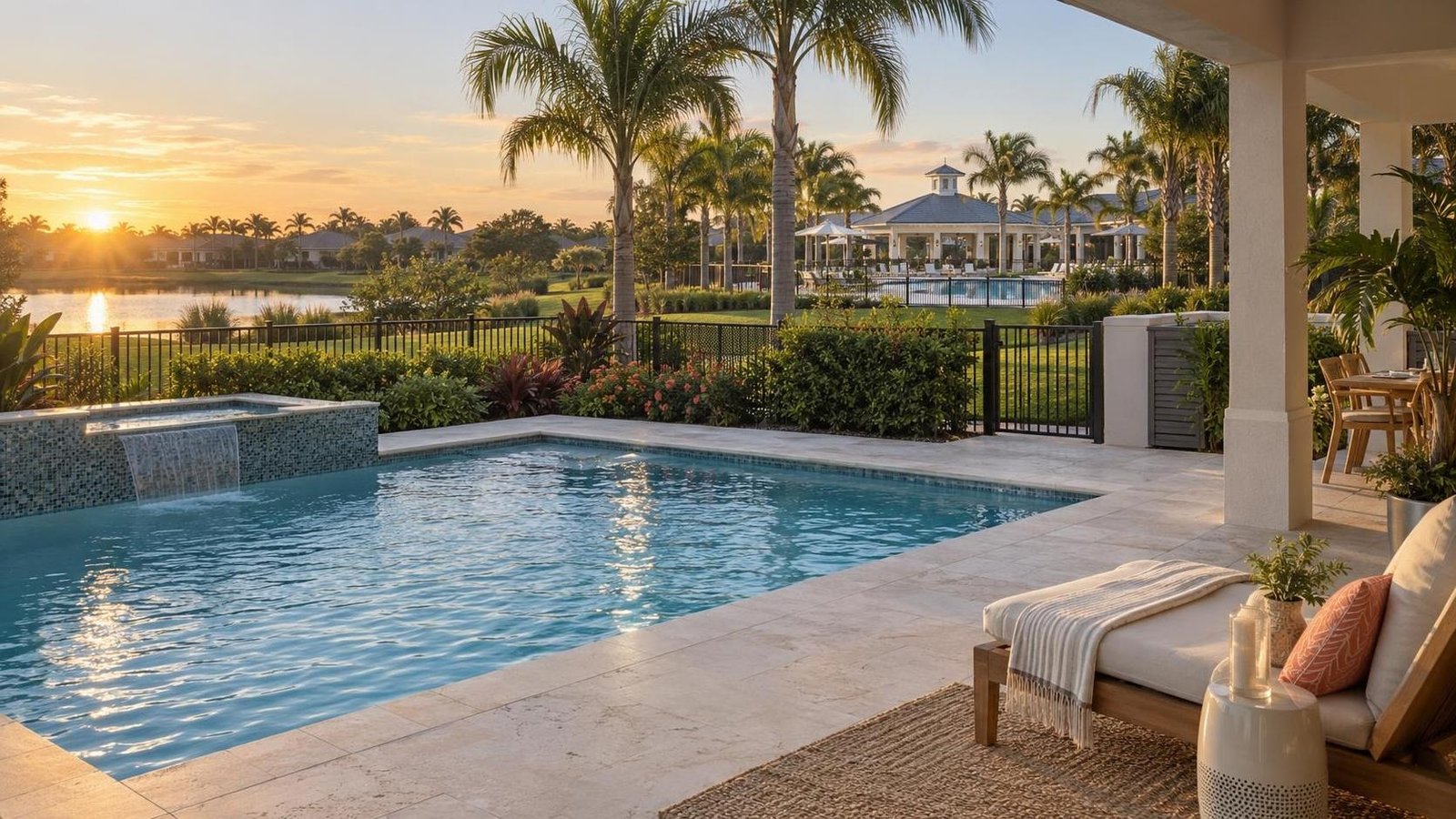
Private Pool or Community Pool: What Should Viera Relocators Choose?
By Carrie Liotta, Space Coast REALTOR® with REAL Broker | Published October 5, 2026
Choose a private pool when your household will use it often enough to justify direct maintenance, repair reserves, safety responsibility, and higher day-to-day control. Choose a community pool when you value shared amenities and less hands-on work, but only after verifying access rights, dues, rules, hours, guest limits, and the association’s financial plan.
I would not make this decision from the water alone. For a Viera buyer, the better choice still fits after you price the monthly obligation and rehearse an ordinary Tuesday. A beautiful backyard pool can become the center of home life. A polished clubhouse pool can be equally appealing and still be too far away, too restricted, or tied to a membership you misunderstood.
Start with the routine you are actually moving for
Before comparing two houses, decide what “having a pool” means to your household. Is it a daily swim before work, ten quiet minutes after school, weekend exercise, entertaining relatives, or an occasional place to cool off? Do you want privacy at 7 a.m., or would you rather walk to a larger shared pool where no one in your household handles chemicals or skims leaves?
A private pool usually wins on immediacy. You set the schedule, choose the temperature, decide when guests come over, and step from the lanai into the water without packing a bag. That can be especially valuable for a remote worker, a lap swimmer, a household with an irregular schedule, or a family that knows the pool will be used several times each week.
A community pool can win when swimming is one amenity among many and the household does not want another system to manage. It may offer more deck space, a social setting, or nearby recreation, depending on the specific community. But distance matters. Walk the route from the house, time it in the heat, and picture carrying towels, water bottles, flotation gear, and tired children home. An amenity is not convenient merely because it appears on a neighborhood map.
This is why I encourage relocators to compare Viera communities as daily environments, not brand names. My guide to Addison Village, Pangea Park, and Viera East for a Melbourne commute shows how amenities, location, housing age, and the workday belong in the same decision.
Build two honest cost ledgers
Do not compare “pool maintenance” with “HOA fee” as though each were one simple number. Build a ledger for each home using documents and property-specific quotes.
For the private-pool home, identify routine service or the time and supplies required for do-it-yourself care; water and electricity; equipment age; screen-enclosure condition; deck and coping condition; heater operation if present; safety features; insurance feedback; and a reserve for the pump, filter, controls, surface, plumbing, enclosure, and other components. Ask for installation records, permits, warranties, service invoices, leak repairs, and recent professional evaluations. A seller’s current bill is useful history, not your forecast.
For the community-pool home, separate every layer: HOA dues, any Community Development District assessment, optional club membership, initiation or application charges if applicable, and other recurring amenity costs. Then review the current budget, financial reports, insurance, contracts, rules, meeting minutes, and any pending project or assessment information available for the association. Florida’s homeowners’ association records statute identifies governing documents, rules, common-area plans and warranties when applicable, insurance policies, contracts, and financial records among the association records buyers should understand.
Keep the public district layer separate. The Viera East Community Development District, for example, describes itself as a Chapter 190 special-purpose government that operates and maintains community-wide improvements and publishes budgets, audits, policies, maps, agendas, and minutes. A CDD assessment, an HOA payment, and an optional club membership are not interchangeable just because all three appear in the same relocation spreadsheet.
Confirm that community-pool access actually transfers
Never let a listing phrase such as “community amenities” substitute for written access terms. Ask whether pool rights are deeded to the property, included through a mandatory association, available through an optional membership, limited to certain neighborhoods, or subject to an application.
The distinction is real in Viera. The Addison Village Club’s official site currently says any Viera resident is eligible for an Approved License Holder Membership and asks interested residents to contact staff for a tour. Eligibility to apply is not the same statement as automatic, no-cost access attached to every Viera home. Before relying on the club in your purchase decision, obtain the current membership terms, fees, privileges, wait or application process, household definitions, and transfer requirements directly from the responsible organization.
For any shared pool, read the operating hours, guest and supervision rules, access terms, closure procedures, and limits on programming or private events. Ask how residents receive maintenance notices. A quiet listing photo does not show how the facility works after school, on a summer weekend, or during a repair.
Inspect a private pool as a group of systems
If the private-pool home is leading, stop treating the pool as one inspection item. Look at the vessel and finish, deck, coping, screen enclosure, doors and gates, pump, filter, heater, controls, lights, plumbing, drainage, autofill, overflow path, and equipment-pad access. Match invoices and permits to the equipment that is actually present. Ask who services it, what has leaked, which components have been replaced, and how the pool behaves after heavy rain.
Use qualified pool, electrical, structural, screen-enclosure, plumbing, and other professionals as the findings require. A clear-looking pool can still have an undocumented light repair, concealed leak, corroded equipment, inaccessible valves, or an enclosure nearing a larger repair. Conversely, cosmetic wear should not automatically be priced like system failure. Written findings let you separate normal ownership from a real negotiation issue.
Safety deserves its own review. Florida’s Residential Swimming Pool Safety Act describes safety-feature options for qualifying new residential pools, including barriers, approved covers, exit alarms, self-closing and self-latching devices, and qualifying pool alarms. Existing homes can have different permit histories and configurations, so do not infer compliance from a screen enclosure or a previous owner’s habits. Confirm the records and have the present setup evaluated for your household.
The CDC’s drowning-prevention guidance recommends close supervision and a four-sided fence at least four feet high with self-closing, self-latching gates. The same guidance says supervision remains necessary even when lifeguards are present. That matters on both sides of this comparison: private control does not remove risk, and shared management does not transfer away a parent’s or caregiver’s responsibility.
Decide how much control you want after closing
A private pool gives you control, but every choice comes back to you. You decide whether to heat it, how often it is serviced, when equipment is replaced, how the deck is furnished, and whether a repair happens now or waits. That freedom can be exactly why the house feels right. It can also be a poor fit for a frequent traveler who does not want to coordinate vendors from another time zone.
A community pool trades control for shared operation. You do not select the pump or hire the resurfacing contractor. Your influence runs through governing documents, budgets, meetings, votes, and management. Decide whether that feels reassuring or frustrating. A buyer who values common standards may appreciate it; an early swimmer or frequent host may feel constrained.
Water care is not an occasional private-pool task. The CDC’s healthy-swimming guidance explains that pool owners need to reduce injury and illness risks and keep water clean. If you plan to handle care yourself, price your time and be honest about whether you will test, clean, observe equipment, and respond consistently. If you will hire service, interview the provider and confirm exactly what the recurring visit does and does not include.
Compare the lots, not only the pools
A private pool changes the backyard. Measure the usable dry space, side-yard service route, drainage path, privacy, sun exposure, screen condition, and room for pets, play, gardening, or future equipment. A large pool on a compact lot may leave less flexible outdoor space than the photos suggest. A smaller pool with shade at the right hour may fit better than a dramatic one that turns the lanai into an afternoon heat trap.
If orientation matters, my comparison of a west-facing pool and an east-facing Viera lanai explains why the best direction depends on the hours you will actually be outside. Visit both homes when you expect to swim, not only during the listing appointment that fits the schedule.
A home without a pool may offer more lawn, privacy planting, or future-project space. Do not assign value to a possible pool until you review setbacks, easements, drainage, utilities, construction access, association approval, and permit feasibility. My guide to Viera preserve-lot pool planning shows why an attractive yard can still have approval or drainage constraints.
Think about resale without pretending there is one winner
Neither option automatically has stronger resale. A private pool can be a meaningful lifestyle feature for the buyer who wants it and an unwanted responsibility for the buyer who does not. A well-run shared amenity can broaden appeal, but dues, restrictions, distance, crowding, or a large pending project can weaken that story.
The most transferable value is clarity. For a private pool, that means permits, service records, understandable equipment, a safe and usable layout, and realistic condition. For a community pool, it means clear access rights, current rules, organized financial records, transparent maintenance planning, and a location residents can conveniently use. Buyers pay more confidently when they can explain what they are receiving and what it will require.
My offer-stage comparison
Before choosing, I would put the two homes on one page and answer these questions:
- How many times will this household realistically swim in a normal week?
- Does the preferred swim time fit community hours and travel time?
- What are the verified first-year and reserve obligations for the private pool?
- Which HOA, CDD, and optional club payments apply to the community-pool home?
- Does pool access transfer with the property, require membership, or depend on another agreement?
- What do current rules, budgets, insurance, contracts, minutes, and project records reveal?
- Are the private pool’s safety features, permits, equipment, enclosure, drainage, and service access acceptable?
- Which backyard and neighborhood still fit when no one is swimming?
If the private pool wins, use inspections and quotes to make a condition-based offer rather than inventing a generic repair credit. If the community pool wins, make document review part of the decision early enough to understand access and financial obligations before deadlines expire. In either case, obtain property-specific insurance guidance; do not assume one choice is automatically cheaper to insure.
Bottom line for Viera relocators
The private pool is usually the better choice for frequent swimmers who value privacy, schedule control, and backyard-centered living enough to own the work and reserves. The community pool is usually better for buyers who want shared recreation without managing another household system, provided the access, rules, distance, and financial file truly fit.
I help Viera relocators compare more than listing photos: the actual pool file, community documents, monthly carrying costs, backyard function, commute, and the routine each home supports. Join my private Facebook group, Moving to Brevard County Florida, or reach out for a no-pressure conversation about Brevard County homes for sale with REAL Broker. Your next chapter starts here.
