

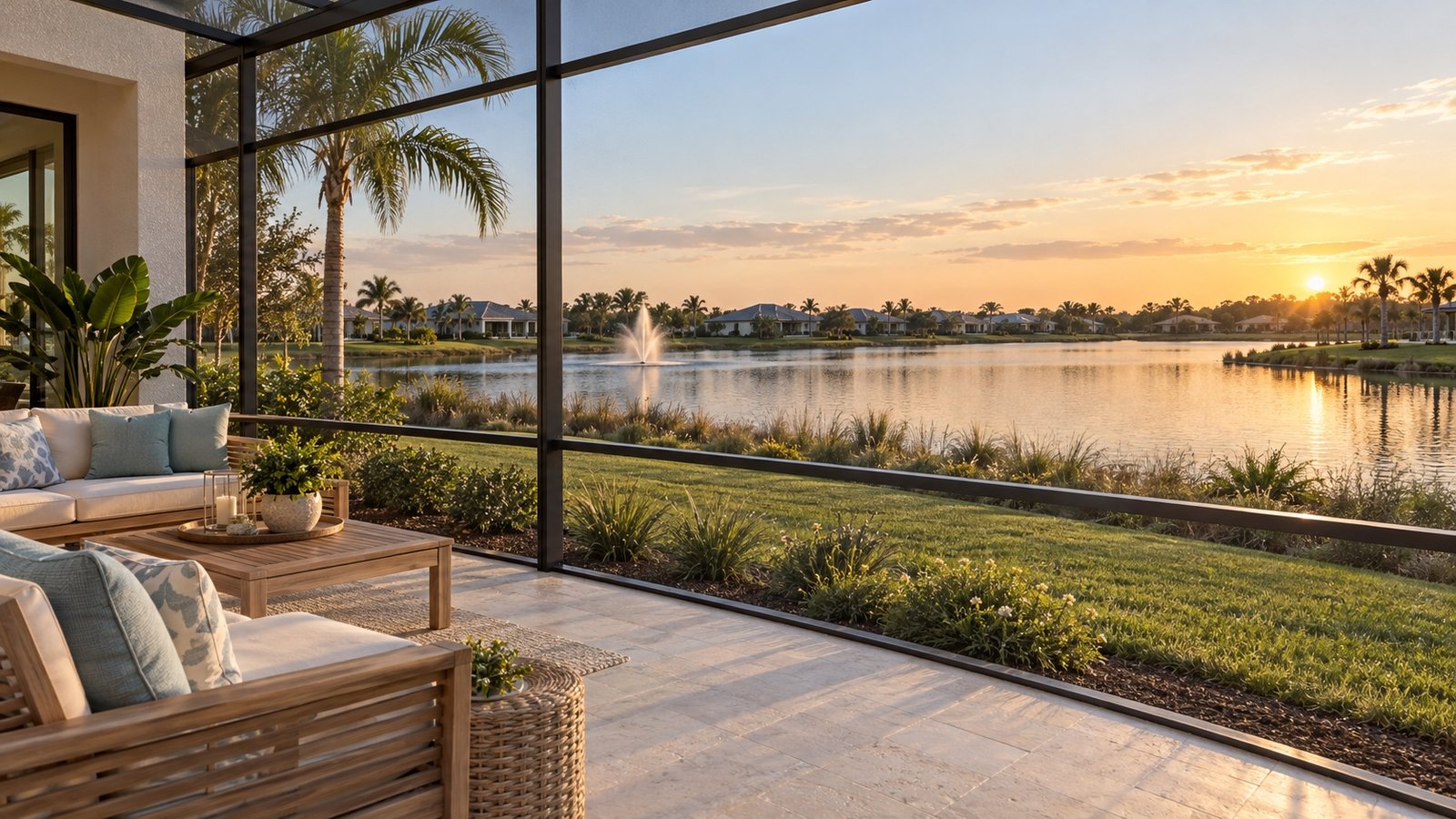
Should Viera Buyers Treat a Decorative Pond View as a Water Feature or a Stormwater System When Comparing Two Newer Homes?
By Carrie Liotta, Space Coast REALTOR® with REAL Broker
If two newer Viera homes are otherwise close, I would treat the pond behind either one as a stormwater system first and a view second. The view may be lovely, but the buyer who understands ownership, access, maintenance, and permitted limits before writing an offer is usually making the stronger long-term choice.
That answer is not meant to drain the romance from a water view. A calm pond can make a lanai feel more open, create welcome separation from the next home, and bring changing light to a backyard. In Viera, where new neighborhoods can place homes around lakes, preserves, trails, and common areas, it is also easy to assume that every attractive body of water is simply an amenity. It may be an amenity. It may also be part of the neighborhood’s surface-water management plan.
When I help buyers compare two homes like this, I do not ask only, “Which backyard feels better?” I ask what sits between the patio and the water, who has the right to be there, who maintains it, and what documents support the answer. That process gives a buyer a more useful comparison than a fountain, a listing photo, or a seller’s casual description ever can.
Why the word “pond” is not enough
A pond can look ornamental and still do a very practical job. Florida’s Environmental Resource Permit program regulates activities that alter surface-water flows, including stormwater runoff created by upland construction. The state explains that water-management districts generally review the remaining ERP applications. That does not mean a buyer should try to interpret permits alone. It does mean the water feature deserves the same kind of careful attention as a drainage swale, a retaining wall, or a shared private drive.
On a specific lot, the water may be within a tract owned or maintained by an association, a community development district, a developer-controlled entity, or another party. It may be bordered by an easement. Its edge may be planted and maintained in a way that makes it feel like a private extension of the yard even when it is not. The survey, plat, title work, association documents, and any available maintenance records are more reliable than the visual impression from the back door.
That distinction matters because the best-looking view is not automatically the most flexible yard. A buyer who imagines a new fence line, shade tree, paver extension, screen enclosure, dock-like platform, or drainage alteration needs to know whether the plan crosses a property line, an easement, association rule, or a stormwater-maintenance area. “We have always used that space” is not the same as having the right to improve it.
Compare the homes from the property line outward
I like buyers to start with a survey rather than a drone photo. First, locate the rear property line. Then ask where the water begins, whether there is a dedicated tract or easement between the line and the pond, and whether any fence is sitting where the documents say it should. A wider-looking backyard can be less usable than a smaller one if a broad strip behind it is reserved for drainage access or maintenance.
Next, look at the grade, drains, inlets, outfalls, and bank condition during an ordinary showing. You do not need to make a diagnosis from the sidewalk. You do need to notice questions worth carrying into the inspection period: Is there erosion at the bank? Is a low spot directing water toward the home? Is a structure or landscape feature blocking a visible inlet? Has the seller made changes near the water edge? Ask the inspector to assess the house and its visible drainage components, then use the appropriate specialist or association contact for questions beyond that scope.
Also, use daylight thoughtfully. A home can have a beautiful sunset reflection and still have less privacy than it appears in listing photos. Walk the view from the primary bedroom, kitchen, lanai, and pool area. Notice nearby rear elevations, trail traffic, lighting, fountain noise, geese, and the distance to the next screened enclosure. For some buyers, the open view is the lifestyle priority. For others, an interior lot with a deeper private yard is the better everyday fit.
This is a useful point of comparison with the choice between a smaller, easier-care property and a larger older one. In my article on smaller low-maintenance versus larger older Viera homes, the better fit comes down to the work and flexibility a buyer actually wants to own. A pond-view lot calls for the same honesty: do not pay for a view as though it grants private waterfront control.
Ask who maintains what, and get the answer in writing
Before the inspection period ends, request the governing documents, current rules, budget, recent meeting minutes, and any records that address the pond, common area, bank work, fountains, algae treatment, or drainage repairs. For an association subject to Chapter 720, Florida law requires applicable associations to keep official records, including plans, specifications, permits, and warranties for improvements the association must maintain, repair, or replace, along with governing documents, rules, minutes, and financial records. The relevant language is in Florida Statutes section 720.303.
That is a reason to ask precise questions, not a promise that every document will answer every question. I would ask the seller and association, in writing where appropriate:
- Who owns the water body, bank, and any tract between the lot and water?
- Who maintains the fountain, shoreline vegetation, inlet structures, and erosion control?
- Are there recorded access easements or maintenance routes behind this lot?
- Have there been special assessments, recurring repairs, contractor disputes, fish kills, algae treatment, or bank-stabilization projects?
- What improvements, plantings, fences, irrigation changes, or lighting are prohibited near the water?
- Are there pending board discussions or capital projects that affect this pond or the buyer’s assessment exposure?
The aim is not to turn a normal neighborhood pond into a deal-breaker. It is to separate a manageable shared amenity from an obligation or limitation the buyer did not price into the decision. Current fees and responsibilities can differ by community, which is why I would never use one Viera neighborhood’s answer for another. The same caution applies when comparing CDD fees, HOA dues, and insurance on a newer Viera home: the listing’s monthly figure is a starting point, not the complete carrying-cost picture.
A pond view does not answer the flood-insurance question
I hear this mix-up often: “The home backs to a pond, so it must be in a flood zone,” or the reverse, “The pond handles the water, so flood insurance cannot matter.” Neither conclusion is safe. FEMA says its Flood Map Service Center is the official source for National Flood Insurance Program mapping products, and its flood-map guidance makes clear that maps help identify flood risk but that there is no such thing as a no-risk zone.
For a specific property, have the lender and insurance professional address the lending and coverage questions, then review the location in the official mapping tools with the property details in hand. Ask whether a prior elevation certificate, survey, or flood-policy history exists, but do not assume any older document is current or transferable. The pond’s beauty, the grade visible from the patio, and a neighborhood marketing map are not substitutes for property-specific due diligence.
What I would prioritize when the two houses are close
If the homes are genuinely similar in price, condition, school fit, and commute, I would give the edge to the pond-view home only when the documents and physical layout support the lifestyle premium. A clear rear boundary, understandable maintenance responsibility, no surprise access path through the yard, sensible rules, a well-kept bank, and a view that still feels comfortable from inside the home are meaningful positives.
I would lean toward the alternative if the pond view comes with unanswered responsibility questions, an unusually constrained yard, visible drainage concerns that deserve expert review, or a premium that leaves no room for the buyer’s other priorities. An attractive view should add enjoyment; it should not force a buyer to minimize an issue that would bother them every rainy season or every time they want to change the backyard.
Viera continues to evolve, as the Viera Company notes on its community site, so I encourage buyers to evaluate the particular home, recorded documents, and surrounding conditions rather than make a decision from broad community branding. Buyers who value quiet should also think about the whole setting, not just the water. My guide to finding a quieter Viera backyard near Health First can help frame that broader conversation.
My bottom line for Viera pond-view buyers
A pond view can be a wonderful reason to choose one newer Viera home over another. Just make the choice with your eyes open. Treat the water feature as part of a working system until the survey, governing documents, association records, inspection findings, lender, and insurance guidance tell you exactly what it means for that parcel.
I help buyers translate those documents into a practical home decision without pretending every pond or every community works the same way. If you are comparing two Viera homes and one has a water view, reach out for a no-pressure conversation about Brevard County homes for sale. Your next chapter starts here.
