

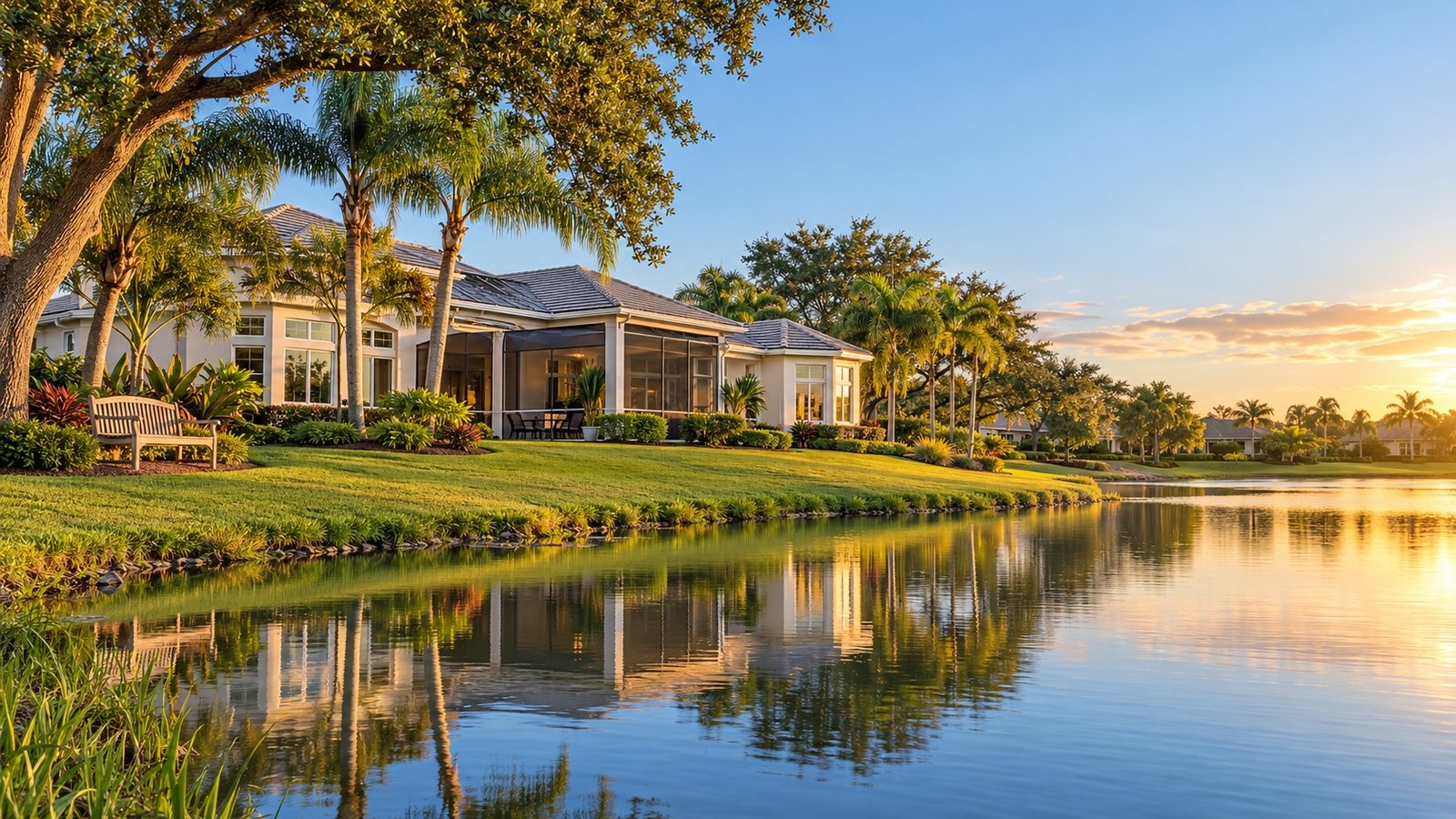
Older Home Near a Retention Pond or Drainage Canal: What Titusville KSC Relocators Should Check
By Carrie Liotta, Space Coast REALTOR® with REAL Broker | Published October 20, 2026
A retention pond or drainage canal near a Titusville home is not an automatic reason to walk away. For a KSC relocator, identify who maintains it, check flood information and records, and let inspection answer the questions photographs cannot.
For buyers moving here for Kennedy Space Center work, the view from a back fence can raise a quiet question: is that water feature part of the neighborhood’s drainage plan, or could it become an ownership, maintenance, insurance, or resale problem? The answer is in the documents, the exact lot, and the condition on inspection day.
Start by naming the feature, not guessing at it
“Pond” is a loose real-estate word. A buyer may be looking at a platted retention area, a drainage easement, a canal maintained by a public entity, a private common area, or water that happens to sit behind a home after rain. Those are different situations with different people responsible for them.
Before I let a buyer make a decision based on a backyard view, I want the survey, title work, listing disclosures, and any homeowners’ association documents on the table. The survey may show a drainage or utility easement. The title commitment may identify recorded restrictions. If there is an association, its budget, rules, and recent meeting minutes can help explain whether it maintains the pond, contracts for mowing or bank work, or has discussed a drainage complaint. A seller’s memory is helpful, but it is not a substitute for recorded documents.
For an older home, I also ask a more practical question: where does water go after a hard rain? Walk the side yards, look at downspout discharge, notice settled areas near the slab or screen enclosure, and ask whether the owner has added swales, drains, fill, a French drain, or a pump. Those improvements are not automatically bad. They are clues that deserve invoices, permits when applicable, and a conversation with the inspector rather than a casual “it has always been that way.”
Flood map context is essential, but it is not the whole drainage story
Every Titusville buyer should check the exact address through the FEMA Flood Map Service Center, the federal government’s official public source for National Flood Insurance Program flood-hazard information. FEMA also cautions that map information can be updated or superseded, which is one reason I do not rely on an old listing screenshot or a neighbor’s recollection.
A flood-map designation is important for insurance and lending conversations, but it does not answer every yard-drainage question. A property can have water-management concerns that do not look like a mapped flood hazard, and a nearby retention feature can be functioning as intended without making the house itself a problem. Treat the map as one part of a property file, then ask your insurance professional, lender, inspector, and—when needed—engineer for the answer that fits the exact home.
Florida’s Department of Environmental Protection explains the state stormwater framework this way: rain running over roofs, streets, and other hard surfaces becomes runoff, and many stormwater systems are designed to retain a specified amount before discharging or overflowing under conditions beyond their design capacity. That is useful context, not a guarantee about any one Titusville pond. It tells buyers why “I have never seen water there” is a weak substitute for reviewing the specific system and its history.
Who owns it, and who is expected to maintain it?
Ownership is where a pleasant water view can turn into a serious due-diligence question. Do not assume that a feature beyond the fence is the city’s responsibility, the association’s responsibility, or no one’s responsibility. Ask for the plat, survey, HOA documents, and any available maintenance agreement. If an association owns common drainage land, read the budget and minutes for recurring mowing, erosion, pump, culvert, or assessment discussion. If the feature is within an easement, ask what access rights exist and whether equipment may need to enter near the lot.
For a home inside Titusville, records may sit with different city departments or with a separate governmental entity depending on the property and the work in question. The City Clerk identifies its office as the records custodian for city departments other than law enforcement and provides a public-records request route. When a visible feature or a past repair matters to a purchase decision, a targeted records request can be more useful than guessing from an aerial image.
That does not mean every buyer needs to launch a broad records search. I would use the concern to set the scope. A clean survey, normal inspection findings, clear HOA maintenance responsibility, and a good insurance conversation may be enough. If the listing shows a recently rebuilt bank, recurring standing water, an unusual drainage structure, or a disagreement about access, that is when I would involve the appropriate local office and consider a specialist opinion before the inspection period ends.
What an older home adds to the decision
Older Titusville homes deserve a more connected look because the house and the lot affect each other. A low spot by the foundation, a patched patio slab, a screen enclosure with corrosion at the base, a downspout that dumps beside the house, or a driveway that slopes toward the garage can change how a buyer reads the drainage question. None of those observations proves a defect. Together, they tell the inspector where to look and tell the buyer which repair history to request.
I would not let a relocation buyer spend all of their attention on the commute and overlook the everyday ownership file. A shorter drive to work is valuable, but it does not erase a surprise repair or insurance question after closing. At the same time, an older house beside a well-maintained drainage feature may be the better purchase if the records are clear, the inspection is sound, the price reflects its condition, and the home fits the household’s real routine.
Ask for a usable history, not a blanket reassurance
“No known flooding” is a starting point, not an investigation. I would ask the seller for a straightforward chronology: when did they buy, what have they observed in heavy rain, what repairs or drainage changes have they made, and are there invoices, permits, reports, photos, claims information, or correspondence that helps explain the work? A useful answer has dates and documents. A vague answer tells us to keep asking.
Then make the answer testable. During the inspection period, your home inspector can evaluate visible grading, exterior drainage, accessible components, and signs of moisture or movement within the scope of the inspection. If the concern is beyond that scope, the right next step could be a drainage contractor, licensed engineer, surveyor, insurer, or attorney—depending on what the documents and inspection actually reveal. I do not ask a general home inspection to answer a specialized engineering question, and I do not promise a buyer that a pond will never overflow.
It is also smart to separate a drainage issue from a general “older-home” anxiety. Older homes can have a perfectly manageable lot and still need attention to roof drainage, windows, electrical, plumbing, or air conditioning. I wrote about that broader inspection mindset in what Titusville buyers should inspect before paying more for a launch-view home. The objective is not to build a case against the property. It is to understand the cost, risk, and responsibility before the contingency period closes.
Build the cost conversation around facts
Do not treat a seller’s estimate, a neighbor’s repair, or one online quote as a reliable budget. If bank work, regrading, drainage changes, fencing, or insurance coverage could matter, get the relevant professionals involved early enough to compare real options.
The decision is bigger than the purchase price. Add the potential cost of inspection specialists, insurance, HOA obligations, maintenance, and the time you will spend managing a question that a simpler home may not have. Then compare that total against the home’s actual strengths: its condition, route to work, layout, lot, storage, neighborhood rules, and resale appeal. This is the same practical logic I use when helping buyers weigh KSC access, HOA costs, and insurance documentation in Titusville. A lower list price is not automatically lower-cost ownership, and a water-adjacent setting is not automatically a deal breaker.
A Titusville KSC relocator’s inspection-period checklist
- Order and read the survey, title commitment, seller disclosures, and applicable HOA documents.
- Use the exact address—not a nearby intersection—to review FEMA mapping, then discuss the property with your insurance professional and lender.
- Ask who owns the pond, canal, swale, culvert, or adjacent common area and who pays for its maintenance.
- Request records for visible drainage work, bank repairs, pumps, fill, grading, or recurring water concerns.
- Walk the lot with your inspector and point out low areas, downspouts, settled concrete, fence lines, and anything the seller says was repaired.
- Read association minutes and budgets for maintenance patterns, planned projects, and assessments tied to common drainage areas.
- Decide whether the home still makes sense after you price the known work and reserve a realistic contingency for what remains uncertain.
That checklist is deliberately practical. It lets a buyer move forward with a clean file when the answers are good, and it creates an orderly path to renegotiate or step away when they are not. It is better than letting a backyard water feature become either a reason to panic or a detail everyone ignores.
When I would lean in—and when I would pause
I would feel more comfortable when the property has clear boundaries, a coherent maintenance story, normal inspection findings, an insurance path that makes sense, and a price that reflects the whole ownership picture. I would pause when documents conflict, responsibility is unclear, water-management work has no explanation, an easement materially affects use of the lot, or a specialist identifies a concern that the buyer cannot comfortably absorb.
For a KSC household, the best home is rarely the one with the fewest questions on paper. It is the one whose questions have answers you can live with. Sometimes that is a well-kept older Titusville home beside a managed retention area. Sometimes it is the next home, with a simpler lot and a slightly different commute. The right choice should leave you confident about both Monday morning and the first major rain after closing.
My bottom line
Do not reject an older Titusville home just because it sits near a retention pond or drainage canal, and do not buy it because the view feels peaceful. Verify the feature, ownership, maintenance, map context, records, inspection findings, insurance implications, and budget. Then make the decision with the same discipline you would use for a roof, electrical panel, or any other major ownership question.
If you are relocating for KSC work and comparing Titusville homes, I can help you organize the questions, read the property story, and compare the tradeoffs without pressure. Reach out for a no-pressure conversation about Brevard County homes for sale with 321 Coastal Living and REAL Broker. Your next chapter starts here.
Join my private Facebook group, Moving to Brevard County Florida, for practical relocation guidance and local buyer questions.
