
By Carrie Liotta, Space Coast REALTOR® with REAL Broker | August 2, 2026
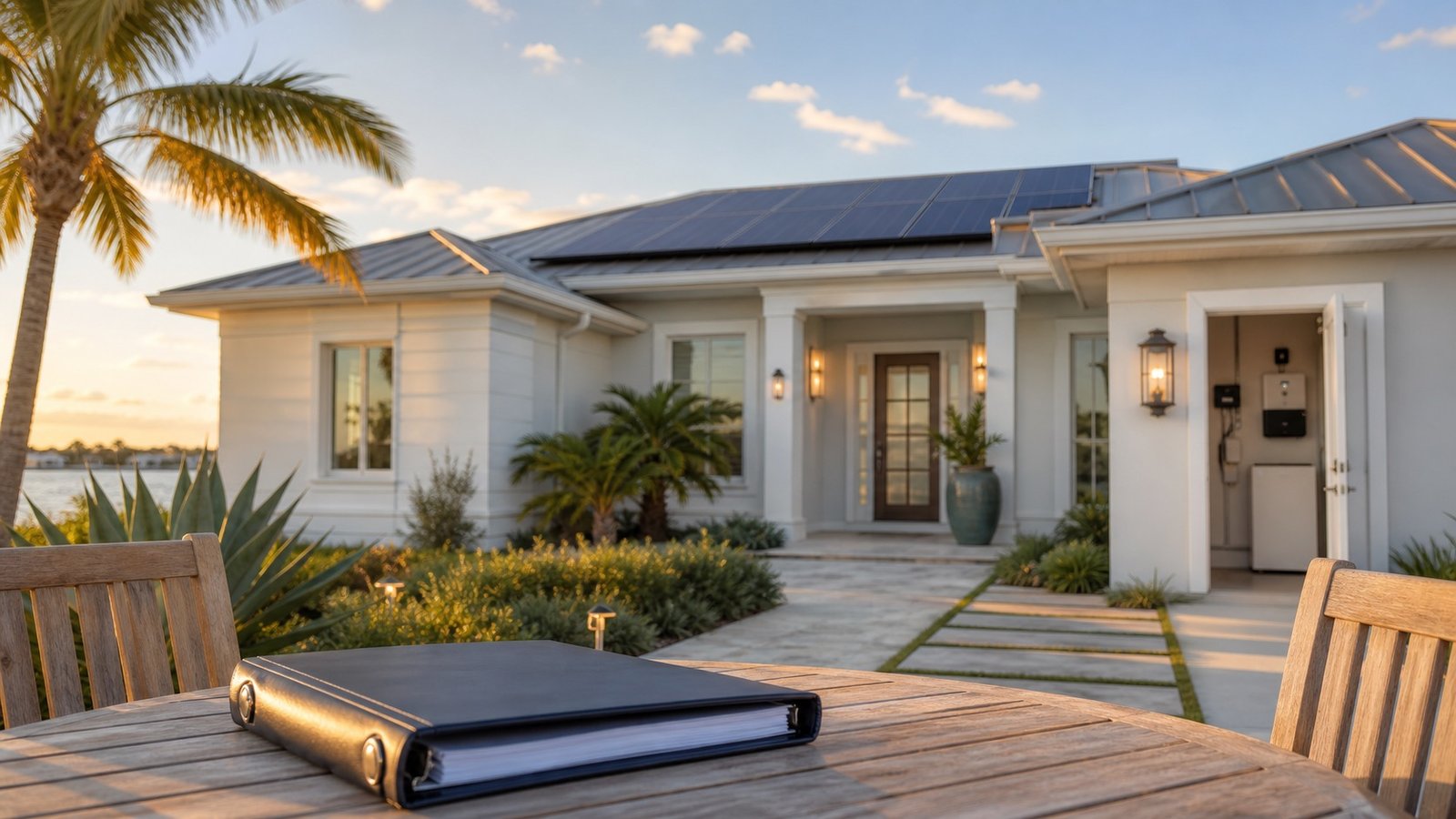
Before listing a Space Coast home with solar panels, battery backup, or a newer roof, gather the ownership and financing documents, permits and final inspections, contracts and warranties, roof and mounting details, monitoring and service records, and the reports an insurer may request. My goal is to answer the buyer’s expensive questions before uncertainty turns useful upgrades into negotiating problems.
These features can strengthen a Brevard County listing. A newer roof addresses one of the first questions buyers and insurers ask, while solar and battery backup may appeal to buyers thinking about energy use and storm preparation. But the value is easier to see when the seller can prove what was installed, who owns it, and what obligations transfer with the property.
First establish who owns the solar system
The first page of the file should say whether the panels are owned outright, financed, leased, or governed by a power purchase agreement. Those arrangements are not interchangeable. If the system is financed, obtain a current payoff statement, lien information, and the lender’s closing instructions. If it is leased or subject to a power purchase agreement, request the full agreement, payment schedule, transfer procedure, buyer qualification requirements, and contact information for the provider.
Sellers should not assume that a buyer will simply “take over the solar.” A buyer’s lender, title company, insurer, and solar provider may each need time to review the arrangement. Starting that process before the listing goes live gives the seller time to resolve missing documents or learn whether payoff is the cleaner option. The contract and qualified closing professionals—not a marketing summary—control what must happen.
For an owned system, keep the purchase contract, paid invoice, equipment list, manufacturer warranties, installer warranty, production or monitoring information, utility interconnection documents, and any maintenance records together. If contractor licensing becomes a question, Florida’s Department of Business and Professional Regulation provides an official license search.
Connect the solar paperwork to the roof paperwork
Buyers do not evaluate rooftop solar separately from the roof. They want to know when the roof was installed, whether the solar came before or after it, who designed the attachment system, and what happens if roofing work is needed later. Gather the roof contract, permit and final inspection, warranty, product information, wind-mitigation report, and photographs or plans showing the installation when available.
For work under Brevard County jurisdiction, sellers can start with Brevard County Building Permits; properties inside a municipality may require city records instead. If records are missing or show an open permit, it is better to discover that before a buyer’s inspection or insurance review.
Also collect the solar mounting specification, roof-penetration details, flashing or sealing information, and any invoice for panel removal and reinstallation during a roof replacement. If the roof is newer than the panels, show how the panels were handled and by whom. If panels remained in place during roof work, expect buyers to ask how the roof beneath them was evaluated.
My buyer-focused guide to solar panels, insurance, and roof condition explains why these questions appear so early in a transaction.
Build a separate battery-backup file
A battery system deserves its own folder. Include the purchase contract, model and serial information, permits, final inspection, warranty, installer details, operating manual, service history, and clear explanation of what circuits or loads it is designed to support. If the battery is part of a solar financing agreement, identify that connection rather than treating it as a separate owned appliance.
Sellers should be precise about performance. “Whole-house backup” can mean different things depending on load calculations, battery capacity, system settings, and whether large equipment such as air conditioning is included. Provide the manufacturer’s documentation and let the buyer’s inspector or qualified contractor explain the configuration. Avoid promising runtime during an outage because actual use and conditions vary.
Before photography and showings, confirm that the monitoring account works and learn how ownership will transfer. Remove personal account information from the marketing copy, but have a clean handoff process ready for closing.
Prepare for the buyer’s insurance questions
The seller cannot promise that a buyer’s carrier will accept or price the home a certain way. The useful step is to make the property easy to underwrite. Have the wind-mitigation report, four-point report if one exists, roof permit and age, installation documentation, and replacement-cost information ready. Tell the buyer to obtain a property-specific quote early.
The Florida Office of Insurance Regulation consumer pages provide statewide information, but the buyer’s licensed insurance professional and carrier make the property-specific decision. Some carriers may ask about panel attachment, roof access, battery location, electrical work, or whether all improvements were permitted.
A newer roof is valuable, yet the listing should not reduce it to a single year. Show the permit, final inspection, material and warranty details, and wind-mitigation features. The stronger the file, the easier it is for a buyer to understand why the roof matters. Sellers with other storm upgrades may also find my guide to documenting shutters and impact windows useful.
What I put in the listing-preparation folder
- Solar purchase, loan, lease, or power purchase agreement
- Current payoff or transfer instructions, including provider contacts
- Panel, inverter, mounting, and monitoring documentation
- Battery contract, specifications, permits, warranty, and service history
- Roof contract, permit, final inspection, warranty, and product details
- Solar and roof contractor information
- Wind-mitigation and four-point reports, if available
- Utility interconnection and permission-to-operate documents
- Receipts for repairs, maintenance, panel removal, or reinstallation
I keep private account numbers and sensitive information out of public marketing. The public listing can accurately describe the features, while serious buyers receive the appropriate documents through the transaction process. A one-page index helps everyone find the supporting record without digging through a random stack of PDFs.
“Carrie is a true professional and an absolute powerhouse—she got our house sold! From the start, her approach was impressive—the photography, video tour and social media outreach were outstanding, leading to multiple offers in a down market.”
FAQ: Selling a Brevard home with solar or backup power
Should I pay off the solar loan before listing?
That depends on the contract, payoff amount, transfer rules, equity, and likely buyer financing. Obtain the exact documents early and discuss the closing implications with the appropriate lender, title, legal, and real-estate professionals.
Does a newer roof guarantee lower insurance?
No. Roof age and features can help, but carriers consider the complete property and their underwriting rules. Documentation and a current quote are essential.
Can I advertise a battery as whole-house backup?
Only if the system documentation supports that description. It is safer to identify the installed equipment and supported circuits accurately than to promise a runtime or capability that varies with usage.
Make the upgrades easy for a buyer to trust
Good listing preparation turns solar, batteries, and a newer roof into a clear ownership story instead of a paperwork chase. If you are preparing a Brevard County home for sale, I can help organize the questions buyers will ask and position the improvements accurately. Read my guide to selling with older roof or HVAC considerations, or reach out for a no-pressure listing conversation. Your next chapter starts here.