

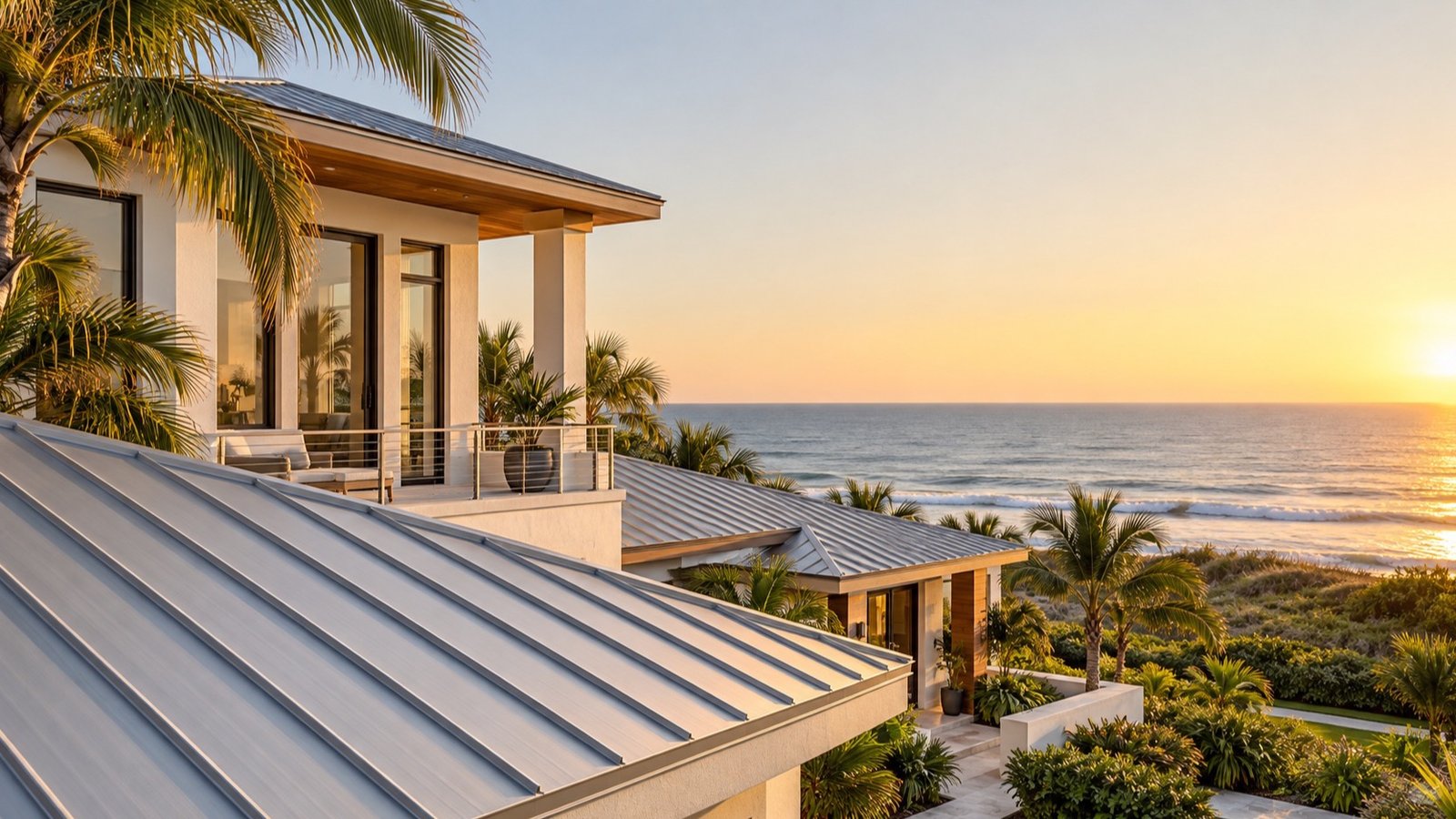
Older Metal Roof or Newer Shingle Roof? A Satellite Beach Buyer’s Coastal Cost Comparison
By Carrie Liotta, Space Coast REALTOR® with REAL Broker | October 19, 2026
When two Satellite Beach homes are otherwise close, I would not choose the newer shingle roof simply because it sounds newer. I would compare the older metal roof’s condition, fastening and maintenance records, inspection findings, and actual insurance quotes against the whole monthly picture. A documented roof can be the better decision; a vague roof history can be the more expensive one.
That distinction matters on the barrier island. Buyers are often balancing salt air, wind exposure, older-home systems, insurance timing, and the simple desire to spend their weekends at the beach rather than managing surprise repairs. The roof decision is not a contest between materials. It is a question of what is installed on this home, what can be verified, and what risk you are accepting after closing.
Start with the records, not the label
“Metal” and “newer shingle” are useful starting points, but neither is a conclusion. A seller may call a roof metal without knowing the panel system, installation date, permit history, underlayment, fastener details, repair history, or whether any additions were completed later. A newer shingle roof may have clean paperwork, or it may simply be a newer roof with no inspection report and an insurance quote that changes the comparison.
Before I let a buyer make this a lifestyle decision, I want a short evidence file for each house: the roof permit and final inspection if available, installation invoice, manufacturer and contractor information, warranties, repair receipts, prior wind-mitigation report, and any recent roof evaluation. Ask whether a leak, stain, or fastener issue has been repaired and request the related invoice. If a record is missing, treat it as missing rather than filling in the gap with a hopeful assumption.
The Florida Building Commission lists December 31, 2023 as the effective date of the Florida Building Code’s 8th Edition (2023). That does not make a pre-2023 roof defective, and it does not certify a particular roof as compliant. It is a reminder that roof work is a system-specific question. The right professional needs to evaluate the actual roof assembly, its records, and the work that was permitted—not a marketing adjective.
What I would want a roofer to look at on the older metal roof
An older metal roof can be a sensible choice when it has been cared for and its condition is documented. It can also be a source of uncertainty when the buyer cannot tell what has been repaired, how water is moving at penetrations, or whether visible fasteners and flashing have been evaluated recently. In Satellite Beach, I would not try to diagnose those details from a showing or drone photo. I would bring in a qualified roofer during the inspection period and ask for a written, property-specific opinion.
Have that professional identify the roof type, visible condition, fastener or clip system where observable, penetrations, flashing, sealant-dependent details, signs of prior repairs, drainage at valleys and transitions, and any recommended maintenance. Ask what needs attention now, what should be budgeted as monitoring or routine service, and what cannot be determined without further review. A useful report separates an active problem from a future planning item.
The same disciplined mindset applies to the rest of the exterior. If the newer shingle-roof home has better impact protection but the older metal-roof home has stronger maintenance records, you are comparing a package, not checking one box. My guide to weighing impact windows against a newer roof in Satellite Beach can help you keep that conversation grounded in records and risk rather than upgrades alone.
Why the newer shingle roof may still carry the higher cost
A newer roof can remove a major near-term unknown, but it does not automatically create the lower ownership cost. The premium quote may reflect the whole property, insurer underwriting, coverage selections, deductible, location, construction features, claims history, and information supplied to the carrier. Two buyers can also receive different quotes for the same house because their coverage choices and insurance profiles differ.
That is why I ask buyers to get insurance quotes early enough to use them in their decision, not after they are emotionally committed. Give each agent the same proposed closing date, coverage limits, deductibles, wind-mitigation documentation, and property details. Then compare the annual premium, deductible structure, exclusions or conditions, inspection requirements, and what information still needs verification. A lower quote that is based on an assumption is not a lower cost yet.
Florida law recognizes that qualifying windstorm-loss mitigation features can matter to residential insurance pricing. Section 627.0629, Florida Statutes, says residential insurer rate filings must include actuarially reasonable discounts, credits, rate differentials, or deductible reductions for qualifying mitigation techniques and features, including roof-related performance and opening protection. That is not a promise that either house will qualify for a particular discount or that one material wins. It is a reason to ask the insurer what documentation it needs before you compare the premiums.
Build a five-year comparison before you make an offer
I would put the two homes on one page. Start with the purchase price and expected payment, then add the insurance quote, anticipated routine roof care, known repairs from the inspection, and the amount you would reserve for the items that remain uncertain. Do not invent a life-expectancy number for either roof. Let the roofer explain condition and planning horizon in writing, and leave room in your budget for the unexpected.
Next, assign a confidence level to the evidence. A newer shingle roof with a permit record, final inspection, transferable warranty, and insurance quote supported by the carrier has high confidence. An older metal roof with dated maintenance invoices, a favorable current evaluation, and complete repair documentation may also have high confidence. A roof of either material with missing permits, unexplained repairs, or an insurer waiting on more information has lower confidence, even if it looks good from the street.
For many buyers, the answer becomes clearer when they separate today’s cost from uncertainty. Paying more each year for insurance may be acceptable if the newer roof gives you a record package and a comfort level that fits your household. Choosing the older metal roof may be smarter if the inspection is strong, the records are complete, the quote is workable, and the purchase price leaves room for informed maintenance. The wrong move is treating either option as automatically safer because of one word in the listing.
Use the inspection period to answer the questions that change the deal
In a competitive coastal market, buyers sometimes feel pressured to keep the inspection request broad and vague. I prefer the opposite: identify the handful of questions that would truly change the decision and give the right professionals time to answer them. For the older metal roof, that might be the condition of a specific transition, a repair history that needs clarification, or a written maintenance recommendation. For the newer shingle roof, it might be an incomplete permit file, a discrepancy in installation dates, or a premium quote that depends on a report the seller has not produced.
Ask the seller for authorization to obtain available public permit information from the appropriate authority, and confirm which jurisdiction holds the record. The City of Satellite Beach is the right starting point for city-specific questions, but a buyer should verify the address and record path rather than assume one database has every historic document. A permit record is useful context; it is not a substitute for a current evaluation by a qualified roofer.
I would also verify the license of any contractor providing an inspection or repair proposal. Florida’s DBPR license-verification portal lets a consumer check a professional by name or license number. That quick step does not tell you whether a quote is fair, but it helps keep the conversation anchored to an identifiable professional rather than a casual opinion from a showing.
How I would negotiate each version of this decision
If the older metal roof receives a favorable written evaluation and the evidence file is complete, I would not ask a seller to replace it merely to make the deal feel newer. I would focus on the inspection findings, the insurance quote, and whether any specific maintenance item deserves a repair, credit, or price adjustment. A clean, narrow request is more credible than turning a documented older component into an open-ended negotiation.
If the inspection identifies an active concern, do not let the contract language become a promise of an undefined fix. Decide whether the seller will have a qualified contractor make a specific repair, whether the buyer receives a credit that works with the lender and insurer, or whether the price changes to reflect the item. The best solution is the one that can be documented, completed on time, and understood by the insurance professional before closing.
The newer shingle-roof home deserves the same care. A high quote may be a fair tradeoff for a better insurance fit elsewhere in the property, or it may signal that the buyer needs more information. Do not negotiate against an unconfirmed number. Get the carrier’s requirements in writing where possible, review the deductibles with the agent, and make sure the figures you compare use the same coverage assumptions.
Do not isolate the roof from the rest of the beachside house
A roof is one important line item, not the whole ownership plan. On a Satellite Beach home, I also want buyers to understand the condition of openings, exterior drainage, attic moisture management, electrical systems, and any equipment exposed to the coastal environment. The right roof choice can still feel wrong if the next inspection reveals a second major issue that was ignored because everyone was focused on the roof.
That is why I encourage buyers to read related decisions as a group. If exterior comfort and protection are part of your choice, my comparison of a screened porch versus impact-rated sliders in Satellite Beach is a useful companion. And if you are reviewing how moisture is being managed inside the home, see what to verify when a whole-house dehumidifier drains to a garage floor drain. Those are different questions, but together they help you see whether the property has been maintained thoughtfully.
My bottom line for Satellite Beach buyers
I would choose the older metal roof when the roof-specific inspection is reassuring, maintenance and repair records are credible, insurance is available on terms that fit the buyer’s budget, and the overall house does not stack up too many other near-term unknowns. I would choose the newer shingle roof when the documentation is clean, the insurance difference is understood and acceptable, and the newer installation meaningfully reduces uncertainty for the buyer’s real budget and timeline.
Neither roof should win on age alone. The better home is the one whose condition, documentation, insurance structure, and inspection findings make sense together. If you are comparing beachside homes, I can help you organize the documents, questions, and tradeoffs before a beautiful exterior turns into an expensive guess. Reach out for a no-pressure conversation about Satellite Beach and Brevard County homes for sale with Carrie Liotta, Space Coast REALTOR® with REAL Broker.
Your next chapter starts here.
