

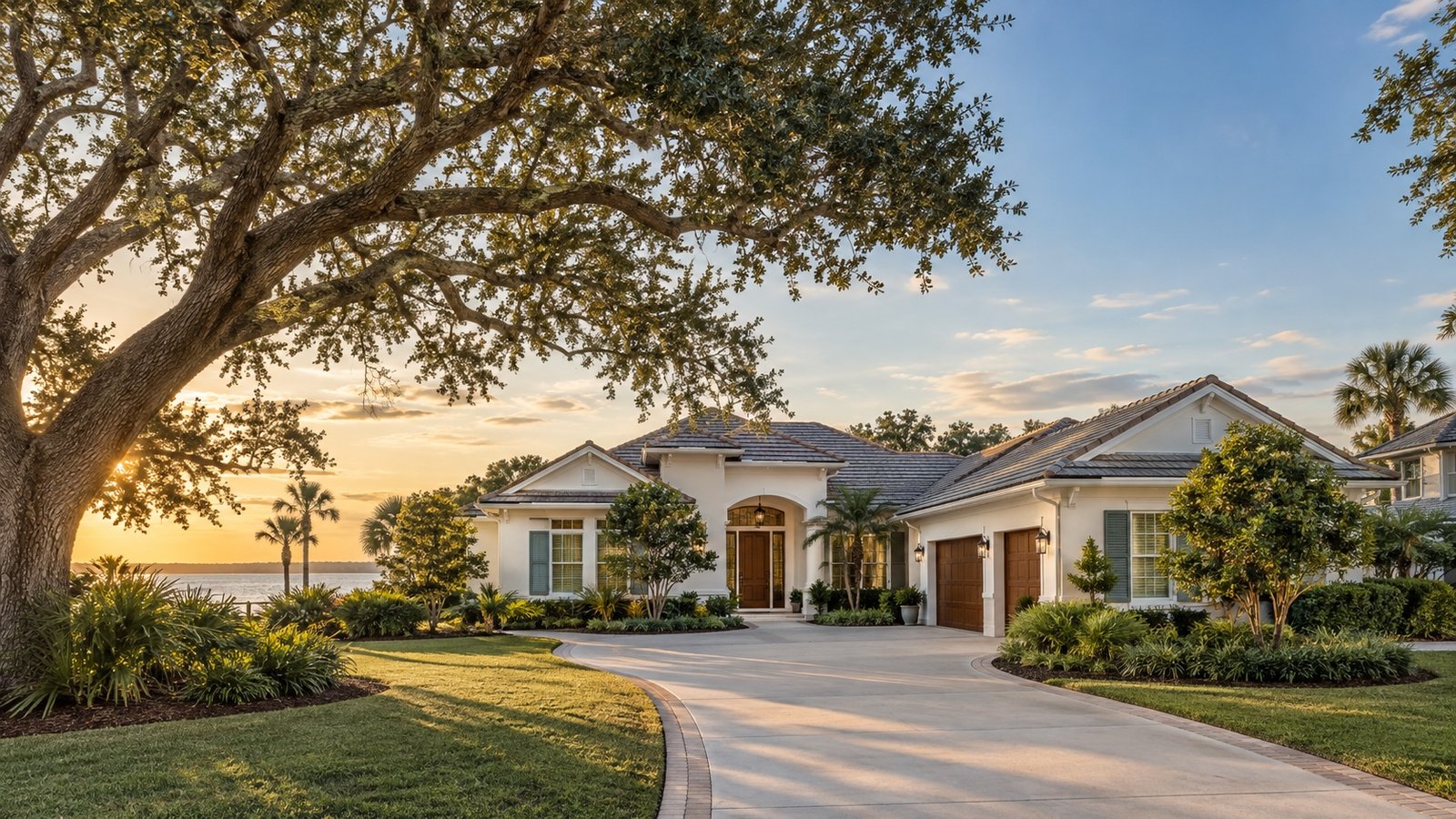
Mature Oak Canopy Over a Roof and Neighbor Driveway: What Rockledge Buyers Should Verify
By Carrie Liotta, Space Coast REALTOR® with REAL Broker
A mature oak canopy is not automatically a reason to walk away from a Rockledge home. Before you fall in love with the shade, verify the property line, the tree’s condition, the roof and driveway clearance, and how future pruning would actually be handled. The canopy can be a real lifestyle asset; uncertainty around it is the problem.
I see this often in established parts of Rockledge: a home has the kind of deep shade and character that newer neighborhoods cannot manufacture overnight, but a major limb reaches over the roof while another crosses above the neighbor’s drive. Buyers start imagining leaf cleanup, insurance trouble, or a difficult neighbor. Sometimes those concerns are manageable. Sometimes the tree has deferred maintenance, a boundary question, or a clearance issue that belongs in the inspection period rather than in a hopeful guess.
The right question is not, “Will this tree be expensive?” It is, “What exactly am I buying, what needs attention, and who has the information to answer that before my contingency window closes?”
Start with the boundary, not the branches
A canopy tells you where a tree reaches; it does not tell you where the trunk sits or where the lot line runs. That distinction matters when a limb extends over a neighbor’s driveway. Ask for the seller’s survey, then compare it with the current title and survey work your closing team recommends. A fence, mulch edge, or long-standing landscaping line may be useful context, but it is not a substitute for a survey.
I also want buyers to ask whether the tree trunk, roots, drainage swales, utility easements, or driveway apron sit near the line shown on the survey. The practical goal is not to turn a home tour into a legal dispute. It is to avoid discovering after closing that routine access, pruning equipment, or a future driveway repair involves an easement or another property owner.
That is especially important with an older Rockledge home because the best feature may be the mature landscape. If the survey is old, unreadable, or missing a relevant improvement, talk with the title professional and a surveyor before assuming the existing arrangement is settled.
Look at the roofline and the driveway as two different exposures
A limb over a roof and a limb over a driveway create different decisions. Over the roof, I am looking for physical contact, rubbing at the eaves or gutters, accumulated leaf debris, a branch that prevents a clear roof inspection, and any signs that prior trimming was done in a rushed or damaging way. Over a driveway, I want to know whether normal vehicles, delivery trucks, moving vans, emergency access, or a future roof crew can use the drive without repeated contact with limbs.
Do not let a beautiful canopy distract you from the ordinary maintenance records. Ask for roof age, roof permits and repair invoices, gutter-cleaning history if available, and any invoices for tree work. My guide to roof age, mature trees, and insurance for Rockledge buyers is useful companion reading because the tree and roof should be evaluated as one ownership system, not as separate cosmetic features.
A seller does not need to promise that a canopy will never shed limbs or that a roof will never need cleaning. Those are not realistic promises in Florida. What buyers need is a factual maintenance picture: what was pruned, when, by whom, and whether there are known roof, gutter, driveway, or drainage issues beneath the canopy.
Get an arborist’s opinion when the tree affects your decision
If the oak’s condition would change your offer, budget, or willingness to buy the home, bring in the right professional during due diligence. A general home inspector may identify an obvious concern, but an arborist can assess the tree itself and explain a reasonable scope of work. Ask for a written assessment that identifies the tree, visible defects or deadwood, recommended work, urgency, and whether the recommendation is pruning, monitoring, or a more involved evaluation.
The International Society of Arboriculture’s homeowner guidance explains that landscape-tree pruning should have a clear objective. It describes “raising” as removing lower branches for building and vehicle clearance and recommends reduction cuts rather than indiscriminate topping. That matters here: a quick request to “cut it back from the roof” can produce poor work if the contractor does not explain the pruning objective or the long-term effect on the tree.
For a large mature oak, I would ask the arborist to walk the roof side and the driveway side with you or provide marked photos. You want to understand what work is needed now, what may recur, whether equipment needs access through a gate or neighboring drive, and whether the recommended work changes the home’s shade or privacy in a meaningful way.
Do not confuse a risk assessment with a permit shortcut
Florida law has a narrow, specific rule for certain residential-tree work. Under Florida Statute 163.045, a local government may not require notice, approval, a permit, fee, or mitigation for pruning, trimming, or removal on qualifying residential property when the owner has documentation from an ISA-certified arborist or Florida-licensed landscape architect that the tree poses an “unacceptable risk” under the statute’s stated standard.
That does not mean every inconvenient limb qualifies, and it does not resolve a boundary, easement, utility, HOA, or neighbor-access issue. The statute is a reason to ask better questions, not a reason to skip them. Before closing, confirm the property’s actual jurisdiction, any HOA rules, utility-line concerns, and the contractor’s planned scope. If a line is involved, do not treat ordinary pruning as a DIY project or ask a tree crew to work around energized equipment without the appropriate utility coordination.
Why Rockledge buyers should care about wind and root conditions
On the Space Coast, the conversation should be broader than leaf cleanup. UF/IFAS research on Florida storm impacts notes that tree performance in wind depends on more than species: age, health, structure, soil conditions, water table, compaction, and site conditions all matter. Its wind-and-trees guidance also recommends pruning damaged and dead branches in mature trees and consulting a qualified professional for higher-risk situations.
That is why a buyer should avoid declaring a tree “safe” or “unsafe” from a listing photo. Look for a recent history of pruning, obvious cavities or cracks, dead limbs, soil movement around the trunk, drainage changes, past storm damage, or a limb that has grown into a roofline. Then let the inspection and arborist findings guide the next move. A mature oak can be healthy and valuable; it can also need careful, ongoing stewardship.
Put the likely cost into the whole-home decision
Tree work should be budgeted like roof maintenance, HVAC service, irrigation repairs, or exterior paint: as part of the carrying cost of an older home, not as an afterthought. Get a written proposal if the work is material. Compare its scope, insurance coverage, cleanup, access assumptions, and whether repeat maintenance is likely. A low quote that ignores the roof-side access or neighbor-side clearance can become a frustrating surprise later.
Then compare the cost with what you are gaining. A shaded lot may make an older Rockledge home feel cooler and more private, offer a more established setting, and differentiate it from a newer subdivision. But the purchase price should leave room for responsible care. I never want a buyer to spend every available dollar at closing and then resent a home for needing the maintenance its age and landscape made foreseeable.
For a seller-side view of the same principle, read my article on documenting mature-tree and drainage work before a Rockledge sale. Good records make a buyer’s decision calmer because they replace assumptions with dates, invoices, and professional observations.
My due-diligence checklist before you remove the tree from your worry list
- Review the survey and identify the trunk, likely lot line, easements, driveway edge, and any features that need access.
- Ask for prior tree-service invoices, roof and gutter records, seller disclosures, and any known storm-damage or insurance documentation.
- Walk the roofline and driveway with the inspector; photograph branches that touch, rub, block access, or appear dead or compromised.
- Use an arborist when the tree’s condition, clearance, or future cost would affect your decision or offer terms.
- Confirm jurisdictional, HOA, utility, and neighbor-access questions before authorizing work or relying on an informal promise.
- Build a realistic first-year maintenance reserve instead of assuming the canopy is free because it came with the house.
Bottom line
A mature oak that reaches over a Rockledge roof and a neighboring driveway can still belong to an excellent home purchase. I would not reduce the decision to “tree good” or “tree bad.” I would verify the boundary, inspect the roof and access, get a tree professional’s written perspective when warranted, and price the maintenance into the home you are choosing.
If you are weighing an established Rockledge home against a newer Brevard County option, I can help you compare the inspection, insurance, maintenance, and resale questions that do not fit neatly into a listing photo. Reach out for a no-pressure conversation about Brevard County homes for sale with Carrie Liotta and REAL Broker. Your next chapter starts here.
