
Which Merritt Island Homes Make the Most Sense for Buyers Who Want Storage, Boat Access, and Lower Flood Risk?
By Carrie Liotta, Space Coast REALTOR® with REAL Broker | Published August 8, 2026
If you want the Merritt Island boat-life feeling but you also want storage and lower flood-risk pressure, do not start with direct waterfront. Start with inland or river-near homes that have a useful garage, driveway or side-yard flexibility, documented storm features, and quick access to public boat ramps, marinas, causeways, or kayak launches. For many buyers, that is the sweet spot: close enough to the water to use it, but not so tied to the water that flood insurance, seawall, dock, and canal maintenance dominate the budget.
That does not mean canal-front homes are wrong. They can be incredible when the canal, seawall, dock, lift, insurance, and price all make sense. But if your real goal is to keep a boat, kayak, paddleboard, fishing gear, or trailer lifestyle within reach, you may not need to buy the water itself. You may need a practical Merritt Island house with the right storage plan and the right route to the water.
I see this most often with buyers who say, “We want Merritt Island because we love the water, but we do not want the carrying costs of direct waterfront.” That is a smart question. The answer is not one neighborhood name. It is a decision framework.
Start with how you actually use the water
Before choosing a Merritt Island home, define the water lifestyle clearly. Are you launching a boat every weekend? Kayaking a few mornings a month? Fishing from shore? Keeping paddleboards in the garage? Watching launches and sunsets near the river? Driving to Port Canaveral? Those are different searches.
A serious boat owner may care about trailer parking, ramp distance, garage depth, side-yard access, HOA rules, and turn radius. A kayak or paddleboard buyer may care more about garage storage, vehicle loading, and a short drive to calm water. A buyer who simply wants the Merritt Island atmosphere may prioritize neighborhood feel, schools, KSC commute, shopping, and weekend access to the beach or river.
The mistake is paying for direct waterfront when your actual use pattern is occasional access. If you will not use a dock often, it may be better to put your money into a stronger house, newer roof, better storage, and lower insurance friction.
Why inland and river-near homes can be the smarter fit
Inland and river-near Merritt Island homes can give buyers practical access without the full waterfront ownership file. You may still be close to Sykes Creek, the Indian River, the Banana River, SR 528, Port Canaveral routes, and beach access, but you are not automatically taking on seawall condition, dock maintenance, lift repairs, canal depth, bridge clearance, or direct-water exposure.
That can broaden the buyer pool for resale too. A future buyer may love that the home has boat or kayak storage and nearby launch access, while also appreciating a more manageable monthly cost. I wrote about this same broader tradeoff in Brevard County homes that make sense for boat parking without direct waterfront costs.
For Merritt Island specifically, yesterday’s guide to buying near Sykes Creek without choosing direct waterfront is a good companion. The same principle applies beyond Sykes Creek: buy access and utility when you do not need to own the edge of the water.
What storage details matter most?
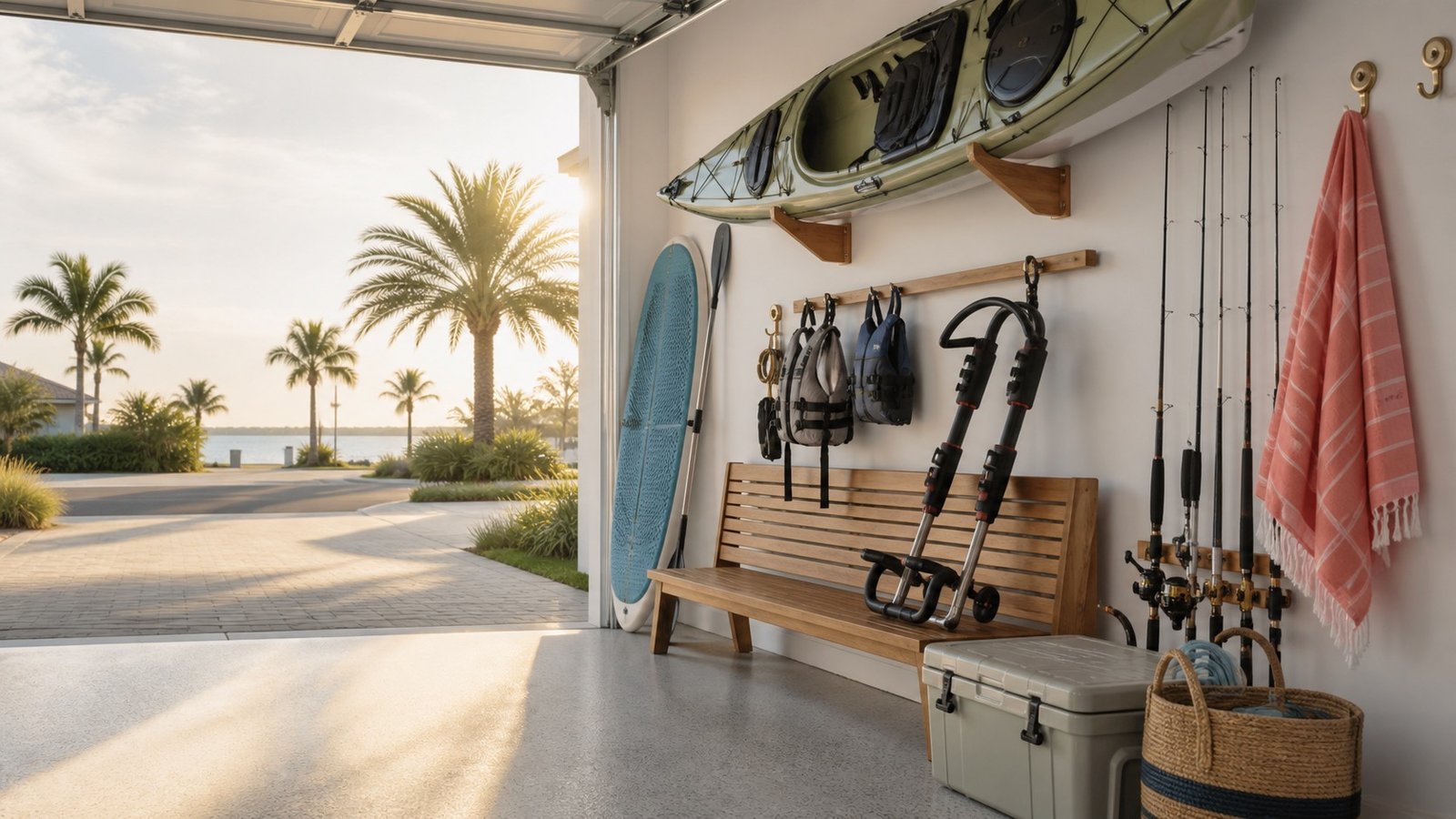
Storage is not a vague bonus on Merritt Island. It can shape whether the home works. I want buyers to check garage depth, door width, ceiling height, driveway length, side-yard access, fence gates, trailer rules, HOA documents, shed rules, and whether the lot layout makes turning and backing up realistic.
A two-car garage does not always mean two-car storage. Some garages are shallow. Some have laundry, water heaters, steps, workbenches, or storage already consuming space. Some driveways are short or steep. Some communities restrict boats, trailers, RVs, work vehicles, or exterior storage. If the boat, kayak, bikes, fishing rods, and storm panels do not have a place to live, the house may not support the lifestyle.
Look at the property at the same level of detail you would use for the kitchen. Where does the trailer go? Where do wet life jackets dry? Can you rinse gear? Can guests park without blocking everything? Is there room for hurricane shutters or panels? Will the HOA allow what you actually own?
Flood risk still matters, even away from direct waterfront
Lower flood risk does not mean no flood risk. Merritt Island is shaped by water, and buyers should check the exact address. FEMA’s flood maps are the starting point for understanding mapped flood hazard. Pair that with insurance quotes, elevation information when available, drainage observations, and local knowledge of how the street behaves after heavy rain.
Some inland homes may still have flood or drainage considerations. Some river-near homes may be acceptable to a buyer once the quote and elevation story are clear. The point is not to assume. The point is to compare address by address instead of saying “Merritt Island” as if the whole island has one risk profile.
If the home is near canals, shorelines, wetlands, or future water-related improvements, the St. Johns River Water Management District permitting information is useful background. Buyers who plan to alter drainage, docks, shorelines, or water-adjacent features should verify the path before relying on a future project.
North, central, or south Merritt Island?
North Merritt Island can work for buyers who want a quieter feel, KSC access, storage, and a little more breathing room. The tradeoff is that daily services may be farther depending on the exact address, and property-specific due diligence matters. Some homes may have larger-lot appeal, but septic, drainage, insurance, roof condition, and access should be reviewed carefully.
Central Merritt Island is often the most practical for daily life. Buyers may be closer to shopping, services, schools, SR 528, and routes toward Cocoa Beach, Cape Canaveral, and mainland Brevard. If you want water access without living directly on the water, central pockets can be a strong place to look because the convenience story is easier to explain to future buyers.
South Merritt Island can offer established residential feel, larger-feeling lots in some areas, and access to both river and beach routines. The drive pattern may be different, so test your commute to work, schools, medical appointments, boat ramps, and weekend destinations before deciding it is “close enough.”
For the broader island-by-island logic, read my guide to choosing canal-front, river-near, or inland Merritt Island homes for insurance comfort. That article pairs well with this storage-and-access question.
How the wildlife refuge shapes the lifestyle
Merritt Island’s identity is bigger than neighborhoods and boat ramps. The Merritt Island National Wildlife Refuge is part of the area’s larger landscape, tied to the space center, protected habitat, wildlife drives, water, and the quieter northern feel that many buyers love. For some buyers, that surrounding environment is the reason Merritt Island feels different from a mainland suburb.
But protected land and water also remind buyers to think practically. Not every future project is simple. Not every route is direct. Not every property can be changed the way a buyer imagines. If your plan depends on adding structures, storing equipment, changing drainage, or creating new access, verify before closing.
“Carrie was an absolute gem! She helped me and my husband look for houses off and on for over two years. She is very professional, understanding, patient, and kind. We are first time home buyers and she advocated for our needs and explained things to us.”
A recent buyer client
My buyer checklist for this search
Before writing an offer on a Merritt Island home for storage, boat access, and lower flood-risk comfort, I would want answers to these questions:
- How often will you actually use a boat, kayak, paddleboard, or fishing setup?
- Where will the gear, trailer, and storm-prep items be stored?
- Do HOA, deed, or municipal rules limit boats, trailers, sheds, fences, or exterior storage?
- What does the FEMA flood map show for the specific address?
- What do homeowners and flood insurance quotes look like?
- How old are the roof, HVAC, water heater, electrical, and plumbing systems?
- How long does it take to reach the boat ramp, beach, Port Canaveral route, or water access you will actually use?
- Will the home be easy to explain to a future buyer who wants the same lifestyle?
If the answer is strong in most of those categories, you may have found the right Merritt Island compromise. If the home only wins on one emotional feature, keep looking.
Bottom line for Merritt Island buyers
The best Merritt Island home for storage, boat access, and lower flood-risk comfort is usually not the flashiest waterfront listing. It is the home that lets you use the water without letting the water control the whole ownership story.
Look for practical storage, clear rules, a manageable flood and insurance profile, a strong roof and systems file, and a route to the water that matches how you actually live. If you want help comparing Merritt Island homes block by block, reach out for a no-pressure conversation about Brevard County homes for sale with REAL Broker. Your next chapter starts here.