

What Merritt Island Buyers Should Verify When a Separate Electric Meter Serves a Boat Lift and Dock Pedestal
By Carrie Liotta, Space Coast REALTOR® with REAL Broker | Published October 16, 2026
A separate electric meter at a Merritt Island dock is not automatically a problem, but it is never a detail I would treat as self-explanatory. Before you make an offer, confirm exactly what the meter serves, who holds the account, where the equipment begins and ends, and whether the dock, lift, pedestal, disconnects, and wiring have a clean documentation trail.
Start with the question the meter cannot answer by itself
A meter label, a second service panel, or a utility bill does not establish ownership, condition, capacity, or permit status. It only tells you that electricity is being measured somewhere in the chain. The useful question is: what equipment is on this service, and what obligation comes with it after closing?
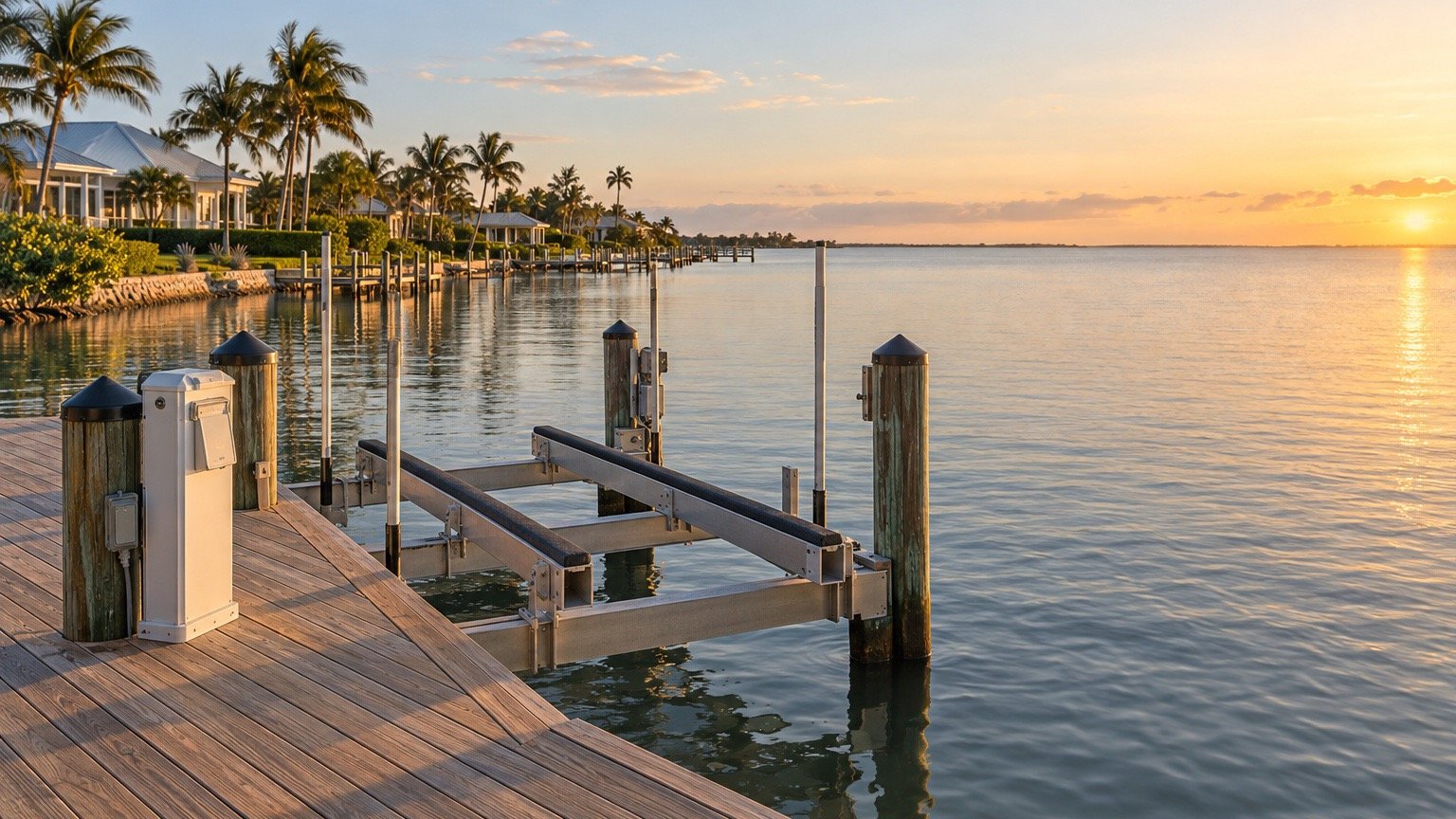
When I help a waterfront buyer sort this out, I want a simple diagram and a simple document set. The seller or listing side should be able to identify the meter, account number or billing arrangement, main disconnect, panel, boat-lift motor and controls, pedestal receptacles, dock lighting, and any shared equipment. If the answer is “we think it only runs the lift,” that is a reason to investigate—not a reason to assume.
A clean setup may have a dedicated meter and an organized service file. A less-clear setup may include a pedestal that serves more than one slip, an old branch circuit added after the original dock work, a panel whose labels no longer match the equipment, or an account that has been handled informally between neighbors. Those are different situations with different closing and future-maintenance consequences.
Verify the billing arrangement before you price the home
Ask for recent bills, not just a monthly estimate. I would want enough history to see whether the meter has ordinary usage, seasonal lift use, shore power, lighting, a refrigerator, an irrigation pump, or something else. The dollar amount is useful, but the more important question is whether the usage matches the seller’s description of what is connected.
Then ask these practical questions in writing:
- Is this a separately billed utility account, a privately installed submeter, or a meter associated with a shared dock arrangement?
- Will the service remain active through closing, and what is the process for a new owner to transfer or establish service?
- Does the meter serve only this property’s boat lift and pedestal, or does any circuit cross a property line or serve common equipment?
- Are there recurring fees beyond energy use, such as service, association, marina, or maintenance charges?
- Has the seller ever had a breaker trip, a lift that would not operate, a pedestal outlet that failed, or a bill that did not make sense?
This is a carrying-cost issue as much as an electrical issue. A buyer should not build a waterfront budget around a verbal estimate or assume that a low bill means the system is uncomplicated. A dedicated account can make future tracking easier; it can also create one more account, service transfer, and piece of equipment to understand. I would rather see the true monthly story before we negotiate than discover it after the keys are handed over.
Follow the electrical path from shore to lift
During the inspection period, have a qualified electrical professional and, when appropriate, a boat-lift or marine professional look at the actual installation. The goal is not for a real estate agent to pronounce an installation safe or compliant. The goal is to identify what should be evaluated, document the answers, and give the buyer a credible repair or maintenance path.
Ask the professional to trace the path in plain language: service equipment, disconnect, panel, breakers, conduit, junction points, lift motor controls, pedestal receptacles, lighting, and grounding or bonding components that are visible and accessible. Photographs with labels are far more useful after closing than a vague note that “dock power works.” The inspection should also distinguish between equipment that is visibly installed and equipment that is actually tested.
Salt air and waterfront exposure are a reason to be especially observant, not a reason to make blanket assumptions. Corrosion at hardware, cracked covers, missing labels, improvised extensions, or conduit that appears to have shifted can change a routine maintenance discussion into a specialist conversation. If anything is questionable, get the electrician’s written scope, cost range if offered, and recommendation on what must be addressed before use.
For a related, narrower issue, I have written about a floating-dock shore-power cable at the hinge. That article is about movement at one connection point; this meter question is broader. Here, the buyer is establishing the basic story of service, billing, equipment, and responsibility.
Do not let “it was here when we bought it” replace records
For any dock electrical system, I ask for the same kind of file I would want for an older roof or HVAC system: permits, final inspections if available, invoices, contractor names, equipment manuals, service reports, warranties, and repair receipts. A clear record does not guarantee that no work will be needed. It does make it easier to identify what was installed, when it was serviced, and which professional may understand the system.
The Brevard County building permit search is a reasonable starting point for unincorporated-county records. A Merritt Island property can also fall under a different jurisdiction or have older records that are incomplete, so an absent online result is not a clean bill of health and is not proof that work was unpermitted. It is simply a prompt to ask more targeted questions and compare the answer with the seller’s paperwork.
Separate electrical documentation from shoreline permission
Electrical records and water-side approvals are related, but they are not interchangeable. A documented service panel does not establish that the dock footprint, lift, pilings, or future changes have the approvals a buyer may need. Likewise, a dock that qualifies for a state exemption does not make every local or electrical question disappear.
Florida Statute section 403.813, reviewed October 16, 2026, describes circumstances in which certain private docks, repairs, and recreational docking facilities may be exempt from specified state permitting. The statute also says that an exemption does not relieve an owner from permissions for public lands or water-management lands, applicable local pollution-control programs, or other county and municipal requirements. That is why the right conclusion is never “there was a dock, so every part is approved.”
Find out whether responsibility is private, shared, or unclear
This is where a separate meter can change the decision. A meter that is wholly within the property’s system and plainly dedicated to the buyer’s dock is one thing. A meter or pedestal tied to a shared structure, an association, a neighbor’s access, or a recorded easement is another. Do not accept a casual answer to a question that could affect access, maintenance, replacement authority, or a future dispute.
Ask the title professional and closing team to flag easements, dock licenses, shared-maintenance language, and any recorded agreement that might affect the electrical equipment or route to it. Then compare those documents with the inspection findings and the seller’s explanation. If a dock is physically next to the house but the service route crosses a boundary or the lift is described as shared, the paperwork matters more than the view from the patio.
If the arrangement is shared, I would want the agreement to answer who can authorize repairs, who pays for routine service, how emergency work is handled, and what happens when a major component needs replacement. A shared arrangement is not necessarily a bad one. It simply needs a clear rulebook and a realistic reserve or cost-sharing plan. My guide to a private dock circuit versus a shared dock with reserves is useful when the larger ownership structure is part of the choice.
Use the inspection period to turn uncertainty into a decision
The best outcome is not a perfect dock with no future expense. The best outcome is a buyer who knows what they are buying and has priced the risk honestly. If the file is complete and the professionals find a straightforward system, you can move ahead with more confidence. If the system works but needs a documented repair, you can decide whether to request a repair, negotiate a credit where appropriate, or accept the work as part of the property’s true cost.
If the answers remain unclear, slow down instead of filling in the blanks. An unverified account arrangement, an inaccessible service component, missing records combined with visible modifications, or conflicting statements about who uses the pedestal may justify more investigation. The repair cost is only one part of the equation; the ability to control the repair, get service, and explain the setup to the next buyer matters too.
My dock-meter checklist for a Merritt Island buyer
- Obtain recent bills and identify whether the meter is utility-billed, a submeter, or part of a shared arrangement.
- Confirm what is connected: lift, dock outlets, shore power, lighting, water equipment, irrigation, or anything else.
- Locate the meter, disconnect, panel, breakers, conduit route, lift controls, and pedestal during the inspection.
- Have the right qualified professionals evaluate the installation rather than relying on a listing description or an informal explanation.
- Request permits, invoices, final inspections when available, service reports, manuals, warranties, and repair history.
- Review the permit record as a starting point and reconcile it with the documents and visible equipment.
- Ask whether any circuit, pedestal, access route, maintenance duty, or cost is shared with another owner or association.
- Review easements, licenses, and recorded agreements with the closing team when the arrangement is not clearly private.
- Decide before the inspection deadline whether the contract should address a repair, credit, documentation request, or further specialist review.
For a different part of the waterfront due-diligence picture, I also recommend reading my guide to comparing dock permits, flood quotes, and wind mitigation before choosing a lower-priced Space Coast home. It helps put the dock system into the broader monthly-cost and ownership decision.
The bottom line
A separate electric meter serving a boat lift and dock pedestal should make a Merritt Island buyer more curious, not automatically more worried. Treat it as an invitation to verify the service, billing, equipment, documents, and responsibility before you commit. When those answers are clear, you can evaluate the waterfront lifestyle with your eyes open. When they are not, the right next step is a qualified inspection and a better paper trail—not wishful thinking.
If you are comparing Merritt Island waterfront homes, I can help you organize the questions that matter beyond the listing photos: dock use, lift records, seawall condition, permits, insurance, and the ownership details that shape both daily life and resale. Reach out for a no-pressure conversation about Brevard County homes for sale with Carrie Liotta, Space Coast REALTOR® with REAL Broker. Your next chapter starts here.
