

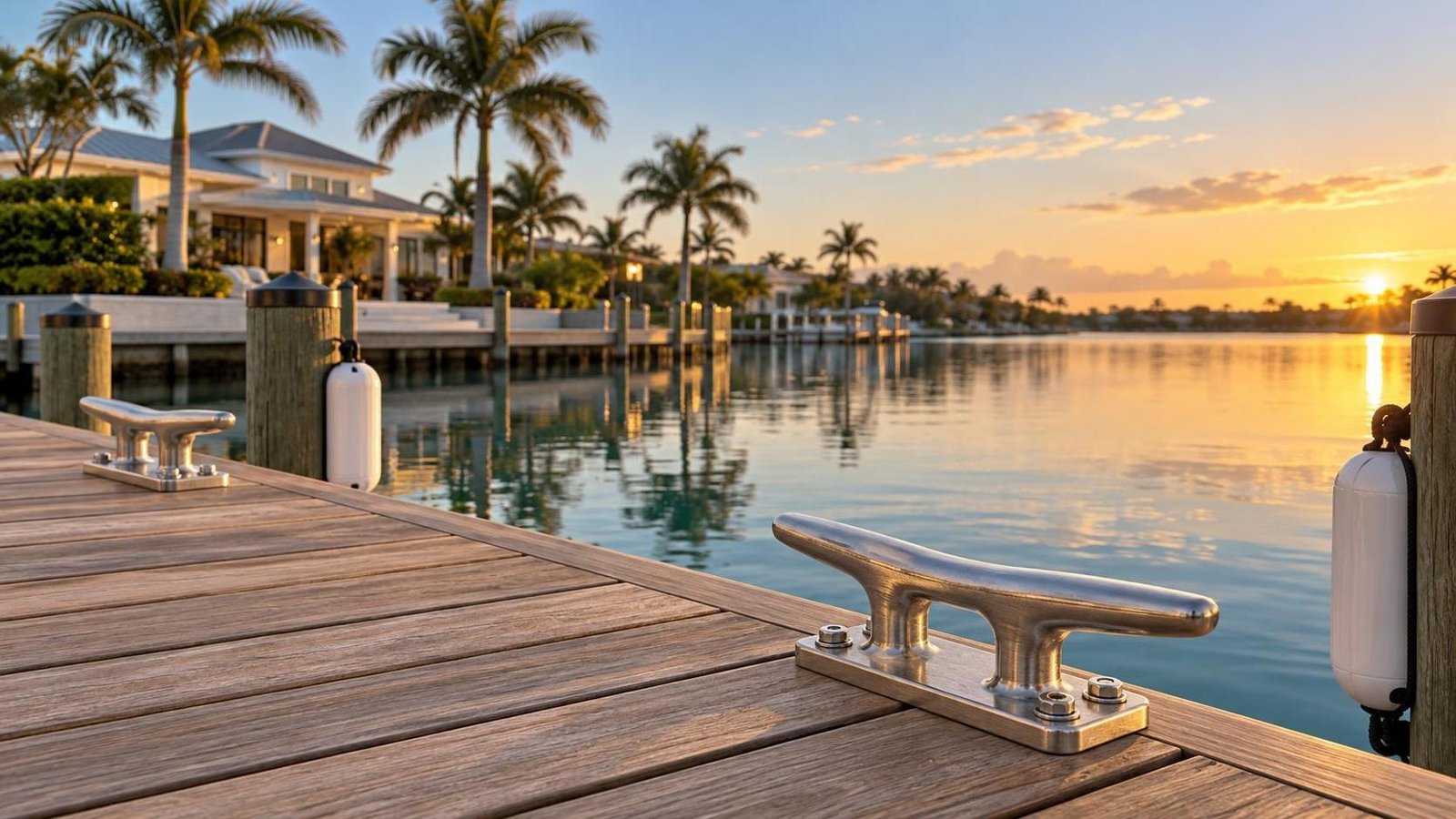
Dock Fenders and Cleats Added Without a Contractor File: What Should Merritt Island Sellers Document?
By Carrie Liotta, Space Coast REALTOR® with REAL Broker | Published October 7, 2026 on 321 Coastal Living
If dock fenders and cleats were added without a contractor file, a Merritt Island seller should document what is physically present, where and how it is attached, what records can be found, and what remains unknown. Do not call the hardware permitted, professionally installed, or suitable for a particular boat unless the evidence supports that statement.
Fenders and cleats may look like accessories, but they transfer contact and mooring forces into deck boards, framing, piles, or other parts of the dock. Mismatched bolts, compressed decking, rust stains, loose backing, or recent patching may make a buyer ask whether the hardware was planned or improvised.
I would build a clean, factual file before photography and let the appropriate professional identify any condition that needs correction or explanation.
Start with a dated map, not a story from memory
Walk the dock in daylight and create a simple plan view. Number every cleat and fender. Show fixed and floating sections, piles, lift components, ladder, utilities, seawall or bulkhead, and the path from the yard to the water. Record the date and water conditions. Then photograph each item from the top, side, and underside where access is safe.
For each cleat, capture its approximate size and material, mounting location, visible fasteners, backing plate or washers if visible, surrounding deck condition, movement, corrosion, and any old holes nearby. For each fender, record its style, dimensions, mounting rail or brackets, fastener pattern, contact marks, cracks, compression, and distance from corners, piles, ladders, and lift cables.
The purpose is not to calculate capacity. It is to preserve visible facts. A cleat that feels solid during a gentle hand check has not been load-tested. A fender with boat marks is not proof that it fits the next owner’s hull, tide range, line arrangement, or docking approach. Those are exactly the conclusions a seller should avoid.
Reconstruct the paper trail from several places
Search the seller’s email, paid invoices, bank or card records, old closing file, warranty folder, and photographs. The useful item may be an invoice for a dock redecking project that also lists new cleats, or a dated photo showing the hardware before a later storm. Ask prior contractors whether they can provide a duplicate invoice, scope, drawing, material list, or warranty, but do not ask them to recreate a document they never issued.
For an unincorporated Merritt Island property, the Brevard County building permit search is a practical local starting point. Search the parcel and address, then compare any dock, seawall, electrical, or repair records with what is visible today. If the property is subject to an association, shared-dock agreement, easement, or architectural review, pull those records separately. An HOA approval is not a county permit, and a permit record is not proof of private-association approval.
If a contractor name appears on an invoice, estimate, or permit, use Florida’s official DBPR license-verification service to check the record. That lookup can help confirm whether a regulated professional holds or held a listed license; it does not prove that person installed these particular fenders or cleats.
Do not make a universal permit claim about replacement hardware
Florida’s waterfront approval system depends on the work, location, waterbody, ownership, and agencies with jurisdiction. Section 403.813 of the Florida Statutes describes exemptions for certain private docks and qualifying repairs, but it also makes clear that an exemption does not erase applicable permission for submerged lands or other county and municipal requirements.
That is why I would not put “no permit required” in listing remarks based on a seller’s recollection. Adding two surface-mounted fenders is not automatically the same scope as replacing piles, altering the dock footprint, rebuilding framing, or moving a structure into the water. If the hardware was part of larger work, review the entire scope rather than isolating the two visible accessories.
The Florida Department of Environmental Protection’s Environmental Resource Permitting page explains that DEP and the water management districts divide review responsibility and that DEP generally handles docking facilities and attendant structures that are not part of a larger development. Federal review can be a separate question; the U.S. Army Corps of Engineers’ Florida regulatory page directs owners to its current “Do I need a permit?” resources. A seller does not need to resolve every theoretical jurisdiction. The seller does need to avoid presenting an incomplete local search as proof that every approval question is closed.
What should a marine contractor examine?
If the original installer cannot be identified, ask a qualified marine contractor to inspect the present condition and provide a written scope. The useful question is not, “Does this look okay?” Ask what the hardware is attached to, whether the attachment can be seen, whether the surrounding material shows damage, and whether additional access or evaluation is needed.
I would want the inspection to address:
- loose, bent, cracked, missing, mixed, or heavily corroded fasteners;
- soft, split, crushed, patched, or distorted decking near a cleat base;
- visible blocking, backing plates, framing, or pile attachment where accessible;
- movement between the hardware and the structural surface;
- fenders that are torn, permanently compressed, poorly aligned, or rubbing another dock component;
- conflicts with lift cables, ladders, gangways, shore-power equipment, water lines, or walking space; and
- old holes, abandoned brackets, fresh sealant, or repairs that need an explanation.
A contractor may be able to recommend tightening, refastening, adding proper backing, relocating an item, replacing damaged material, or completing a broader dock evaluation. The written proposal should state what was inspected, what was inaccessible, what work is recommended, and whether another professional is needed. Keep the contractor’s license and insurance information with the file, along with before-and-after photographs and the paid invoice if work is completed.
This is similar to the decision I explain in my guide to repairing dock boards or disclosing a repair estimate before listing. Small visible defects can create a much larger buyer concern when nobody can show what supports them.
Repair the active problem; document the cosmetic imperfection
A seller usually gains more from fixing a loose cleat or damaged fender correctly than from polishing it for photographs. Hardware that moves, exposes a sharp edge, interferes with a cable path, or sits on visibly damaged material deserves prompt professional attention. Fresh paint, new rope, or a decorative cover should not conceal the condition.
Replacement is not automatically the answer. Removing a cleat can reveal hidden damage or leave penetrations that require proper repair. Moving a fender may change where a boat contacts the dock. If the hardware is serviceable but the records are incomplete, a dated condition report and clear disclosure may be more credible than last-minute work with no documentation.
Price decisions should follow actual proposals, not online averages. Access, dock construction, fastening method, corrosion, material compatibility, and the need to open decking can change the scope. If a buyer is likely to replace the dock soon, the present hardware may have limited standalone value. If the dock is otherwise well maintained, a modest documented repair may protect confidence in the entire waterfront package.
Keep the fender-and-cleat file connected to the rest of the dock
Buyers do not inspect cleats in isolation. They look at deck boards, piles, lift components, utilities, ladder placement, seawall condition, and future repair access. A good seller file should have one index with separate sections.
If the property also has a floating section, my article on documenting a floating dock’s hinge, gangway, and grounding explains why connection points and utilities need their own review. Where the dock edge, seawall drainage, and conduit meet, use the coordinated approach in my Merritt Island waterfront drainage and dock-conduit seller guide.
The final file can be concise:
- a one-page dock map with numbered fenders and cleats;
- dated overview, detail, and underside photographs;
- known installation or repair dates, clearly labeled as documented or estimated;
- permit-search results and any association or shared-dock approvals;
- original invoices, proposals, product information, and warranties;
- marine-contractor inspection notes and repair documentation;
- relevant dock, seawall, lift, utility, and storm records; and
- a short list of unresolved facts stated without speculation.
How should the seller describe missing records?
Use plain distinctions: known, observed, reported, and unknown. “Two cleats were present when the seller purchased the home in 2021” is different from “cleats installed in 2021.” “No invoice was located after a permit, email, and paper-file search” is more useful than “unpermitted,” because a missing record does not establish what approval was or was not required.
The seller disclosure, listing remarks, feature sheet, and contractor file should not contradict one another. If a marine contractor repaired the backing under one cleat but did not inspect the other three, say exactly that. If a fender was replaced with the same product but nobody verified the original bracket, do not describe the whole assembly as new.
I also recommend removing private information from the buyer-review copy. Keep account numbers, signatures, alarm or gate codes, and unrelated financial details secure. The buyer needs property facts, dates, scopes, and professional contacts—not access to the seller’s personal accounts.
What a buyer can still verify during the inspection period
Good seller preparation does not replace buyer due diligence. The buyer may have a different boat, line plan, draft, beam, lift configuration, or insurance concern. The buyer should be allowed to evaluate the dock with appropriate professionals, compare the visible arrangement with the survey and approvals, and obtain proposals for any work that matters to the purchase decision.
That separation protects both sides. The seller provides an organized history and access. The buyer decides whether the dock suits the intended use. The marine contractor evaluates condition and scope. The relevant authority determines permitting questions. Real estate professionals coordinate documents and deadlines without pretending to be engineers or permitting officials.
My pre-listing sequence for this Merritt Island dock question
- Photograph and number every fender and cleat before moving or removing anything.
- Collect old photos, invoices, closing records, warranties, and contractor names.
- Search local permit history and separate any HOA, easement, or shared-dock records.
- Have a qualified marine contractor examine unknown attachments and visible damage.
- Correct active safety or condition issues with a written scope and final invoice.
- Update the map and photos after repair, preserving the original condition record.
- Align the disclosure, marketing language, and buyer-review file with what the evidence actually proves.
This sequence gives a seller control without overpromising. It also lets us distinguish a manageable hardware repair from a larger dock condition question before the listing attracts a buyer with a short inspection deadline.
Bottom line
Missing contractor records do not automatically make dock fenders and cleats a deal breaker. The risk comes from unsupported claims, hidden attachment problems, and a file that leaves the buyer guessing. Map the hardware, preserve photographs, search the available records, obtain a qualified condition review, repair what needs attention, and disclose the remaining unknowns accurately.
If you are preparing to sell a Merritt Island waterfront home, I can help you organize the dock, seawall, permit, and maintenance questions before buyers begin asking them. Reach out for a no-pressure conversation about selling your Brevard County home with REAL Broker. Your next chapter starts here.
