

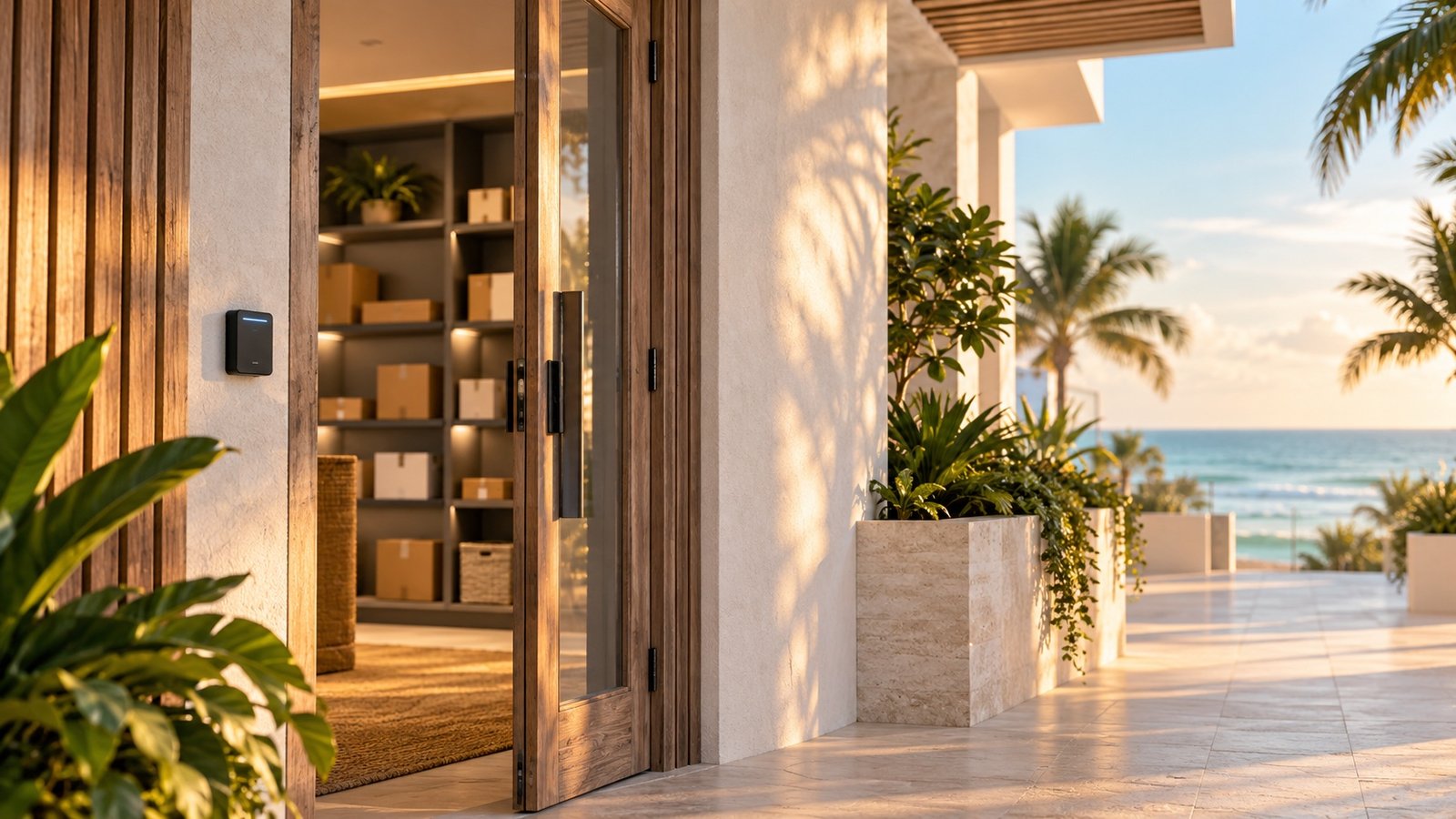
What Cocoa Beach Condo Buyers Should Verify When an Exterior Package-Room Door Is Connected to a Unit-Specific Electrical Panel
By Carrie Liotta, Space Coast REALTOR® with REAL Broker
If an exterior package-room door at a Cocoa Beach condo is powered by a panel identified with one unit, do not assume it is a minor oddity. Before you buy, establish what the door serves, who has authority to maintain it, who pays for its electricity and repairs, and whether the wiring was properly approved and documented.
I see buyers focus first on the view, balcony, dues, and parking. Those are important. But an access door that appears to run through a private unit’s electrical panel raises a different kind of question: is a building function depending on an individual owner’s equipment? That may be perfectly explainable. It may also be a clue that a past alteration, access arrangement, billing practice, or maintenance responsibility was never documented clearly.
Why this is worth slowing down for
A package-room door can sound like a small amenity issue until it stops working. If delivery access, a common hallway, a mail room, or a shared storage area depends on a circuit associated with one unit, a failure can affect more than one owner. The practical concern is not that every unit-specific panel is automatically wrong. The concern is that the declaration, association records, panel directory, electrician’s findings, and current operating practice should tell the same story.
Florida condominium ownership is shared ownership, not simply an apartment purchase with a monthly fee. Under section 718.111 of the Florida Statutes, an association has authority to manage condominium property and to maintain, repair, and replace common elements or association property. The declaration can also allocate responsibility differently for particular components or limited common elements. That is why I would not try to settle this by looking only at a breaker label.
For a Cocoa Beach buyer, the question deserves attention because salt air, age, storm exposure, prior renovations, and the everyday wear on beachside buildings already make documentation valuable. A clean answer protects the buyer’s use of the building, budget, and future resale story.
Start by defining exactly what the door serves
Ask the listing agent and association manager for a simple, written description before the inspection period starts. Is the exterior door exclusively for one unit, a shared package room, a lobby-adjacent delivery area, a storage room, or a space with restricted access? Is it part of the common elements, a limited common element, or an improvement controlled by the association?
Then ask what happens during a power outage or when the identified unit is vacant, under renovation, or has a panel issue. A package door should not become unusable simply because one owner needs electrical work. If the answer is “the association handles it,” ask where that responsibility appears in the governing documents, maintenance records, budget, or a board resolution.
The distinction matters more than the word “package.” A door used by multiple residents is usually part of a larger access system: locks, strikes, intercoms, cameras, Wi-Fi equipment, garage or lobby controls, or common-area lighting. An electrician should trace what is actually on the circuit rather than relying on an assumption from a panel directory.
The documents I would request before making the decision
I would ask for the declaration and amendments, bylaws, rules affecting package or delivery access, the current year’s budget, recent board minutes, maintenance logs, invoices, permits, and any correspondence about the door or electrical service. If the association says a unit owner is reimbursed for the power, request the written arrangement and the recent reimbursement history. If no reimbursement exists, the buyer should understand whether the unit is effectively subsidizing a shared amenity.
This is not an exercise in creating conflict with the association. It is a way to find out whether the building has already handled the issue thoughtfully. A clear record might show a licensed electrician installed a dedicated subpanel, the board approved the work, and the association pays for ongoing service. That is a much different situation from “it has always been wired that way.”
For a broad picture of condominium resources and education, the Florida DBPR Division of Condominiums, Timeshares and Mobile Homes explains its role in education, complaints, mediation, and association matters. It is a useful starting point, but it does not replace advice from the buyer’s attorney, inspector, licensed electrician, lender, or insurance professional on a specific purchase.
Have a licensed electrician answer the technical questions
A general home inspector may flag the arrangement, but a licensed electrician is the person I would want to identify the actual circuit, overcurrent protection, disconnects, labeling, access, condition, and apparent scope of the work. The goal is not to turn the inspection into a code lecture. It is to learn whether the door is safely supplied, whether the panel has adequate capacity, and whether a repair to the door could unexpectedly require access to the unit or interruption of private service.
Ask the electrician to document the answer in plain English. Does the panel serve only the door, or does it serve a mix of unit and shared equipment? Is there a properly identified disconnect? Is the equipment readily accessible to the party responsible for the door? Does the observed installation suggest permitted work, or should the buyer seek permit and final-inspection records? If the electrician recommends a correction, ask for a written scope and estimate rather than guessing from a verbal comment.
This is similar to the way I advise buyers to approach other electrical questions: the concern is not merely the age of a panel but the quality, documentation, safety, and insurance conversation around the whole system. My guide to four-point inspections before a Brevard County offer explains why electrical findings can affect timing and negotiation even when a home otherwise looks well maintained.
Who pays if the door or circuit fails?
This is the buyer question that needs a direct answer. The declaration and association documents should define responsibility; the panel label alone does not. If a component serves the association or common area, association responsibility may be logical, but a particular condominium’s declaration can allocate maintenance and cost obligations in a more specific way. Do not let a seller, manager, or neighbor make a legal conclusion from memory.
Ask for answers to these practical points:
- Who calls and pays the electrician if the package-room door will not unlock?
- Who pays for power used by the door and related equipment?
- May association vendors enter the unit to reach the panel, and is that access right documented?
- What happens if a unit owner upgrades, replaces, or shuts down the panel?
- Has the board discussed a dedicated common-area circuit, and is a project or assessment planned?
- Has the arrangement ever caused outages, disputes, insurance questions, or delivery-access problems?
The best outcome is often straightforward: a documented shared-system arrangement with clear access, billing, repair responsibility, and a recent electrician’s confirmation. The harder outcome is ambiguity. If nobody can explain the arrangement in writing, I would treat that as a due-diligence item to solve before the inspection period expires, not an inconvenience to postpone until after closing.
Read the minutes as carefully as the budget
Board minutes can show whether a “small” door issue is really part of a larger pattern. Look for references to package theft, access-control failures, electrical repairs, water intrusion near the door, contractor bids, insurance claims, owner complaints, or pending projects. Also look at the budget line items for repairs, security, electrical work, and reserves. One invoice does not necessarily mean a problem; repeated temporary fixes without a durable plan deserve questions.
This is the same discipline I use when helping Cocoa Beach condo buyers evaluate building work. A beautiful unit can be the wrong fit if the building story is unclear. Before writing an offer, I would also read my overview of Cocoa Beach condo reserves, concrete restoration, balconies, and master insurance. It gives the broader context for why association records matter as much as interior finishes.
How this can affect financing, insurance, and resale
A single access-door circuit does not automatically make a condo unfinanceable or uninsurable. What creates trouble is an unresolved condition that produces a safety concern, an unclear repair bill, an association dispute, or incomplete records. Lenders, insurers, future buyers, and their inspectors each ask slightly different questions, but all of them value a clear paper trail.
If the solution is inexpensive, documented, and completed before closing, the issue may become a footnote. If it requires rewiring common equipment, adding a dedicated circuit, obtaining permits, or changing an association policy, the buyer should understand the price, schedule, approvals, and who bears the cost. I would also want the contract strategy to reflect that answer, whether it is a seller repair, association confirmation, credit, or a contingency that lets the buyer make an informed choice.
For a future sale, clarity becomes part of the value story. A buyer is much more comfortable when you can say, “The common-area door now has a documented dedicated supply, approved records, and a clear maintenance path,” than when you have to explain why a shared door depends on a private panel.
My Cocoa Beach condo checklist for this situation
- Confirm in writing what the exterior door serves and who uses it.
- Review the declaration, amendments, rules, budget, minutes, invoices, and any board approval.
- Have a licensed electrician trace the circuit and describe the arrangement in writing.
- Request permits and final inspections when the record suggests an alteration or new equipment.
- Verify access rights, reimbursement, maintenance responsibility, and emergency response.
- Ask whether a dedicated common-area circuit, repair, or assessment is planned.
- Get advice from the appropriate licensed professionals before waiving inspection or document-review rights.
Bottom line for Cocoa Beach buyers
An exterior package-room door connected to a unit-specific electrical panel is not automatically a reason to walk away from a Cocoa Beach condo. It is a reason to get a complete answer. When the documents, association, electrician, and budget all point in the same direction, you can make a confident decision. When they do not, slow down and resolve the question before closing.
If you are comparing Cocoa Beach condos, I can help you organize the building questions alongside the view, parking, monthly cost, and daily-life details that make the right home feel right long after move-in. Reach out for a no-pressure conversation about Brevard County homes for sale with Carrie Liotta at REAL Broker. Your next chapter starts here.
