

First-Floor Storage or an Upper-Floor Locker: What Should a Cape Canaveral Seasonal Owner Choose?
By Carrie Liotta, Space Coast REALTOR® with REAL Broker | Published September 25, 2026 on 321 Coastal Living
Choose first-floor storage when you make frequent beach-gear trips, want easy cart access, and can verify the room’s flood, drainage, security, and insurance history. Choose the upper-floor locker when keeping belongings above lower-level water exposure matters more and the building has dependable elevator service, workable stair access, and a clear outage plan. Neither location wins without the records.
Seasonal owners use storage differently from full-time residents. The locker may hold chairs, umbrellas, luggage, owner supplies, linens, bicycles, tools, or storm-season items while the unit is vacant. You may arrive after hours, leave during a busy turnover day, or depend on a local contact to move belongings when you are out of state.
That makes location only one part of the decision. The storage room’s legal status, access route, permitted contents, ventilation, moisture history, elevator dependency, emergency power, security, and association maintenance all shape whether it is useful.
Confirm what you are actually buying
Do not assume a numbered locker is deeded with the unit. It may be part of the unit, a limited common element assigned for exclusive use, a common element controlled by the association, or a space allocated under rules that can change. Ask for the declaration, amendments, survey or exhibits, assignment records, rules, seller documentation, and any separate storage agreement.
The Florida Condominium Act, Chapter 718 defines condominium property concepts such as units, common elements, and limited common elements and governs association operations and records. The controlling answer for a particular locker comes from the recorded condominium documents and current association records, not the seller’s long use of the space.
Confirm the locker number and location in person. Ask how keys, fobs, and access permissions transfer. Verify whether the association can reassign space, whether owners may add shelves or locks, and who repairs doors, walls, lighting, ventilation, or water damage.
The first-floor room wins on friction
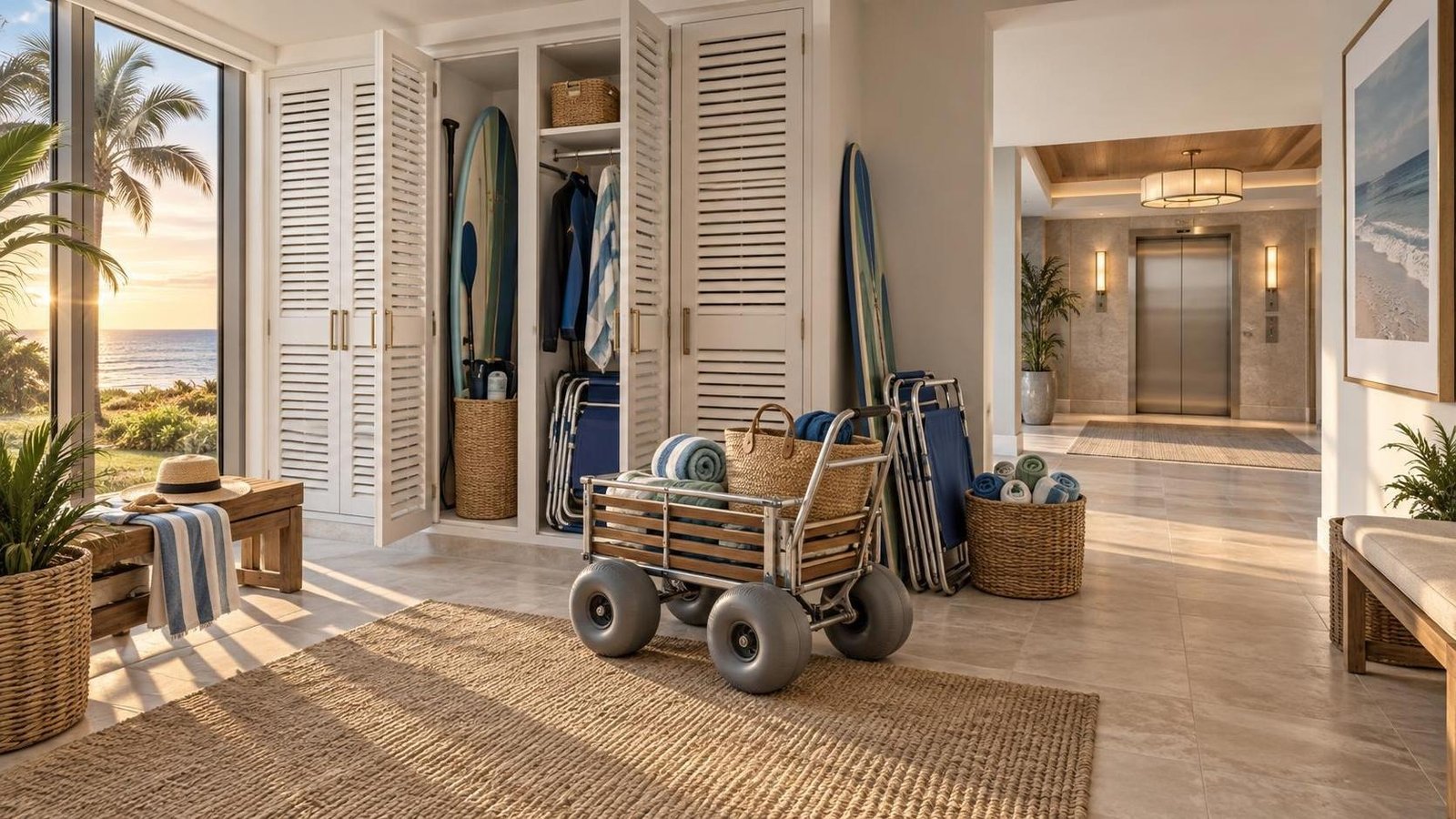
A first-floor room can make beach days much easier. You may be able to move a cart from parking to storage without waiting for the elevator or carrying sandy gear through residential corridors. A local property manager or family member may find it easier to access. Heavy coolers and luggage stay off stairs.
Test the entire path with the largest item you expect to store. Measure the parking-space clearance, gate, exterior door, hallway turns, storage-room entrance, and locker opening. Check whether carts are available and where they must be returned. Note door closers, thresholds, ramps, and surfaces that become slippery when wet.
The practical advantage disappears if the room is difficult to secure, frequently damp, poorly ventilated, or separated from parking by a locked route that seasonal owners cannot use after hours. Visit after rain if possible, look for staining and corrosion, and ask for water-intrusion, remediation, drainage, and insurance-claim records.
The upper-floor locker wins on elevation, but creates dependence
An upper-floor locker may reduce concern about lower-level water reaching stored contents, but floor number alone does not guarantee dryness. Roof, wall, plumbing, sprinkler, condensation, and wind-driven rain issues can affect higher spaces. Inspect the actual room and read the maintenance history.
The main tradeoff is elevator dependence. Ask how many elevators serve the route, whether the locker can be reached by stairs, and whether owners may use the stairs with carts or bulky items. Review elevator inspection, service, modernization, outage, and repair records. Ask whether emergency power serves any elevator, under what operating limits, and how the building communicates an extended outage.
My guide to Cape Canaveral elevator backup, storm closures, and remote access explains why a generator label is not enough. Seasonal owners need a documented plan for the specific systems and access points they depend on.
Review flood information without treating a map as a room inspection
The FEMA Flood Map Service Center is the official public source for NFIP flood-hazard information. Use the address to review the current effective map and available products, then discuss the building, unit, storage area, elevation information, master policy, unit-owner policy, and personal-property coverage with the appropriate insurance professionals.
A flood map does not tell you whether a particular storage room has taken water from a failed drain, pipe, wind-driven rain, or prior event. Ask for association records, minutes, claims information available to buyers, repair invoices, and direct written answers. Look at the room’s elevation relative to grade, garage ramps, exterior doors, drains, and nearby mechanical areas.
Do not store irreplaceable records, medication, electronics, batteries, or high-value property merely because a room appears elevated or dry. Follow association rules and insurer guidance for permitted contents and coverage.
Storage rules can make either locker useless
Read the current rules for bicycles, e-bikes, lithium-ion batteries, gasoline-powered items, propane, paint, chemicals, surfboards, wet gear, food, furniture, and commercial supplies. Ask whether charging is prohibited, whether items must remain inside the locker, and whether the association inspects storage areas.
Ventilation matters for salty, damp beach gear. A room that traps humidity can damage metal, fabrics, paper, and electronics even without a leak. Check for musty odor, rust, swollen shelving, stained ceilings, blocked vents, and fans that do not appear to operate. Ask who maintains the ventilation system and whether it shares equipment or airflow with garages or mechanical rooms.
Seasonal ownership adds remote-access questions
Imagine a building notice arrives while you are away: the storage room must be emptied for waterproofing, the elevator will be offline, or owners need to secure loose items. Who can act for you? Is that person registered with management? Does the key or fob work after hours? Can a vendor enter without the owner present? Are move rules or elevator reservations required?
Request written procedures for emergency entry, planned maintenance, pest treatment, inspections, locker relocation, and abandoned items. Ask how notices are delivered and how much lead time owners usually receive when the work is not urgent. Keep an inventory and current photographs of stored property, and label your contact information as rules permit.
First-floor access may be better for a local helper, while an upper-floor locker may be harder during an outage. On the other hand, a secure upper floor may reduce casual traffic. Decide which operational problem you are more prepared to manage from another state.
Read the association’s building story
The Florida DBPR Condominium Information and Resources site emphasizes safety, accountability, transparency, inspection, and reserve planning in the state’s current condominium framework. For a buyer, those principles translate into a full document review.
Read budgets, reserve materials, financials, insurance information, engineering reports that apply, and recent meeting minutes. Search for elevators, garage flooding, drainage, waterproofing, storage leaks, mold remediation, ventilation, access controls, fire inspections, generator work, locker reassignment, and special assessments. One repair is not automatically a problem. Repeated unresolved issues without funding deserve closer attention.
My article on elevator reserves versus walkable Cape Canaveral convenience makes the same point: a building system you rely on every week should be evaluated in the budget, not just during a showing.
Who should choose the first-floor room?
I favor first-floor storage for owners who visit often, bring substantial beach or fishing gear, travel with children or guests, use heavy carts, or depend on a local helper. It is also practical when elevator waits are long, outages recur, or the upper locker is not reachable by a usable stair route.
I would want the lower room’s drainage, water history, ventilation, security, and insurance implications to be clearly documented. Easy access is not worth storing property in a space with recurring moisture or an unresolved lower-level water problem.
Who should choose the upper-floor locker?
The upper locker may suit owners who store modest, lightweight items, visit less often, can use stairs when necessary, and prioritize separation from lower-level water exposure. It becomes more persuasive when elevator service is well documented, there are multiple access options, and the room itself has a clean envelope and ventilation history.
It is weaker for a buyer with mobility limitations, oversized gear, frequent turnover needs, or no local backup. Do not assume an elevator will always be available during move-ins, maintenance, storms, or power interruptions.
For another operations-focused comparison, read my analysis of a storm-rated package room versus easier first-floor access. The correct choice changes with how the owner actually uses the building.
Calculate cost beyond the purchase price
A locker may not have a separate monthly line item, but the building systems supporting it affect association expenses. Elevator contracts, modernization, emergency power, drainage, waterproofing, ventilation, access controls, and remediation may appear in the operating budget, reserves, or assessments.
Compare the unit’s full carrying cost and building risk. A convenient first-floor locker should not distract from weak drainage or insurance. An elevated locker should not distract from an underfunded elevator project. Ask your lender and insurer to review the project early if the building’s condition or documents raise questions.
My storage-room test before an offer
- Verify the locker’s legal status and assignment in the governing records.
- Walk the route from parking and the unit with the largest expected item.
- Measure doors, turns, locker dimensions, and usable shelving space.
- Review storage and battery rules, access hours, and vendor procedures.
- Inspect for moisture, corrosion, odors, pests, and ventilation issues.
- Review flood information, water-intrusion history, claims, and repairs.
- Read elevator service, outage, modernization, and emergency-power records.
- Confirm personal-property and loss coverage with the insurer.
- Name a local contact who can reach the space when you are away.
Bottom line
First-floor storage is usually better for frequent, heavy, practical use when the lower level is dry, secure, and well managed. Upper-floor storage is usually better for lighter use when elevation matters and elevator dependence is acceptable. The best Cape Canaveral locker is the one whose legal status, access, moisture history, rules, and supporting building systems are all clear.
If you are comparing Cape Canaveral condos for seasonal ownership, I can help you look beyond the unit to storage, parking, elevators, storm procedures, reserves, insurance, and remote access. Reach out for a no-pressure conversation with Carrie Liotta, Space Coast REALTOR® with REAL Broker. Your next chapter starts here.
