

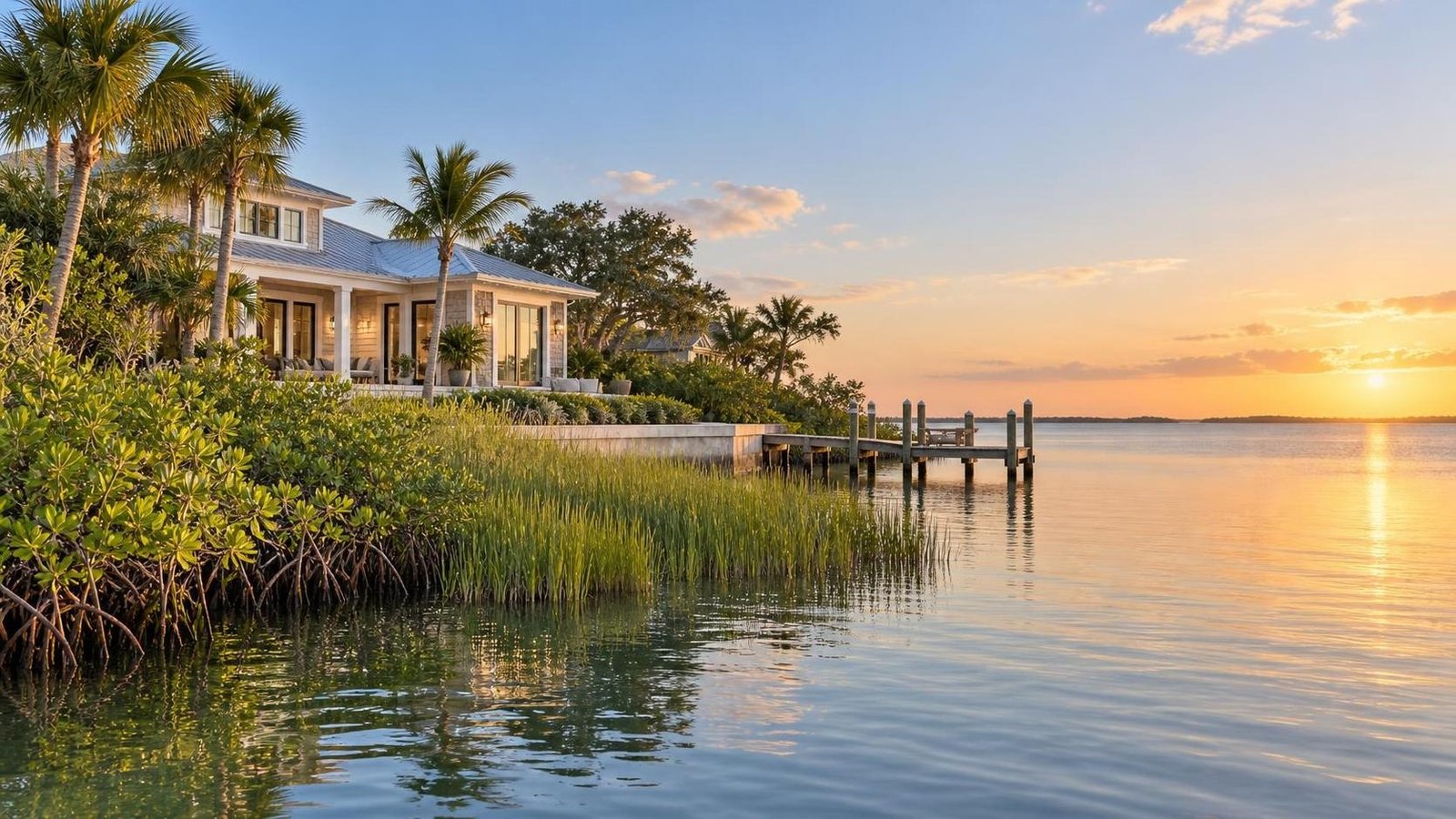
Living Shoreline or Traditional Seawall: What Should Brevard Waterfront Buyers Choose?
By Carrie Liotta, Space Coast REALTOR® with REAL Broker | Published September 14, 2026
If you are comparing Brevard County waterfront homes, a living shoreline is not automatically better than a traditional seawall, and a concrete wall is not automatically the safer choice. The right answer depends on the parcel: wave energy, erosion pattern, water depth, existing structures, boating use, neighboring shorelines, permits, and the amount of maintenance you are prepared to manage.
My practical answer is to buy the shoreline that is documented, functioning, and appropriate for the site—not the one with the most attractive label. On a protected lagoon edge, native vegetation and a low rock or oyster sill may provide habitat while reducing erosion. On a narrow working canal where a dock, lift, and deep-water edge are central to the property, a permitted hard structure may fit the use better. Some homes need a hybrid solution.
First, understand what you are actually looking at
A traditional seawall or bulkhead creates a relatively hard line between upland soil and the water. Materials and construction vary, but a buyer is typically evaluating panels, cap, joints, tiebacks or anchors, drainage, returns, and the soil immediately behind the wall. A wall may look tidy from the yard while movement, washout, cracks, failed drainage, or submerged deterioration is developing elsewhere.
A living shoreline uses natural elements such as native plants, sand, rock, or oyster-based components to stabilize an estuarine edge. The NOAA Ocean Service explanation of living shorelines describes vegetation used alone or with low sills. NOAA also points to benefits including wave buffering, habitat, sediment capture, and improved water quality. That is valuable context for the Indian River Lagoon, but it is not a promise that every Brevard lot is suitable.
A hybrid shoreline combines natural and structural elements. You might see native vegetation landward of strategically placed rock, a low sill with planted marsh behind it, or a hardened section near a dock with a softer edge elsewhere. Buyers should evaluate the installed system, not assume that “living shoreline” means plants only or that “seawall” means one standard design.
Let exposure decide before aesthetics do
The calm appearance of the water during a showing does not tell you what the shoreline experiences through boat wakes, seasonal winds, storms, high water, and heavy rain. A qualified marine contractor or coastal engineer should evaluate fetch, wave energy, currents, soil, slope, adjacent improvements, and evidence of ongoing erosion.
Protected lagoon coves and some low-energy river edges can support natural or hybrid systems. A canal with frequent boat traffic, a tight setback, a pool close to the edge, or a neighboring wall that redirects energy may present a different engineering problem. The decision is parcel-specific even when two homes are on the same street.
I also ask buyers to walk the upland side after rain when possible. Bare soil, depressions near the edge, exposed roots, sinkholes behind a cap, sediment leaving the lot, or drains that discharge poorly may matter as much as the visible waterline. A shoreline system cannot compensate for unmanaged roof runoff or yard drainage indefinitely.
Boating use can change the answer
Be honest about why you want the property. If the goal is kayaking, bird-watching, a softer lagoon view, and modest water access, a living or hybrid edge may complement the lifestyle beautifully. If the plan depends on keeping a particular boat on a lift, stepping from a fixed dock, maintaining a specific depth, or maneuvering in a narrow canal, the shoreline and dock have to work together.
Do not infer water rights, dredging rights, or dock feasibility from an existing path to the water. A pretty opening in the mangroves is not the same as a permitted access plan. A neighbor’s lift does not prove that a similar lift can be added to this lot. If access comes through shared infrastructure, my guide to buying with dock access through an easement explains why recorded rights and maintenance duties matter.
Permits are part of the property, not an afterthought
Shoreline work can involve more than one level of review. Florida’s Environmental Resource Permitting program covers activities that alter surface-water flows, as well as dredging and filling in wetlands or other surface waters. DEP explains that responsibility may sit with a department district office or a water management district depending on the project, and that docking facilities and certain single-family water-related work may be handled under specific operating agreements.
For a buyer, that means “the seller said it was allowed” is not enough. Ask for permits, approved plans, final inspections, exemptions, contractor invoices, engineering reports, and correspondence tied to the work. If the system predates the seller, obtain what is available and have the relevant agencies or qualified professionals help interpret the file. Do not rely on a real estate agent to give an engineering or legal conclusion.
Recorded easements, covenants, and agreements may also affect access or maintenance. The Brevard County Clerk’s Official Records resources include deeds, liens, contracts, plats, and other real-estate instruments, although the Clerk cautions that online information is a public service rather than a substitute for official records or a title examination. Your title professional and surveyor should connect those documents to the parcel you are buying.
How I compare condition and future cost
For a hard seawall, I want a marine specialist to look beyond surface staining. Ask about alignment, panel and cap condition, cracks, joints, tiebacks, returns, drainage penetrations, soil loss, and the relationship to the dock. Then ask for a written opinion that distinguishes routine maintenance from repairs that may require design and permitting. A casual “looks fine” should not support a major price decision.
For a living shoreline, inspect plant coverage, bare areas, scouring, displaced rock, invasive growth, accumulated debris, access paths, and whether the installed elevations still function. Find out who maintains the vegetation and sill, how storm damage has been addressed, and whether prior repairs followed the approved plan. Natural does not mean maintenance-free.
A useful budget has three layers: work needed now, periodic maintenance, and a reserve for a larger future intervention. Compare written scopes rather than generic cost-per-foot numbers from a different shoreline. Access for equipment, materials, engineering, disposal, neighboring structures, and permit requirements can make two similar lengths of shoreline very different projects.
This is why I often advise buyers to prioritize the current marine file over cosmetic finishes. My article on paying more for a current marine inspection when the interior needs updating shows how to compare those tradeoffs without treating either report as a warranty.
Insurance, flood maps, and shoreline protection are separate questions
A functioning shoreline can protect soil at the water’s edge, but it does not remove flood exposure or guarantee an insurance outcome. Buyers still need an address-specific flood-zone review, an elevation certificate when available, homeowners and flood quotes, and a clear understanding of deductibles and exclusions. The structure’s elevation, roof, openings, construction, claims history, and other underwriting details remain part of the carrying cost.
Ask the insurance professional how each existing shoreline feature is described and whether any unresolved damage or planned construction affects underwriting. Ask the marine professional about shoreline performance. Keeping those roles separate produces a more dependable answer than asking one person to solve every part of the decision.
Think through resale before choosing a “better” system
A well-designed living shoreline can appeal to buyers who value lagoon habitat, a natural view, and lower-impact ownership. A documented seawall can appeal to buyers who want a defined edge and a straightforward dock-and-lift setup. A hybrid may offer the strongest balance on some parcels. None deserves a premium merely because of its category.
At resale, clarity creates value. A future buyer will want to see what was approved, who designed or installed it, when it was inspected, how it has performed, and what maintenance has occurred. If a lagoon-front seller has mangroves, shoreline work, or shared dock rights, I explain the seller-side documentation in my Merritt Island lagoon-front preparation guide.
Also consider whether the shoreline supports the next buyer’s likely use. A natural edge with no practical boat access may be ideal for one household and a poor fit for another. A tall hard wall and large lift may be valuable to a boater but feel disconnected from the water to a paddleboarder. Resale strength comes from matching the system, setting, and likely buyer pool—not from declaring one design universally superior.
My offer-stage shoreline checklist
- Identify whether the edge is natural, living, hard, or hybrid and who installed it.
- Collect permits, exemptions, plans, final approvals, engineering, invoices, warranties, and repair records.
- Hire the appropriate marine contractor or engineer for a site-specific condition review.
- Compare water exposure, boat wakes, adjacent structures, runoff, and signs of erosion.
- Confirm that docks, lifts, access paths, and shared rights fit the intended use.
- Review the survey, title work, easements, and recorded maintenance agreements.
- Price current repairs, recurring care, and a reasonable future reserve.
- Obtain property-specific homeowners and flood insurance guidance during the inspection period.
- Verify future project feasibility before assigning value to an addition, conversion, or replacement.
Three conclusions I would not accept without proof
“Living shorelines never fail.” They can be resilient and ecologically valuable, but design, exposure, establishment, and upkeep matter. A neglected or poorly matched installation can erode.
“Concrete is permanent.” Seawalls age, components move, drainage can fail, and soil can wash out. The inspection should address the complete system and site.
“You can change it after closing.” Maybe, but feasibility may depend on multiple agencies, engineering, neighboring conditions, protected resources, cost, and access. Treat an unverified future improvement as a hope, not as existing property value.
The bottom line for Brevard waterfront buyers
Choose a living shoreline when the site supports it, the natural-waterfront experience fits your plans, and the installation and maintenance file are sound. Choose a traditional seawall when a properly engineered hard edge suits the parcel and intended water use, and its condition and permits are clear. Consider a hybrid when it solves the site more thoughtfully than either extreme.
When I help someone compare Indian River Lagoon, Banana River, canal, and riverfront homes, I want the shoreline discussion to happen before the finishes distract us. We can gather the documents, bring in the right specialists, and decide whether the home’s water edge supports the way you actually want to live. Reach out for a no-pressure conversation about Brevard County waterfront homes for sale with REAL Broker. Your next chapter starts here.
