

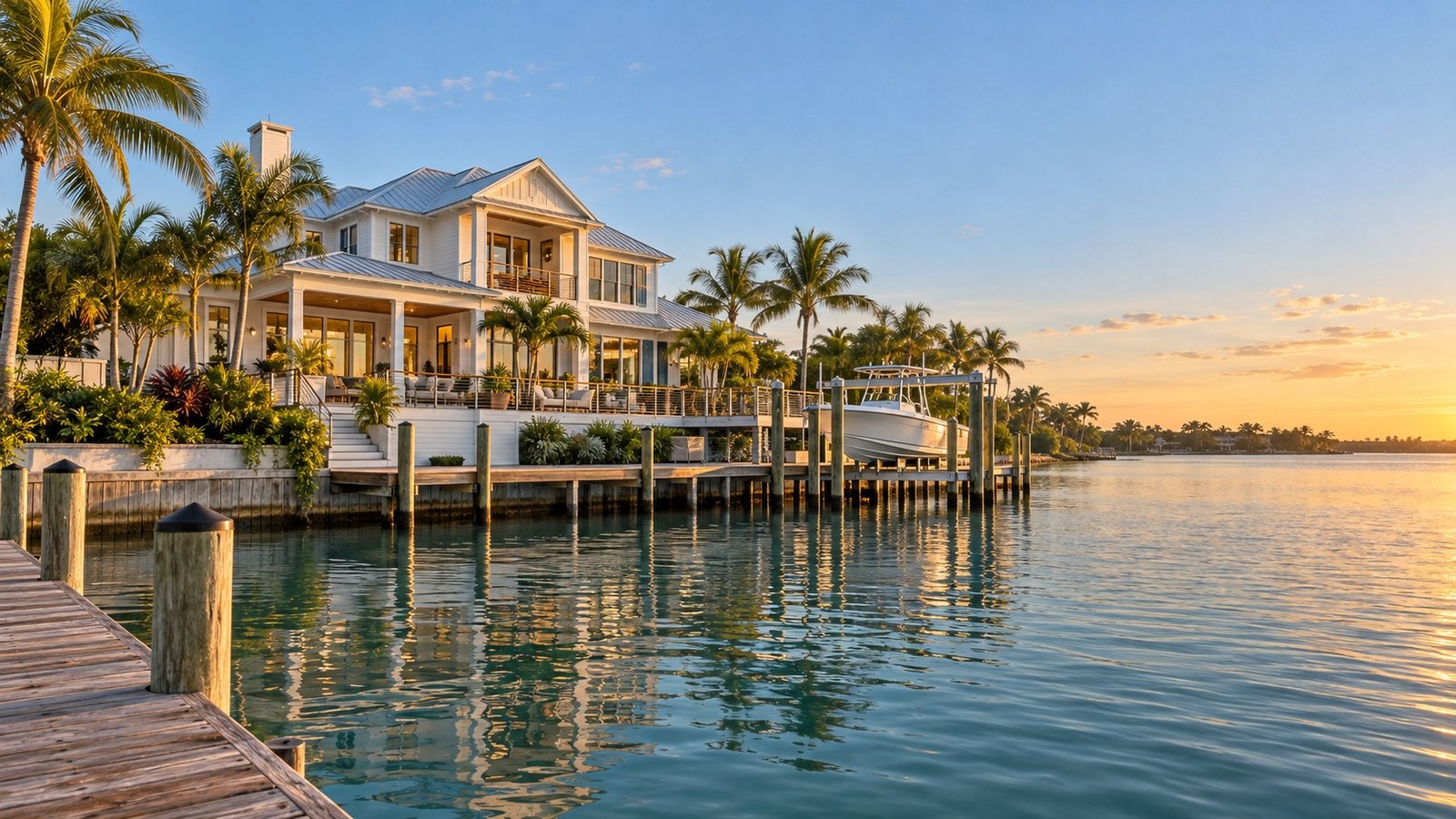
Merritt Island Buyers: Verify a Boat-Lift Control Box Below an Elevated Deck Before You Rely on It
By Carrie Liotta, Space Coast REALTOR® with REAL Broker | Published October 23, 2026
If a Merritt Island canal home has a boat-lift control box tucked below an elevated deck, do not treat it as a minor cosmetic detail. Before you rely on the lift, confirm who owns it, how a technician reaches it, what the permit and service records show, and whether the location has been altered since the work was completed.
I see waterfront buyers focus understandably on the view, the lift capacity, and whether the boat clears the bridge. But the ordinary-looking control box is where a waterfront setup becomes usable or frustrating. A lift can appear to work during one showing and still leave the next owner with limited service access, unclear electrical history, or a repair conversation that is harder than it needed to be.
Why the location matters more than the box itself
A control enclosure mounted below a deck is not automatically a problem. In some layouts, that placement keeps equipment out of sight and protects it from direct sun. The question is whether it remains reasonably reachable, protected, and understandable after the deck, railing, storage, lighting, or landscaping changed around it.
Think about the practical moment when something stops working. Can a qualified marine electrician or lift technician get to the enclosure without removing deck boards, moving stored kayaks, or climbing over a railing? Is there a clear route to the disconnect, conduit, and equipment labels? Is the box visibly weathered, loosely mounted, or surrounded by hardware that makes an inspection incomplete? Those are not reasons to walk away automatically. They are reasons to investigate before the inspection period runs out.
For a broader waterfront starting point, my guide to buying a canal-front home in Merritt Island explains why the dock, lift, seawall, route to open water, flood exposure, and insurance picture need to be evaluated together. The control-box location is one piece of that larger system.
Start with ownership and the exact equipment list
Before asking whether the box is in a good spot, establish what you are actually buying. Ask the seller for the lift make and capacity, the approximate age of the motors and controls, any service invoices, warranty information, and documentation for recent modifications. If a listing says “boat lift,” do not assume every visible cable, switch, canopy motor, remote, dock outlet, or panel is included in the sale.
I would also want to know whether the home is in a community with association rules, whether the dock serves only this parcel, and whether there are shared components. The answer can change the repair path. A buyer should not find out after closing that a controller appears private but is fed through a shared dock service, or that a deck alteration narrowed the access route a contractor needs.
A useful document request is simple: provide the permit record, final inspection if available, installation invoice, lift-service records, and any written approval for later deck work. Missing paperwork is not proof that the equipment is unsafe or unpermitted. It does mean the buyer should stop filling in the blanks with assumptions.
Use permit history as a starting point, not a condition report
For unincorporated Merritt Island, the Brevard County building permit search is a practical first stop for checking available county records. A property inside a municipality may have records with that city instead, and older files or waterfront-related approvals may not all appear in one search. I use the record to frame better questions, not to declare that a system is current or trouble-free.
Compare dates and descriptions. Does the record describe a dock, lift, electrical work, deck work, or a repair? Does the seller’s invoice match the address and the scope shown in the record? Was the elevated deck already there when the control equipment was installed, or was the deck changed afterward? A clean answer can be reassuring. A mismatch may simply require a contractor or the appropriate permitting office to clarify what happened.
Waterfront work can involve more than one review path depending on the location and scope. The Florida Department of Environmental Protection’s Environmental Resource Permitting information is a useful reminder that shoreline and in-water projects are not a one-size-fits-all exercise. Florida law also provides that activities regulated under part IV of chapter 373 require the appropriate authorization; see section 373.413 of the Florida Statutes. That does not tell you the answer for a particular dock or lift. It tells you why a buyer should verify the actual scope before planning changes.
What to ask during the inspection window
A general home inspector may identify visible electrical concerns, but a boat lift deserves its own focused conversation when it matters to your purchase. Depending on the property and the concerns found, ask a qualified marine electrician, lift technician, dock contractor, or other appropriate professional to inspect the equipment and explain the practical repair path.
- Access: Can a technician safely reach the enclosure, disconnect, motors, conduit, and related components without altering the deck?
- Protection: Is the enclosure secured and appropriately protected from water intrusion, sun, corrosion, and physical damage for its setting?
- Electrical path: Where does power originate, where is the disconnect, and is the wiring route visible enough to evaluate?
- Operation: Can the seller demonstrate the lift through a normal cycle, and are limit switches, remotes, and safety features behaving as expected?
- Service history: What has been repaired or replaced, by whom, and when? Are there invoices that identify the work?
- Deck changes: Did a later deck, storage enclosure, screen, railing, or outdoor-kitchen feature crowd the service area?
This is different from asking a seller to guarantee future performance. You are trying to understand today’s condition, access, and documentation well enough to decide whether the home fits your budget and tolerance for waterfront maintenance.
Separate a usable lift from a pretty dock scene
On Merritt Island, a dock can make a backyard feel like a destination. That emotional pull is real, and it is part of why waterfront living is special. Still, I encourage buyers to separate the lifestyle picture from the operating details. A tasteful elevated deck, a polished lift canopy, and a clean line of string lights do not tell you how easy the equipment will be to inspect or service.
The same discipline applies when you compare homes. A property with a newer-looking dock but inaccessible controls may not be the easier ownership choice than a less polished property with a well-documented lift, clear service access, and records a contractor can follow. If the choice is between a private electrical setup and one that shares documented responsibilities, this comparison of a private dock circuit versus a shared dock with reserves can help you think through the ownership side of the decision.
I would not ask a buyer to price an unknown repair based on internet guesses. Instead, get the appropriate inspection, request a written scope if work is recommended, and use that information to decide whether to proceed, negotiate, or keep looking. The best waterfront purchases are not the ones with zero maintenance; they are the ones where the maintenance is visible, documented, and financially manageable.
How this can affect your offer strategy
If the lift is central to the value you are paying for, make room in the inspection period to evaluate it. That may mean scheduling the waterfront specialist early, requesting records as soon as the contract is accepted, and getting insurance input early if the entire waterfront setup affects your comfort with the property.
When records are complete and the access is workable, the issue may be a simple confirmation. When a technician cannot fully inspect the box because the deck obstructs it, or when the paperwork does not match visible changes, you have useful information before you remove your contingencies. Depending on the facts and your contract, you may ask for further access, repairs by a qualified professional, a credit supported by a written estimate, or a price that recognizes the uncertainty. Your real estate professional, inspector, contractor, lender, insurer, and attorney each have separate roles; this is not a substitute for their advice.
My Merritt Island waterfront checklist
Before I would let a buyer rely on a boat lift beneath an elevated deck, I would want these answers in the file:
- What equipment is included, and who has maintained it?
- Can a qualified professional inspect and service the controller without removing finished deck elements?
- What does the available permit and invoice history actually describe?
- Has the deck configuration changed since the lift or electrical work was installed?
- Can the seller demonstrate ordinary operation?
- Are shared access, association, easement, or utility questions resolved in writing?
- What would the likely repair path and cost range look like if the controls need attention?
The right answer may still be yes. Waterfront homes are meant to be enjoyed, and many have equipment that simply needs normal care. I just want my buyers to understand the system they are taking on, rather than discovering its access limitations after the keys change hands.
Bottom line
A boat-lift control box below an elevated deck is not a red flag by itself. It is a prompt to verify access, records, ownership, and condition before you count the lift as a dependable part of the home’s value.
If you are comparing Merritt Island waterfront homes, I can help you look beyond the view and organize the questions that shape everyday ownership: dock access, lift records, seawall condition, flood considerations, insurance, and resale. Reach out for a no-pressure conversation about Brevard County waterfront homes with Carrie Liotta, Space Coast REALTOR® with REAL Broker. Your next chapter starts here.
