

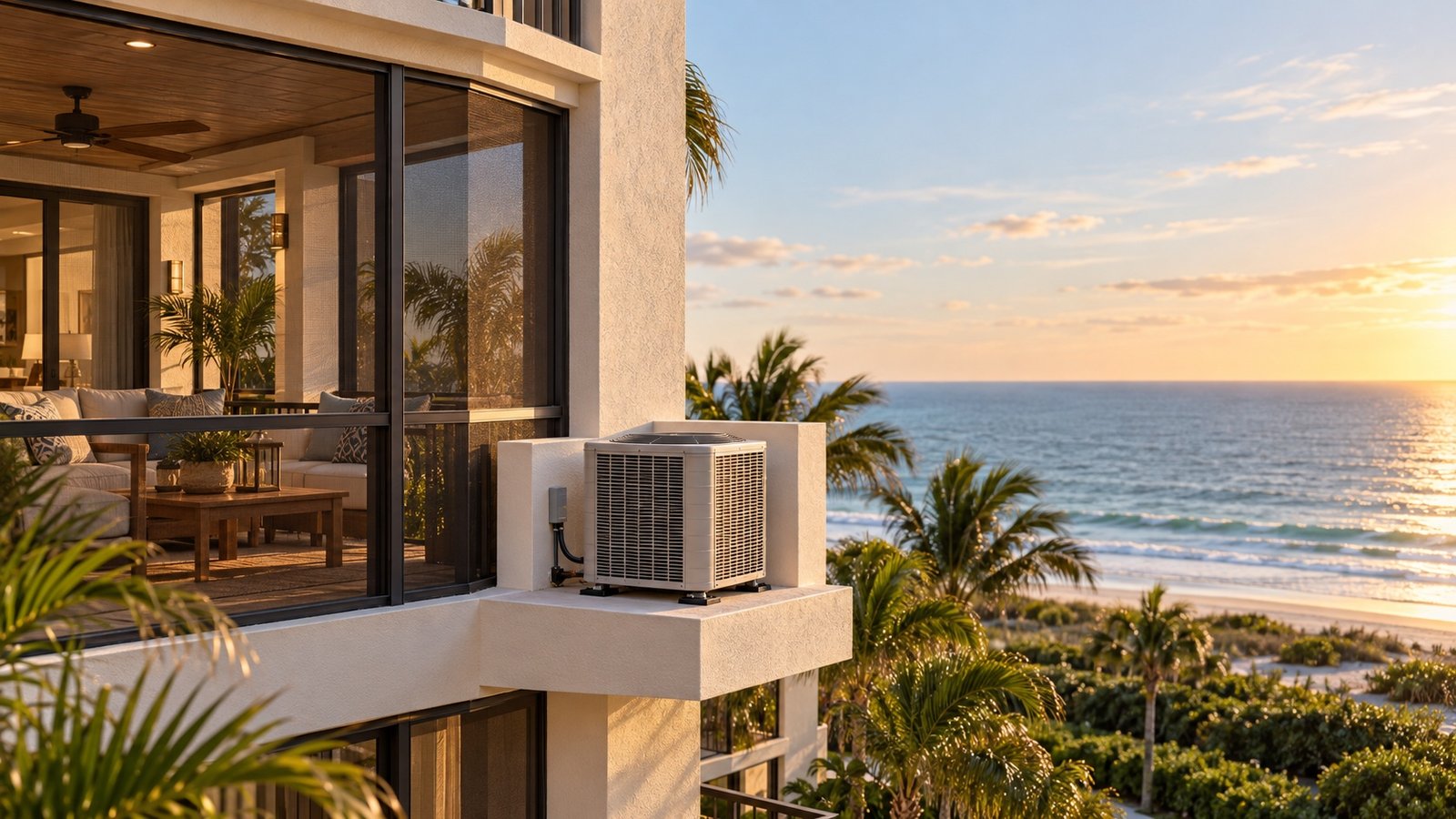
Cocoa Beach Condo Buyers: Verify the AC Platform Before You Rely on It
By Carrie Liotta, Space Coast REALTOR® with REAL Broker | October 23, 2026
If a Cocoa Beach condo’s air-conditioning condenser sits on a balcony, exterior ledge, roof section, or other limited-common-element platform, do not assume the unit owner controls the replacement—or that the association will pay for the platform when it fails. Before you rely on that setup, verify its declaration, maintenance allocation, approval path, access plan, and support condition.
That detail can change the cost, timing, and stress of replacing a condenser in a beachside condo. A system can cool beautifully during a showing while the component that makes replacement possible is subject to association access, exterior-work rules, contractor requirements, or an unlisted cost split.
Why an AC platform is not just an HVAC detail
In a single-family home, the condenser usually sits on a pad beside the house and the owner can call a contractor when it reaches the end of its useful life. A condo can be different. The equipment may be physically close to one unit but located on property the declaration treats as common or limited common. That distinction matters because it can separate the right to use an area from the responsibility to maintain, repair, replace, insure, or provide access to it.
Florida law defines a limited common element as a common element reserved for certain unit or units to the exclusion of other units, as specified in the declaration. That last phrase is the practical point. A platform may feel like part of the condo because it serves one unit, but the recorded documents—not the showing-day explanation—tell you how it is classified.
When I help a buyer evaluate a Cocoa Beach condo, I do not treat a condenser platform as a reason to walk away. I treat it as a file to understand. If the documents are clear, the area is sound, and the association has a workable approval process, it may be a routine ownership issue. If no one can identify who owns the work, who gives access, or who pays when the platform needs attention, I want that uncertainty priced and resolved before closing.
Start with the declaration, not the listing description
Ask for the declaration, all amendments, the condominium survey or graphic description if available, and the association rules that govern exterior work. Then locate the language on unit boundaries, limited common elements, maintenance, alterations, contractor access, and insurance. I also ask the association or manager to identify the exact platform on a building plan rather than relying on a verbal answer.
The declaration can assign maintenance of a limited common element to the unit owner, to the association as a common expense, or to the association with cost shared among the owners entitled to use it. Florida Statutes section 718.113 says the association generally maintains common elements, except where the declaration assigns responsibility for limited common elements to the unit owner; it also recognizes that the declaration can set a shared-cost method for certain limited common elements. Read the statute here, but use the building’s own documents to answer the property-specific question.
That is why “the seller always handled it” is useful history, not a complete answer. A seller may have paid for the condenser itself while the association approved access and retained responsibility for the support structure. Or the association may have simply allowed an owner to address a past repair without changing the written allocation. I want the buyer to know which is which.
Five answers I would get before the inspection period ends
1. Is the platform actually limited common, and which unit has the exclusive use right?
Start by matching the unit number to the declaration and plan. “Limited common” does not mean “inside my unit,” and it does not automatically mean the platform belongs only to the owner using it. It means the recorded declaration reserves the common element for specific unit or units. If the platform serves two stacked units, a line of units, or a mechanical system with shared components, the answer may be less intuitive than it looks from the balcony.
2. Who maintains the platform, the condenser, the line set, and any surrounding waterproofing?
Ask this as separate questions. A condenser, its disconnect, the platform, mounting hardware, condensate route, wall penetration, railing clearance, and waterproofing do not necessarily share the same maintenance assignment. A buyer can be comfortable owning the equipment and still need to understand whether a structural repair, coating failure, or exterior-waterproofing project is an association obligation, a unit expense, or a limited-group cost.
That distinction also helps you read the budget. A platform repair that belongs in a common project may show up in reserves or a future assessment discussion; a unit-owner item may need to be built into your own ownership budget. I use the same full-cost mindset when clients compare what it actually costs to own a Cocoa Beach condo. The purchase price is only one part of the decision.
3. What must happen before a contractor can replace the condenser?
Request the architectural-review form, exterior-work rules, contractor insurance requirements, permitted work procedures, and any restriction on work hours, crane access, roof access, or elevator use. The association may have a sensible process designed to protect the building and neighbors. The important question is whether that process has been followed consistently and whether it can accommodate a replacement when the unit’s system fails in July.
Florida law also limits material alterations or substantial additions to common elements except through the procedure in the declaration; where the declaration does not supply a procedure, the statute sets a voting rule. That does not mean every condenser swap is a material alteration. It does mean the buyer should not assume that an exterior equipment change is a purely private decision. The statutory framework and the recorded documents should be read together.
4. Has the platform or adjacent exterior been repaired before?
I would ask for invoices, engineering reports if any, board minutes, contractor proposals, warranties, photographs from prior work, and correspondence about water intrusion, corrosion, movement, or access problems. A prior repair is not automatically bad. Often it is evidence that a building addressed a problem. The concern is an incomplete story: a recent cosmetic patch with no explanation of why it was needed, or a repair history that conflicts with the declaration’s maintenance allocation.
For a Cocoa Beach buyer, this review belongs beside the usual building questions about concrete, balconies, reserves, insurance, and pending projects. My guide to Cocoa Beach condo concrete, balconies, reserves, and insurance explains why a building file matters more than a single attractive feature.
5. Can the association and HVAC contractor explain how access works?
Some replacements are straightforward. Others require a key, a roof hatch, a protected corridor, a lift plan, a temporary shutdown, or coordination with another unit. Ask the question before an emergency creates leverage for someone else. Florida law gives an association a right of access to a unit during reasonable hours when needed for maintenance, repair, or replacement of items the association maintains under the declaration; the association’s maintenance authority is described in section 718.111. Your documents and the contractor’s scope should make the real-world access plan clear.
What I would look for during a showing and inspection
I am not an HVAC contractor or engineer, so I want the right licensed professionals involved. But a buyer can notice useful clues: Does the platform look improvised? Is there visible corrosion, staining, cracked coating, loose hardware, restricted airflow, or a condenser tucked where service access seems impossible? Does a balcony or corridor layout make it likely that a replacement would affect neighbors? Is there an exterior project already underway nearby?
Then I would move from observation to documents. A qualified HVAC contractor can evaluate the equipment and explain the replacement scope. If there is a question about the support surface, waterproofing, or exterior system, ask whether a building professional should evaluate it. The inspection contingency is the time to clarify—not to diagnose by photo after closing.
How I would handle an unclear answer before closing
First, put the question in writing. Ask the association or manager to identify the governing document section and to confirm the approval and access procedure for replacement of the unit’s condenser. Ask the seller for the last service invoice, any prior approval, and any correspondence about the platform. A clear written answer is more valuable than a confident phone call because it lets the buyer, lender, insurer, contractor, and closing team work from the same facts.
Second, make the contract response match the risk. Sometimes the answer is simply to continue after the buyer has reviewed the documents. Sometimes a buyer may want a licensed contractor’s opinion, a seller repair, an association approval, a credit, or a negotiated timeline for a known project. There is no one-size-fits-all concession. The useful outcome is one where the buyer knows what is being purchased and the seller is not promising work they cannot authorize on association-controlled property.
Third, do not confuse a clean condenser inspection with a clean platform file. An HVAC technician may reasonably say the unit is operating today while a separate document question remains about exterior access or maintenance. Both can be true. That is also why I encourage buyers to read related building questions together. For example, a balcony door or exterior threshold can involve a similar division between private use and a shared exterior system; this guide on Cocoa Beach balcony-threshold drainage shows the kind of document-and-condition review that prevents surprises.
A practical document request list
- The recorded declaration and amendments, plus the pages or plans identifying the platform.
- Rules for exterior alterations, contractor access, work hours, insurance certificates, and architectural approval.
- The most recent association budget, reserve information, and meeting minutes that mention exterior mechanical work or building repairs.
- Seller invoices for the current condenser, prior replacements, repairs, and any approval correspondence.
- A licensed HVAC contractor’s written scope for replacement, including access needs and any work beyond the equipment itself.
- Information on open or planned exterior projects that could affect access, waterproofing, or timing.
The Cocoa Beach angle: ocean air makes clarity more valuable
That is the local-expert approach I want for every condo purchase: enjoy the lifestyle, but make the building file part of the tour. The most comfortable buyers are not the ones who find a unit with no questions. They are the ones who get good answers early enough to make a calm decision.
Bottom line
A limited-common-element AC platform can be perfectly manageable, but it should never be a mystery. Before buying a Cocoa Beach condo with one, verify the declaration’s classification, the maintenance assignment, the approval and access path, the repair history, and its replacement scope. If the answers line up, you can move forward with confidence. If they do not, use the inspection period to get clarity, negotiate a solution, or choose a building whose ownership responsibilities are easier to understand.
I’m Carrie Liotta, Space Coast REALTOR® with REAL Broker. If you are comparing Cocoa Beach condos and want help organizing the association questions before you commit, reach out for a no-pressure conversation about Brevard County homes and condos for sale. Your next chapter starts here.
